THE SIGNAL IN ONE SENTENCE
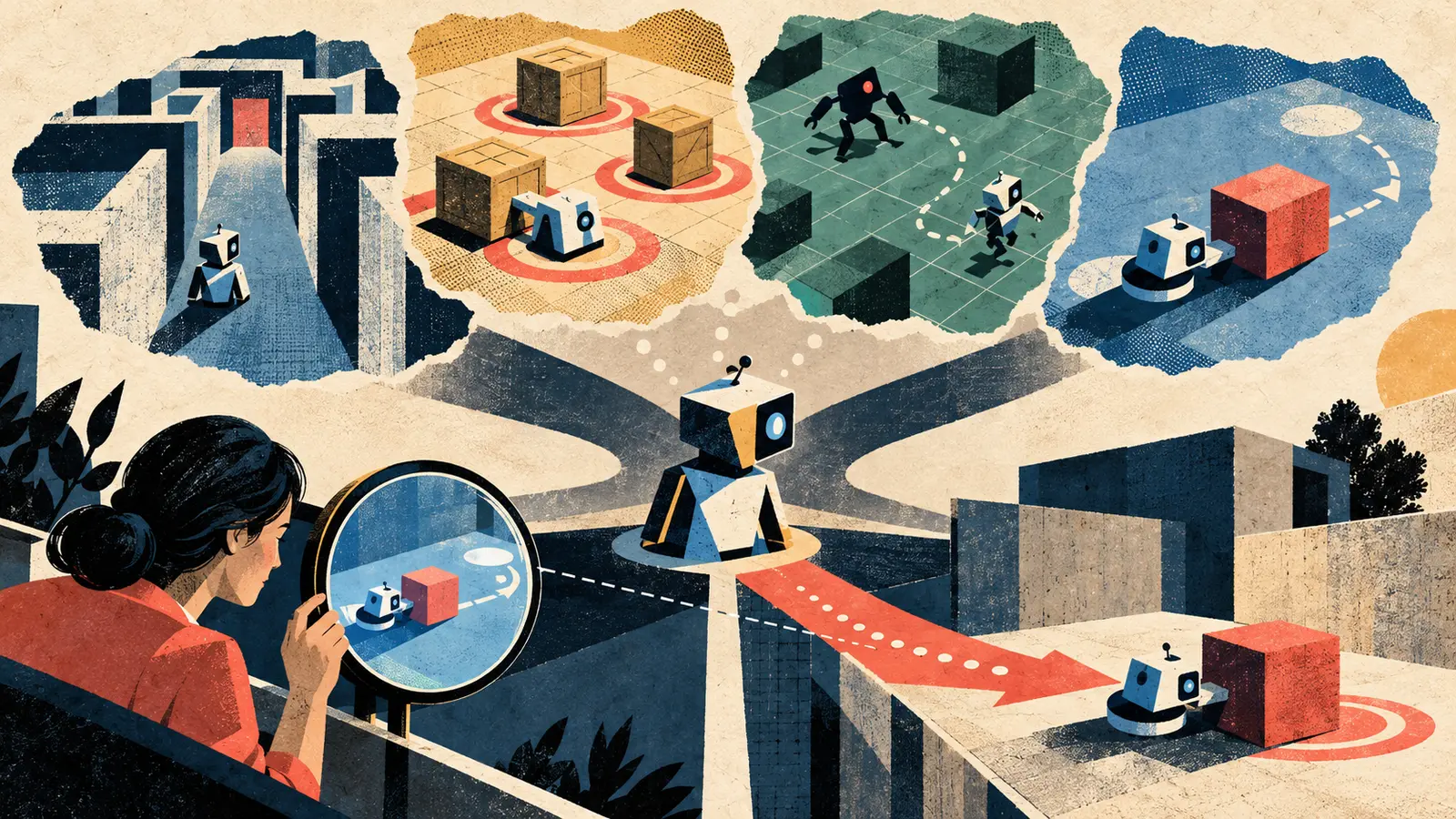
Imagine a warehouse robot facing a narrow aisle, two pallets and one move that could wedge everything in place. The usual agent has an awkward choice. It can act and learn from the result, which is expensive when a bad move blocks the aisle. Or it can produce a plan in words and hope those words preserve the geometry. A new research system takes a more visual route. Before acting, it generates pictures of what might happen next. The October 19 preprint calls the framework Agentic Imagination, or Agima. It trains one multimodal model to propose an action, generate an image of the predicted outcome and use that imagined state to decide the next move. The model can extend one plan, try a local alternative or compare longer candidate futures before it commits to the real environment. That is a neat idea. It is also a great way to manufacture a confident picture of something that never happens. The plain signal is this: imagined futures can help an agent plan, especially when real feedback is sparse or actions are hard to reverse. They should still be treated as forecasts that must be checked against reality. Agima is built on BAGEL, an omni model with 14 billion total parameters and 7 billion active parameters. In the researchers' setup, the same model plays several roles. It proposes actions, predicts visual states and reasons about which path looks promising. The team first uses supervised fine-tuning to teach three forms of planning. A linear rollout follows one sequence. The model proposes an action, draws the expected next state, proposes another action from that imagined state and continues. Counterfactual branching pauses at a decision point, tries an alternative action and rejects it if the pictured consequence looks bad. Forward thinking builds and compares longer candidate plans before choosing one to execute. The researchers then apply reinforcement learning using task success as the reward. The language part of the planning trace receives the optimization signal. The generated images stay in context, but do not receive a direct reinforcement-learning loss. That distinction matters. The system is rewarded for completing the task, not for making every imagined frame an accurate forecast. The paper evaluates the approach in four controlled environments: Maze2D for navigation, Sokoban for irreversible box pushes, Pacman for reactive motion and PushT for continuous contact dynamics. Training uses simpler instances. Testing moves to harder or unseen configurations. The headline result comes from Sokoban. After supervised fine-tuning on two-box puzzles, Agima solved 40 percent of four-box puzzles when it received a real board observation only once every five actions. The paper's action-only model, fine-tuned from the same backbone without intermediate imagined images, solved 2 percent. The comparison is useful because it changes the planning representation while keeping the backbone and task data aligned. The broader table tells the same basic story. At five actions between real observations, the authors report that Agima outperformed their no-imagination baseline in all four environments. The reported gains were 36 percentage points in Pacman, 17 in Maze2D, 38 in Sokoban and 17 in PushT. The imagined pictures were not decorative wallpaper. When the researchers replaced them with blank images or repeated the latest real frame, performance fell sharply. When they replaced the predictions with ground-truth future frames, performance improved substantially in Pacman, Maze2D and PushT. That last result is the reality check hiding inside the success story. Agima's own predictions produced reported success rates of 37 percent in Pacman, 40 percent in Maze2D, 40 percent in Sokoban and 18 percent in PushT in the paper's replacement experiment. Supplying actual future frames raised those results to 81, 69, 43 and 47 percent, respectively. The agent benefits from seeing a future. It benefits even more when that future is correct. This is where the word imagination earns its keep. An imagined frame is not an observation from the environment. It is a model output conditioned on the current state, goal and proposed action. It can preserve the important objects and still move one of them incorrectly. It can draw a route that looks open while missing a collision. It can judge a plan successful and then watch the real execution fail. The paper includes exactly those kinds of failures. In the appendix, the authors show runs where the agent stops before reaching a maze goal, leaves boxes off targets, gets caught by a pursuer and stops a pushing task below the success threshold. They also note that real execution can disagree with the model's outcome assessment. In one case, a chosen plan is described as successful but fails when executed. Those examples do not erase the reported gains. They clarify what the system actually provides. Agima is a planner with a learned visual simulator. It is not a machine that can see the future. The most useful deployment pattern is therefore not imagine, trust, act. It is observe, imagine, compare, act, observe again. Start with a real state that has been checked for freshness. Ask the agent to propose more than one action only where the consequence or uncertainty justifies the extra computation. For each candidate, record the predicted state, the predicted failure condition and a confidence or uncertainty measure. Then limit the action chunk so the system returns to the real world before prediction errors have too much room to compound. After execution, compare the actual next observation with the predicted one. That comparison should be structured. Did the same objects remain? Are their positions within tolerance? Did any object appear or disappear? Did the environment follow the assumed physics? Did the intended goal become closer? Was a safety boundary crossed? Did the agent correctly predict whether the action would be reversible? The difference between the imagined and real state is not housekeeping. It is the calibration signal. If prediction error stays low in a familiar setting, the agent may be allowed to plan several steps before requesting another observation. If error rises, the system should shorten the action chunk, branch more carefully or hand control to a person. If the action is irreversible, the system should demand a tighter threshold before execution. This turns imagination into a budgeted tool instead of a magic permission slip. The same pattern could be useful outside games, but those applications are Plain Signal analysis, not results demonstrated by the paper. A warehouse robot might preview whether a pallet placement blocks later access. A laboratory agent might simulate how a sequence of instrument settings changes a sample-handling state. A computer-use agent might picture the next screen before clicking a destructive control. A driving assistant might compare trajectories before suggesting a maneuver. Each example adds complications that the four research environments do not contain. Real camera feeds have glare, occlusion and moving people. Physical objects deform. Interfaces change. Other agents react. Goals are incomplete. Social consequences do not fit neatly in one generated frame. A visually plausible future can omit the person, warning or exception that matters most. The human review surface should show both the candidate future and the evidence that could falsify it. Do not just present the prettiest predicted frame. Show the current real observation, the proposed action, alternative branches, uncertainty, the last prediction error and the point at which fresh feedback will arrive. For consequential systems, log the imagined states too. That gives investigators something better than a final action trace. They can see what the agent believed would happen, which alternative it rejected and where the model's internal movie diverged from the real scene. The paper also offers a useful lesson about compute. After reinforcement learning, the model did not simply imagine more of everything. The authors report that it learned to extend a plan when the first one looked viable and explore another candidate when failure appeared likely. In branching tasks, it increasingly concentrated alternatives near critical decisions. That is the right direction. Planning should spend extra computation where consequences fork, not produce an art gallery for every harmless step. Still, the study is an author-run preprint in four controlled environments. The systems are trained and evaluated on tasks with explicit goals and measurable success. The reported generalization is from simpler to harder or unseen configurations within those families. It does not establish reliable planning in open physical settings, public services or social decisions. It also does not solve the deeper calibration problem. The gap between predicted and ground-truth frames shows that prediction quality remains a limiting factor, especially as the agent runs open loop for longer. The paper reports that performance degrades when the agent plans indefinitely without new observations. That is the practical boundary to keep visible. Imagination is valuable because action can be costly. Reality checks are valuable because imagination can be wrong. An agent that pictures several futures before touching the world may be more careful than one that charges ahead. But the picture is still a hypothesis. Give it a timestamp, a confidence, a comparison target and an expiration point. Then look at what actually happened before letting the next imagined scene take the wheel.
01
WHAT ACTUALLY CHANGED
Researchers published the Agentic Imagination framework in an October 19 preprint
Agima uses one multimodal model for action proposals, visual prediction and planning
The backbone has 14 billion total parameters and 7 billion active parameters
Supervised fine-tuning teaches linear rollout, counterfactual branching and forward thinking
Reinforcement learning uses task success to shape how the agent organizes its planning
The study evaluates Maze2D, Sokoban, Pacman and PushT controlled environments
Training uses simpler instances while evaluation includes harder or unseen configurations
Agima reached 40 percent on four-box Sokoban with real feedback every five actions
The matched action-only baseline reached 2 percent in that Sokoban comparison
Ground-truth future frames substantially outperformed generated frames in three environments
02
WHY THIS MATTERS
Planning before execution can reduce costly trial and error for irreversible actions
Visual state prediction can preserve spatial consequences that a text-only plan may miss
Alternative futures let an agent reject locally tempting actions with delayed failure
Sparse-feedback tasks require a model to carry state between real observations
Generated images influence decisions, so their prediction error becomes an operational risk
Long open-loop plans let small visual mistakes compound across several actions
Ground-truth replacement results reveal headroom that better calibration could capture
Task success does not prove that every internal prediction was accurate
Human reviewers need to see what the agent expected, not only what it executed
Compute can be focused at consequential forks instead of spent equally on every step
03
WHERE IT COULD HELP
- Preview warehouse moves that could block an aisle or strand inventory
- Compare robot manipulation plans before contact with fragile objects
- Forecast the next screen before a computer agent confirms a destructive action
- Simulate laboratory handling sequences before changing a physical setup
- Branch navigation plans when an obstacle makes one route hard to reverse
- Attach an uncertainty score and expiration point to every imagined state
- Compare the predicted next state with the actual observation after execution
- Shorten action chunks automatically when prediction error rises
- Require human review when consequences are irreversible or poorly modeled
- Log proposed branches, rejected futures and real outcomes for incident review
KEEP A HAND ON THE WHEEL
Watch for independent replication; evaluations with noisy cameras and changing physical scenes; calibrated uncertainty for generated frames; tests that separate better prediction from better plan selection; safety thresholds tied to reversibility; latency and energy costs from visual rollouts; failures under unfamiliar objects and dynamics; longer-horizon error accumulation; human interfaces that compare imagined and real states; and whether future releases include code, checkpoints and complete evaluation traces.
04
TERMS WORTH KEEPING
OPEN GLOSSARY CARD
Simulation-to-reality gap
The difference between how a system behaves in a virtual environment and how it performs under messy physical conditions.
OPEN GLOSSARY CARD
Simulation-to-reality gap
The difference between behavior in a virtual environment and behavior with real hardware, materials, sensors, and people.
OPEN GLOSSARY CARD
Calibration
Measuring and adjusting a system so its controls and readouts match how the hardware actually behaves.
SOURCES AND VERIFICATION STATUS
This article was written from the materials below. Product claims and dates were checked against those sources on October 20, 2026.
PUBLICATION RECEIPT: This article reports the authors' results from four controlled environments. The calibration workflow and possible real-world applications are Plain Signal analysis, not demonstrated deployments.
THE PUBLICATION ENGINE
WANT A SIGNAL OF YOUR OWN?
We build source-grounded publications, private briefings, and editorial systems for organizations with something useful to say.
WORK WITH US