THE SIGNAL IN ONE SENTENCE
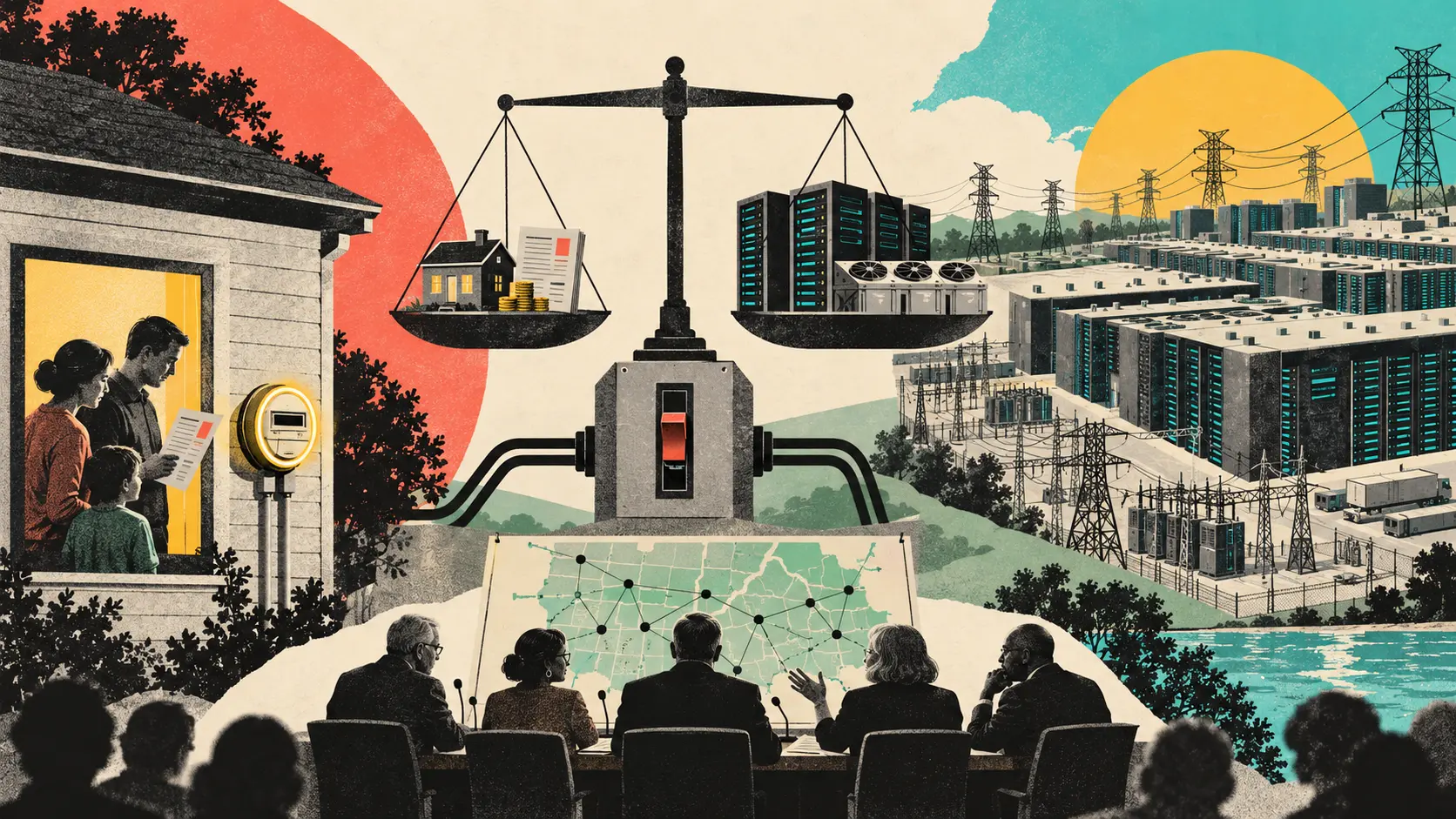
The United States House scheduled a vote on a bipartisan bill aimed at a question ordinary electricity customers have been asking with increasing volume: when a giant data center needs new power plants, transmission lines, substations, and local distribution equipment, who pays for the upgrade? H.R. 9340 would add a federal standard under the Public Utility Regulatory Policies Act for data centers with peak demand of at least 100 megawatts at one site or campus. The standard says the customer's rate should recover the full incremental cost of the generation, transmission, and distribution upgrades needed to serve that load, backed by financial assurances before construction. That sounds admirably direct. The mechanism is less direct. The bill would require state regulators and nonregulated utilities to consider the standard and make a determination. It would not automatically impose one national tariff, settle every disputed cost, or cover water, land, pollution, tax incentives, and other public expenses. It had not passed the House, Senate, or president when this article was verified. The useful signal is that AI infrastructure has moved from vague promises about bringing its own power to a testable public question about contracts, deposits, stranded assets, and which bill receives the risk.
01
WHAT ACTUALLY CHANGED
The House placed H.R. 9340, the Ratepayer Protection Act, on its schedule for the week of September 14. Reuters reported on September 16 that a vote was expected as soon as Wednesday. The House Energy and Commerce Committee approved the measure 52 to 0 on July 21 after Representatives Gabe Evans of Colorado and Kathy Castor of Florida introduced it on June 18. A floor schedule is not passage, and passage by the House would still leave the Senate and president.
The amended text defines a covered large-load customer as a nonresidential electricity user whose facility primarily operates information-technology infrastructure for data storage or computational services and whose aggregate peak demand reaches at least 100 megawatts at one site or campus. That captures very large data centers. It can leave smaller facilities, dispersed portfolios, and other electricity-intensive AI infrastructure outside this particular definition.
The proposed standard says the electric rate or agreement for a covered customer should recover the full incremental cost of generation, transmission, or distribution upgrades needed to serve its load. The obligation expressly continues if the customer terminates its electricity contract or otherwise stops buying from the utility. Before making an upgrade, the utility would require financial assurances or contributions that cover its cost.
The bill uses the process already built into the Public Utility Regulatory Policies Act. Each state authority with ratemaking power, and each relevant nonregulated utility, would have one year after enactment to begin considering the standard or schedule a hearing and two years to complete that consideration and make a determination. States with a comparable standard, a completed proceeding, or a legislative vote before enactment can fall under the prior-action provisions.
That process matters because the federal proposal is a required consideration, not an automatic nationwide rate design. State commissions can examine local utility structures, forecasts, contracts, and law, then decide what to adopt. The headline promise that data centers will pay their own way therefore depends on the eventual state order, the definition of incremental cost, the financial instrument, the customer's credit, and the enforcement that survives after a project shrinks or disappears.
02
WHY THIS MATTERS
A data center can arrive faster than a power plant or transmission line. Utilities may spend years and billions of dollars preparing for a load whose owner can delay, reduce, relocate, or cancel the project. If ordinary customers backstop that risk, they can keep paying for the infrastructure after the glamorous tenant has left the rendering. Exit protection is not a footnote. It is the part that decides whether a failed forecast becomes a household charge.
The 100-megawatt threshold is concrete enough to be useful and blunt enough to invite games. A developer could divide a campus, phase connections, distribute workloads across sites, or structure contracts in ways that alter how the threshold is measured. Regulators will need aggregation rules, affiliate disclosure, common-control tests, and continuing review. Otherwise a bright line becomes a drafting exercise for people with very expensive counsel.
Full incremental cost also needs an auditable ledger. Some upgrades serve one data center. Others improve reliability or capacity for many customers. A new generator can create fuel, interconnection, and retirement obligations. A transmission project can outlive the original customer and provide wider benefits. Regulators should publish which costs are direct, which are shared, which assumptions allocate them, and how later benefits or overruns change the account.
Financial assurance is the bill's practical hinge. A letter of credit, cash contribution, parent guarantee, minimum bill, collateral requirement, or termination payment can shift risk differently. The amount, duration, credit standard, replenishment trigger, and release conditions matter more than the reassuring noun. A guarantee from a thin project company is not the same thing as cash or support from a solvent parent.
Electricity is only one public account. The proposal does not by itself price water withdrawals, backup generators, air pollution, roads, emergency services, land, tax abatements, noise, housing pressure, or community benefits. That does not make the electricity rule useless. It makes it one ledger in a much larger civic bargain. A narrow bill should be judged by what it actually covers, not recruited as a certificate that the entire project pays for itself.
03
WHERE IT COULD HELP
- Require every covered project to publish a load forecast with phases, probability ranges, energization dates, contract term, owner, affiliates, and the person financially responsible if demand never arrives
- Separate direct, shared, and systemwide upgrade costs in a public cost-allocation model, then show how overruns, delays, cancellations, and later benefits change each account
- Use durable financial assurance with transparent amount, issuer, credit standard, replenishment trigger, expiry date, release conditions, and protection against transfer to an undercapitalized project company
- Test the 100-megawatt threshold against phased campuses, affiliated sites, multiple meters, colocated tenants, and contract restructuring so one physical project cannot become several paper projects
- Pair the electricity proceeding with separate public records for water, emissions, land, tax incentives, emergency services, jobs, community benefits, complaints, and enforceable remedies
KEEP A HAND ON THE WHEEL
The cited House text establishes a proposed federal standard and a state consideration process. It does not establish a national tariff that automatically takes effect, a House vote result, Senate approval, presidential signature, a final state order, or proof that household bills will fall. The bill applies its large-load definition to certain data-center contracts requested or entered on or after enactment, uses a 100-megawatt threshold at one site or campus, and includes prior-state-action provisions. It does not resolve how regulators should calculate every incremental cost, divide shared benefits, value financial assurance, treat phased or affiliated projects, or recover costs when forecasts change. It also does not cover the complete water, land, pollution, tax, labor, housing, and community account of a data center. Watch the recorded House vote, amendments, Senate action, the final enacted text if any, state commission proceedings, utility tariffs, threshold rules, contract transparency, credit requirements, stranded-cost treatment, judicial challenges, and measured effects on residential and small-business bills.
04
TERMS WORTH KEEPING
OPEN GLOSSARY CARD
Ratepayer
A household, business, or other customer that pays a regulated utility rate for electricity service.
OPEN GLOSSARY CARD
Incremental cost
The additional cost caused by serving a new customer or load beyond what the system would otherwise need.
OPEN GLOSSARY CARD
Financial assurance
Money, collateral, a guarantee, or another enforceable promise intended to cover an obligation if a project changes or fails.
SOURCES AND VERIFICATION STATUS
This article was written from the materials below. Product claims and dates were checked against those sources on September 16, 2026.
PUBLICATION RECEIPT: Revision 1. Published September 16, 2026.
THE PUBLICATION ENGINE
WANT A SIGNAL OF YOUR OWN?
We build source-grounded publications, private briefings, and editorial systems for organizations with something useful to say.
WORK WITH US