THE SIGNAL IN ONE SENTENCE
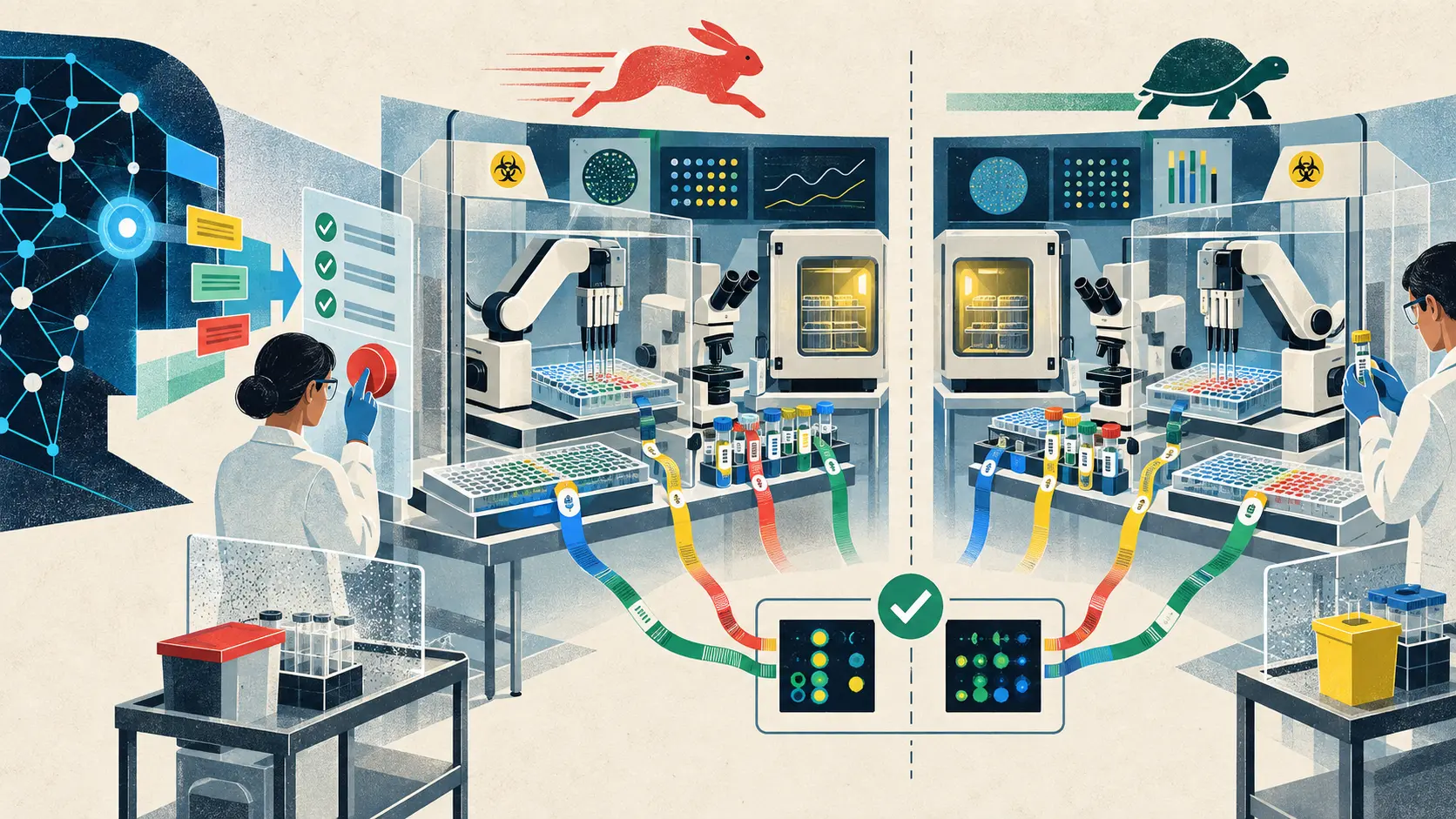
Anthropic has confirmed that it operates a wet lab in the San Francisco Bay Area and also works with outside laboratories. That means its biology effort is no longer confined to software, simulations, and scientific chat. Physical samples, instruments, reagents, robotic equipment, failed runs, and contaminated plates now sit inside the evidence chain. Reuters reports that Anthropic wants Claude to direct robotic units through experiments with limited human intervention, while the company says human oversight remains essential. Its public Model Hardware Standard already shows what the bridge can look like: one interface exposes instruments to agents, applies device-level limits, records state, and lets experimental results inform the next step. The demos are interesting, and they are not proof that Anthropic has an autonomous drug laboratory or a successful treatment. The company calls its own lab effort early, has not identified the diseases, external partners, protocols, instruments, safety level, or results, and says the facility is not specifically a drug-discovery lab. The plain signal is that AI has crossed into the room where biological claims become physical evidence. Speed now matters less than whether every sample, robot action, model decision, human approval, control, failure, and reproduction can be traced.
01
WHAT ACTUALLY CHANGED
Reuters reported on September 18 that Anthropic built a wet lab in the San Francisco Bay Area. Eric Kauderer-Abrams, the company's head of life sciences, confirmed that Anthropic performs some real laboratory work in its own facilities and some through external partners. A spokesperson clarified that the lab is not specifically for drug discovery and declined to give more detail. The company has not publicly identified the site, partners, biosafety level, instruments, protocols, budget, or experimental results.
The laboratory extends Anthropic's biology work beyond in-silico evaluation. Kauderer-Abrams told Reuters that the company is still in the early stages of using AI to automate laboratory execution. Reuters says Anthropic wants Claude to direct robotic units through scientific experiments with limited human intervention, while an Anthropic spokesperson said human oversight and involvement are essential for safety. Those statements describe an ambition and operating principle, not a measured autonomy level.
Anthropic has also published a research preview of its Model Hardware Standard, an interface intended to let software and AI agents read instrument state and control equipment from different vendors. In public demonstrations, researchers used it for monitored qPCR, robotic plate handoffs, dose-response experiments, microscopes, and laser systems. Anthropic labels the academic examples proofs of concept and documents practical failures, including bubbles that caused a liquid handler to transfer the wrong volume until people explained the physical problem.
The public hardware work illustrates two distinct control patterns. In some cases Claude remains inside the loop, choosing the next acquisition or analysis step. In the QuEra laser example, Claude developed a deterministic recovery script that could later run without the model. That distinction matters in biology: an inspectable procedure with fixed limits is easier to validate than an open-ended agent that can revise the procedure while samples are moving.
Anthropic previously said it intended to conduct preclinical work in areas that traditional companies found financially unattractive. Kauderer-Abrams told Reuters that the company sees potential in difficult targets, including bispecific and trispecific antibodies, but the precise diseases and progress remain unclear. He also said Anthropic is not running clinical trials and is not competing with pharmaceutical or biotechnology companies that bring drugs to market.
The FDA describes preclinical research as laboratory and animal testing that answers basic safety questions. Clinical research tests products in people for safety and effectiveness, followed by regulatory review. Anthropic's lab activity therefore sits near the beginning of a long chain. A promising experiment would not be a treatment, clinical result, approved product, or demonstrated health benefit.
02
WHY THIS MATTERS
Software errors can be rerun. Wet-lab errors can consume a scarce sample, mix up identities, contaminate a plate, damage an instrument, expose a worker, or create a persuasive result from the wrong material. Physical automation turns model quality into only one part of the system. Calibration, handling, environment, maintenance, chain of custody, controls, and the authority to stop the run become equally important.
A closed loop can accelerate learning and accelerate mistakes. If a model proposes an experiment, reads the result, and chooses the next experiment, one faulty sensor or mislabeled well can shape every later decision. The useful speedup comes from short feedback cycles with checkpoints. The dangerous speedup is a bad assumption reproducing itself overnight while the equipment follows orders perfectly.
Human oversight is meaningful only when a person knows what is happening and can change it. A scientist needs the protocol, sample identity, instrument state, hazard assessment, model rationale, expected controls, deviation log, and enough time to intervene. A person who receives a cheerful completion notice after the plate is discarded is not supervising the experiment. That person is being informed by the machine.
The evidence record must survive the interface. A natural-language instruction may become a model plan, hardware commands, vendor-specific actions, sensor readings, analysis code, and a new model instruction. If those transformations are not versioned together, a result can look reproducible while the decisive robot setting or prompt has disappeared. The laboratory notebook has to include the agent, not merely the final chart.
Automation could make valuable experiments cheaper and more available. Anthropic's public examples show why researchers are interested: instruments from several vendors can share one interface, routine monitoring can happen continuously, and a robot can repeat tedious work without asking a graduate student to return at 4 a.m. The same architecture can also concentrate operational access. Permissions and device limits should be narrow enough that one compromised account, mistaken prompt, or misread signal cannot command the whole laboratory.
Independent repetition is the exit from the company story. Anthropic can confirm that a robot completed a protocol and can publish the resulting curve. Trust grows when another qualified laboratory receives the complete materials, software, model version, prompts, hardware configuration, controls, raw observations, exclusions, and failures, then obtains a consistent result. Without that second lab, an impressive automated run remains a promising internal demonstration.
03
WHERE IT COULD HELP
- Attach one immutable run record to every physical experiment, linking sample and reagent identities, lot numbers, storage history, protocol version, model and tool versions, prompts, instrument configuration, calibration, robot actions, sensor readings, human approvals, deviations, raw data, analysis, failed wells, discarded runs, and final disposition
- Place a deterministic safety layer between the model and each instrument, with device-specific limits, allowed actions, collision checks, volume and temperature bounds, hazard rules, emergency stops, authentication, and a circuit breaker that defaults to a safe state when sensors disagree or context is missing
- Separate proposal, approval, execution, analysis, and acceptance so the same model cannot silently design an experiment, authorize the risky step, grade its own result, discard inconvenient data, and declare success without independent checks
- Build controls and blind samples into the automation plan before the run begins, then publish the complete denominator, including failed, repeated, contaminated, excluded, and manually rescued experiments rather than only the best-looking plate
- Require an independent laboratory to reproduce consequential findings from a frozen protocol and complete evidence package before a result supports a drug program, safety claim, public announcement, or decision about people
KEEP A HAND ON THE WHEEL
Anthropic confirmed physical laboratory work through a direct Reuters interview, but it has not published a detailed announcement, laboratory paper, protocol, result set, partner list, safety assessment, facility description, or independent audit of this lab. The company says the facility is not specifically for drug discovery, even though its broader life-sciences effort includes preclinical ambitions and tools for pharmaceutical customers. Reuters' description of Claude directing robotic units with limited human intervention comes from people familiar with the effort; Anthropic separately says human oversight remains essential. The public Model Hardware Standard demonstrations occurred across partner laboratories and do not establish the capabilities, controls, scale, or outcomes of Anthropic's own facility. Demonstrations with colorimetric dye, qPCR, microscopy, or lasers do not prove reliable performance on every biological material or protocol. The precise diseases, experiments, progress, procurement, external partners, instruments, data governance, biosafety level, sample sources, oversight bodies, and results remain undisclosed. Preclinical work is not a human trial, regulatory approval, treatment, or health outcome. Watch for a named scientific lead, published protocol, complete run provenance, negative and failed results, safety limits, incident reporting, independent reproduction, partner disclosures, clinical boundaries, and evidence that any faster laboratory cycle produces better science rather than merely more experiments.
04
TERMS WORTH KEEPING
OPEN GLOSSARY CARD
Reproducibility
The ability of another qualified team to repeat a method with documented inputs and obtain results consistent with the original finding.
OPEN GLOSSARY CARD
Research provenance
A traceable record of the data, code, models, parameters, tools, environments, and human decisions behind a scientific result.
OPEN GLOSSARY CARD
Wet lab
Hands-on experimental work performed with physical samples, instruments, reagents, and biological or chemical procedures.
SOURCES AND VERIFICATION STATUS
This article was written from the materials below. Product claims and dates were checked against those sources on September 18, 2026.
PUBLICATION RECEIPT: Revision 1. Published September 18, 2026.
THE PUBLICATION ENGINE
WANT A SIGNAL OF YOUR OWN?
We build source-grounded publications, private briefings, and editorial systems for organizations with something useful to say.
WORK WITH US