THE SIGNAL IN ONE SENTENCE
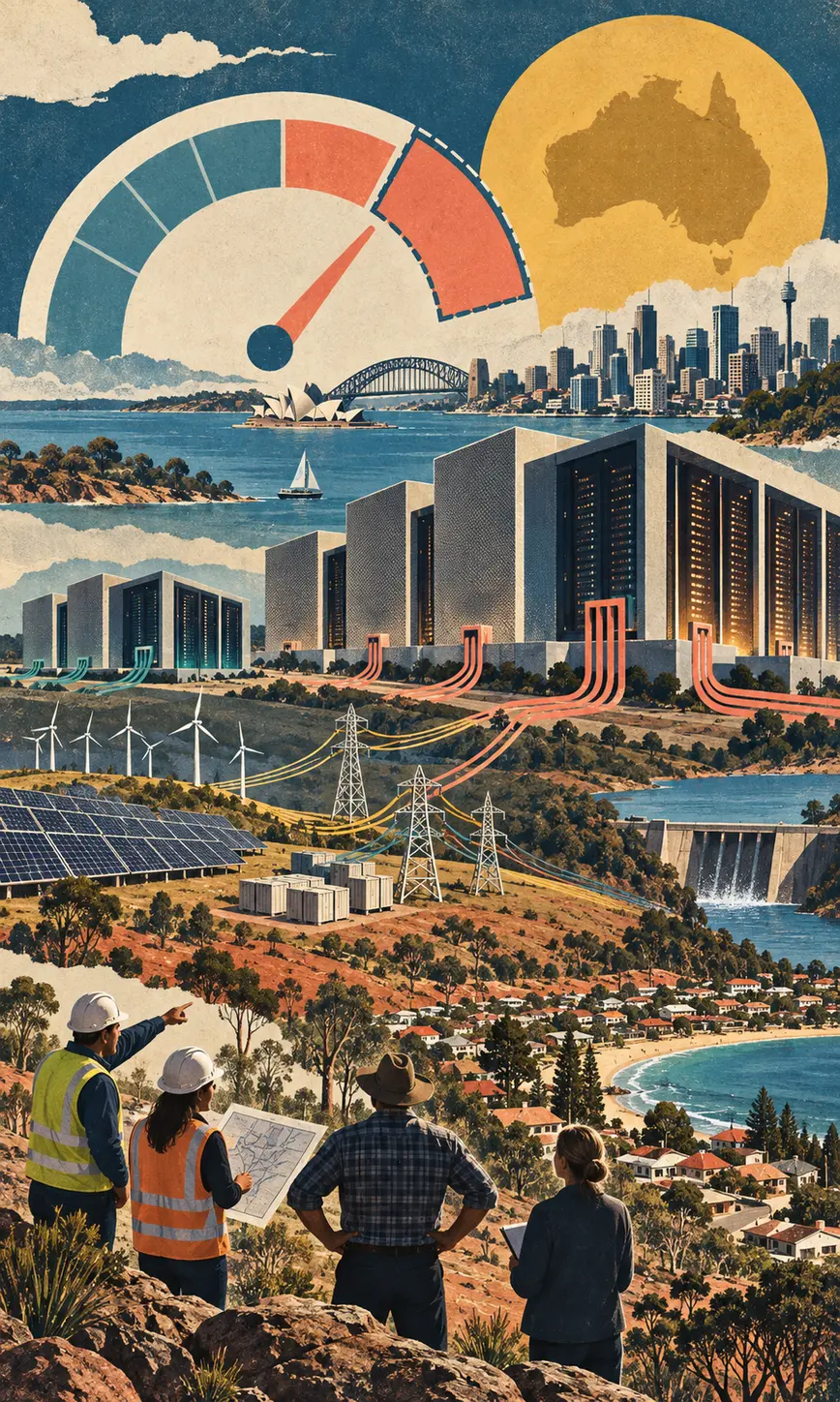
Australian data-center operators working with Nvidia want to add up to two gigawatts of AI computing capacity by 2027. That proposed addition is bigger than the 1.6 gigawatts the industry says the whole country uses today, but it is a target, not a finished power system.
01
WHAT ACTUALLY CHANGED
Nvidia said on September 10 that it is working with Australian cloud and data-center companies including Firmus, CDC Data Centres, NEXTDC, and AirTrunk on a buildout of up to two gigawatts of AI-related capacity by 2027. Reuters reported the announcement and the company's statement. The Australian operators would run the facilities, while Nvidia would supply its DSX computing platform, networking, software, and ecosystem support.
The comparison is the part that makes the number sit up straight. Data Centres Australia put the country's current data-center capacity at 1.6 gigawatts, using research from DC Byte. The proposed addition is 25 percent larger than that present figure. It does not follow that national use will neatly jump to 3.6 gigawatts, because projects may overlap with existing plans, arrive in stages, change scope, or never reach their full target.
The word capacity also needs a seat belt. Two gigawatts describes the scale the partners say they are targeting. It is not proof that the facilities have been built, connected to the grid, filled with processors, or are drawing that amount continuously. Reuters did not report a complete site list, individual allocations, construction schedule, financing map, connection agreements, generation mix, or water budget for the whole program.
Nvidia said the expansion would let Australian developers build models, applications, and agents locally, and that it would support additional power-generation projects for regional and global demand. That is the commercial case. The physical case remains local: substations, transmission, firm electricity, cooling systems, backup generation, land, permits, and communities must all arrive in the same places at roughly the same time.
One Australian operator is already describing the trade-offs in unusually plain terms. NEXTDC says higher-density AI workloads increase heat and cooling requirements, and that a system designed to reduce water can sometimes use more electricity. Its own guidance asks buyers to examine total electricity demand, water sources, peak-period performance, equipment life, and operator transparency together. That is useful context, although it is company guidance rather than an independent environmental assessment of this two-gigawatt plan.
02
WHY THIS MATTERS
For Australia, this is less a chip story than a coordination test. A data hall can be designed faster than a major transmission line can be planned and built. If compute projects arrive before new generation, storage, and grid capacity, they can compete for limited connections and make reliability planning harder. If the supporting energy arrives first and can serve other users, the same projects could help finance infrastructure the wider region needs.
The local value depends on what Australians get besides construction. Domestic access to advanced computing could help universities, startups, hospitals, miners, manufacturers, and public agencies run sensitive workloads closer to home. But a facility can also consume Australian land, power, and water while selling most of its output abroad. Contracts, access terms, jobs, taxes, and research partnerships will decide which version shows up.
Water cannot be reduced to one scary national total. Cooling choices depend on climate, workload density, site design, and whether an operator can use recycled water. A low-water design may shift more demand onto electricity, while a water-assisted system may reduce energy use but put pressure on a local supply. The honest unit of accountability is the site, with measured water and energy performance published over time.
The deadline is aggressive enough to matter. Reaching substantial new capacity by 2027 requires land, equipment, network connections, planning approvals, power contracts, construction labor, and customers. Announcing a round number is the easy afternoon. The durable evidence will be megawatts commissioned, generation added, connection dates met, cooling systems tested, and public performance data that residents can inspect.
The plain signal is that Australia is being asked to treat computing as heavy infrastructure. Two gigawatts is not a software feature that can quietly ship on Tuesday. It is an industrial promise whose credibility belongs in grid plans, water accounts, permit files, and operating meters. The AI factory is only real when the boring systems around it work.
03
WHERE IT COULD HELP
- Publish site-by-site power, water, cooling, and backup-generation plans before construction
- Tie new compute load to dated grid connections, generation, storage, and demand-response commitments
- Reserve affordable local capacity for universities, startups, public services, and regulated Australian workloads
- Report commissioned megawatts separately from announced or reserved capacity
- Measure energy and water performance at each site and disclose results after operations begin
KEEP A HAND ON THE WHEEL
The two-gigawatt target, 2027 date, partner list, DSX role, and 1.6-gigawatt comparison come from Nvidia's statement as reported by Reuters on September 10. A complete primary announcement with binding project terms was not publicly available during verification. The target is not installed capacity or continuous electricity consumption. The partners did not publish a full site list, company-by-company allocation, financing schedule, grid-connection plan, generation mix, water budget, power usage effectiveness target, customer allocation, or guarantee that every project will be completed by 2027. NEXTDC's cooling guidance is useful operator context, not an independent assessment of the announced buildout.
04
TERMS WORTH KEEPING
OPEN GLOSSARY CARD
Power usage effectiveness
A data-center efficiency ratio that divides total facility energy by the energy delivered to information-technology equipment.
OPEN GLOSSARY CARD
Gigawatt
A unit of power equal to one billion watts, commonly used for large power plants and electricity systems.
SOURCES AND VERIFICATION STATUS
This article was written from the materials below. Product claims and dates were checked against those sources on September 10, 2026.
PUBLICATION RECEIPT: Revision 1. Published September 10, 2026.
THE PUBLICATION ENGINE
WANT A SIGNAL OF YOUR OWN?
We build source-grounded publications, private briefings, and editorial systems for organizations with something useful to say.
WORK WITH US