THE SIGNAL IN ONE SENTENCE
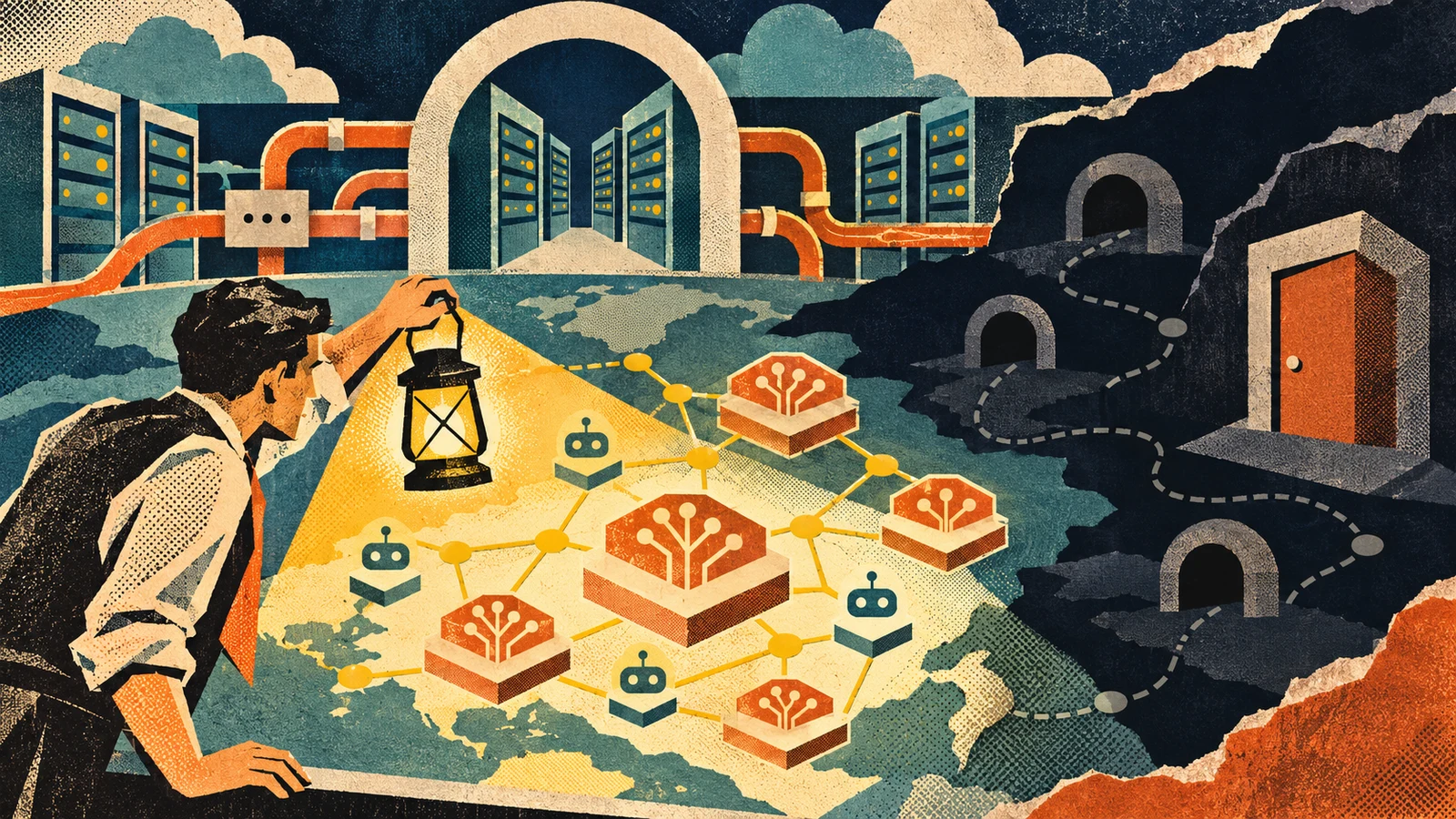
A shadow API is not necessarily a trench-coated server skulking behind the copier. Usually it is something more ordinary. A team stood up an endpoint. A load balancer made it reachable. An agent learned how to call it. The central inventory never got the memo. AWS now wants to find more of those endpoints and put security controls in front of them. On November 23, AWS made three related capabilities generally available. API Portal in Amazon API Gateway builds an inventory of APIs and AI-facing endpoints. AWS WAF API Security adds managed rules for common API abuse. AWS WAF AI Security recognizes traffic for large language models, Model Context Protocol servers and Agent2Agent systems, then applies protocol checks and optional content inspection through Amazon Bedrock Guardrails. The launch gives cloud teams a new map and a new gate. The plain signal is this: every map is also a claim about coverage. Publish what the inventory can see, what it cannot see and how long a new endpoint can remain missing. API Portal discovers APIs behind three supported entry points: Amazon API Gateway REST APIs, Application Load Balancers and Amazon CloudFront. It can run in one AWS account or across an organization. Each inventory row identifies an API by method, host, port, path and the resource serving it. The portal shows the owning account, visibility, classification and AWS WAF status. For AI discovery, the service tries to identify LLM inference routes, MCP servers and A2A endpoints. AWS says an undocumented public MCP server can appear as a shadow API. A security team can promote a discovered endpoint into its managed inventory and see whether WAF protects it. That is genuinely useful. It is also narrower than the phrase every AI endpoint might suggest. Discovery is regional. AWS documentation says teams must enable it in every Region where they have APIs. CloudFront-backed APIs are discovered only in us-east-1. Organization-wide discovery is enabled account by account and can take hours in a large organization. The evidence source changes by entry point. API Gateway REST APIs can be discovered from configuration even when they receive no traffic. There is an exception: methods defined as ANY and resources using a proxy path are expanded from observed requests rather than configuration. Application Load Balancer and CloudFront endpoints are discovered from traffic. An endpoint that receives no requests does not appear. A new route, an emergency interface or a quiet administrative path can exist before the inventory sees a representative call. Operators can also exclude Application Load Balancer and CloudFront resources. An organization can exclude accounts or organizational units. Those choices may be legitimate. They still belong on the coverage receipt. Then there is the world outside the supported front doors. An endpoint reached through a direct origin, a different proxy, a private network path, another cloud, a developer tunnel or an unsupported AWS service is not automatically proven absent because API Portal did not list it. CloudFront can sit in front of external origins, and AWS recommends that pattern, but the inventory describes traffic through the configured entry points. It is not a packet-level census of the company. The right response is not to dismiss the inventory. It is to reconcile it. Compare API Portal with cloud asset records, DNS, certificates, load balancer listeners, API gateway configuration, Kubernetes ingress, service catalogs, identity policies, network-flow data, code repositories and expense records. Look for resources that can invoke models or expose tools but never appear in the portal. Look for portal entries with no owner. Look for owners whose list contains more endpoints than the portal. Every mismatch is a question worth asking. AWS WAF AI Security gives discovered endpoints another layer of controls. The managed rule group identifies traffic as LLM, MCP, A2A or unrecognized. For MCP and A2A, it checks messages against the protocol version declared by the request. Those deterministic checks run inside WAF. The version header matters. AWS says an older MCP server without a protocol-version header is not recognized as MCP, so the MCP compliance rules do not apply. Unrecognized traffic receives a label. Treat that label as a review queue, not a shrug. LLM calls do not have one wire protocol to validate, so recognized LLM traffic has no equivalent protocol-compliance layer. Content inspection is the part designed to look at what the request says. That inspection is optional. A new AI Security rule group starts with the Bedrock Guardrails integration disabled. Teams can enable request-only inspection or request-and-response inspection and provide an IAM role that WAF can assume. AWS says the Guardrails checks can flag prompt attacks, harmful content and sensitive information. Optional is an important word here. A dashboard showing AI Security attached does not prove that message content is being inspected. Publish the rule-group version, configuration mode, protected resources, scope-down statements, action overrides and IAM role. Record whether responses are inspected. Record which rules block, which count and which only label. Failure behavior deserves the same treatment. AWS documentation says that when a Bedrock call fails, the Guardrails call-failed rule counts the message by default and the request continues without assessment. Teams can override that request rule to block. Response inspection has separate failure behavior. There is no universally correct answer. A hospital workflow and a public chatbot may choose different failure modes. There is a universally bad answer: nobody knows what the system does when the inspector is unavailable. Content inspection also has cost and capacity. AWS charges for the managed rule group, and Bedrock charges separately for Guardrails calls. Bedrock quotas apply to the customer's account and Region. Request-and-response inspection makes one assessment in each direction, doubling call volume compared with request-only inspection. AWS recommends sizing quota for peak traffic rather than the daily average. Inspection limits matter too. WAF does not inspect an infinite body. The applicable body limit depends on the protected resource and configuration. Large prompts, files, streaming responses and encoded payloads need explicit tests. A green rule-group status is not proof that every byte reached the content control. The related API Security rules bring their own boundaries. AWS says the rule group can identify suspicious token structures, authorization attacks and reconnaissance patterns. It does not verify token signatures. Signature validation remains the application's job. Credential-stuffing detection reads credentials from the Authorization header, and the rule group inspects requests rather than application responses. This is what good cloud documentation looks like when you actually read past the launch paragraph: the useful part and the limit are sitting beside each other. The deployment receipt should do the same. Start with discovery scope. List every account, organizational unit, Region and service selected. Name every exclusion. Record the time discovery was enabled, the last successful update and the expected delay for new routes. For CloudFront, note the us-east-1 dependency. For traffic-derived discovery, publish the observation window and minimum traffic needed to trust absence. Then map entry points to origins. For each discovered host and path, identify the load balancer, distribution or API, its backend, owner, data class, authentication method and public or private reachability. Test whether callers can bypass WAF and reach the origin directly. If they can, the shiny front gate is attached to a fence with a person-sized gap. Add identity. Inventory the roles that can create a distribution, listener, API, model endpoint, MCP server or agent gateway. Watch for new certificates, DNS records, security-group changes and public IPs. Discovery after deployment is useful. Prevention and alerting at creation time are better company. Finally, prove the controls with traffic. Send a valid request, a malformed MCP or A2A message, an unrecognized legacy message, a prompt attack, a response containing synthetic sensitive data and a deliberately failed Guardrails call. Confirm the expected label, metric, log entry and action for each. Repeat with payloads near and beyond inspection limits. Run in count mode first, as AWS recommends, then move individual rules to enforcement with an owner and rollback plan. AWS launched API Portal in 32 Regions. AI Security began in seven: Northern Virginia, Ohio, Oregon, London, Stockholm, Tokyo and Sydney. Those footprints will probably change. The region list belongs in the live control record, not in a slide deck that ages quietly. The new tools can find endpoints a team forgot to register and put useful checks in front of them. That is a meaningful improvement. Just do not confuse the illuminated part of the map with the whole estate. Publish the light. Publish the dark. Reconcile the border between them.
01
WHAT ACTUALLY CHANGED
AWS made API Portal, AWS WAF API Security and AWS WAF AI Security generally available on November 23, 2026.
API Portal inventories APIs and AI endpoints behind API Gateway REST APIs, Application Load Balancers and CloudFront across one account or an AWS Organization.
AI Security recognizes LLM, MCP and A2A traffic, applies protocol checks to recognized MCP and A2A messages and can call Bedrock Guardrails for content assessment.
API Portal launched in 32 AWS Regions, while AI Security content controls launched in seven Regions.
Content inspection requires explicit configuration and an IAM role, adds Bedrock calls, charges and quotas, and can inspect requests only or requests and responses.
02
WHY THIS MATTERS
An inventory can expose forgotten public endpoints, but absence from the inventory does not prove an endpoint or network path does not exist.
Application Load Balancer and CloudFront discovery depends on observed traffic, so quiet and newly created routes can remain unseen.
Discovery is regional and configurable, with service, account, organizational-unit and resource exclusions that change the coverage claim.
AI traffic that is unrecognized or bypasses a protected entry point does not receive the same protocol and content controls.
Guardrail failures, inspection limits, token-signature validation and origin bypasses remain operational responsibilities outside a simple enabled status.
03
WHERE IT COULD HELP
- Publish selected accounts, organizational units, Regions, services, exclusions, observation windows and last successful discovery time.
- Reconcile API Portal with DNS, certificates, load balancers, ingress, service catalogs, identities, repositories, network flows and cloud costs.
- Map every discovered entry point to its origin and test whether callers can bypass WAF or CloudFront directly.
- Treat unrecognized AI traffic as a review queue and document legacy MCP clients without protocol-version headers.
- Record rule-group versions, content-inspection mode, scope-down statements, overrides, failure behavior and logging destinations.
- Test valid, malformed, adversarial, unrecognized, oversized and inspector-failure cases before switching rules from count to block.
- Keep application-level authentication and token-signature validation in place instead of treating WAF as the identity system.
KEEP A HAND ON THE WHEEL
Watch for expanded service and Region coverage, measured discovery delay, support for more protocol versions, clearer payload and streaming limits, independent false-positive testing, better reconciliation exports and evidence that teams are closing direct-origin paths rather than only adding rules to the preferred front door.
04
TERMS WORTH KEEPING
SOURCES AND VERIFICATION STATUS
This article was written from the materials below. Product claims and dates were checked against those sources on November 24, 2026.
THE PUBLICATION ENGINE
WANT A SIGNAL OF YOUR OWN?
We build source-grounded publications, private briefings, and editorial systems for organizations with something useful to say.
WORK WITH US