THE SIGNAL IN ONE SENTENCE
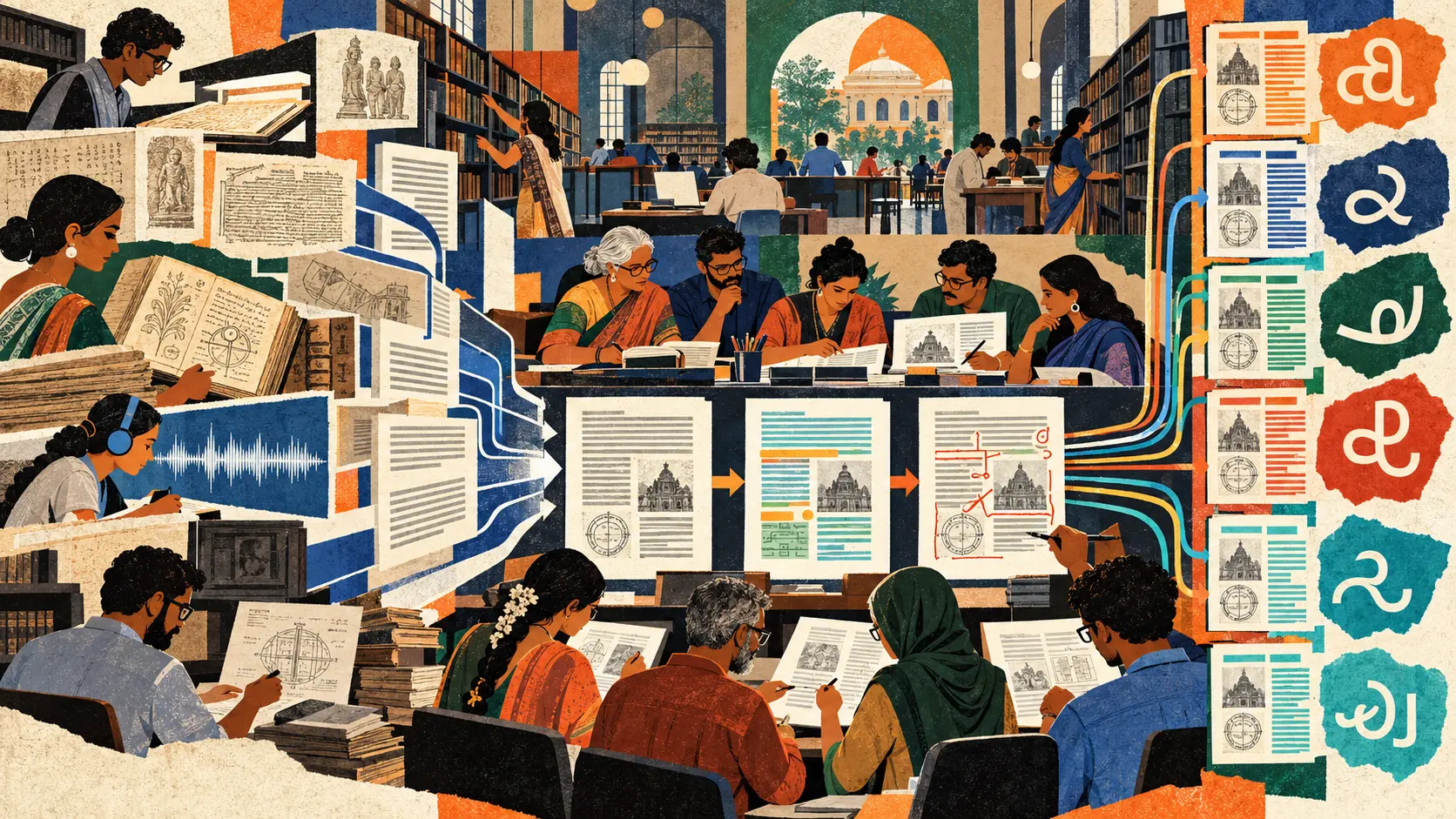
India has an enormous research library hidden behind two doors. The first door is access. A thesis can be buried in a repository, a scanned PDF or a lecture recording that is difficult to search. The second door is language. Even when the document is online, its argument may be effectively unavailable to a student, farmer, clinician, policymaker or independent researcher who does not work comfortably in the source language. On October 24, the Digital India BHASHINI Division described how its multilingual AI tools could help open both doors. At the International Symposium on Electronic Theses and Dissertations at IIT Delhi, the government platform demonstrated speech transcription with simultaneous translation, optical character recognition for scanned material and document translation for long, structured files. BHASHINI invited universities, libraries and research repositories to explore collaboration on multilingual access to theses, dissertations and other scholarship. That is the promising part. The dangerous part would be treating the job like a giant translate button. Research documents are fussy little machines. A thesis is not only paragraphs. It contains citations, equations, captions, footnotes, tables, abbreviations, page references, legal names, chemical symbols and terms that may have no agreed equivalent in another language. A fluent sentence can still be scientifically wrong. A polished translation can move a decimal, detach a qualifier or turn a tentative finding into a confident claim. The plain signal is this: build the review queue first. Every translated research document should move through a visible sequence before it becomes a published copy. Preserve the source. Extract the structure. Produce the machine draft. Flag uncertain passages. Assign language and subject reviewers. Record corrections. Publish the final version with a receipt. Start with the source object. A repository should preserve the original file, edition, page order, checksum and stable identifier before translation begins. If the input came from a scan, retain the page image beside the extracted text. If it came from audio, keep the time-coded recording beside the transcript. Readers and reviewers need a route back to what the author actually submitted. Optical character recognition is useful because a scan without machine-readable text is hard to search, quote or translate. It is also a place where errors multiply quietly. A broken character in a name can make a citation disappear. A superscript can fall into the body text. A table column can drift into the wrong row. A model can then translate the extraction error perfectly. That is why extraction needs its own confidence layer. Mark passages where the system is unsure. Render equations, tables and figures as distinct objects instead of flattening them into a paragraph. Compare page counts, heading counts, references and figure numbers before the text moves forward. The first quality test is not whether the translation sounds natural. It is whether the document survived digitization. Then lock the terminology. Specialized scholarship depends on words that carry field-specific meaning. A term in constitutional law may look ordinary to a general translation model and still require a settled legal expression. A phrase in agronomy may differ by region. A medical abbreviation may need to remain unchanged, be expanded once or carry a warning that no accepted equivalent exists. BHASHINI highlighted terminology management as part of its broader toolkit. That feature should become a shared, versioned glossary for each repository and discipline. Every entry should record the source term, approved translations, domain, language, reviewer, evidence and date. Reviewers should be able to challenge an entry rather than inherit it forever. The glossary is not decoration. It is infrastructure. Next, separate language review from subject review. A native speaker can tell whether a sentence is clear, natural and culturally sensible. A subject expert can tell whether it still means what the research means. For technical documents, one person may not be able to do both jobs. The queue should assign each responsibility explicitly. Language reviewers should check grammar, script, local usage, names, tone and readability. Subject reviewers should check claims, terms, equations, units, methods, citations and uncertainty. When the two disagree, the document should remain in review rather than letting the machine choose which expert to ignore. The review should focus human effort where it matters most. Not every sentence needs the same level of scrutiny. A copyright notice and a results table are not equally risky. The system can route high-risk sections to deeper review: abstracts, conclusions, clinical recommendations, legal interpretations, numerical findings, safety instructions and passages with low confidence or contested terminology. That routing rule must be public enough to inspect. A confidence score is not a truth meter. Repositories should show what produced the flag, which threshold triggered review and how often apparently high-confidence passages were still corrected. Otherwise the green sections become the ones nobody reads, which is exactly where a quiet error can settle in. BHASHINI says its ecosystem supports 36 Indian languages for text, 23 for voice and 35 international languages. It also reports more than 10 billion cumulative AI inferences and translation support across more than 800 government websites. Those figures show reach. They do not establish equal research-translation quality. A language can be technically supported while one script, dialect, academic field or document layout remains weak. A platform-wide inference total does not tell a student whether a 300-page chemistry thesis preserved its equations. Coverage should therefore be reported by language pair, domain, document type and error category. For each pair, publish a small, representative evaluation set with permission to inspect it. Include born-digital documents, degraded scans, mixed scripts, tables, formulas, citations and locally relevant terminology. Measure more than sentence similarity. Count missing claims, changed numbers, broken references, altered qualifiers and corrections requested by human reviewers. The system should also know when not to translate. Some passages require permission. Some contain personal data, confidential field notes or culturally sensitive material. Some quotations should remain in the original language with an explanatory note. Some manuscripts may have rights that allow reading but not republication in a translated edition. Before processing, the queue needs a rights and data check. Who owns the document? What license applies? Is personal information present? May the translation be made public? How long will uploaded material be retained? Will it be used to improve a model? Can an author request correction or withdrawal? India's linguistic diversity makes consent and attribution especially important. Community-contributed language resources can make tools better, but contribution is not a blank cheque. A speaker who donates a recording for language access has not necessarily agreed to every future commercial or surveillance use. The repository receipt should name the data source and the permitted use without exposing private material. Then publish the translation history. The final multilingual copy should not pretend it appeared whole. Link it to the source document. Name the machine service and version. Identify the glossary version. Record the review date, reviewer roles, sections that received subject review and unresolved passages. If the document changes, preserve the earlier translation and explain what was corrected. This is especially important for citations. A translated title can help discovery, but a researcher must still be able to locate the original work. Keep author names, repository identifiers, original titles and page references intact. When a quotation is translated, label it as a translation and provide the source passage. Do not let a cleaner sentence erase the route back to evidence. The same rule applies to generated summaries. A multilingual abstract can make research discoverable. It should not replace the author's abstract without a label. A plain-language summary can help more readers. It should not be indexed as if the author wrote it. Generated additions need visible provenance because access improves when readers know what they are reading. Practical pilots should begin narrow. Choose a small collection with clear rights, willing authors, stable digital files and reviewers in both the language and the discipline. Translate a defined set of abstracts before attempting full theses. Track turnaround time, reviewer workload, corrections, unresolved terms and reader use. Compare machine-assisted work with a human baseline rather than declaring victory because a PDF appeared. Then expand by evidence. A repository may find that abstracts in one field work well while equations and captions still break. Good. Publish that boundary. Another language pair may need more glossary work. Good. Fund it. One OCR pipeline may fail on an older script or a damaged scan. Good. Keep the image visible and stop the workflow until a reviewer resolves it. The point is not to make every document look equally finished. The point is to make every document honestly usable. BHASHINI also described Shrutlekh, which can transcribe speech while translating it, and Pragati, a document-translation workbench developed for India's Comptroller and Auditor General. The government release says Pragati can process documents from 100 to 500 pages with quality checks and data-security considerations. Those examples show that the components exist. What has not been announced is a completed national deployment across research repositories, a budget, a publication timetable or a public accuracy study for specialized scholarship. That distinction matters. The October 24 event was a demonstration and an invitation to collaborate. It was not evidence that every thesis in Shodhganga has been translated, reviewed or made reliably searchable in every supported language. The next milestone should be a documented pilot, not a larger promise. Universities and libraries can help by publishing their requirements before vendors or platforms write them on their behalf. Researchers can nominate high-value collections. Language departments can build glossaries and evaluation sets. Disability-access teams can test whether translated outputs work with screen readers and alternative formats. Authors can review how their claims travel. Students can report passages that remain confusing. The public platform can do something a private translation box usually does not: create shared infrastructure for correction. That is the real opportunity. A machine draft can lower the cost of the first pass. A public glossary can reduce repeated work. A review queue can route difficult passages to the right people. A translation receipt can let readers trace a sentence back to its source. Source. Structure. Draft. Flags. Review. Receipt. Build that sequence before the archive starts speaking in languages it has not yet learned to check.
01
WHAT ACTUALLY CHANGED
India's Digital India BHASHINI Division demonstrated multilingual research-access tools at ETD-2026 at IIT Delhi
The demonstration included real-time speech transcription with simultaneous translation through Shrutlekh
BHASHINI presented optical character recognition, document translation, transliteration and terminology-management capabilities
The government identified theses, dissertations, research reports, lectures and conferences as potential academic use cases
BHASHINI Pragati was presented as a document workbench for structured files ranging from 100 to 500 pages
The division invited universities, libraries and research repositories to identify priority use cases and collaborate on domain-specific resources
BHASHINI reports support for 36 Indian languages in text and 23 Indian languages in voice
The platform reports more than 10 billion cumulative AI inferences and translation support on more than 800 government websites
Officials explicitly described human review and quality assurance as necessary for specialized academic translation
No completed national repository deployment, accuracy evaluation, budget or publication calendar was announced
02
WHY THIS MATTERS
Language barriers can keep publicly available scholarship practically inaccessible to students, practitioners and communities
Scanned documents require reliable extraction before translation, or OCR errors can become fluent translation errors
Academic meaning depends on citations, equations, units, qualifiers and discipline-specific terminology
A language-support count does not establish equal quality across language pairs, domains, scripts or document types
Separate language and subject review can catch different classes of failure
A visible review queue can focus scarce expert attention on high-risk passages rather than every sentence equally
Versioned glossaries can reduce repeated work while preserving a path to challenge or update a term
Stable links to original documents protect attribution and let readers verify translated claims
Rights, privacy and consent checks are necessary before repositories process unpublished or sensitive material
A public translation receipt can make machine assistance inspectable without pretending the output is author-written
03
WHERE IT COULD HELP
- Preserve the original file, page images, stable identifier and checksum before processing begins
- Separate OCR, layout reconstruction and translation into reviewable stages
- Flag uncertain extraction, numerical claims, equations, tables, citations and contested terminology
- Maintain a versioned glossary for each language pair and discipline with named reviewers
- Assign both language reviewers and subject reviewers for technical material
- Pilot on a small collection with clear rights and willing authors before scaling to full repositories
- Evaluate quality by language pair, field, script, document type and error category
- Keep author names, original titles, identifiers, quotations and page references traceable
- Label machine-translated abstracts and generated summaries instead of presenting them as author text
- Publish a receipt listing the model or service version, glossary, review roles, corrections and unresolved passages
KEEP A HAND ON THE WHEEL
Watch for a named university or repository pilot; a public list of target collections and language pairs; rights and data-handling rules; stable source-document links; OCR and layout tests; discipline-specific glossaries; language and subject reviewer roles; author correction and withdrawal paths; accuracy results by language pair and document type; reviewer workload and turnaround time; accessibility testing; a budget and delivery timetable; and evidence that the translation receipt travels with every published copy.
04
TERMS WORTH KEEPING
SOURCES AND VERIFICATION STATUS
This article was written from the materials below. Product claims and dates were checked against those sources on October 25, 2026.
PUBLICATION RECEIPT: The demonstration, stated platform coverage, named tools and invitation to collaborate are attributed to the October 24 Government of India release and BHASHINI's official pages. The article distinguishes platform-reported scale from measured academic translation quality and does not present a proposed repository workflow as a completed deployment.
THE PUBLICATION ENGINE
WANT A SIGNAL OF YOUR OWN?
We build source-grounded publications, private briefings, and editorial systems for organizations with something useful to say.
WORK WITH US