THE SIGNAL IN ONE SENTENCE
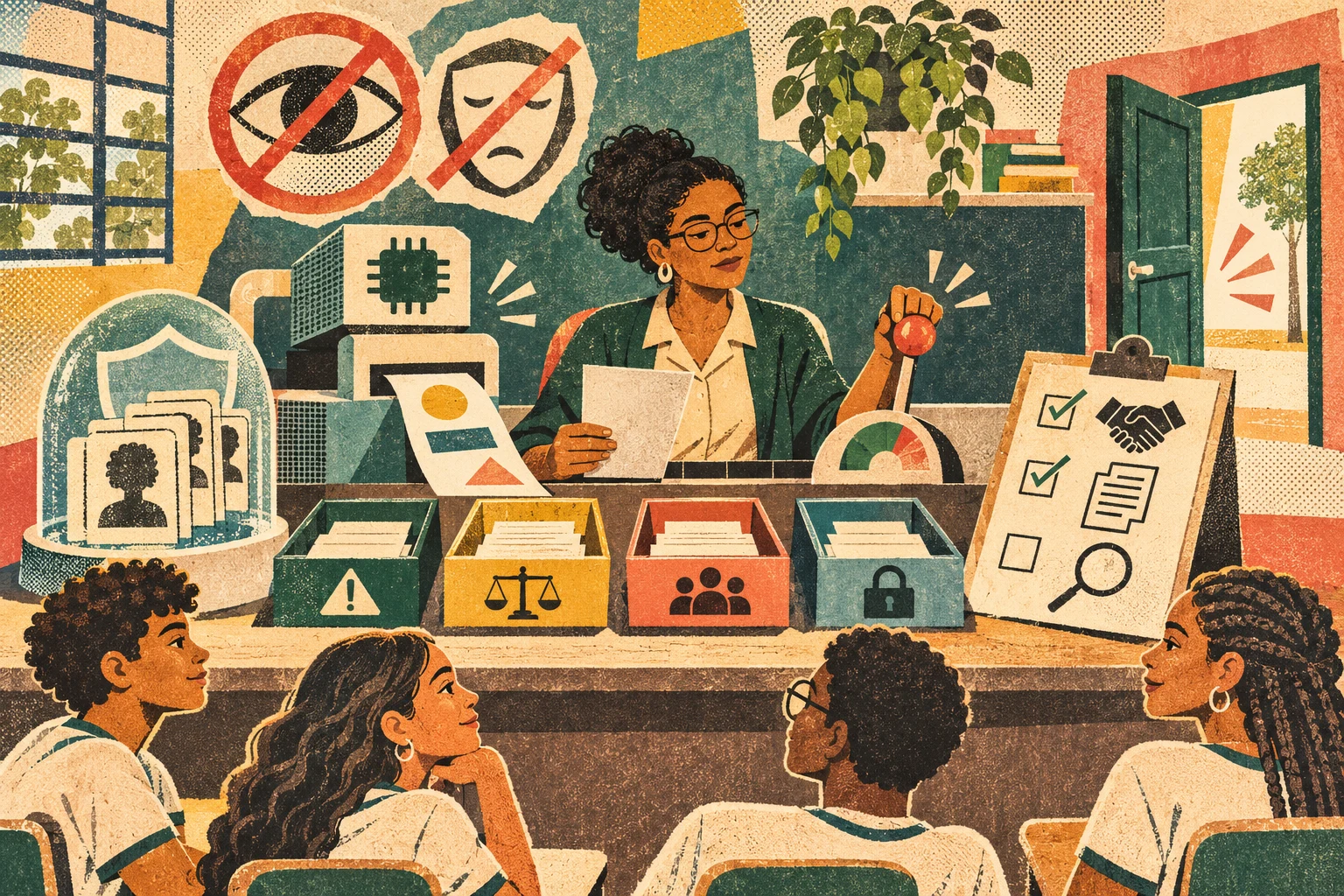
The useful question about AI in a school is not whether the software feels clever. It is who still has the authority to decide what happens to a student. Brazil has now answered that question at the national level. On November 10, the federal government announced that the Ministry of Education had approved National Education Council guidance for responsible use of artificial intelligence across Brazilian education. The framework covers public and private institutions at every level, stage and modality. Its central rule is regência humana, or human authority. AI may support teaching, administration, academic work, research and management, but it may not fully replace the responsible professional. That boundary becomes especially firm when the decision affects evaluation, certification, progression, continued enrollment, selection, benefits or sanctions. Those decisions must remain human. The guidance sorts educational AI uses into four risk levels: low, moderate, high and excessive or incompatible. A school is expected to consider the purpose and setting of the system, the data it uses, how much autonomy it has, whether it profiles people and how strongly its output can affect rights or an educational trajectory. It also names practices that do not belong in the classroom at all. The prohibited list includes social scoring, automated recognition or inference of emotions, continuous biometric surveillance, exploitation of vulnerability, exclusively automated decisions that affect a student's educational path, targeted advertising or commercial exploitation of educational data, and systems that segregate or discriminate. For children through the fifth year of elementary school, the guidance says there should be no direct, autonomous or unsupervised access to generative, conversational, predictive or adaptive AI. Any use must be planned and mediated by educators. Two familiar shortcuts also get a direct no. Schools should not let AI alone correct or grade essays and other work that requires interpretation of authorship. They should not impose an academic or disciplinary sanction based only on an automated detector's claim that AI generated the work. Those are the verified rules described in the federal government's public account. They are also a welcome reminder that a confidence score is not a head teacher wearing tiny digital spectacles. The practical work now moves to education systems, schools and universities. The prohibitions are meant to apply immediately when the resolution is published. Institutions and system providers then have 12 months to update policies, practices, governance tools and contracts. That gap is where a short school AI decision card can help. Start with the educational purpose. Name the task in one sentence. Is the tool suggesting reading practice, translating a parent notice, helping a teacher draft a lesson, screening applications or predicting dropout risk? If nobody can state the purpose without drifting into words like transformation and personalization, the purchase is not ready. Then name the people affected. A system used privately by a teacher to brainstorm examples creates a different risk from one that ranks students, shapes discipline, routes a child into a support program or decides who receives a benefit. Map the data. List what enters the system, what the provider stores, where it is processed, how long it remains, which subcontractors can see it, whether it trains another model and how a school can retrieve or delete it. A contract link is not the same thing as an answer. Put the answers on the card. Classify the risk before discussing convenience. Low risk should mean genuinely low consequence, not low attention from the sales team. A system that profiles a student, changes access to learning or influences progression deserves closer review even if the final screen calls its output a suggestion. Check the prohibitions in plain language. Does the tool infer emotion from a face or voice? Does it watch biometric signals continuously? Does it score social behavior? Does it sell against educational data? Can it place a student into a consequential category without a professional making the decision? If yes, stop. This is not the section of the card where a discount code changes the answer. Assign the human decider by role. Do not write human in the loop and move on. Name the teacher, coordinator, admissions officer, counselor or other authorized professional who will examine the evidence, make the decision and sign the record. Give that person enough time and information to disagree. A human reviewer who sees only a red flag, a confidence score and a queue of 400 cases is not exercising authority. They are decorating automation. The card should therefore show the source material behind an output, the rule or rubric applied, the model and version, known limits, uncertainty and any previous human changes. For a student's essay, preserve the submitted work, classroom context, drafts and teacher judgment. A detector score can trigger a conversation or closer review. It cannot become the verdict. Age matters. For younger children, educator planning and mediation are not optional extras. The school should specify when the tool appears, what an adult does during the interaction, which information the child may enter and how the activity works for students who cannot or should not use the system. Test whether the tool improves learning rather than simply producing activity. Compare student understanding, teacher workload, error patterns, accessibility and participation before and after use. Break results down where possible so an average does not hide worse treatment of a language group, disabled student or under-resourced classroom. Open an appeal path. Students and families should know that AI played a role, what decision a person made, how to challenge it and where to report a problem. The reviewer should be able to correct the record and reverse the outcome. A contact form that disappears into a vendor dashboard is not an appeal. Keep an incident log. Record data exposure, discriminatory outputs, fabricated information, unsafe advice, inaccessible interfaces, unexplained changes and attempts to use the system outside its approved purpose. Include near misses. A problem caught by an attentive teacher is evidence about the system, not a reason to pretend nothing happened. Finally, put a review date and removal condition on the card. Schools should not inherit an AI tool forever because somebody approved a pilot during a busy semester. If the provider changes the model, data practice, price, purpose or terms, the decision returns to the authority desk. The national guidance also treats AI literacy as part of education. Students should learn how systems work, how data shape them, where bias and misinformation enter, how synthetic content is made, how to verify sources and how to think about their own thinking. That is a stronger educational response than either banning every unfamiliar tool or handing children a chatbot and calling the result future readiness. Teachers need corresponding support. The official summary calls for initial and continuing training in digital literacy, pedagogical use, critical data analysis, technology-assisted assessment and ethics. Training should include the right to say no, the ability to recognize a prohibited practice, and time to inspect a system before it lands in a lesson. Research institutions have a disclosure duty too. A relevant AI contribution to scientific work should be declared. That helps readers distinguish assistance from authorship and examine the chain of evidence rather than guessing which parts came from a model. The national framework is not proof that every school has the staff, procurement power, connectivity or training to carry it out. Brazilian education systems vary enormously. A well-resourced university and a small municipal school do not begin with the same technical team or bargaining position. The government also acknowledges that evidence about the effects of the digital transition on learning still needs to advance. A separate federal account of an education regulatory sandbox warns that technology can reinforce inequality and import commercial logic into schools. That is an important limit on the whole conversation. Rules can stop certain harms and force better questions. They cannot manufacture educational benefit. That is why the decision card should travel with the tool. Purpose, people, data, risk, prohibition check, human authority, learning evidence, appeal, incident log and review date. One visible record, updated when the system changes. Brazil has set the national boundary: consequential education decisions belong to responsible people. Now every school needs to make that authority real enough for a student or family to see it, question it and use it.
01
WHAT ACTUALLY CHANGED
Brazil's Ministry of Education approved National Education Council guidance for responsible AI use across public and private education at every level, stage and modality.
The framework establishes human authority, meaning AI may support educational work but cannot fully replace the responsible professional.
Decisions involving evaluation, certification, progression, continued enrollment, selection, benefits or sanctions must remain human.
Educational AI uses are divided into low, moderate, high and excessive or incompatible risk.
Risk assessment should consider purpose, context, data, autonomy, profiling and effects on rights or an educational trajectory.
The guidance prohibits social scoring, automated emotion recognition or inference, continuous biometric surveillance, exploitation of vulnerability and exclusively automated consequential decisions.
It also prohibits targeted advertising or commercial exploitation of educational data and systems that segregate or discriminate.
Children through the fifth year of elementary school should not have direct, autonomous or unsupervised access to generative, conversational, predictive or adaptive AI.
AI alone should not grade essays or other interpretive work, and an automated AI-content detector alone should not support an academic or disciplinary sanction.
Prohibitions take effect with publication of the resolution, while institutions and system providers receive 12 months to update policies, practices, governance tools and contracts.
02
WHY THIS MATTERS
The framework locates accountability with an identifiable professional rather than a model, score or vendor.
A four-level risk model gives schools a structure for treating a lesson-planning aid differently from a system that profiles or ranks students.
Explicit prohibitions create a firmer boundary around surveillance, emotional inference, social scoring and commercial use of student data.
The rules for younger children recognize that age and supervision change the educational and privacy risk of direct AI use.
Restrictions on automated grading and AI detectors protect students from high-stakes decisions based on uncertain pattern matching.
Required literacy and teacher training can move the debate from tool access toward critical understanding and professional judgment.
Brazil's approach offers other countries a concrete model for connecting national principles to local school governance.
03
WHERE IT COULD HELP
- Create one decision card for every AI system used with students or educational records.
- State the educational purpose and name every affected learner group.
- Map the data, storage location, retention period, subcontractors, training use and deletion path.
- Assign the low, moderate, high or incompatible risk level before procurement or classroom use.
- Run a plain-language check against every prohibited practice.
- Name the authorized professional who makes each consequential decision.
- Give that reviewer the source material, rule, uncertainty and time needed to disagree.
- Preserve drafts and classroom context when investigating suspected AI use in student work.
- Use age-appropriate planning, mediation and data limits for younger students.
- Test learning, workload, accessibility and equity outcomes rather than counting logins.
- Tell students and families when AI contributed to a process and how to appeal the human decision.
- Maintain an incident and near-miss log that schools can review across vendors.
- Set a review date and require a new decision after material model, contract, data or purpose changes.
- Include refusal, removal and complaint procedures in teacher training.
- Pool technical and procurement support so smaller education systems can inspect vendors rather than accept boilerplate claims.
KEEP A HAND ON THE WHEEL
The federal government page summarizes an approved National Education Council opinion and the anticipated resolution. It is a primary official account, but it is not evidence that every institution has implemented the rules or that any particular AI system improves learning. The prohibitions are described as immediate upon publication of the resolution, while institutions and providers have 12 months to update policies, governance tools, practices and contracts. Watch for the published resolution, implementation guidance, school-level risk records, procurement standards, teacher-training resources, complaint routes and enforcement evidence. The four risk levels will need consistent operational definitions across varied education systems. Smaller and under-resourced institutions may need shared technical, legal and procurement support. Human review is not meaningful when a professional lacks time, authority, source evidence or a practical way to reject the model's output. The official summary does not establish independent measures of accuracy, educational benefit, workload, accessibility or equity for any named product. Those claims require separate evidence. Original approval announcement date: November 10, 2026.
04
TERMS WORTH KEEPING
SOURCES AND VERIFICATION STATUS
This article was written from the materials below. Product claims and dates were checked against those sources on November 11, 2026.
THE PUBLICATION ENGINE
WANT A SIGNAL OF YOUR OWN?
We build source-grounded publications, private briefings, and editorial systems for organizations with something useful to say.
WORK WITH US