THE SIGNAL IN ONE SENTENCE
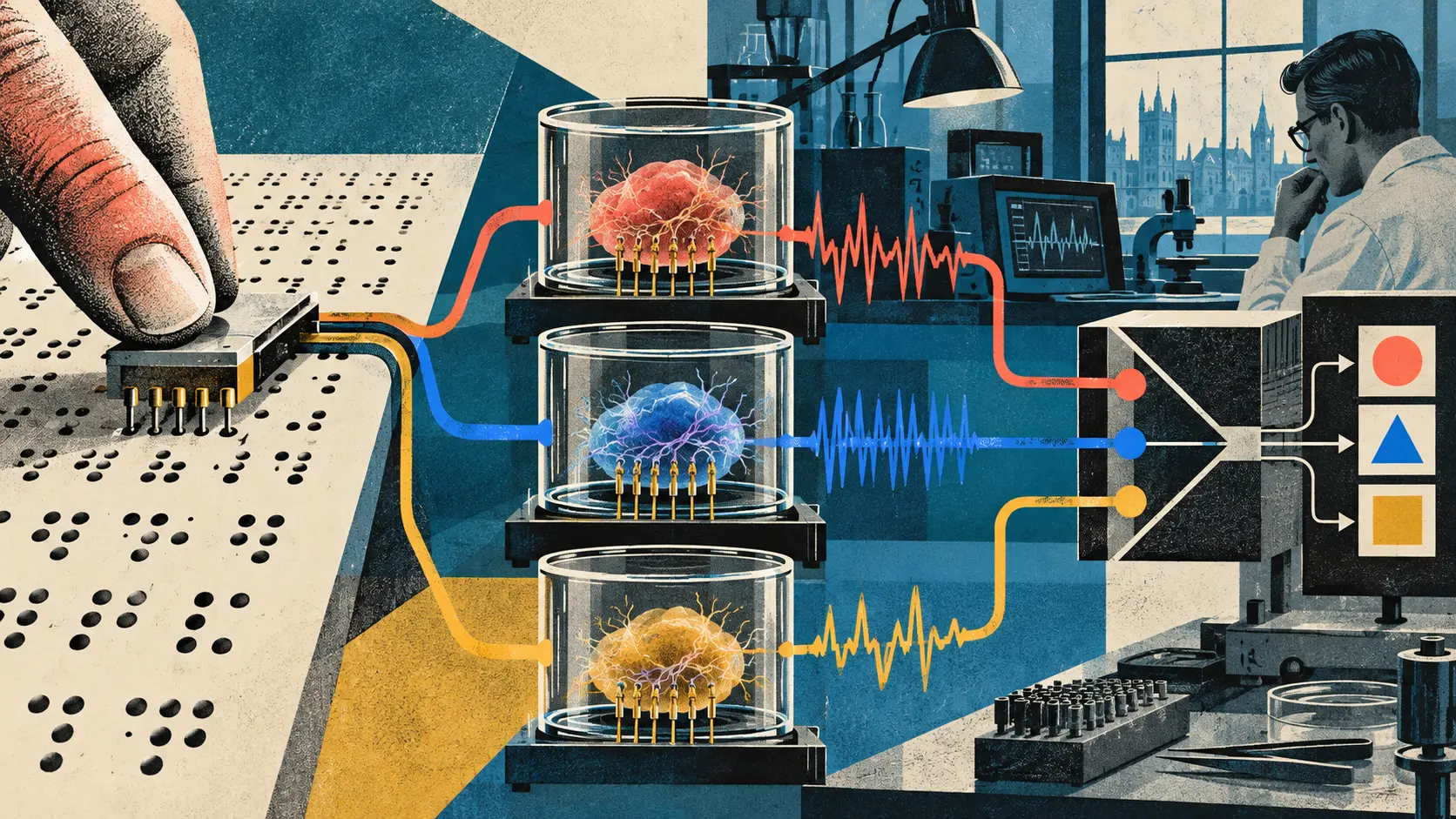
A fingertip crosses a field of raised dots. A sensor records the contact. Software turns that touch into electrical pulses. Living neural tissue responds. Another piece of software guesses which letter began the trip. That chain is the real experiment behind a headline-ready phrase: mini brains reading Braille. Researchers at the University of Bristol reported on October 16 that they could classify all 26 Braille letters from the electrical responses of human forebrain organoids. A support-vector machine decoded the output of a single organoid with an average accuracy of about 61 percent. When the researchers combined responses from three organoids, accuracy rose to 83 percent. That is interesting. It is not a tiny brain learning to read. The paper says so plainly. This was an open-loop encoding and decoding study. The organoids received fixed stimulation patterns and produced electrical activity. A conventional machine-learning classifier was trained to distinguish the resulting response patterns. The organoids were not given feedback, did not change strategy and were not shown to improve with experience. The distinction sounds like a footnote until you realize it is the whole story. An organoid in this setup is a small cluster of human-derived neural cells, roughly 500 micrometers across in the paper's platform and less than a millimeter across in Bristol's summary. The university says each contained about 10,000 neurons plus supporting cells. It lacked the structures, sensory organs, body and developmental history of a human brain. The organoids sat on low-density microelectrode arrays supplied through FinalSpark's remotely accessible Neuroplatform in Vevey, Switzerland. Each organoid had eight electrode channels. The platform kept the living tissue active, delivered electrical stimulation and recorded spikes. On the other side of the experiment was an Evetac event-based tactile sensor. It recorded a robot pressing across Braille letters. The researchers divided the sensor output into eight spatial regions and extracted four features from each region: event count, event duration, timing of peak activity and variation in event intensity. Those features were not handed directly to the organoid as a picture of dots. They were mapped onto four electrical stimulation parameters: pulse count, pulse duration, trigger delay and pulse amplitude. The eight resulting signal streams were sent through the eight electrodes. The team then counted spikes across the same eight channels during a 500 millisecond window after the initial stimulation artifact was removed. Those eight counts became the features for the software classifier. So the pipeline was not organoid sees Braille, organoid names letter. It was tactile sensor, engineered encoding, electrical stimulation, biological response, spike counting, software decoder, letter label. That is still a useful result. Building a dependable bridge between sensors and living neural tissue is a hard engineering problem. If biohybrid systems are ever going to do anything outside a dish, they will need agreed ways to translate the world into signals the tissue can receive and to translate its activity back into something a machine can use. The three-organoid result makes the bridge more intriguing. The single organoid supplied eight response features. Combining three supplied 24. The paper says the additional dimensions improved linear separation when the organoids contributed non-redundant information. The researchers hypothesize that differences in network connections, developmental states and ongoing activity produced complementary transformations of the same input. In plainer language, the three pieces of tissue made different mistakes. That can be valuable. Ensembles are common in machine learning because several imperfect models can collectively outperform one. Here, biological variability may have behaved like a source of diversity. When artificial noise was added to the input, the multi-organoid output was also more robust than directly decoding the corrupted stimulation pattern with the same type of classifier. But this is not yet proof that biological tissue performed a uniquely useful computation. The classifier received more features in the three-organoid condition than in the one-organoid condition. The paper acknowledges that higher dimensionality can help when the new features carry non-redundant class information. It also says direct measurements of correlations between organoids are still needed. Scaling beyond three has not been tested, and weak or redundant organoids could add noise rather than value. A stronger follow-up would compare one, two, three and four organoids under identical data splits, corruption patterns and channel budgets. It would include ablation tests showing what each organoid adds. It would report error correlations and compare the living system with carefully matched synthetic transformations using the same number of output features. That comparison matters because the headline number alone cannot locate the intelligence. Some structure comes from the tactile sensor. Some comes from the hand-designed feature mapping. Some may come from nonlinear biological responses. Some comes from the support-vector machine. The result belongs to the whole pipeline, not to the dish alone. The energy claim needs the same discipline. Living neural systems are attractive partly because neurons can process signals at very low power. The paper presents organoids as potential low-power computational elements. It did not, however, publish a complete energy measurement for this experiment. The organoid is not the whole machine. A usable accounting must include the pumps and perfusion that keep tissue alive, temperature control, the microelectrode array, stimulation electronics, recording hardware, the tactile sensor, the remote platform, data transfer and the conventional classifier. Sugar may be a delightful fuel. The incubator still has a plug. Until that full receipt exists, energy efficiency remains a research motivation rather than a demonstrated advantage of this Braille pipeline. Reproducibility is in better shape. The authors released a University of Bristol dataset containing encoded tactile inputs, single-organoid outputs, individual responses from the three organoids and the combined 24-channel data used for classification. That gives other researchers something more useful than a press-release percentage. The dataset can support reanalysis of the decoder and the response patterns. It cannot by itself reproduce the living preparation. Organoids vary. The paper notes that complementarity may arise from different network connections and developmental states. The platform can keep organoids electrophysiologically active for roughly 100 days under favorable conditions, but a replacement organoid is not a software container restored from a checksum. Biohybrid computing will need standards that respect that variability instead of sanding it off with a confident average. Each experiment should identify the cell line and provider, organoid age and culture conditions, electrode geometry, stimulation history, viability measures, baseline activity, excluded preparations and failure rate. Results should be reported per organoid as well as across ensembles. A useful benchmark should test new preparations and new days, not merely new samples drawn from one familiar recording regime. Ethics should travel with the technical standard. The paper says no new ethical approval was required because the work used pre-existing human-derived organoid material from the commercial provider FinalSpark and involved no participant recruitment or prospective sample collection by the Bristol authors. That describes the approval status of this experiment. It is not a permanent ethical clearance for everything the field might build next. These organoids are not miniature people. The study offers no evidence of consciousness, sentience or subjective experience. Inflating the tissue into a tiny person is scientifically careless and ethically distracting. Yet declaring today's sample simple does not settle tomorrow's governance. Researchers are actively interested in larger, longer-lived and more responsive systems, including closed loops that can adapt through feedback. Oversight should therefore track capabilities and experimental conditions rather than wait for a cinematic threshold. A sensible governance record would document human tissue provenance, consent pathway, commercial custody, stimulation limits, monitoring, endpoint rules and the scientific reason living material is needed. It should also define escalation triggers for systems that show durable plasticity, increased complexity, persistent responses or integration with other neural tissue. None of that requires pretending a 500 micrometer organoid is having opinions about Braille. It requires admitting that living computation is both a technical object and biological material. Treating it as only one of those things will produce bad engineering or bad ethics, and perhaps both before lunch. The most important next experiment is a closed loop. In a closed-loop system, the organoid's output would change what happens next. Feedback could reward a useful response, alter the next stimulus or drive an actuator. Researchers could then ask whether response patterns shift over time, whether the shift survives a pause, whether performance improves on held-out data and whether any adaptation belongs to the tissue rather than the decoder. That would make learning a measurable claim instead of a decorative verb. For now, Bristol and FinalSpark have demonstrated a tactile-to-tissue interface with a surprising ensemble effect. Three variable organoids produced signals that a simple decoder classified better than signals from one. The released data invites other researchers to inspect the result. The paper itself keeps the boundary visible. The useful signal is not that a mini brain can read. It is that engineers can route touch through living neural tissue, recover structured information and begin separating what the sensor encoded, what biology transformed and what software recognized. That is less magical than a brain in a jar learning Braille. It is also much more testable.
01
WHAT ACTUALLY CHANGED
University of Bristol researchers published an open-access tactile encoding and decoding experiment on October 16, 2026
A robot-mounted event-based tactile sensor recorded patterns associated with all 26 Braille letters
The team mapped four tactile features onto pulse count, pulse duration, trigger delay and pulse amplitude across eight electrodes
A support-vector machine decoded single-organoid spike-count responses at about 61 percent average accuracy
Combining 24 channels from three organoids raised classification accuracy to 83 percent
The three-organoid ensemble was more robust under several forms of artificial input noise than direct decoding of the corrupted stimulation patterns
The experiment used FinalSpark human forebrain organoids through a remotely accessible Swiss Neuroplatform
The authors released the encoded inputs, single-organoid outputs and three-organoid response data through Bristol data.bris
The paper explicitly classifies the work as open-loop encoding and decoding, not a demonstration of learning or long-term plasticity
02
WHY THIS MATTERS
Biohybrid systems need reliable interfaces between artificial sensors, living neural tissue and conventional software before they can support practical control tasks
The ensemble result suggests biological variation may supply complementary features rather than functioning only as unwanted noise
A classification score for the whole pipeline does not reveal how much useful transformation came from the sensor, encoding, organoid or software decoder
Learning requires change through experience or feedback, while this experiment repeatedly decoded responses to a fixed encoding
Energy-efficiency claims need full-system measurements that include culture support, stimulation, recording and digital decoding
Released data allows independent decoder checks, but reproducing the biology requires detailed records of preparation and variability
Commercial access to living neural material creates governance questions about provenance, custody, oversight and experimental endpoints
Careful language can recognize a real engineering advance without inventing consciousness, sentience or general intelligence
03
WHERE IT COULD HELP
- Test tactile encoding methods for textures, edges, slip and contact force rather than only fixed Braille trajectories
- Build closed-loop experiments in which organoid output changes the next stimulus and adaptation can be measured over time
- Compare one, two, three and four organoids under identical feature budgets, cross-validation splits and corruption tests
- Measure pairwise response and error correlations to determine whether ensemble gains come from genuine complementary information
- Run organoid-ablation tests that report the marginal accuracy and robustness contribution of each preparation
- Benchmark living responses against synthetic nonlinear transforms with matched channel counts and classifier complexity
- Publish per-organoid results, culture metadata, exclusion criteria, failures and day-to-day stability
- Measure energy at the wall for the complete wetware, hardware and software stack rather than the neural tissue alone
- Create versioned provenance records covering tissue source, consent pathway, platform custody and stimulation history
- Define ethics escalation triggers for longer-lived, more complex or demonstrably adaptive closed-loop systems
KEEP A HAND ON THE WHEEL
The 83 percent result belongs to a fixed, open-loop, 26-class tactile pipeline with a simple support-vector machine. The study did not demonstrate learning, memory, consciousness, sentience, general intelligence or a complete-system energy advantage. The three-organoid condition also supplied more output features than the single-organoid condition. Watch for matched synthetic baselines, repeated preparations, per-organoid stability, explicit energy accounting, blinded replication and closed-loop tests in which performance changes through feedback.
04
TERMS WORTH KEEPING
SOURCES AND VERIFICATION STATUS
This article was written from the materials below. Product claims and dates were checked against those sources on October 17, 2026.
THE PUBLICATION ENGINE
WANT A SIGNAL OF YOUR OWN?
We build source-grounded publications, private briefings, and editorial systems for organizations with something useful to say.
WORK WITH US