THE SIGNAL IN ONE SENTENCE
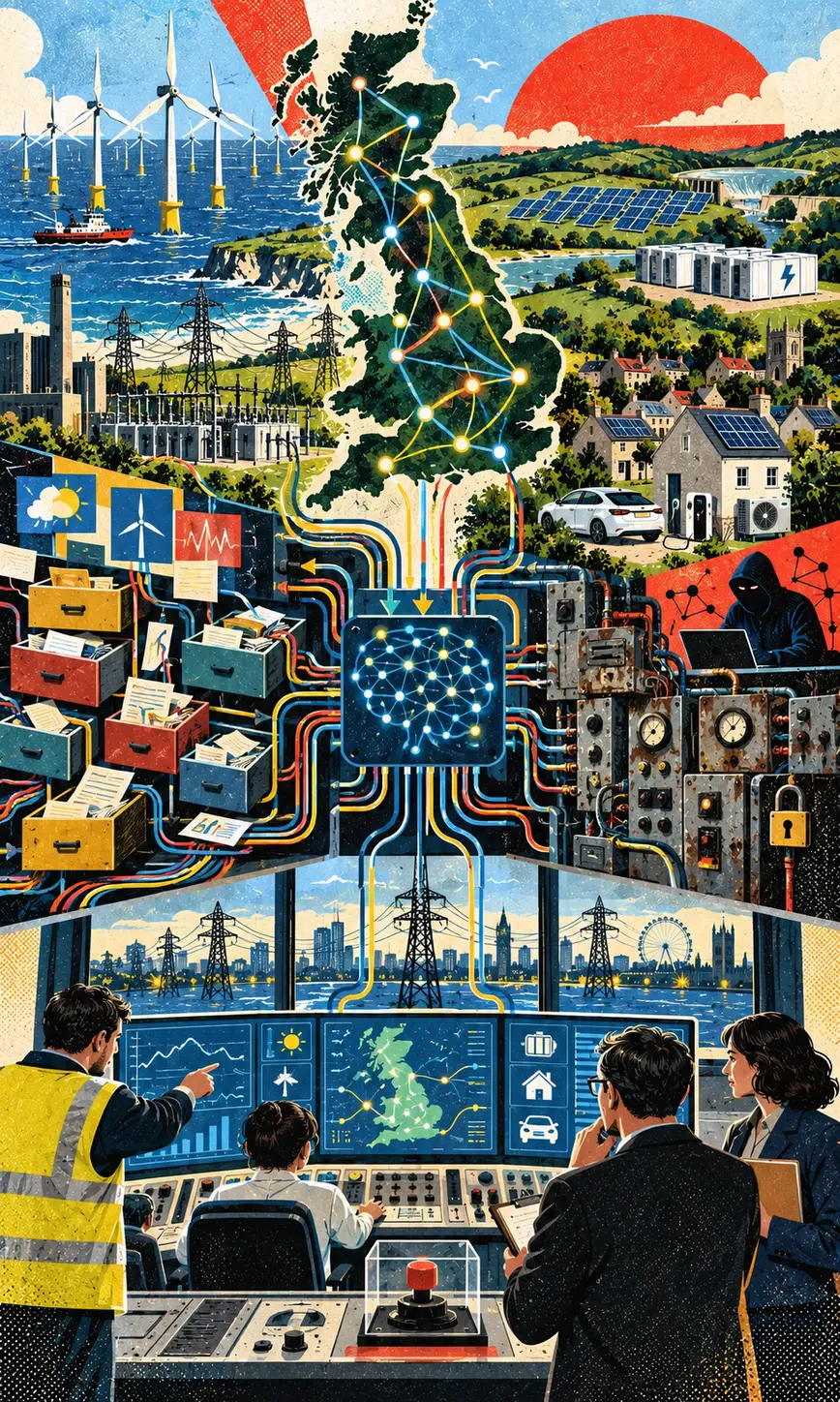
AI could help Britain coordinate wind, solar, batteries, electric vehicles, heat pumps, and power demand, but only if the country makes energy data usable and keeps automated decisions secure, explainable, and accountable.
01
WHAT ACTUALLY CHANGED
The UK Department for Energy Security and Net Zero published a 21-page vision and open call for evidence on September 8. It asks energy companies, regulators, researchers, innovators, system operators, and consumer groups how artificial intelligence should be used across the energy system. Responses are due November 6 and will inform the country's first AI for Clean Energy Strategy.
The near-term applications are practical rather than mystical. The government points to better forecasts for weather, renewable generation, demand, prices, and grid conditions; predictive maintenance for equipment; more efficient network planning; improved coordination of batteries, electric vehicles, heat pumps, and smart appliances; and faster discovery of energy materials and technologies.
The document proposes three outcomes for deployment: lower bills for households and businesses, greater system efficiency and decarbonization, and energy security. It says AI is already being used for tasks such as forecasting and electric-vehicle charging, but adoption remains uneven and many useful systems have not moved from pilots into ordinary operations.
The government identifies six overlapping barriers: access to usable data, weak or misaligned incentives, uncertain regulation and governance, security and trust, integration with older technical systems, and shortages in skills and organizational readiness. Energy data may be plentiful while still being fragmented across owners, recorded under inconsistent standards, hidden by commercial concerns, or too awkward for operational software to use.
The long-term section goes further. It asks what happens if autonomous AI agents begin coordinating energy assets, markets, and decisions at machine speed. That future raises unresolved questions about control, accountability, market stability, cyber risk, interactions among multiple automated systems, and whether existing rules still work when the grid begins making more of its own choices.
02
WHY THIS MATTERS
A cleaner grid is harder to coordinate than a power system dominated by a few predictable generators. Wind and sunlight change, electric vehicles can become flexible loads or batteries, heat pumps move demand into different hours, and millions of smaller devices can respond to prices. Better prediction and coordination could reduce wasted power, prevent unnecessary construction, and use existing equipment more effectively.
The awkward part is that an AI model cannot optimize information it cannot reliably see. If one network records equipment differently from another, asset ownership is unclear, sensor readings arrive late, or permissions block access, the clever optimizer becomes a beautifully trained person staring through a dirty window. Data standards and interfaces are not supporting trivia. They are part of the energy infrastructure.
Critical infrastructure also changes the acceptable failure budget. A wrong movie recommendation is irritating. A poisoned forecast, drifting control model, opaque dispatch decision, or compromised software supplier can affect bills, equipment, and electricity reliability. The UK document is right to treat assurance, resilience, security, and explainability as operating requirements rather than a footnote beside innovation.
The accountability question becomes sharper as automation expands. An agent may find a mathematically efficient plan while moving costs or risks onto a particular community. Someone still has to define the public outcome, inspect the tradeoffs, approve consequential control, and answer when the system behaves badly. Faster coordination cannot be allowed to produce slower responsibility.
03
WHERE IT COULD HELP
- Forecast renewable generation and electricity demand more accurately
- Detect equipment faults before they interrupt service
- Coordinate batteries, electric vehicles, heat pumps, and smart appliances
- Plan grid upgrades using better system-wide evidence
- Test automated energy decisions inside secure operational sandboxes
KEEP A HAND ON THE WHEEL
This is a government vision and evidence-gathering exercise, not a deployment result. The applications, savings, and emissions benefits described are potential outcomes, not measured improvements produced by this strategy. The call applies to England, Scotland, and Wales, and the eventual policy may change after consultation. Any move from decision support into autonomous control would require much stronger operational evidence, security testing, governance, and clearly assigned human responsibility.
04
TERMS WORTH KEEPING
OPEN GLOSSARY CARD
Energy flexibility
The ability to shift when electricity is produced or consumed so supply and demand remain balanced.
OPEN GLOSSARY CARD
Interoperability
The ability of different systems, devices, and data formats to work together without custom rebuilding at every connection.
OPEN GLOSSARY CARD
Model drift
A decline or change in model performance as real-world conditions move away from the data and patterns it learned.
SOURCES AND VERIFICATION STATUS
This article was written from the materials below. Product claims and dates were checked against those sources on September 8, 2026.
PUBLICATION RECEIPT: Revision 1. Published September 8, 2026.
THE PUBLICATION ENGINE
WANT A SIGNAL OF YOUR OWN?
We build source-grounded publications, private briefings, and editorial systems for organizations with something useful to say.
WORK WITH US