THE SIGNAL IN ONE SENTENCE
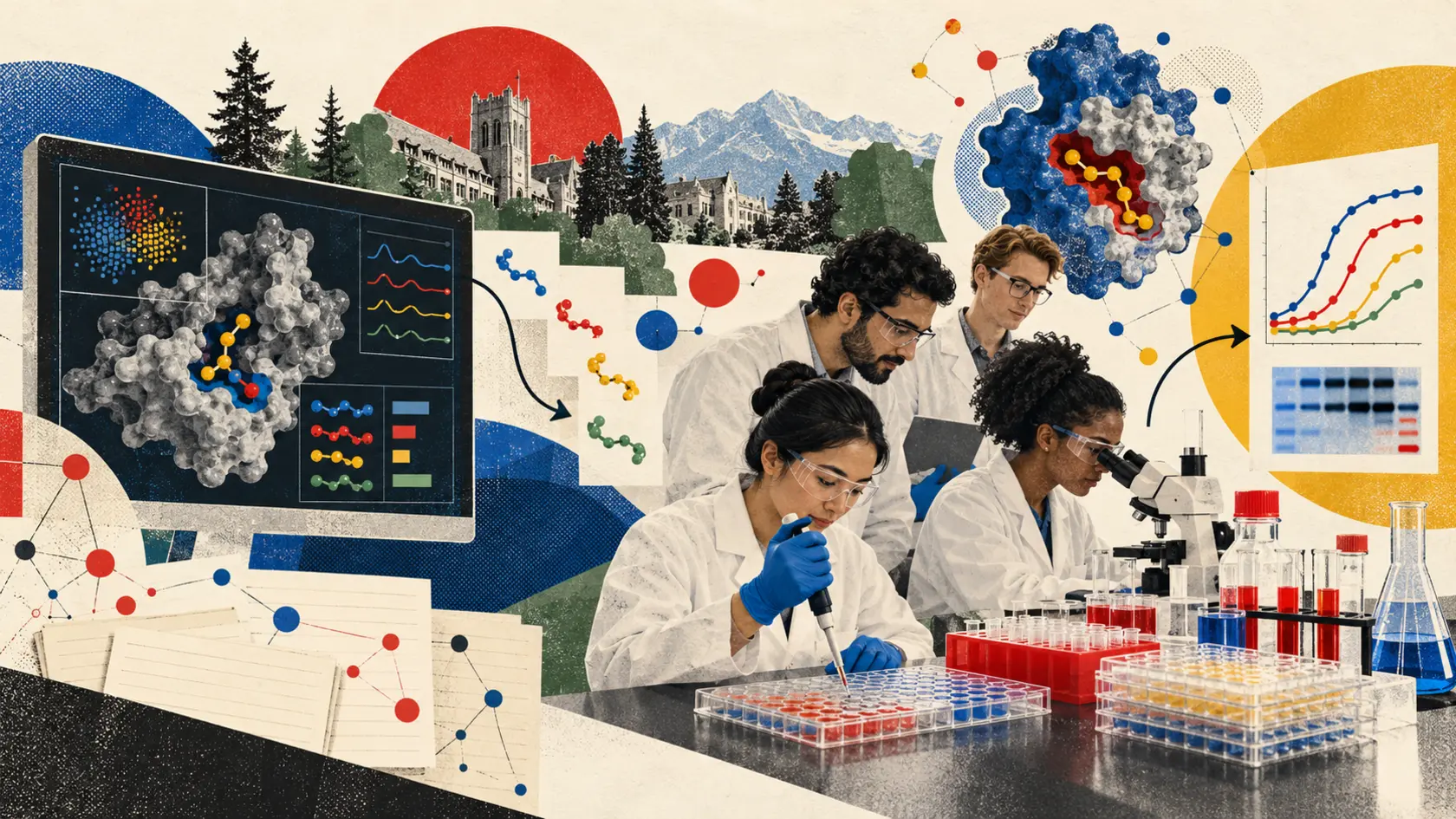
Peptide drug discovery has a data problem disguised as a chemistry problem. Researchers can make enormous numbers of possible short amino-acid chains. Only a tiny fraction will bind the right biological target, and fewer still will behave like useful medicines. The expensive part is learning which possibilities deserve another experiment. OpenPep, a new project led by University of Toronto assistant professor Joseph Brown, wants to make that first filter better. On October 14, the Leslie Dan Faculty of Pharmacy announced that Google.org awarded the project US$2.3 million through its Impact Challenge: AI for Science. The team plans to create an open database of experimental peptide binding measurements and train models that predict which peptides will bind to target proteins. The word plans is doing important work there. OpenPep is a funded research program, not a finished drug platform. The announcement does not report a validated therapeutic, a clinical result, a model accuracy score or an external benchmark. It describes a sensible build: create data in the lab, train models from those measurements, test the predictions, add the results back to the dataset and repeat. That loop is the real story. Peptides are short chains of amino acids. They sit between conventional small molecules and larger proteins, and researchers can engineer them to interact precisely with biological targets. Brown says peptides account for 8 percent of newly approved drugs. The attraction is easy to understand. A well-designed peptide may fit a protein surface that a smaller drug struggles to reach. The search space is also brutally large. If a model can rank plausible candidates before researchers spend time and reagents testing them, the lab can concentrate on better bets. That is useful even when the model is far from perfect. A recommendation system for experiments does not need to replace the scientist. It needs to improve the next tray of experiments. OpenPep's proposed pipeline begins with physical measurements. Keith Pardee's group plans to use cell-free synthetic biology systems to produce as many as 500 disease-relevant proteins. Brown's team will use mass spectrometry to test large peptide libraries against those proteins and measure both whether binding occurs and how strong it is. The resulting observations will become training material for models intended to predict binding for peptide and protein combinations that have not yet been tested. The researchers then intend to test those predictions experimentally. New results can flow back into the database and inform the next model. This is much healthier than asking a model to hallucinate a medicine from the mist. It is also where public evidence matters. Open data is not automatically useful data. A downloadable file can still hide duplicated measurements, inconsistent assay conditions, missing failures, uncertain labels or near-identical examples split across training and test sets. A model can appear excellent because the exam resembles the homework too closely. OpenPep should publish a validation pipeline alongside the database. Start with provenance. Every measurement should say which peptide and protein were tested, how each material was produced, which assay was used, under what conditions, on what date and with which quality checks. If a measurement was repeated, the record should preserve the replicates rather than replacing them with one tidy average. Then publish the negatives. A peptide that did not bind is not failed data. It tells the model where the boundary may be. Negative and weak-binding results are essential for estimating false positives and for preventing a dataset from becoming a scrapbook of only the exciting experiments. The absence of a measured interaction also needs careful language. It can mean the peptide truly does not bind. It can mean the assay could not detect the interaction. It can mean a sample degraded, a protein folded incorrectly or the chosen conditions were wrong. Those outcomes should not collapse into one convenient zero. Next comes the split. Machine-learning teams divide data into training, validation and test sets. The test set is supposed to approximate new work. If closely related peptides or proteins appear on both sides of that boundary, a model may memorize a chemical family rather than learn a general rule. OpenPep should report performance on several harder tests. One split could hold out peptide families. Another could hold out protein families. A third could hold out every result from a later experimental campaign. A prospective test, where the model commits predictions before the lab runs the assay, would be especially informative. That sequence makes it harder to tune the story after seeing the answers. Report more than one score too. An aggregate accuracy number is not enough when most possible peptide and protein pairs may not bind. Precision shows how often a predicted binder actually binds. Recall shows how many real binders the model finds. Calibration shows whether a prediction labeled 80 percent likely succeeds around eight times out of ten. Enrichment shows whether the ranked list gives scientists more useful candidates than a reasonable baseline. The baseline should be visible. Does the model beat random selection? Does it beat choosing peptides similar to known binders? Does it beat a standard docking or sequence model? Does the result persist for unfamiliar proteins? Fancy architecture names are less important than a fair contest against methods a working laboratory could actually use. The team also needs to separate binding from medicine. Binding to a target can be the start of a therapeutic idea. It does not establish that a peptide reaches the right tissue, survives in the body, avoids toxic effects, behaves selectively, can be manufactured reliably or helps a patient. Even strong laboratory binding may disappear in cells, animals or clinical studies. The public interface should keep those stages distinct. A predicted binder should be labeled predicted. A measured interaction should name the assay and confidence. A replicated result should say where and how it was replicated. A disease connection should identify whether it is a research rationale or an observed therapeutic effect. That sounds fussy until a promising chart becomes a health claim on social media. OpenPep plans to crowdsource nominations for disease-relevant protein targets from hospitals, pharmaceutical companies and research institutes. The team names pediatric and rare diseases, cancer, neurodegeneration and cardiovascular disease as areas of interest. That invitation could make the resource more useful to researchers whose targets do not attract large commercial datasets. It also needs a transparent selection log. The public should be able to see which targets were nominated, which were selected, the criteria used and any conflicts of interest. Producing up to 500 proteins is a substantial effort, but it is still a narrow slice of the human proteome. Choices will shape which diseases and biological mechanisms the model learns best. Canada can make this a piece of scientific infrastructure, not just a lab project. The database needs a durable identifier for each release, a change log, machine-readable downloads, a clear licence and a policy for contributed data. The model needs versioned code or enough documentation to reproduce the training procedure. Researchers should be able to cite the exact dataset and model used in a paper, then rerun the analysis years later. Open access also needs an honest definition. Can a university lab download the full measurements? Can a company use them? Are model weights included, or only an interface? Are there restrictions on derivative datasets? What happens if a contributed record carries patent, privacy or commercial constraints? The answers can be reasonable and still not be unlimited, but they should be readable before someone builds on the resource. There is another practical reason to publish the pipeline: errors will be found. Large experimental datasets contain swapped labels, batch effects, instrument drift and strange outliers. Public issue tracking gives outside researchers a way to report a suspect record. Corrections should remain linked to the original version so a retraction or changed measurement does not silently rewrite history. The project announcement gets one principle exactly right. Brown says AI will not replace experiments, but can help researchers choose better ones. That is the useful contract. The model ranks candidates. The lab tests them. The database records successes, failures and uncertainty. Independent researchers challenge the splits and reproduce the measurements. Each loop either earns more trust or reveals where the model stops generalizing. OpenPep could give peptide researchers a better place to start. The project has funding, relevant experimental expertise and a commitment to an open resource. Those are real advantages. Now it needs receipts that are as open as the promise. Publish the measurements, including the boring ones. Freeze the test sets. Date every model. Separate prediction from assay and assay from therapy. Let outsiders discover the awkward edge cases before a confident score becomes a confident headline. The plain signal is simple: the valuable product is not an AI that declares a molecule promising. It is a public learning loop that shows why the next experiment is worth doing, records what actually happened and gets more useful when the prediction was wrong.
01
WHAT ACTUALLY CHANGED
Google.org awarded US$2.3 million to a University of Toronto-led project called OpenPep
The funding comes through the Google.org Impact Challenge: AI for Science
OpenPep plans to create an open database of experimental peptide binding measurements
The team plans to train models that predict whether and how strongly peptides bind to target proteins
Keith Pardee's group plans to produce as many as 500 disease-relevant proteins using cell-free systems
Joseph Brown's team plans to test large peptide libraries with mass spectrometry
The proposed workflow returns model predictions to the lab for experimental validation
New measurements are intended to feed back into the database and improve later models
The project will invite researchers to nominate disease-relevant protein targets
The announcement describes a research plan and does not report a drug candidate, clinical result or model benchmark
02
WHY THIS MATTERS
Peptide discovery depends on scarce experimental binding data that is often dispersed across laboratories and companies
A shared dataset could reduce duplicated work and give smaller research groups a stronger starting point
Models can help laboratories prioritize experiments without pretending to replace physical measurement
Negative and weak-binding results are necessary for learning useful decision boundaries
Poor train and test splits can make a model look more general than it is
Prospective tests can show whether predictions survive contact with experiments that were not available during model development
Target selection will influence which diseases and biological mechanisms the resource serves well
Versioned data, methods and licences determine whether other researchers can reproduce and reuse the work
Binding evidence is only one early step in the much longer path toward a safe and effective medicine
A public correction process can turn inevitable dataset errors into a stronger scientific resource
03
WHERE IT COULD HELP
- Publish raw and processed binding measurements with assay conditions and quality-control fields
- Keep negative, weak and inconclusive results instead of releasing only successful binders
- Record replicates and uncertainty rather than replacing them with one unexplained average
- Version every dataset release and preserve a public change log
- Use family-aware train, validation and test splits for both peptides and proteins
- Reserve prospective experiments that are chosen only after model predictions are frozen
- Report precision, recall, calibration and enrichment alongside aggregate accuracy
- Compare results with random selection, similarity search and practical baseline methods
- Break out performance for unfamiliar protein families and peptide chemistries
- Label predictions, measured interactions, replications and therapeutic evidence as separate stages
- Publish the criteria used to choose among crowdsourced protein targets
- Disclose conflicts of interest and constraints attached to contributed data
- Provide machine-readable downloads, persistent identifiers and a clear reuse licence
- Document model versions, training procedures and the exact dataset behind each result
- Maintain a public issue and correction process for suspect measurements
KEEP A HAND ON THE WHEEL
The reviewed sources describe funding, collaborators and a proposed experimental and machine-learning workflow. They do not provide a released database, model weights, benchmark results, complete licence, target-selection policy, prospective validation study, drug candidate or clinical evidence. Watch for the first versioned dataset, the treatment of negative and inconclusive measurements, family-aware benchmark splits, frozen prospective predictions, independent replication, machine-readable licensing and a clear statement of what open access includes.
04
TERMS WORTH KEEPING
SOURCES AND VERIFICATION STATUS
This article was written from the materials below. Product claims and dates were checked against those sources on October 14, 2026.
PUBLICATION RECEIPT: Published from primary sources available October 14, 2026. The project is at the funded research stage, so future dataset releases, benchmarks, licences and validation results should be checked before treating its planned capabilities as demonstrated performance.
THE PUBLICATION ENGINE
WANT A SIGNAL OF YOUR OWN?
We build source-grounded publications, private briefings, and editorial systems for organizations with something useful to say.
WORK WITH US