THE SIGNAL IN ONE SENTENCE
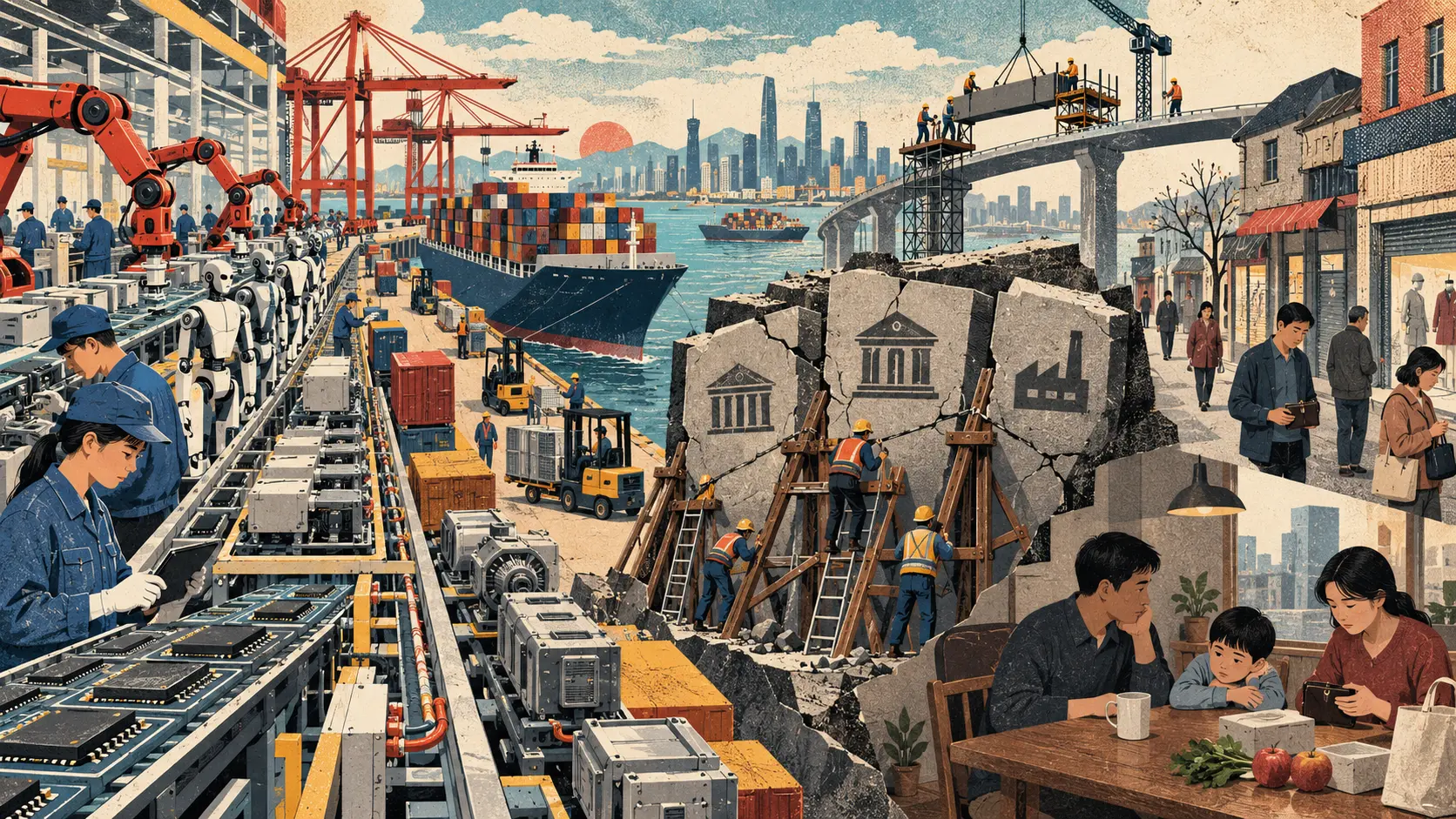
Peking University economist Huang Yiping warned on September 19 that wider artificial-intelligence deployment could make China's strong-supply, weak-demand imbalance worse. The mechanism is simple enough to fit on a warehouse clipboard. AI can help a factory design, inspect, schedule and produce more with the same labor, capital or time. If wages, household confidence and domestic consumption do not rise alongside that output, the extra supply needs another buyer. Exports can provide one, and Reuters reports that the global AI boom has helped Chinese exports this year. But exports are not an infinite drainpipe. Large volumes affect foreign prices, competitors and trade politics, while slower markets and new barriers can narrow the exit. Huang argues that a durable repair also needs higher household income, market reform and stronger balance sheets for local governments, financial institutions and companies. His remarks are a policy warning, not a People's Bank of China decision, an official forecast or proof that AI has already caused the imbalance. The plain signal is that productivity and prosperity are related, not identical. A machine can make a factory more efficient without making a family feel safe enough to buy what the factory makes.
01
WHAT ACTUALLY CHANGED
Reuters reported from a Beijing economic forum on September 19 that Huang Yiping, a member of the People's Bank of China's monetary policy committee, warned that wider AI deployment and faster innovation could deepen an economy already characterized by strong supply and weak demand. The forum has not published a transcript or complete record that this article could inspect, so the new remarks and proposals are attributed to Reuters rather than presented as independently transcribed speech.
Huang's September argument adds AI to a concern he described in a February 10 report published by Peking University's Beijing International MBA. In that earlier account, he said exports once absorbed domestic capacity more easily, but trade barriers and China's scale now make rapid export growth a less sustainable release valve. He identified income, social security and consumer confidence as foundations for sustained consumption.
AI changes the supply side first. Software can accelerate product design, improve quality inspection, predict maintenance, optimize inventory, coordinate ports and lower the cost of some engineering or administrative tasks. Those gains can improve domestic value added and export competitiveness. They do not automatically raise household income, create enough new demand or distribute the gain to workers and consumers.
Official trade data show why the export channel matters without proving that AI produced the result. China's State Council reported that goods exports rose 13.4 percent year over year in the first half of 2026, while total foreign trade rose 16.9 percent. Those figures cover the complete trade basket. They do not isolate AI products, AI-enabled production or the share of growth caused by AI adoption.
Huang proposed that the central government consider more borrowing to help repair the balance sheets of local governments, financial institutions and companies. His point is that entities focused on servicing debt or rebuilding financial capacity may not respond strongly to ordinary stimulus because they are not ready to spend, lend or invest. That is a proposal from an adviser, not an announced fiscal program.
He also argued for market-oriented reform, a larger household-income share, deeper overseas investment and industrial cooperation, and less reliance on exports alone. His February account similarly called for stronger income and social security, more services, disciplined local-government behavior and a form of openness that supports mutual growth with trading partners.
China's own policy documents already recognize the demand side. A March 2025 consumption plan from the central party and State Council offices called for higher earnings, lower financial burdens and measures that strengthen willingness to spend. The existence of that plan does not establish its effects, but it shows that household spending power and confidence are official policy concerns rather than an argument imported only from foreign critics.
02
WHY THIS MATTERS
A productivity gain answers how much output can be produced from a set of inputs. It does not answer who receives the saving. A manufacturer may cut defects and delivery time while the benefit appears as higher profit, lower export prices, new investment, shorter hours, higher wages or fewer jobs. Household demand changes only through the channels that reach households.
Exports can cushion weak domestic demand, but the cushion has a political surface. When a very large economy sends more subsidized, automated or simply cheaper goods abroad, importing countries may see useful products, pressure on local producers, strategic dependence or alleged overcapacity. The same container can be a bargain to a buyer and a campaign issue to a government.
The story is not that China should make less or stop innovating. More efficient energy systems, industrial equipment, vehicles, electronics and medicines can create real global value. The problem appears when investment and production expand faster than sustainable demand, prices and returns, leaving companies competing to move volume while households remain cautious.
Household caution is not a software bug. Income expectations, employment, housing wealth, pensions, healthcare costs, education expenses, social insurance and confidence in future policy all influence whether a family spends or saves. An excellent factory model cannot repair those institutions from the production line.
Balance-sheet repair is different from a cash injection. A local government carrying debt, a bank managing weak assets or a company facing thin margins may use new funds to refinance, repay or rebuild reserves rather than start a new project. That can be rational. It also means the size of a stimulus announcement tells less than the financial condition of the organizations expected to transmit it.
AI can complicate employment on both sides of the ledger. It may create demand for engineers, technicians, maintenance, integration and higher-value services while reducing some routine tasks or compressing staffing elsewhere. The effect on consumption depends on the number, pay, security and location of the resulting jobs, not the number of robots shown at a trade fair.
Foreign investment and industrial cooperation could place production closer to overseas customers and share more value locally. They can also move capital, create new dependencies or meet national-security restrictions. The useful question is not whether investment is more virtuous than exports. It is whether the arrangement produces durable demand, fair competition, local capability and a route through political friction.
Huang sits on the central bank's monetary policy committee, but this was not a rate decision, committee statement or central-bank forecast. Treating every public remark by an adviser as official policy would flatten the institution and overstate certainty. His value here is as an experienced economist describing a mechanism that can be tested.
03
WHERE IT COULD HELP
- Publish an AI productivity ledger that separates output, unit cost, defects, energy use, lead time and domestic value added from wages, employment, household income, prices, profits and actual consumer demand
- Label export evidence precisely by product, destination, price, volume, ownership and imported content, then distinguish AI products from ordinary goods made with AI-assisted processes
- Test household transmission by tracking whether factory savings become higher pay, more secure jobs, lower domestic prices, stronger services, dividends, taxes or only additional capacity
- Assess local-government, bank and company balance sheets before modeling stimulus, including debt service, arrears, asset quality, refinancing needs, cash flow and the capacity to begin new activity
- Evaluate overseas industrial partnerships with a shared-value map covering local employment, suppliers, technology, taxes, environmental duties, data control, financing, market access and the right to exit
- Create an imbalance dashboard that pairs production and export indicators with retail demand, service consumption, household income, employment, savings, credit stress, margins, inventories and price changes
- Require causal claims about AI and trade to name the comparison, adoption measure, product scope and alternative explanations instead of treating simultaneous export growth and AI investment as proof
KEEP A HAND ON THE WHEEL
No public transcript, recording or organizer record of Huang's September 19 forum remarks was located when this article was verified. Reuters is the direct source for the new comments, the AI connection and the proposal for central borrowing. Peking University's February article documents Huang's longer argument about exports, income, social security, confidence, services, markets and openness, but it predates the September forum and should not be treated as its transcript. Huang's committee membership does not convert his remarks into a People's Bank decision or official forecast. The official first-half trade figures describe all goods trade and do not isolate AI-related exports or prove that AI caused the increase. The public record does not provide a measured size for the imbalance attributable to AI, an adoption denominator, a household-demand counterfactual, a fiscal cost for Huang's proposal, a borrowing timetable, an implementation authority or evidence that more central borrowing would reach households. Watch for a full forum record, sector-level productivity and wage data, household-income and consumption outcomes, inventories and prices, local-debt restructuring terms, company margins, employment transitions, export price and volume decomposition, overseas-investment agreements, trading-partner responses and careful causal work connecting specific AI adoption to both supply and demand.
04
TERMS WORTH KEEPING
OPEN GLOSSARY CARD
Capital expenditure
Money spent to acquire, build, or improve long-lived assets such as factories, machinery, infrastructure, data centers, and equipment.
OPEN GLOSSARY CARD
Domestic value added
The portion of a product's value created through work, materials, intellectual property, equipment, and services performed within a country.
OPEN GLOSSARY CARD
Causal inference
Methods used to estimate whether one factor produced an outcome rather than merely appearing alongside it.
SOURCES AND VERIFICATION STATUS
This article was written from the materials below. Product claims and dates were checked against those sources on September 19, 2026.
THE PUBLICATION ENGINE
WANT A SIGNAL OF YOUR OWN?
We build source-grounded publications, private briefings, and editorial systems for organizations with something useful to say.
WORK WITH US