THE SIGNAL IN ONE SENTENCE
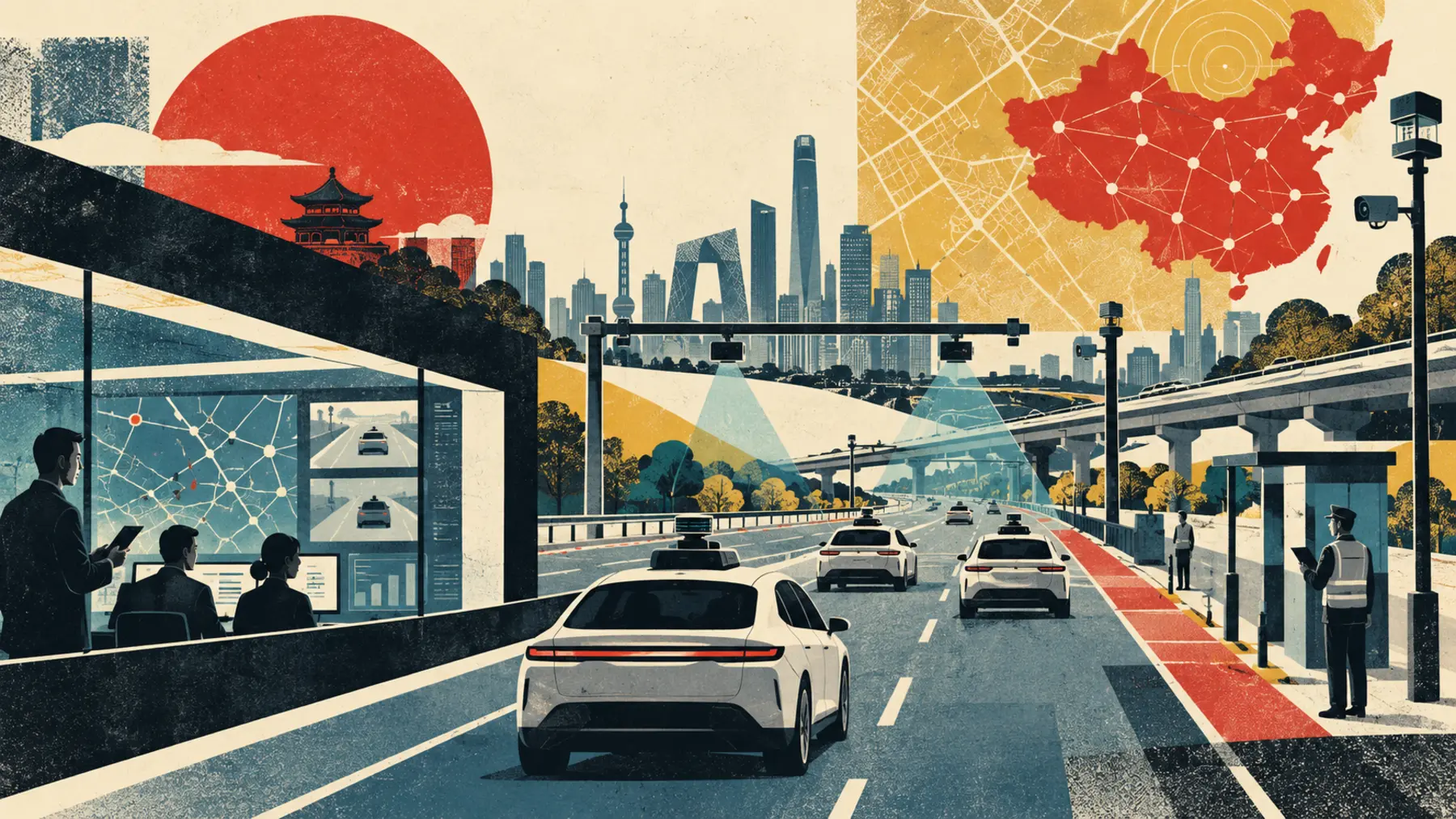
China has set a 2030 goal for cars with self-driving capabilities to be used at large scale, including on highways, urban expressways, and selected city roads. The plan also calls for tighter rules covering production, road safety, automated driving, and software updates. It is a national direction, not proof that fully driverless cars are ready for every road or every weather condition.
01
WHAT ACTUALLY CHANGED
China's Ministry of Industry and Information Technology unveiled a five-year roadmap on September 10 for what it calls the intelligent connected new-energy vehicle industry. Reuters reported the details on September 11. Nine government departments issued the plan, which is meant to carry the sector through 2030. Its clearest AI target is also its largest: vehicles with automated-driving functions should move into large-scale use instead of remaining mostly inside bounded demonstrations.
The roadmap names highways, urban expressways, and selected city roads as places where highly automated driving should be deployed. That wording matters. It does not promise a robot car for every village lane, construction zone, mountain road, or monsoon. It describes a staged expansion across road types that can be mapped, instrumented, monitored, and regulated more consistently than the entire national network.
The policy is not only an adoption target. It calls for tighter rules covering vehicle production, road safety, autonomous driving, and software upgrades. It also says autonomous vehicles should reach safety levels above human drivers. That is an ambition, not a measured result. The useful work begins when regulators define the exposure, crash, disengagement, injury, and near-miss evidence that would make such a comparison fair.
The industrial plan reaches beyond the driving system. China wants several domestic automakers to rank among the world's ten largest by sales, wants Chinese brands to carry more weight overseas, and wants a stronger voice in international vehicle standards. At home, the ministry plans more oversight of vehicle and battery capacity, action against inefficient investment, stronger antitrust and product-quality enforcement, and fewer inappropriate local-government incentives.
The government also plans guidance for automakers expanding abroad and deeper research, investment, and market cooperation between Chinese and foreign companies. This makes the roadmap both a transport policy and an export strategy. The same stack of sensors, chips, maps, models, batteries, software, safety cases, and update rules that operates on a Chinese road will increasingly arrive at foreign regulators' desks.
02
WHY THIS MATTERS
Scale changes the nature of the problem. A small robotaxi zone can be mapped repeatedly, watched by a remote operations team, and limited to favorable streets. A national deployment encounters unusual vehicles, damaged lane markings, road workers, emergency scenes, bad weather, unpredictable pedestrians, and local enforcement practices. More miles can improve systems and reveal failures, but they also increase the number of people exposed while the evidence is still being gathered.
The 2030 target gives automakers, component suppliers, cities, insurers, and road authorities a common clock. That can concentrate investment in sensors, compute, simulation, maps, roadside communication, repair skills, and fleet operations. It can also tempt every participant to count deployment before defining what safe deployment means. A deadline is useful for coordinating work. It is terrible at braking for a cyclist.
Software-update rules deserve as much attention as the steering. A modern vehicle can change after it leaves the factory, including changes to perception, planning, driver monitoring, and the conditions under which an automated mode operates. Regulators need a durable record of which software version was installed, what changed, how it was tested, where it may be used, and what happens when a safety patch fails.
China's domestic scale can influence standards elsewhere. Companies that validate hardware and software across a very large fleet may reduce costs and bring automated features to more markets. Foreign authorities will still need local evidence. Traffic behavior, signs, liability law, privacy rules, road design, emergency response, and acceptable risk are not exported in the same shipping container as a lidar unit.
For ordinary drivers and passengers, the real signal will not be the number of pilot permits or glossy demonstration miles. It will be whether the system publishes comparable safety data, identifies its operating limits, responds clearly when those limits are reached, preserves evidence after an incident, and assigns responsibility without making the human in the seat the universal spare part.
03
WHERE IT COULD HELP
- Operate autonomous shuttles or taxis on mapped urban corridors with defined weather and road limits
- Automate long highway segments while preserving a clear minimal-risk stop and remote-support path
- Use fleet data to find rare road scenarios and turn them into repeatable simulation and track tests
- Audit vehicle software updates against the approved driving domain before broad release
- Compare machine and human safety using matched road types, conditions, mileage, and severity measures
KEEP A HAND ON THE WHEEL
The 2030 goal is a government roadmap, not evidence that highly automated driving is currently safer than people or ready for unrestricted use. Reuters verified the policy details, but the complete English-language primary document was not available during verification. Terms such as large-scale deployment and higher safety levels still need measurable definitions. Crash comparisons can mislead when robot fleets operate on easier roads or in better weather than the human comparison group. The roadmap also combines safety, industrial, export, competition, and capacity goals, which may pull policy in different directions. Watch for binding technical standards, reporting requirements, software-update approvals, liability rules, independent incident investigations, and public data that separates driver assistance from genuinely driverless operation.
04
TERMS WORTH KEEPING
SOURCES AND VERIFICATION STATUS
This article was written from the materials below. Product claims and dates were checked against those sources on September 11, 2026.
PUBLICATION RECEIPT: Revision 1. Published September 11, 2026.
THE PUBLICATION ENGINE
WANT A SIGNAL OF YOUR OWN?
We build source-grounded publications, private briefings, and editorial systems for organizations with something useful to say.
WORK WITH US