THE SIGNAL IN ONE SENTENCE
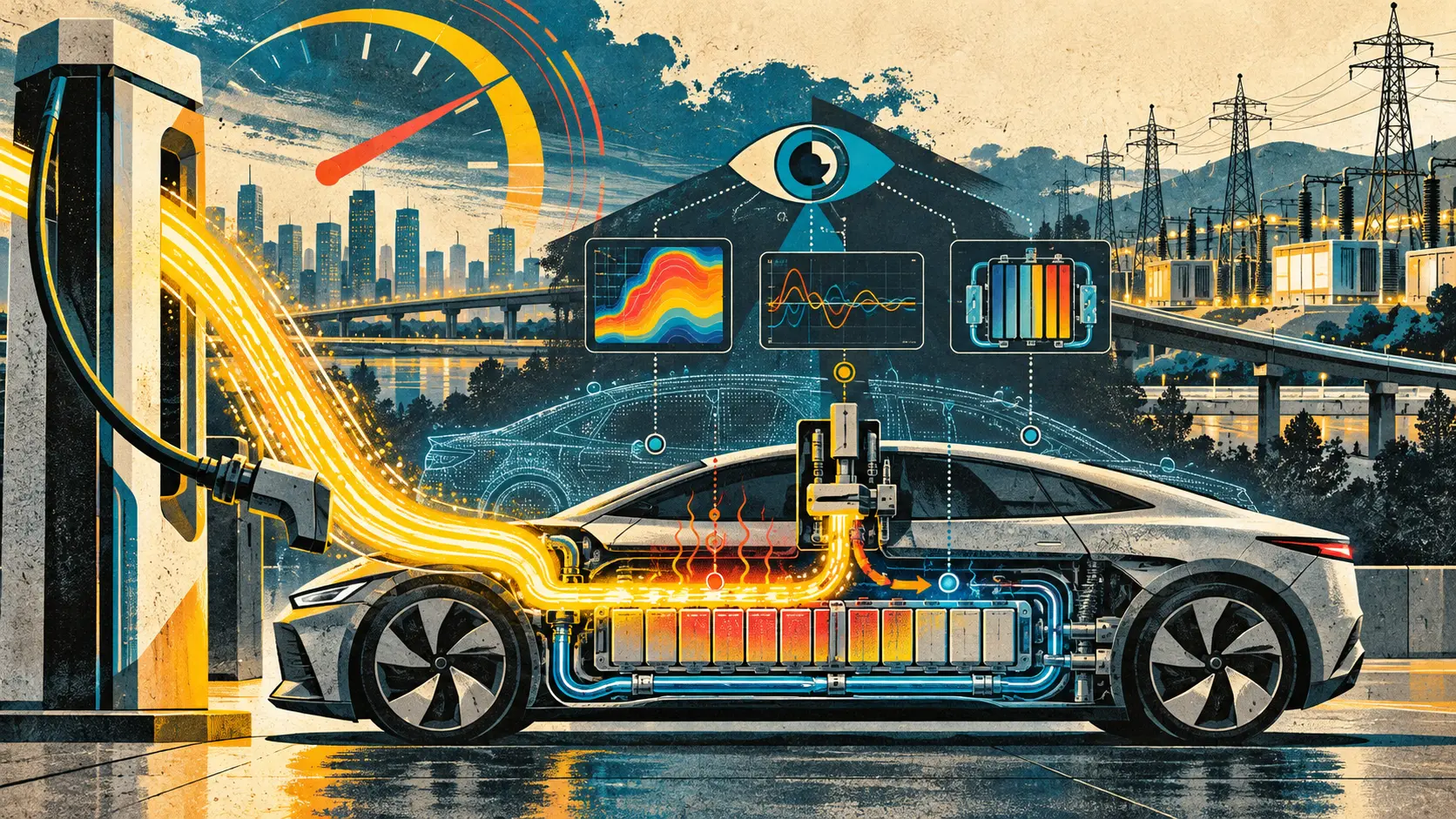
Geely used a launch in Ningbo on September 23 to make two claims at once. The easy one to notice is speed: its fifth-generation Smart Charging Station has a peak rating of 2,250 kilowatts, or 2.25 megawatts, and the company says a compatible high-rate battery in the Lynk & Co 10 and Zeekr 001 can move from 10 to 70 percent state of charge in 4 minutes 30 seconds and from 10 to 97 percent in 8 minutes 40 seconds under normal ambient conditions. The more interesting claim is about restraint. Geely says Xingrui PowerMind, an energy model developed with StepFun, coordinates the vehicle, battery, charger, cloud, grid and station energy storage. It predicts battery temperature up to 30 seconds ahead and changes current, cooling and charging time before heat becomes a problem. Five liquid-cooling loops run across the station storage battery, charging pile, cable, port and vehicle pack. That matters because a charger rating is a ceiling, not a promise that 2.25 megawatts will flow into every car. The battery management system has to reduce power as cells warm, as state of charge rises and as voltage or cell imbalance approaches a limit. Geely itself presents the headline station beside batteries with different capabilities: a 12C Shendun Golden Battery used for the fastest tests and a new 6C Ultra Short Blade Battery intended for more affordable vehicles. EVwire reports that a CATARC instrument log showed roughly 1,093 kilowatts at the Lynk & Co test, about half the station rating. That is still enormous power. It also demonstrates why the pile number and the vehicle result belong in separate columns. The safety evidence remains mostly a manufacturer account. Geely says the system holds average pack temperature below 55 degrees Celsius and peak temperature below 65 degrees, cuts charging heat in the new blade battery by 10 percent and can improve cycle life by 20 percent when AI charging management and pulse restoration are combined. It has not published the complete test protocol, cell-level temperature distribution, comparison group, model error rates, degradation curves, incident record, cold-weather results, station rollout or an independent safety validation. The plain signal is that ultra-fast charging is becoming a control problem as much as a power problem. AI may help predict heat and tailor current, but the useful product is not a fast demo with a smart label. It is a charger, battery and grid system that can prove when it slowed down, why it slowed down and what happened after thousands of ordinary drivers used it in weather that refused to stay normal.
01
WHAT ACTUALLY CHANGED
Geely Auto Group introduced Geely Smart Charging in Ningbo on September 23 and described it as an AI-powered energy-management system rather than a charger acting alone.
The fifth-generation Geely Smart Charging Station carries a company-stated peak rating of 2,250 kilowatts. Reuters rounded the setup to 2.2 megawatts.
Geely says the system links the vehicle, battery, charging station, cloud, grid and station energy storage through Xingrui PowerMind, developed with Chinese AI company StepFun.
The company says its software predicts battery temperature up to 30 seconds ahead and adjusts charging power before the pack exceeds its intended thermal envelope.
Geely says the thermal system is designed to keep the average battery temperature below 55 degrees Celsius and the peak below 65 degrees during fast charging.
A five-point liquid-cooling chain covers the station energy-storage battery, charging pile, cable, vehicle port and battery pack.
In company-described real-world tests, the Shendun Golden Battery in the Lynk & Co 10 and Zeekr 001 charged from 10 to 70 percent in 4 minutes 30 seconds and from 10 to 97 percent in 8 minutes 40 seconds.
The Shendun pack supports a company-stated peak charging rate of 12C. Geely also introduced a next-generation Ultra Short Blade Battery rated at 6C for more affordable vehicles.
EVwire reports that CATARC instrumentation logged about 1,093 kilowatts during the Lynk & Co 10 test. That figure describes observed vehicle-side peak power in that test, not the charger's 2,250-kilowatt nameplate capacity.
Geely says laser-welded cell tabs and covers reduce charging heat in the new blade battery by 10 percent. The company did not publish the complete test method or baseline behind that percentage.
The company also says AI charging management combined with lithium-ion pulse restoration can increase battery cycle life by 20 percent. No independent long-duration degradation study accompanied the launch.
Reuters reported that Geely introduced an upgraded Galaxy E5 alongside the charging and battery technology as competition with BYD intensifies in China.
The launch did not include a complete station rollout schedule, public pricing, grid-connection specification, compatible vehicle matrix or independent safety report.
02
WHY THIS MATTERS
A 2.25-megawatt charger rating describes the maximum power the station hardware can offer under specified conditions. It does not mean every battery can accept that power or that the station sustains it for an entire session.
Charging power usually falls as a battery fills. Comparing a peak number with a time across a defined state-of-charge window is more useful than treating either one as a universal refill speed.
The gap between the station rating and the reported vehicle-side peak is not necessarily a defect. It can reflect the battery voltage, pack chemistry, cell limits, temperature, state of charge and deliberate safety controls.
At megawatt scale, heat is not an accessory problem. Resistance in the cells, busbars, cable, connector and power electronics turns some electrical energy into heat, and local hot spots can matter even when the pack average looks acceptable.
An average temperature can hide a dangerous outlier. Independent evidence should include the hottest cell, temperature spread, sensor coverage and the time each part of the pack remains near a limit.
Predicting temperature 30 seconds ahead could let the controller taper current earlier and avoid a sharp thermal intervention. Its value depends on forecast error, sensor quality and how safely the system behaves when the prediction is wrong.
Calling the controller AI does not establish that it is safer than a conventional control system. Buyers need to see the baseline, failure modes, model version, validation conditions and fallback rules.
Cloud coordination can help a station plan power and compare a vehicle with a digital twin. The on-vehicle controller still needs a safe local mode when the network, cloud model or station data is unavailable.
Battery longevity is the economic hinge. A four-minute stop is a poor bargain if repeated use causes faster capacity loss, larger warranty reserves or lower resale value.
The 20 percent cycle-life figure combines two interventions, AI charging management and pulse restoration. Without a comparison group and cycle protocol, readers cannot tell how much each contributed or whether the gain transfers to daily driving.
Grid impact begins before a cable touches the car. A station delivering megawatt bursts may need a strong connection, onsite storage, power sharing and carefully managed demand charges. Those costs determine where the experience can actually exist.
China can deploy compatible vehicles, batteries and charging infrastructure as an integrated domestic ecosystem. Export markets bring different connectors, grid rules, permitting, utility capacity and service networks.
A charger network is more valuable than a laboratory record. Drivers need working, geographically useful stations with transparent uptime, queue time, pricing and the ability to charge more than one showcase model.
The broader lesson reaches beyond cars. When software controls a high-energy physical system, safety claims should come with logs showing what the model saw, what it predicted, what action it took and whether the result stayed inside limits.
03
WHERE IT COULD HELP
- Put station peak rating, measured vehicle peak, average power and energy delivered in separate fields on every charging result.
- Publish the exact vehicle, battery capacity, chemistry, pack voltage, software version, starting temperature, ambient temperature and state-of-charge window for each test.
- Show the full charging curve rather than one peak. Drivers need to see when power rises, when it tapers and how much energy arrives each minute.
- Report the hottest cell, pack average, temperature spread and cooling energy throughout the session, not only the final temperature.
- Validate temperature forecasts across seasons, battery ages and damaged sensors. Publish false-negative and false-alarm rates for the hazard predictor.
- Give the vehicle a local fallback that can reduce or stop charging when cloud service, network connectivity or the predictive model fails.
- Record every automatic power reduction with the sensor evidence, model version and reason so engineers can distinguish a useful intervention from a nuisance trip.
- Compare the AI controller with a strong conventional battery-management baseline under the same charger, vehicle, weather and degradation conditions.
- Run repeated fast-charge cycles followed by ordinary driving cycles, then publish capacity retention, internal resistance, cell imbalance and warranty-relevant failures.
- Test cold, hot and humid conditions as well as normal ambient temperature. Preconditioning energy and time belong in the customer result.
- Certify the cable, connector, port and pack as one thermal chain. A cool battery does not make an overheating plug acceptable.
- Publish station uptime, successful-session rate, average queue, repair time, delivered energy and the share of sessions that reach headline power.
- Disclose grid connection, onsite storage capacity, peak demand, power-sharing rules and the number of cars that can charge simultaneously.
- Keep compatible vehicle lists precise. A 6C affordable pack and a 12C performance pack should not inherit each other's stopwatch result.
- Use an independent laboratory to reproduce the charge curve, thermal limits, degradation and controller behavior before calling the system production-ready.
KEEP A HAND ON THE WHEEL
Geely's September 23 release is the primary source for the 2,250-kilowatt station rating, 30-second temperature forecast, temperature targets, five-point liquid cooling, 12C and 6C battery ratings, 10 percent heat reduction and 20 percent cycle-life improvement. Those are company statements, not independent conclusions. Reuters independently attended the Ningbo launch and reported the 10-to-70 and 10-to-97 percent times under normal ambient conditions, but its report does not provide a complete protocol or safety audit. EVwire reports a CATARC reading of about 1,093 kilowatts in the Lynk & Co 10 test. The underlying certified trace was not located as a standalone public report before publication, so that number remains attributed to the outlet. Peak charging power is not sustained power, station capacity is not battery intake and a state-of-charge percentage is not a fixed amount of energy across different pack sizes. The public material does not establish cold-weather speed, pack capacity for every test, long-term degradation, prediction error, false-negative rate, performance during cloud failure, connector durability, station economics, network rollout or independent incident reduction. Watch for a full charging curve, CATARC report, compatible model list, deployment timetable, grid and storage design, warranty terms, independent cycle testing and a safety case tied to the exact production software and hardware.
04
TERMS WORTH KEEPING
OPEN GLOSSARY CARD
Peak charging power
The highest instantaneous electrical power a charger or battery reaches under stated conditions, which may be held only briefly.
OPEN GLOSSARY CARD
C-rate
A charging or discharging rate relative to battery capacity. One C would theoretically move an amount of energy equal to the battery capacity in one hour.
OPEN GLOSSARY CARD
State of charge
An estimate of how much usable energy remains in a battery, usually expressed as a percentage of its current usable capacity.
SOURCES AND VERIFICATION STATUS
This article was written from the materials below. Product claims and dates were checked against those sources on September 23, 2026.
PUBLICATION RECEIPT: Revision 1. Published September 23, 2026.
THE PUBLICATION ENGINE
WANT A SIGNAL OF YOUR OWN?
We build source-grounded publications, private briefings, and editorial systems for organizations with something useful to say.
WORK WITH US