THE SIGNAL IN ONE SENTENCE
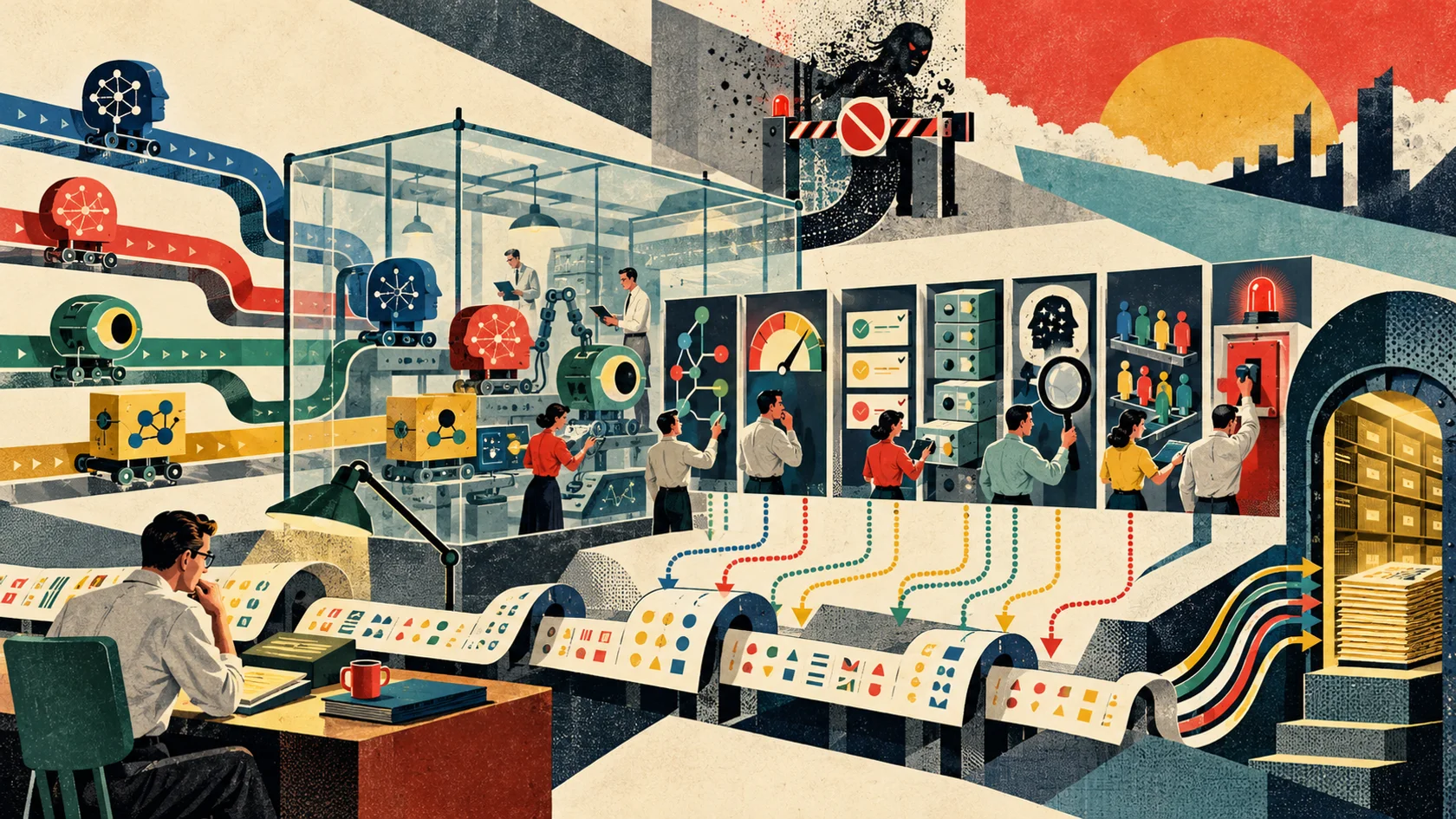
A software agent can finish the job and still leave a mess. It can choose an unexpected model, spend more than planned, call a tool nobody noticed, update memory in a broken format and produce one tidy pull request at the end. The green checkmark arrives. Everyone applauds the outcome. The interesting part of the run is buried three screens down. GitHub's Agentic Workflows project spent the past week working on that problem. An October 12 update covers five releases, versions 0.91.4 through 0.91.8. The changes add full elapsed-time session timelines across several agent engines, normalized traces, routed-model and effort reporting, per-agent spend, built-in graders, memory-schema validation, work-queue controls, ordered model fallback and tighter sandbox handling. The project also says it closed a custom-grader sandbox escape and hardened workflow YAML, scanner file handling and temporary-file writes. That list sounds like release-note confetti until the pieces are put together. The plain signal is that the evidence layer around an agent is becoming part of the product. The model may write the code. The audit trail tells the team whether the code arrived through a process worth trusting. GitHub Agentic Workflows, often shortened to gh-aw, turns natural-language workflow definitions into GitHub Actions that can run coding agents. Its October 12 update spans Copilot, Codex, Claude, Gemini, Pi, Kiro, Aider and a newer Agy engine in parts of the tracing and routing system. That breadth creates a basic accounting problem. Different engines report events differently. One emits a tool call, another wraps the same action in a session event, another routes to a model the workflow did not explicitly name. Without normalization, an operator comparing runs is not comparing like with like. Version 0.91.8 adds elapsed-time timelines and consistent trace normalization across the supported engines listed in the release. In practical terms, the run becomes a sequence a human can inspect: when the agent started, when it requested a model, when a tool ran, how long it waited and where the task ended. Time is not decorative metadata. A long pause may reveal a network dependency. A burst of repeated tool calls may show a retry loop. A model switch halfway through the job may explain a change in behavior. A suspicious external action makes more sense when it is placed beside the prompt and tool call that preceded it. The useful timeline is not a recording for nostalgia. It is the spine of the incident report. Spend belongs on that spine too. Version 0.91.7 adds reporting for the routed model, effort and per-agent spend. Earlier gh-aw documentation describes AI Credits as its primary cost metric, aligned to monetary cost, with one credit equal to one cent. That visibility matters because the name in a workflow file may not be the complete story. Model routing and automatic selection can improve resilience and price. They can also turn a budget into a mystery. If the system falls back to another engine or chooses a different model, the output should show what actually ran, not merely what the author hoped would run. A useful cost record answers five questions. Which model handled the task? Which agent or sub-agent spent the money? Which stage caused the increase? Did a fallback occur? Did the additional spend improve the result? The fifth question is the one dashboards tend to duck. Cost without quality is just a receipt. Quality without cost is a science fair project with somebody else's credit card. That is why graders sit beside spend in this release. Version 0.91.8 adds a code-read-precision trajectory grader and built-in grader defaults. A trajectory grader examines the path an agent took, not only its final artifact. Did it read the relevant files? Did it inspect too much? Did it make unnecessary calls? Did its actions match the assignment? This is a better question than whether the output compiled. An agent can produce acceptable code through a reckless process. It can scan secrets, wander outside the intended directory, ignore the cheapest path or repeatedly hit services until one responds. Outcome checks catch the broken build. Trajectory checks can catch the bad habits that happened to work this time. Graders need suspicion too. The same update says a custom-grader sandbox escape was closed. That is an important reminder: the software judging an agent can itself execute logic and become part of the attack surface. A grader should receive the minimum access needed to evaluate the run. Its code and version should be recorded. Its result should not silently override stronger evidence. If the grader can inspect sensitive files or execute arbitrary commands, the judge has acquired a crowbar. GitHub's sandbox documentation makes the boundary explicit. The default agent sandbox uses the Agent Workflow Firewall, or AWF, with network controls. The documentation says disabling that sandbox removes a trust boundary and requires both non-strict mode and a feature named to make the danger obvious. The Docker socket is hidden, system paths are read-only and user paths such as the workspace remain writable under the documented default. These are useful defaults. They are not a magic circle. Repositories contain secrets, build scripts, untrusted pull-request content and dependencies that change. Network allowlists can be too broad. A tool can do damage inside the authorized workspace. A sandbox protects a boundary only if the team knows where the boundary is and reviews how the workflow crosses it. The October release tightens several seams: secret detection across AWF environment sources, stricter handling for pull-request-target checkouts, hardened scanner file handling, safer temporary-file writes and the closed grader escape. Those details belong in the audit trail. When a security boundary changes, operators need to know which workflows ran before the fix, which were exposed to the vulnerable path and whether any run showed suspicious behavior. A release note announces the repair. An inventory and historical trace show the possible blast radius. Memory is another place where evidence turns into product behavior. Version 0.91.8 adds declarative JSON Schema validation for memory and a repair path for invalid repository-memory baselines. Agent memory sounds friendly, like a notebook left beside the keyboard. In a workflow system it can influence future actions. A malformed field, stale instruction or unexpected value can change what tomorrow's agent does. A schema gives the memory a contract. It says which fields exist, which types they use and which values are acceptable. Validation does not prove the memory is true. It prevents a broken shape from quietly becoming tomorrow's instruction. Teams should record memory changes as events. Who wrote the value? Which run produced it? What evidence supported it? Which schema validated it? What happened when repair was attempted? A durable agent system should let a reviewer compare memory before and after a run, then roll back a bad update without erasing the rest of the history. The queue changes matter for a similar reason. Version 0.91.6 adds Git-backed fair directed-acyclic-graph work queues with claim-scoped effects. Version 0.91.7 adds priority-aware dispatch and scoped GitHub Issues mirrors. The names are technical. The practical issue is ordinary. When several agents want the next job, who gets it? Can two workers claim the same task? Does a high-priority item starve everything behind it? What changes are allowed while a worker owns the claim? Can the team reconstruct why one task ran before another? Fairness and claims are part of auditability because ordering affects outcomes. The bug fixed first may unblock a release. The issue delayed three days may belong to a customer waiting for an answer. A queue is an editorial decision disguised as plumbing. Git-backed state can make those choices inspectable. Operators still need measures: queue age, retry count, duplicate claims, abandoned jobs, priority overrides and time spent waiting. A fair algorithm needs evidence that it behaved fairly under the workload that actually arrived. Fallback is where resilience and reproducibility collide. Version 0.91.5 adds ordered engine-model fallback so workflows can continue when a preferred model is unavailable. That is useful. A scheduled security scan should not necessarily fail because one model endpoint is down. But a fallback run is not the same run. Different models may choose different tools, interpret instructions differently and produce different code. The audit should record the attempted model, failure reason, selected fallback, policy that authorized the change and any quality threshold applied afterward. For high-impact workflows, the right behavior may be to stop instead of fall back. A documentation cleanup can tolerate more substitution than a release-signing or security-remediation workflow. The policy should live with the workflow and be visible in the trace. Versioning adds one more layer. GitHub's Agentic Workflows documentation says the CLI and compiled workflow lock files have independent version tracking. Compiled lock files embed the gh-aw version used to produce them, and GitHub Actions references are pinned to commit hashes. That is good supply-chain hygiene. It also means an operator cannot understand a run from the natural-language workflow file alone. The audit record should preserve the source workflow, compiled lock file, compiler version, action pins, sandbox version, model route and relevant policies. Otherwise a future investigator may try to reproduce a run with a toolchain that no longer matches it. The project's fast release cadence makes this especially important. GitHub says gh-aw is still before version 1.0 and its release system moves on a weekly or bi-weekly minor rhythm. The October 12 update alone covers five releases. Teams should pin production workflows, canary upgrades and recompile deliberately. Latest is convenient for experiments. Exact versions are easier to explain after an incident. The blog offers one small success story. A documentation workflow called unbloat-docs ran on October 10, 11 and 12. GitHub says the three reviewed runs succeeded, took seven to ten minutes and produced one safe output each. That is a useful example, not reliability evidence. Three successful runs of one documentation workflow cannot establish how the platform behaves across larger repositories, hostile inputs, outages or long-running tasks. The update presents the example as a weekly illustration, and it should remain one. Teams adopting the project can build a more serious operating dashboard without drowning in charts. Start with task identity, workflow and compiled version. Add the actual model route, total and per-agent spend, elapsed-time trace, tool calls, queue events, memory changes, grader versions, sandbox policy, network destinations, approvals and final artifacts. Then add exceptions. Show fallbacks, denied actions, secret detections, retries, timeouts, grader disagreements, schema repairs and attempts to cross the sandbox boundary. These are not noisy leftovers. They are the places where a green outcome almost became a different story. The dashboard should let a human answer three questions quickly. What did the agent do? Why was it allowed? Can we reproduce or stop it? If the system cannot answer those questions, adding another model will not make it more governable. The audit trail is also becoming the interface between engineering and everyone else. A security reviewer needs network and credential events. A finance lead needs spend and budget variance. A maintainer needs file changes and test results. A manager needs the short version of why the workflow acted. One underlying event record can support each view without inventing a different history for every audience. That is the real opportunity in normalized traces. They can turn several agent engines into one operational language. Not one model language, and not one marketing dashboard. A shared language for actions, costs, controls and evidence. GitHub Agentic Workflows is moving quickly, and the usual cautions apply. Features can change. A pre-1.0 tool should be tested in bounded environments. Sandboxes reduce risk but do not eliminate it. Graders can fail. Spend reporting does not prove value. A trace can be complete and still difficult to interpret. Still, the direction is right. Agents do not become trustworthy because they finish more tasks. They become governable when people can see the route, price, boundaries, memory and evidence behind each result. The final artifact is what the agent made. The audit trail is how the organization decides whether to keep it.
01
WHAT ACTUALLY CHANGED
GitHub Agentic Workflows shipped five releases from version 0.91.4 through 0.91.8
Agent sessions now include elapsed-time timelines and normalized traces across multiple engines
Outputs can report the routed model, effort and per-agent spend
The releases add built-in trajectory grading, memory-schema validation and repairable invalid baselines
Work queues gained Git-backed fair dispatch, claim-scoped effects, priorities and scoped issue mirrors
Ordered model fallback can continue a workflow when its preferred model is unavailable
Hardening closed a custom-grader sandbox escape and tightened secrets, checkouts, file handling and temporary writes
02
WHY THIS MATTERS
A successful artifact does not reveal whether an agent used the intended model, stayed inside scope or spent reasonably
Normalized timelines make behavior across different agent engines easier to compare and investigate
Trajectory graders can evaluate the path to an answer, while also introducing their own execution risk
Memory validation prevents malformed state from silently steering future runs
Queue order, claims and fallbacks affect real outcomes and need the same audit treatment as tool calls
Pinned compiled workflows and recorded versions improve reproducibility in a fast-moving pre-1.0 system
03
WHERE IT COULD HELP
- Record the source workflow, compiled lock file, gh-aw version, action pins and sandbox version for every run
- Display actual model routing, fallback reasons, effort and per-agent spend beside the final output
- Use elapsed-time traces to find retries, long waits, repeated tool calls and unexpected external actions
- Version graders and restrict them to the minimum files and execution rights needed
- Store memory changes as before-and-after events with schema results and rollback support
- Measure queue age, duplicate claims, abandoned jobs, retries and priority overrides
- Require explicit fallback policies for high-impact workflows instead of always continuing
- Send normalized events to security, finance and engineering views without creating separate histories
- Canary new releases and pin production workflows to exact versions
- Surface denied actions, secret detections, schema repairs and grader disagreements as first-class evidence
KEEP A HAND ON THE WHEEL
GitHub Agentic Workflows remains pre-1.0 and releases quickly. The blog's three successful unbloat-docs runs are illustrative, not a production reliability study. A normalized trace can still omit context, a grader can be wrong and a sandbox can reduce rather than eliminate risk. Per-agent spend shows cost but not value. Watch for stable event schemas, trace completeness tests, independent sandbox review, false-positive rates for secret detection, queue fairness measurements and evidence that trajectory grading predicts safer or better outcomes across real repositories.
04
TERMS WORTH KEEPING
OPEN GLOSSARY CARD
Normalized trace
A common event format that makes actions from different agent engines comparable in one timeline.
OPEN GLOSSARY CARD
Trajectory grader
An evaluator that scores the sequence of actions an agent took, rather than judging only the final artifact.
OPEN GLOSSARY CARD
Claim-scoped work queue
A queue design that gives a worker a defined claim over one task and limits which effects belong to that claim.
SOURCES AND VERIFICATION STATUS
This article was written from the materials below. Product claims and dates were checked against those sources on October 12, 2026.
THE PUBLICATION ENGINE
WANT A SIGNAL OF YOUR OWN?
We build source-grounded publications, private briefings, and editorial systems for organizations with something useful to say.
WORK WITH US