THE SIGNAL IN ONE SENTENCE
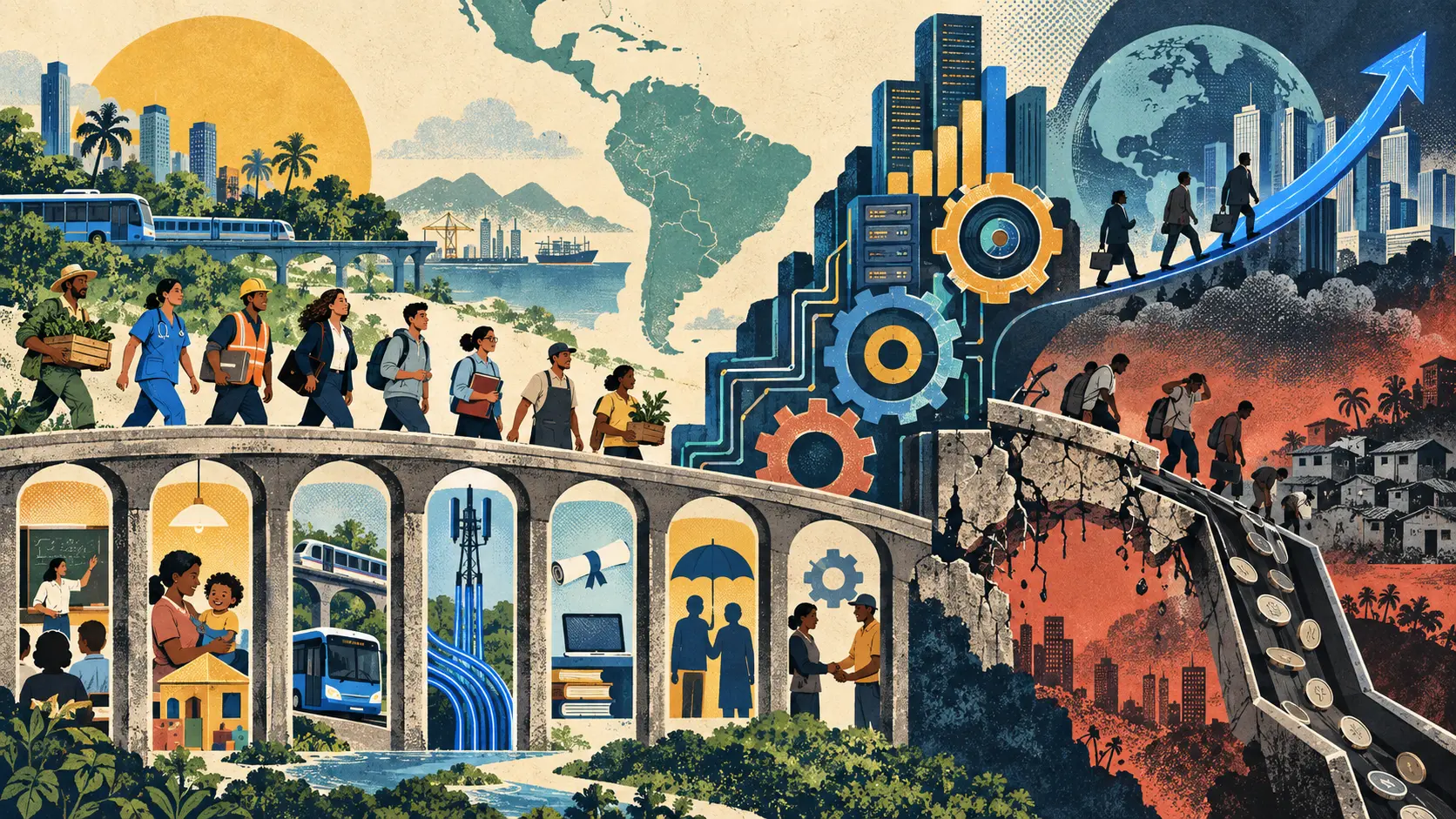
A forthcoming Inter-American Development Bank model says broad artificial-intelligence adoption could leave economic output in Latin America and the Caribbean 5.1 percent higher after a decade. That is the number likely to appear in cheerful slide decks. The same model has a much less cheerful branch. Reuters reported that wages could rise between 2.3 and 5.3 percent if workers move into jobs in expanding sectors, but fall between 13.5 and 20.9 percent if they cannot. Under limited adoption and small productivity gains, output would be only 0.3 percent higher. These are scenarios, not measured results, and the full flagship report is not due until November. Its country assumptions, sector detail, equations, sensitivity tests and distributional results cannot yet be inspected. Still, the published range reveals the decision that matters. Adoption is not the same thing as shared prosperity. A worker does not move because an economic model supplied a tidy arrow. There must be a real job, within reach, at a livable wage, with a recognized path into it and enough income, time, transport, care and bargaining power to survive the trip. The region also includes large informal labor markets and severe gaps in workplace digital access. Older joint research from the International Labour Organization and World Bank estimated that 26 to 38 percent of jobs in the region could be exposed to generative AI, while digital gaps could block productivity gains in as many as 17 million jobs. The plain signal is that the 5.1 percent dividend is not a technology forecast. It is a transition challenge. If governments and employers want the upper branch, they need to publish the bridge, fund it and show who actually crossed.
01
WHAT ACTUALLY CHANGED
Reuters reported on September 21 that the IDB's 2026 flagship report will model the regional economic effects of artificial intelligence. The report is scheduled for November, so the figures available now come through Reuters' account of the forthcoming research rather than a public technical document.
In the broad-adoption scenario, the model estimates that economic output across Latin America and the Caribbean could be 5.1 percent higher after ten years. The comparison is with the modeled baseline, not a prediction of annual growth and not a claim that every country or household gains 5.1 percent.
A limited-adoption scenario with small productivity gains produces only a 0.3 percent increase in output after the same period. The difference shows that the model is sensitive to how widely firms use the technology and how much useful productivity it produces.
The labor branch is larger and more uncomfortable. Reuters said wages rise between 2.3 and 5.3 percent when workers can move into jobs in expanding sectors. When they cannot, wages fall between 13.5 and 20.9 percent. Those endpoints are scenario results, not observed wage changes.
The new figures separate aggregate output from pay. An economy can produce more while a large group of workers loses bargaining power or income. Gross output does not contain an automatic transfer mechanism that routes productivity gains to the people whose tasks changed.
The article does not assign a probability to any branch because no public probability was reported. It also does not average the best and worst figures into one forecast. The purpose of scenarios is to expose the conditions that move an outcome, not to let a midpoint impersonate certainty.
The IDB identifies itself as a development institution serving 26 borrowing member countries in Latin America and the Caribbean, with public-sector financing, research and technical support among its functions. Its regional position makes the forthcoming model relevant to policy, lending and investment decisions, which raises the value of full methodological disclosure.
Existing primary research provides regional context without validating the new percentages. A 2024 ILO and World Bank working paper estimated that 26 to 38 percent of jobs in the region could be exposed to generative AI, with 8 to 14 percent potentially seeing productivity-enhancing transformation and 2 to 5 percent facing current automation potential.
That earlier study estimated that inadequate digital access could prevent as many as 17 million jobs from realizing possible productivity gains. It found the likely benefits concentrated more heavily in formal, urban, educated and higher-income work, while many people in poverty and informal employment face thinner access to workplace technology.
A 2025 ILO global index found that job transformation is more likely than complete occupational replacement because most jobs contain tasks that still require human input. That finding does not make the transition painless. It means the unit of analysis should include tasks, job quality and workplace organization rather than a simple count of occupations erased.
The November release should make it possible to inspect the model's treatment of informal work, migration, geography, gender, race and ethnicity, age, disability, firm size, sector, public employment, language, internet access, social protection and the time needed to move between jobs. None of that distributional detail was available before publication.
02
WHY THIS MATTERS
The phrase workers move into expanding sectors sounds frictionless because models need a tractable mechanism. Real workers have leases, children, debts, health needs, professional licenses, family care and local knowledge. A transition can be economically available and personally impossible at the same time.
A growing sector is not the same as an open job. The region needs vacancy data, wage offers, locations, skill requirements, contract quality and hiring records before it can claim that displaced people have somewhere credible to go.
Training is useful only when it connects to demand. A course completion certificate may improve a ministry dashboard while leaving the participant with the same income and fewer hours. Programs should be evaluated by placement, wage recovery, retention and job quality, not enrollment alone.
Income support changes who can attempt a transition. A well-paid professional may study at night or absorb a short spell without work. An informal vendor or hourly worker may not survive a week without cash. Paid training, unemployment protection and portable benefits are not side programs. They determine whether mobility is real.
Digital access is part of the production system. If a worker or small business cannot reach reliable broadband, suitable devices, cloud services or technical support, the economy may record an AI opportunity that the person cannot use. The 17 million-job bottleneck estimate shows why access belongs inside productivity policy.
Informal employment complicates every neat lever. Workers outside formal payroll systems may lack unemployment insurance, documented credentials, collective bargaining, training time and a reliable record of prior tasks. A transition system built only through large employers will miss many of the people carrying the downside risk.
Productivity can weaken wages when technology increases the supply of acceptable work, makes monitoring easier or reduces worker bargaining power. A worker may produce more value with AI and still receive less of it. Wage-setting institutions, competition and ownership matter beside technical capability.
Geography matters. Expanding digital-services work may cluster in capitals and large cities, while losses arrive in a smaller industrial city, rural district or island economy. Remote work helps some occupations, but connectivity, language, time zone, tax and employer practices still shape access.
Credentials can become a quiet gate. A worker may have the needed skill but lack a university degree, recognized certificate or cross-border license. Governments and employers should test skills directly and make credentials portable without replacing one exclusion with an expensive new badge market.
Women can face a double constraint because clerical and administrative work is highly exposed while unpaid care reduces time and mobility. The 2024 regional study found automation exposure concentrated in formal, skilled work held disproportionately by women. Childcare, safety and schedule design therefore belong in AI labor policy.
Small firms need a different bridge from large firms. A bank can buy systems, consultants and compliance. A neighborhood business may need shared tools, local-language support, financing, data protection and help redesigning work without losing customer trust or creating a single-vendor dependency.
Worker participation can improve both fairness and performance. People doing the job know where information is unreliable, which exceptions matter and which automated shortcut will create rework. Consulting them before procurement can prevent a costly productivity fantasy and preserve useful autonomy.
The 5.1 percent figure can organize investment, but only the wage branch can organize legitimacy. If governments celebrate aggregate gains while people experience falling pay and brittle work, opposition is not evidence that workers failed to understand innovation. It is evidence that the transition contract failed.
The region can turn a modeling result into a public operating plan before November. The practical artifact is a transition ledger that links exposed tasks to actual vacancies, paid pathways, placement, wages, retention, public cost, employer contribution and correction when the promised job does not appear.
03
WHERE IT COULD HELP
- Publish the full model, code or equations, baseline, adoption assumptions, productivity ranges, labor-mobility mechanism and sensitivity tests with the November report
- Release country, sector, firm-size and worker-group results instead of relying on one regional average
- Map tasks likely to shrink or change, then connect them to verified vacancies with wages, locations, schedules, contract terms and skill requirements
- Require employers receiving AI incentives to report task changes, jobs removed or created, training offered, worker consultation, wage effects and retention
- Fund paid training tied to real employer demand and judge programs by placement, six- and twelve-month retention, wage recovery and job quality
- Provide income bridges, portable health and pension coverage, childcare, transport and device support so workers can complete a transition without absorbing the entire cost
- Recognize prior learning and test skills directly so a capable worker is not blocked by an unnecessary degree or expensive proprietary certificate
- Bring informal and self-employed workers into training, credit, procurement and social-protection programs through simple registration and worker organizations they trust
- Expand reliable workplace connectivity and shared technical support in poorer countries, rural areas and smaller cities before counting projected productivity gains
- Create local-language programs and accessibility standards so a regional AI strategy does not default to English, Spanish-speaking urban professionals or workers without disabilities
- Give unions, worker associations and affected employees a role before AI procurement and task redesign, with access to impact evidence and a route to challenge harmful uses
- Track wage distribution, hours, surveillance, work intensity, injury, autonomy and grievance outcomes alongside output per worker
- Separate public subsidies for experimentation from evidence of self-sustaining commercial demand and publish who captured the resulting productivity value
- Build a public transition ledger showing exposed tasks, expanding jobs, funded seats, completions, placements, wages, retention, gaps and corrective action
KEEP A HAND ON THE WHEEL
The IDB flagship report was not public before publication. The 5.1 percent, 0.3 percent, 2.3 to 5.3 percent and negative 13.5 to 20.9 percent figures were reported by Reuters from forthcoming research and could not be checked against a technical appendix, model code, country tables or sensitivity analysis. They describe modeled scenarios after a decade, not observed outcomes, annual growth rates, guaranteed forecasts or results for each country. The article does not assume the scenarios are equally likely or that the endpoints cover every plausible outcome. The 2024 ILO and World Bank estimates use a different research design and should not be combined numerically with the forthcoming IDB model. Occupational exposure is not the same as job loss, adoption is not the same as productivity and training completion is not the same as a job transition. Watch for the November report, independent methodological review, country and sector tables, baseline and price assumptions, model treatment of informal work, distribution by gender and income, migration and geography, technology costs, labor-demand estimates, transition speed, social-protection costs, market concentration, wage-setting mechanisms, worker consultation and evidence that the modeled expanding jobs exist at sufficient scale and quality.
04
TERMS WORTH KEEPING
SOURCES AND VERIFICATION STATUS
This article was written from the materials below. Product claims and dates were checked against those sources on September 21, 2026.
PUBLICATION RECEIPT: Revision 1. Published September 21, 2026.
THE PUBLICATION ENGINE
WANT A SIGNAL OF YOUR OWN?
We build source-grounded publications, private briefings, and editorial systems for organizations with something useful to say.
WORK WITH US