THE SIGNAL IN ONE SENTENCE
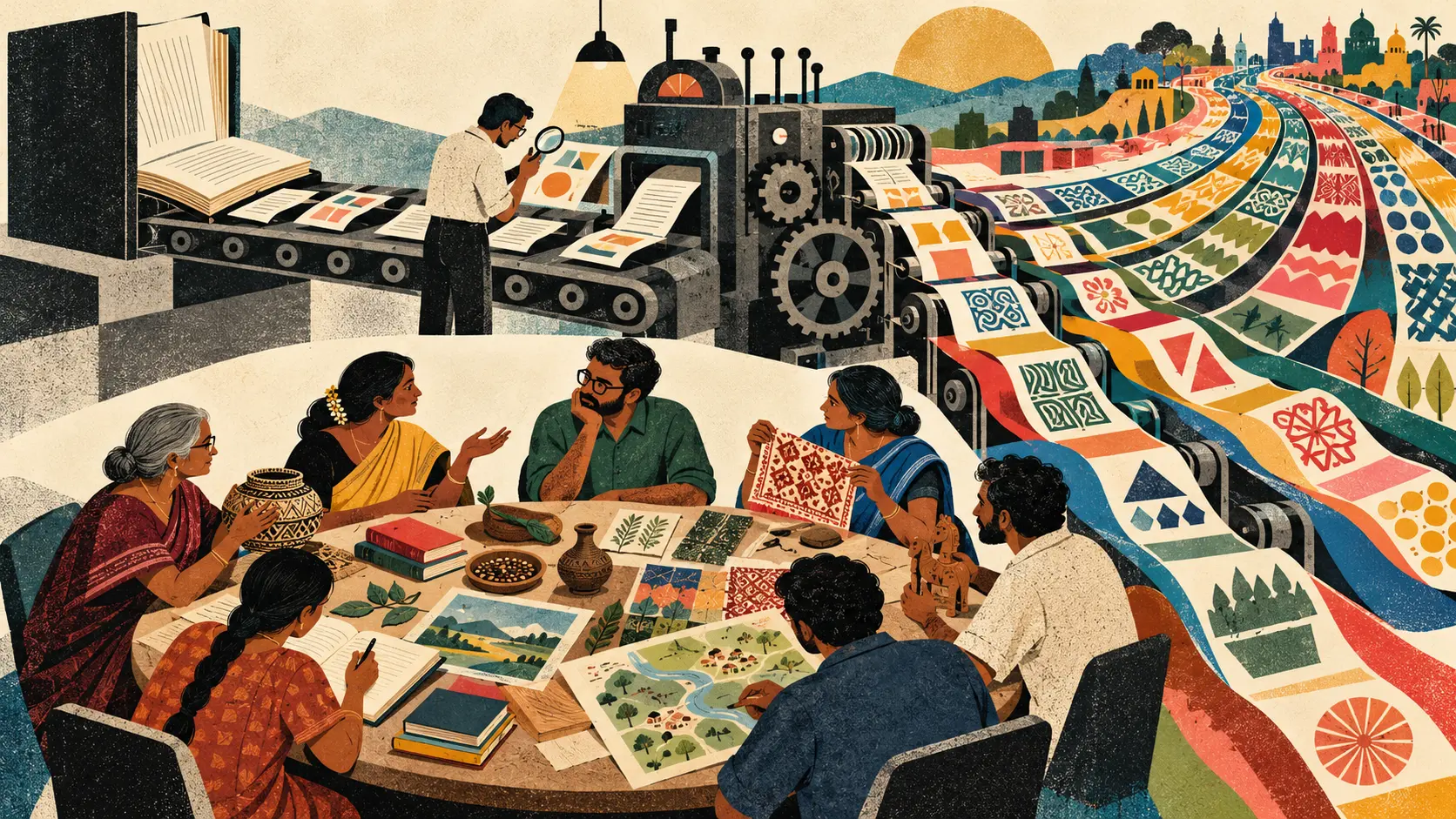
Two numbers can describe this release, and they tell very different stories. The first is 2.8 trillion. NVIDIA, IIT Madras and AI4Bharat have announced Nemotron-pretraining-Indic-v1, a synthetic pretraining corpus with about 2.83 trillion retained output tokens across 22 Indian languages and 34 language-and-script configurations. Native-script text covers all 22 languages. Twelve also receive romanized text written in Latin letters. That is a serious piece of data engineering. It can give model builders much more material for teaching systems to explain technical subjects, answer questions and work through problems in languages that are routinely underrepresented in large training mixtures. The second number is zero. Zero of those 2.83 trillion tokens should be counted as proof that the corpus contains the full local knowledge, culture or lived experience of the people who speak those languages. The material begins with curated English source documents from 15 subsets of Nemotron-CC-v2. A pipeline translates, scores and sometimes repairs that source material. The release announcement says this directly. Translated data complements naturally authored Indic text. It does not replace it. That distinction is not a complaint about translation. It is the map legend. The corpus contains 2,601.0 billion native-script tokens and 224.6 billion romanized tokens, counted with the Gemma-4 tokenizer. Those are retained outputs, including accepted rewrites and script variants. They are not a count of unique English documents, and they are not automatically the number of tokens a model should consume in one training run. For Bengali, Gujarati, Hindi, Kannada, Malayalam, Marathi, Nepali, Odia, Punjabi, Tamil, Telugu and Urdu, the project supplies both native-script and romanized data. Assamese, Bodo, Dogri, Kashmiri, Konkani, Maithili, Manipuri, Sanskrit, Santali and Sindhi receive native-script data. The word native in native-script can be slippery here. It describes the writing system. The text is still translated from English. The team built two related workflows. For twelve languages, Gemma-4-31B-it translates whole English documents. Prompts tell it what to translate and what to preserve, including code, equations, URLs, tables and formatting. The same model then judges its own translation against the English source using a rubric for meaning, fluency, terminology, style and formatting. Outputs scoring at least 75 out of 100 are kept. That 75 is a rubric threshold, not a claim of 75 percent factual accuracy. Lower-scoring outputs can be repaired using the model's feedback and judged again. NVIDIA says this recovery step contributed 438.4 billion native-script and romanized tokens already included in the total. A subset of accepted native-script translations is then converted into Latin script, with another comparison against the native-script input. For the other ten languages, the pipeline uses Bodhan AI's Indic Translate model and then uses Gemma-4-31B-it as the evaluator. Eight keep the whole-document method. Long Santali documents are translated in overlapping windows and reconstructed. Manipuri goes through Bengali script before conversion to Meitei Mayek. These ten-language outputs can pass the same 75-point threshold, but they do not receive the same feedback-based rewrite step. The recipe matters almost as much as the inventory. The Nemotron Bharat plugin for NeMo Data Designer is available on GitHub. It includes translation and evaluation prompts, optional rewriting, document windowing and script-remapping support. A university lab, public-interest group or company can bring its own source documents, run a smaller experiment and inspect the pipeline before scaling it. That is the strongest part of the release. A reusable process is easier to audit, adapt and criticize than a giant download with a triumphant token count attached. It also makes the weak spots easier to name. Quality assessment is primarily automated. Human review is sampled, and its coverage varies by language. In the twelve-language workflow, the translator is also the judge. That is efficient, but it can preserve a model's blind spots. A system may prefer the wording it generated, miss an omission it caused or score fluent nonsense too generously. The ten-language workflow needs broader validation by native speakers, according to the release. The project removes processing duplicates by source identifier, but it does not semantically deduplicate similar content. Translated records derived from the same source can appear across languages and scripts. Romanization adds another useful complication. Many people type Hindi, Tamil, Bengali or another Indian language in Latin characters because of habit, keyboard availability or the context of a messaging app. Training data that reflects that practice can improve search, chat, transliteration and code-mixed interfaces. But romanized text is not one stable spelling system. The same word can be typed several ways across region, age, platform and social group. A model trained on polished synthetic romanization may still stumble over the wonderfully unruly spellings people actually use. Then there is the source-material question. Translating mathematics, code and question-answer material from English can spread useful technical content. It does not automatically add a village's agricultural vocabulary, a regional legal practice, a family recipe, a local health belief, a folk story, a municipal form, a dialect joke or the way a teacher explains a concept in a crowded classroom. A translated English web corpus can make a model more capable in an Indian language while leaving its worldview stubbornly imported. That is why a language-data program needs two ledgers. The first ledger records scale: source collections, licenses, document identifiers, language, script, tokenization, translation model, evaluator, score, rewrite history and release revision. The second records representation: who created the original knowledge, where it came from, which dialects and registers appear, which communities reviewed it, what rights contributors retained and what is still missing. The first ledger helps reproduce a corpus. The second helps explain whose world the model can see. The early model results are encouraging, with an important asterisk. Nemotron 3.5 Super VL received a 100-billion-token continued-pretraining stage. Ten percent of that budget, or 10 billion tokens, was a mixture of synthetic and natural Indic text. The other 90 percent preserved the preceding training mixture's relative proportions. Scores rose on all five reported Indic knowledge and reasoning benchmarks. NVIDIA reports gains from 4.98 to 9.82 percentage points across MILU, Indic MMLU-Pro, Indic ARC-Challenge, Indic ARC-Easy and Indic GSM8K. That comparison supports the combined continued-pretraining recipe. It does not isolate the effect of this synthetic corpus from the natural Indic text, the English portion of the stage or other design choices. The companion report also says evaluation of the full corpus, including repaired outputs and the additional ten languages, remains future work. This is a useful result, not a blank cheque. Teams considering the data should begin with a small streamed sample when the full repository becomes available. Check the dataset card and license. Pin an exact revision. Group records by original source so translations or script variants of the same document cannot leak across training and evaluation splits. Then recruit native-language reviewers before deciding the acceptance policy. They should inspect meaning, terminology, grammar, script stability, residual English, preserved equations, cultural awkwardness and whether the translated document makes sense in its target setting. Low-resource languages need more attention, not the same review percentage applied to a much larger Hindi sample. Compare several fixed-budget mixtures. Measure natural versus synthetic shares and native versus romanized shares. Report each language separately. Averages across 22 languages can hide the one that broke. Test real tasks, not only translated benchmarks. Can the model understand a local government notice? Explain a crop advisory? Retrieve a medicine warning? Follow a code-mixed customer message? Decline to invent a cultural fact it has never seen? And keep a receipt for the release itself. As of verification on October 17, NVIDIA's announcement said the full corpus was releasing soon. The linked public artifacts included the open generation plugin and a two-file report dataset, while NVIDIA's public pretraining-data collection did not yet list the full Nemotron-pretraining-Indic-v1 corpus. The blog's loading example asks readers to obtain the repository ID from a future dataset card. That makes the present tense important. The corpus has been announced and described in considerable detail. The pipeline is available. The full public data release still needs to be checked when it lands. There is no need to choose between enthusiasm and scrutiny here. India's language ecosystem needs more usable training data. Translating carefully curated technical material at this scale can lower the cost of building models that work beyond English. Publishing the process gives researchers something concrete to improve. But a trillion translated tokens do not become local knowledge by wearing a different script. The better outcome is a layered public resource: transparent synthetic translation, well-governed naturally authored text, community review, per-language evaluation and a clear record of what the corpus cannot claim. Scale can open the door. People who live inside the languages still have to furnish the room.
01
WHAT ACTUALLY CHANGED
NVIDIA, IIT Madras and AI4Bharat announced Nemotron-pretraining-Indic-v1 with about 2.83 trillion retained synthetic output tokens
The corpus covers 22 Indian languages in native scripts and twelve of those languages in romanized form, producing 34 language-and-script configurations
The inventory contains 2,601.0 billion native-script tokens and 224.6 billion romanized tokens counted with the Gemma-4 tokenizer
All corpus text begins with English source documents from 15 Nemotron-CC-v2 subsets, including web, question-answer, mathematics and code material
A twelve-language workflow uses Gemma-4-31B-it for translation, automated judgment and optional feedback-based repair
A ten-language workflow uses Bodhan AI Indic Translate for generation and Gemma-4-31B-it for assessment, with special handling for Santali and Manipuri
Outputs must reach a rubric score of at least 75 out of 100, which is a quality threshold rather than an accuracy percentage
The open Nemotron Bharat plugin exposes prompts, assessment, rewriting, windowing and script-remapping tools for reuse
The full corpus was described as releasing soon and was not yet listed as a downloadable public dataset at verification time
02
WHY THIS MATTERS
Large synthetic corpora can reduce the data bottleneck that keeps many Indian-language models behind English systems
Native-script coverage and romanized coverage serve different users and should not be treated as interchangeable copies
Translation distributes source knowledge but does not collect the local knowledge, culture and lived experience produced in the target language
Automated evaluation makes trillion-token production possible, but a translator judging its own work can reproduce the same blind spots
A reproducible open pipeline lets universities and public-interest groups audit the process and apply it to their own licensed sources
Per-language results matter because one combined token count can conceal uneven quality in smaller languages and scripts
Model gains from a mixed synthetic-and-natural training stage cannot be attributed to the announced synthetic corpus alone
A release claim becomes useful public infrastructure only when the dataset, license, revisions and reproducible loading path are available
03
WHERE IT COULD HELP
- Pretrain and continue training language models that need broader Indic technical and reasoning coverage
- Build tutoring, search, question-answering and coding assistants in native and commonly romanized language forms
- Adapt the open generation pipeline to licensed education, public-service, scientific or domain-specific documents
- Preserve equations, code, tables, URLs and document structure during large-scale translation
- Create controlled mixture studies comparing natural, synthetic, native-script and romanized data at a fixed token budget
- Stream small samples for audit before downloading or training on a full corpus
- Develop per-language quality dashboards with native-speaker review and documented error categories
- Create source-grouped splits that prevent translations and script variants of the same document from leaking into evaluation
- Pair translated technical material with naturally authored local sources and community-governed collections
- Test models on local public-service, agricultural, health, education and code-mixed tasks that translated benchmarks may miss
KEEP A HAND ON THE WHEEL
Watch for the full public dataset card and repository ID, license terms, downloadable language configurations, pinned revisions, per-language sample audits, the distribution of automated scores, native-speaker validation for the ten-language workflow, independent checks of self-judging bias, semantic deduplication, dialect and register coverage, source-rights documentation, training-mixture ablations, evaluation of repaired outputs, culturally grounded benchmarks and evidence that naturally authored Indic knowledge receives funding and governance equal to synthetic translation.
04
TERMS WORTH KEEPING
SOURCES AND VERIFICATION STATUS
This article was written from the materials below. Product claims and dates were checked against those sources on October 17, 2026.
PUBLICATION RECEIPT: This article treats 2.83 trillion as the announced retained synthetic output inventory, not unique source documents or a training budget. It distinguishes script from authorship, does not attribute mixed-stage benchmark gains solely to the synthetic corpus and records that the full corpus was still described as releasing soon at verification time.
THE PUBLICATION ENGINE
WANT A SIGNAL OF YOUR OWN?
We build source-grounded publications, private briefings, and editorial systems for organizations with something useful to say.
WORK WITH US