THE SIGNAL IN ONE SENTENCE
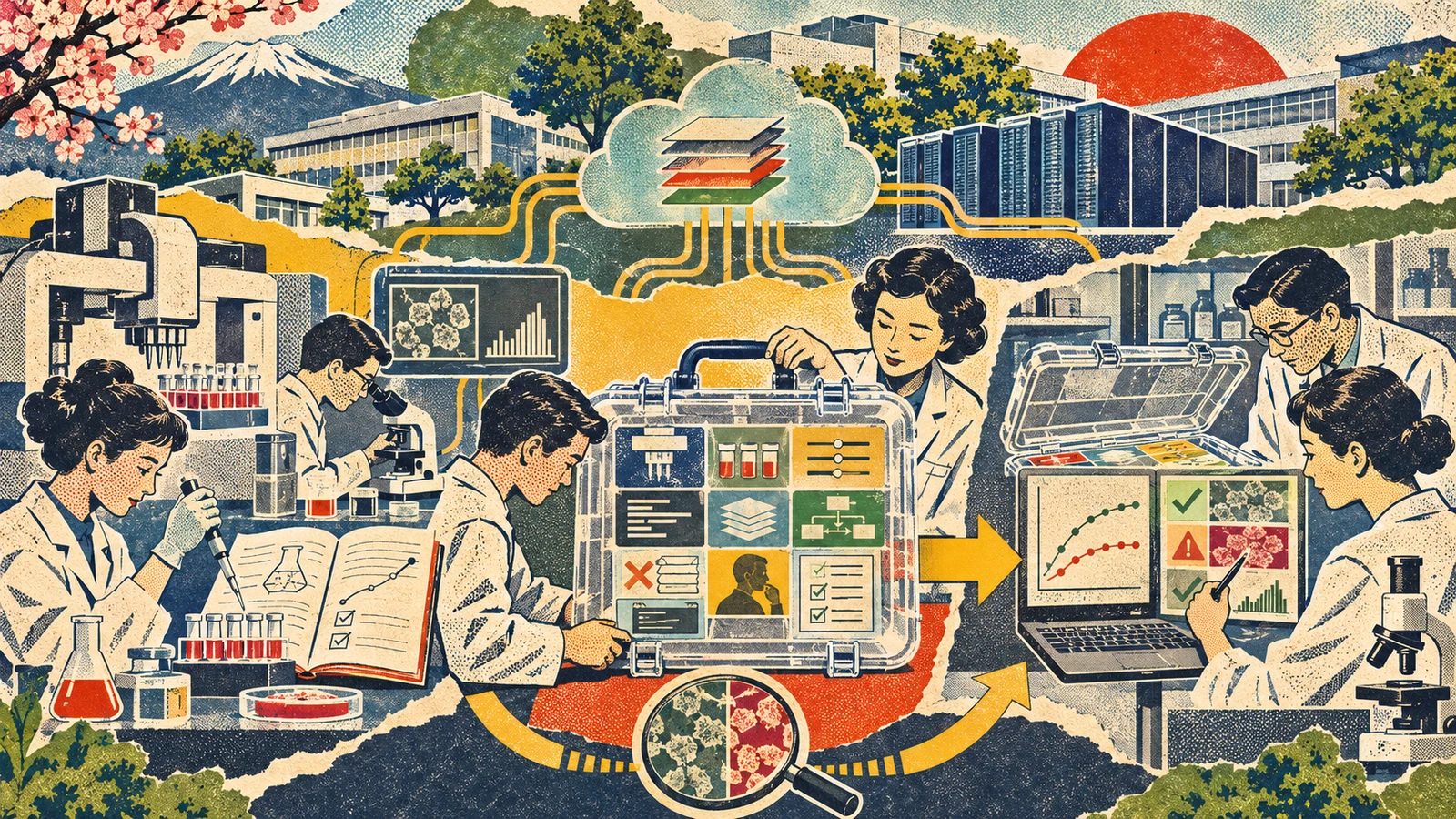
Japan's National Institute of Informatics is trying to connect the entire scientific loop. Not just the shiny parts. The robots that synthesize and measure samples. The instruments that produce images and signals. The electronic notebook that records the experiment. The research-data platform that stores the result. The supercomputer that analyzes it. The software environment that makes the analysis run again. At SC26 in Chicago, NII is presenting research around its AI-integrated Research Data Cloud, known as NII RDC+. The institute says the work joins its national academic network, research-data services and AI capabilities to support data-driven science. One exhibit connects synthesis and measurement robots with advanced instruments through a high-speed network. Another uses an electronic laboratory notebook to move faster through experiment design, execution, measurement and analysis. A bio-imaging example uses a vision-language model to inspect microscope images and draft the protocol for the next experiment. Then there is the part that deserves a large red circle. NII describes a data-analysis service that can automatically build JupyterLab, RStudio and MATLAB environments with the required packages from inside its research-data platform. A researcher can publish an analysis as a computational reproduction package that another researcher can use to rerun the result. That package should become the center of the system. Automating an experiment is useful. Automating an experiment while preserving enough context for somebody else to challenge it is science infrastructure. The distinction matters because an automated laboratory can produce unreliable work at extraordinary speed. A robot will faithfully repeat a calibration error. A model can propose a plausible next protocol based on a mislabeled image. A notebook can synchronize incomplete metadata. A supercomputer can transform the wrong input with magnificent efficiency. A polished result can travel through the cloud while the one undocumented human decision that shaped it remains on a sticky note beside the instrument. The reproduction package needs more than the final code and a tidy dataset. Start with the physical experiment. Record the instrument identifier, hardware configuration, firmware, calibration status, maintenance history and relevant environmental conditions. Preserve the sample identity, origin, preparation steps, storage conditions, custody, batch and any deviations from the planned procedure. If a robot performed the work, record the robot, control software, motion or liquid-handling program, deck layout, consumables, sensor readings, warnings, overrides and recovery steps. If a person intervened, record the intervention. That is not an admission of failure. It is part of the method. Next, bind the electronic notebook to the actual files. Every notebook entry should point to immutable or versioned data, instrument output, images, protocols and code. The relationship should survive renaming, moving and institutional transfer. A screenshot of a chart is not the chart's lineage. The package needs the input, transformation, environment and command that produced it. Use stable identifiers and checksums. Store timestamps with time zones. Keep units explicit. Record who created, changed and approved each item. Preserve the earlier versions rather than replacing the awkward history with a clean final story. The failed runs belong in the package too. Researchers learn from contamination, sensor drift, unstable optimization, corrupted files and protocols that did not behave as expected. Removing those runs can hide selection decisions and make a result look more inevitable than it was. Mark failures clearly. Do not mix them with valid observations. Keep the reason for exclusion, the person or rule that made the decision and the evidence available at the time. Then capture the computational environment. A reproducible notebook is not only the visible cells. Record the operating system, container or virtual-machine image, processor and accelerator details, libraries, package-lock files, compiler, random seeds, locale, environment variables that affect behavior and the order in which steps ran. For external services, record the API version, request parameters, response identifiers and date. If the service cannot be preserved, document that dependency and provide a mock or cached result where licensing and privacy allow. AI adds another layer of moving parts. Record the model and exact version, provider or repository, weights when available, prompt or instruction, sampling settings, tool calls, retrieved material, preprocessing, postprocessing and human edits. Preserve the model output that informed the next experiment, not only the cleaned protocol that entered the notebook. When a model proposes the next step, separate suggestion from authorization. The record should show what the model recommended, what evidence it cited, what uncertainty it expressed, who reviewed it, what changed before execution and which safety rule could stop the run. That is especially important when a generated protocol touches hazardous materials, expensive samples, living systems or instruments that can damage themselves. The package also needs a data map. Show which files are raw, calibrated, derived, labeled, excluded, aggregated and published. Identify the transformation between each stage. Record data schemas, units, missing-value rules, label definitions, quality checks and access restrictions. Do not call a folder raw because it is the earliest folder someone remembered to save. Raw should mean as close as practical to the instrument output, with the original format and acquisition metadata intact. Privacy, security and intellectual property do not disappear in the name of reproducibility. Some clinical, ecological, industrial or dual-use work cannot publish every input openly. The package should still describe what is missing, why access is limited, how an authorized researcher can apply, which synthetic or reduced dataset can test the workflow and which independent body verified the restricted portion. Reproducibility is not the same as unrestricted release. It is a claim that another qualified person can understand the evidence path and, under appropriate conditions, test it. Now make the rerun a test, not a download button. When another laboratory opens the package, the system should check the environment, verify file integrity, identify missing dependencies, run the workflow and compare outputs with declared tolerances. It should produce a difference report rather than a green badge based only on process completion. Exact equality is not always the correct standard. Randomized algorithms, floating-point hardware, stochastic models and physical experiments can produce legitimate variation. The original team should publish the expected range, the statistics used for comparison and the result that would count as a meaningful failure to reproduce. If the rerun differs, preserve that result. Do not treat disagreement as a software bug to be deleted. A changed library, a different accelerator, a local instrument calibration or a hidden assumption may explain the gap. The difference is evidence about the portability of the claim. The package should accumulate a reproduction history. List who attempted the rerun, when, with which environment, which parts succeeded, which parts differed, what explanation was proposed and whether the original result or package changed afterward. That history can turn reproducibility from a one-time ceremony into maintenance. Version the package as carefully as the code. A new model, corrected label, updated calibration or revised protocol can improve the research. It can also produce a result that is no longer the one described in the paper. Give every release a permanent identifier. Link the paper to the exact package version used for the published claim. Keep later corrections visible without silently rewriting the earlier record. Assign stewardship after the grant ends. The institute that hosts the package needs a retention policy, preservation format, migration plan, access-control record and funding model. A perfectly reproducible environment that disappears when one cloud account closes is a temporary demo. NII's wider architecture makes this a national coordination problem. The institute operates SINET6, which connects Japanese universities and research institutions, and the NII Research Data Cloud. It is also presenting authentication that gives researchers unified access to high-performance computing resources across Japan. Common identity and connected infrastructure can reduce friction. They also make authorization, logging and institutional responsibility more important. A single sign-on should not become a single unexplained permission set. Record which person, institution and role accessed which data, instrument and compute environment. Use project-level and purpose-specific permissions. Make revocation travel across the connected services. Preserve audit records outside the researcher's editable workspace. The Smart Cloud Lab iLIS project, launched in June by the National Institutes of Natural Sciences, NII and other institutions, aims at remote automated experiments and AI-driven autonomous research. That ambition makes provenance the safety system. If an AI model reads microscope images, drafts a new protocol and sends that protocol toward a connected robot, every transition needs a traceable handoff. Image acquisition. Model interpretation. Suggested protocol. Human or policy review. Robot command. Instrument execution. Observed result. Decision about the next loop. Each step should carry the input, version, actor, timestamp, decision and result. The official announcement is a description of research infrastructure and SC26 demonstrations. It is not proof that every participating institution can already reproduce every experiment. NII does not publish adoption figures for the reproduction service, success rates across laboratories, operating cost, long-term preservation performance or an independent audit in this release. Those are the next useful measurements. Publish how many packages were created, how many were independently rerun, the median setup time, the share that completed, the share that matched declared tolerances, the most common failure causes, the cost of preservation and the time required to correct a broken package. Break the results down by research field and dependency type. A computational notebook, a microscope workflow and a robot chemistry experiment do not have the same portability problem. Invite outside laboratories to try the ugly cases. Rerun on a different operating system. Use another accelerator. Remove network access. Rotate credentials. Change locale. Rebuild after a package registry has moved. Test a restricted dataset. Reproduce the analysis five years later. Follow a protocol on another instrument model. Publish the failures. Japan's connected research infrastructure could make data-driven science faster and easier to share. It could also create a durable chain from physical experiment to public claim. The second achievement is harder. Preserve the instrument state. Preserve the sample history. Preserve the code, model, prompts and software environment. Preserve the failed runs and the human decisions. Give another laboratory a package it can execute, inspect and challenge. The goal is not to make the result look inevitable. It is to make the path visible enough that someone else can find where it changes.
01
WHAT ACTUALLY CHANGED
Japan's National Institute of Informatics announced on November 16 that it would present AI-integrated research-infrastructure work at SC26 in Chicago.
NII is developing NII RDC+, which combines the NII Research Data Cloud, academic networking and AI capabilities.
The Smart Cloud Lab iLIS project connects synthesis and measurement robots and advanced instruments through a high-speed network.
NII says the project aims to support remote automated experiments and AI-driven autonomous research.
The platform work covers collection, storage and sharing of experimental data, electronic laboratory notebooks and advanced analysis on supercomputers.
An electronic-notebook exhibit uses the open-source eLabFTW platform to support experiment design, execution, measurement and analysis.
A bio-imaging case study uses a vision-language model to analyze microscope images and draft a protocol for the next experiment.
A data-analysis service can build JupyterLab, RStudio and MATLAB environments with required packages from within GakuNin RDM.
Researchers can publish analyses as computational reproduction packages for other researchers to rerun.
NII also describes unified authentication for Japanese high-performance computing resources and connected research-data services.
02
WHY THIS MATTERS
Automated laboratories can repeat an error faster when provenance, calibration and human interventions are missing.
A portable environment can preserve dependencies that ordinary notebooks and code archives leave implicit.
Physical experiments require instrument, sample and environmental context in addition to code and data.
AI-assisted research adds model versions, prompts, retrieved material, tool calls and human edits to the evidence chain.
Failed runs and exclusions reveal selection decisions that a clean final dataset can conceal.
Independent reruns need declared tolerances and difference reports, not only a successful completion message.
Restricted data can remain controlled while methods, missing elements and verification paths are documented.
Versioned packages can connect a publication to the exact environment and evidence used for its claim.
Connected identity and compute services reduce friction while increasing the need for purpose-specific authorization and durable audit records.
A reproduction history can show where results travel well and where hidden assumptions remain.
03
WHERE IT COULD HELP
- Record instrument identifiers, firmware, calibration, maintenance and environmental conditions.
- Preserve sample origin, preparation, storage, custody, batch and protocol deviations.
- Capture robot programs, layouts, consumables, sensor readings, warnings, overrides and recovery steps.
- Link notebook entries to immutable or versioned files with stable identifiers and checksums.
- Keep raw instrument output and acquisition metadata separate from calibrated and derived data.
- Publish reasons, rules and decision owners for excluded or failed runs.
- Package operating systems, containers, libraries, lock files, hardware details, seeds and execution order.
- Record model versions, weights or providers, prompts, settings, retrieval, tools and human edits.
- Separate AI suggestions from human or policy authorization before physical execution.
- Map transformations from raw data through calibration, labeling, analysis and publication.
- Describe restricted inputs, access procedures and independent verification without exposing sensitive data.
- Verify file integrity and dependencies before an independent rerun.
- Compare rerun outputs with declared tolerances and publish a difference report.
- Give each package release a permanent identifier and link publications to exact versions.
- Maintain a reproduction history across laboratories, environments and dates.
- Assign long-term stewardship, retention, migration, access-control and funding responsibility.
- Measure package creation, rerun success, setup time, mismatch causes, correction time and preservation cost.
- Test packages on different hardware, operating systems, locales, network conditions and instrument models.
KEEP A HAND ON THE WHEEL
The November 16 NII release describes research infrastructure, projects and SC26 demonstrations. It is not evidence of a completed nationwide production deployment or universal reproducibility across Japanese research institutions. The release does not publish adoption figures, independent reproduction rates, cross-laboratory tolerance results, operating costs, preservation guarantees, security audits or governance outcomes for the reproduction-package service. A computational package can reproduce an analysis without reproducing the physical experiment that generated its inputs. Instrument state, sample history, environment and human intervention remain essential. Automatically rebuilding an environment does not guarantee that external services, proprietary software, restricted data, model APIs or discontinued hardware will remain available. Vision-language analysis and drafted protocols are research examples, not evidence that generated protocols are safe, accurate or ready for unsupervised execution. Single sign-on improves access but does not by itself establish least privilege, purpose limitation, revocation or institution-level accountability. Watch for independent laboratory reruns, published package specifications, persistent identifiers, data and software licensing, model-version preservation, tolerance policies, failure reports, security controls, long-term funding and evidence that the infrastructure remains usable after projects and dependencies change.
04
TERMS WORTH KEEPING
SOURCES AND VERIFICATION STATUS
This article was written from the materials below. Product claims and dates were checked against those sources on November 17, 2026.
THE PUBLICATION ENGINE
WANT A SIGNAL OF YOUR OWN?
We build source-grounded publications, private briefings, and editorial systems for organizations with something useful to say.
WORK WITH US