THE SIGNAL IN ONE SENTENCE
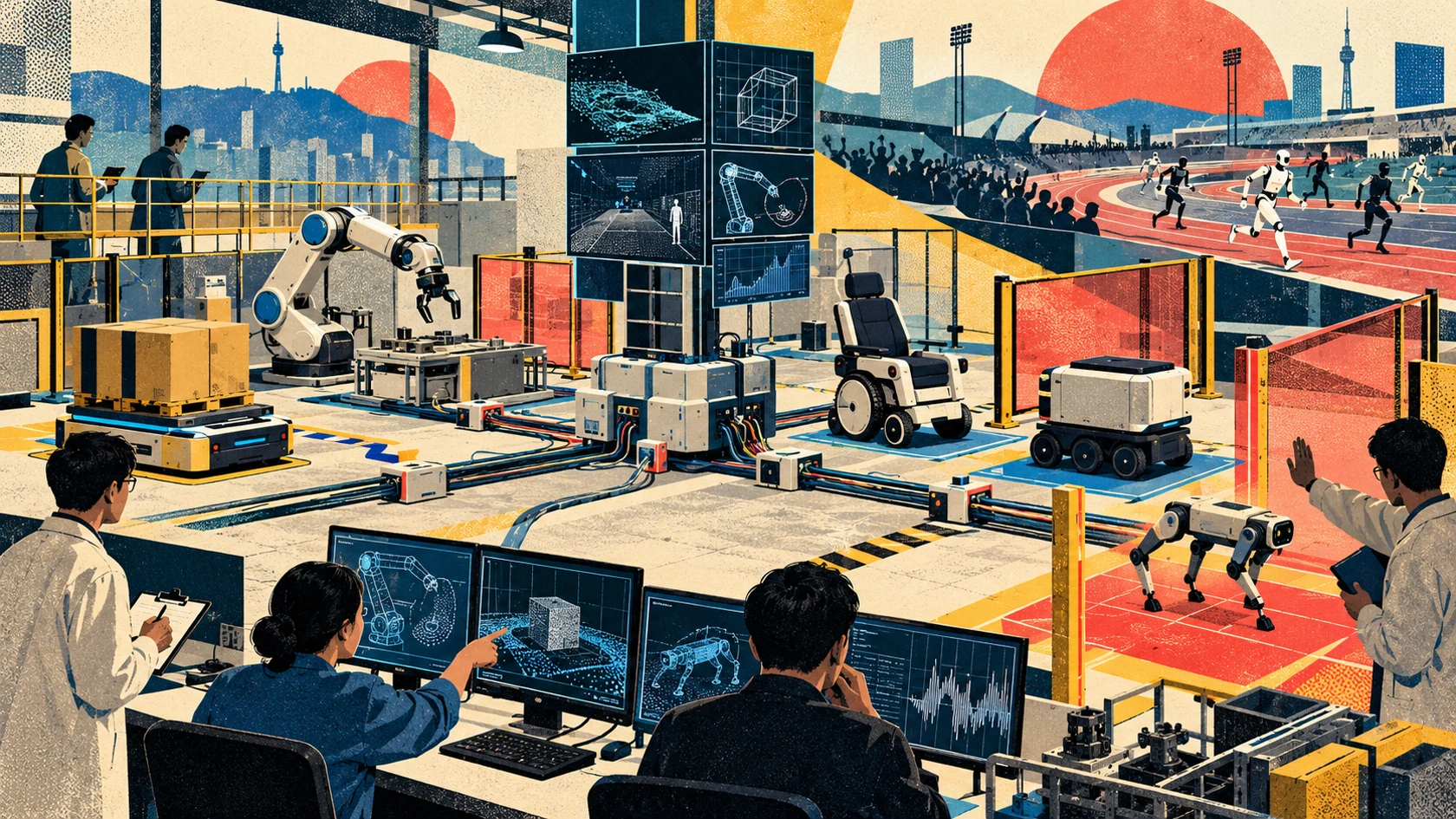
The easiest physical-AI demonstration is a robot doing something photogenic. It runs around a track. It lifts a box. It waves at an audience that has already agreed to be delighted. The difficult demonstration begins after the applause, when somebody wheels the machine onto a cluttered factory floor and asks it to work beside three other machines built by different companies. That is the difference between a showpiece and a platform. KAIST announced on October 11 that it will host Physical AI KOREA 2026 at its Daejeon campus on October 13. The university says the event will present platform technologies that could be used across manufacturing, healthcare, defense, logistics and everyday life, alongside research, education and startup strategies. The headline idea is platform first. KAIST is arguing that the important contest is not which humanoid looks most like a person. It is whether AI that senses, decides and moves in the physical world can be used across many machines and real environments. That is a better question. It is also much harder. Software can retry a failed request. A warehouse robot cannot politely reload the page after clipping a pallet. A medical device cannot treat an unexpected sensor reading like a quirky benchmark. A factory arm that misunderstands distance does not hallucinate a sentence. It occupies the same room as a person. The plain signal is that physical AI becomes useful when the test floor is treated as the product. A platform needs shared interfaces, controlled experiments, safety boundaries, failure records and a route from simulation to reality. Without those, the word platform is decorative plumbing around a collection of demos. KAIST has been assembling pieces of this approach. In March, the university announced KAIROS, the KAIST AI Robot Orchestration Systems testbed. KAIST describes it as a factory platform that integrates mobile robots, humanoids, collaborative arms, sensors, automation equipment and digital twins through one AI-agent-based operating system. The university says the system was developed with support from South Korea's Ministry of Science and ICT and is intended to become both a testing site for domestic robotics companies and a basis for factory operating systems and simulation environments. Those are institutional claims, not independent performance results. KAIST has not shown, in the October announcement, a common benchmark proving that every machine can plug in safely or that a shared control layer improves reliability across industries. The October 13 event had not yet occurred when this article was verified. That caution is not a footnote. It tells us what the test floor needs to prove. The first test is compatibility. A real platform should let different robots, sensors and industrial devices exchange commands and state without a bespoke integration project every time two machines meet. That does not mean one giant system should control everything. It means the connections should be defined clearly enough that a company can replace a robot, add a sensor or change a controller without rebuilding the factory's nervous system from scratch. The platform should publish interface specifications, timing expectations, permission boundaries and fallback behavior. It should say what happens when one device sends stale data, disappears from the network or reports a state the rest of the system does not understand. The useful demo is not five robots moving in formation. It is one robot failing while the other four remain boring. The second test is the safety envelope. Every physical-AI system operates inside limits: speed, force, distance, temperature, payload, location, human proximity and authority. Those limits should be enforced outside the model whenever possible. A learned policy may propose a movement. An independent safety layer should decide whether that movement is allowed. Emergency stops, access zones, collision detection and safe fallback states cannot depend on a model being in a cooperative mood. The platform should record every safety intervention. Which rule fired? What did the machine attempt? Was the cause a sensor fault, a planning error, an integration mistake or an unexpected human action? Did the system stop one device or the whole line? How quickly did a person understand what happened? Physical-AI progress is often presented through completed tasks. Safety progress is visible in the near misses that were caught, explained and prevented from recurring. The third test is the gap between simulation and reality. Digital twins and virtual verification are central to KAIST's KAIROS plans. They are useful because crashing a simulated robot is cheaper than crashing an expensive one into a conveyor. Simulation is not an alibi. Real floors have dust, glare, vibration, warped pallets, weak wireless signals, tired workers, reflective surfaces and objects that nobody entered into the scene file. Motors wear. Sensors drift. A wheel picks up a strip of packaging and develops a personality. The testbed should publish how performance changes between simulation and deployment. Did the system complete the same task at the same speed? How often did a person intervene? Which physical variables caused the largest errors? How much new data was needed before the system stabilized? Did a solution trained on one floor transfer to another? KAIST's broader physical-AI work has emphasized the need for meaningful data from real operations and predictable physical variables, rather than assuming virtual performance will carry over automatically. That is the right instinct. The test floor should make the gap measurable. The fourth test is access. KAIST says it wants platform technologies that a wide range of companies can use. That phrase needs terms and conditions. Can a small robotics company reserve time in the testbed? What does it cost? Can a startup bring a competing controller? Who owns the operating data? Can researchers publish failures? Are interface specifications open, licensed or tied to approved partners? Can a company test one component without revealing its entire design? A platform that only the founding consortium can use is a project. A platform becomes infrastructure when outsiders can build on it without asking for a ceremonial introduction. South Korea has a practical reason to care about this distinction. The country has deep manufacturing, semiconductor, automation and robotics capabilities. A shared physical-AI layer could help smaller suppliers test equipment before entering an expensive production line. It could also reduce dependence on foreign integration software and help domestic machines work together. But industrial sovereignty can create its own little walled gardens. If every national programme builds a proprietary stack, manufacturers inherit another collection of incompatible systems. The platform should be judged partly by how well it connects to international safety standards, existing industrial protocols and machines that were not designed inside the programme. The fifth test is the human role. KAIST's announcement reaches beyond manufacturing into healthcare, logistics, defense and daily life. Those settings have different tolerances for failure and different people affected by it. A factory may optimize throughput. A hospital must preserve patient safety, clinician authority and an auditable reason for every action. A delivery system works in public space among people who never agreed to join a pilot. A defense application creates dual-use questions that cannot be solved by a faster benchmark. The platform should not flatten those differences into one physical-AI score. Each sector needs its own test cases, prohibited actions, approval rules and incident process. People working beside the systems should help define those tests. Operators know where jams occur. Nurses know which interruptions matter. Warehouse workers know which aisle becomes dangerous at shift change. Maintenance crews know which alarm everyone ignores because it fires twelve times a day. Physical AI needs this knowledge before deployment, not as a post-incident interview. The sixth test is the failure record. Press pages collect successful demonstrations because that is their job. A trustworthy platform needs a second archive for what did not work. It should publish anonymized incident and near-miss summaries, integration failures, simulation mismatches, human overrides, recovery times and changes made afterward. Companies should be able to compare not only peak performance but operational maturity. This does not require exposing trade secrets or turning every lab mistake into a scandal. It requires recognizing that repeated, documented failure is how a testbed earns its name. The record should distinguish laboratory validation, supervised pilot work and unsupervised production. It should state how many hours a system ran, under which conditions and with what human coverage. A robot completing ten prepared cycles is a demonstration. A platform coordinating mixed equipment through changing conditions for thousands of hours is evidence. The applications are real if the foundation holds. Manufacturers could pre-verify equipment before installation. Logistics operators could test mixed fleets and safe handoffs. Healthcare teams could evaluate mobility or rehabilitation devices in constrained settings before patient use. Cities could test service robots around pedestrians. Universities could teach robotics on a shared control and simulation layer. Startups could learn where their device fails before a customer learns it for them. The platform could also provide a common place to evaluate energy use, maintenance burden, cybersecurity and workforce effects. Those are not side metrics. A system that finishes a task but requires constant remote rescue may not be autonomous in any meaningful economic sense. A robot that increases output while making maintenance dangerous has moved the cost, not removed it. A factory operating system that centralizes control also creates a larger target for cyberattack and a larger blast radius when something goes wrong. Platform first should therefore mean accountability first. Every machine needs an identity. Every command needs a source. Every software and model version needs to be recorded. Every permission needs a boundary. Every operator needs a stop path that works when the AI does not. The test floor should be able to replay an incident from sensor input to model decision to physical action. If it cannot, the platform is integrating machines faster than it is integrating responsibility. There is a lot KAIST has not yet promised publicly. The announcement does not provide benchmark results, access prices, published interface specifications, incident data or independent safety evaluations. It does not prove the same platform can move cleanly from a factory to a hospital or public street. The KAIROS material describes an ambitious integrated testbed, but it comes from the institution building and promoting it. That does not make the work unimportant. It makes the next questions obvious. Who can use the platform? Which interfaces are open? Which safety layer can overrule the model? What failure data will be published? How is simulation compared with real deployment? What does a worker or patient get to say before the system arrives? Physical AI will always produce spectacular footage. The serious work happens outside the frame: integration logs, stop conditions, worn sensors, messy data and the person standing close enough to know when the machine is wrong. Humanoid races can tell us which robot crossed the line first. The test floor tells us whether any of them belong at work.
01
WHAT ACTUALLY CHANGED
KAIST announced Physical AI KOREA 2026 for October 13 at its Daejeon campus
The event is framed around platform technology rather than humanoid performance alone
KAIST says the platform direction spans manufacturing, healthcare, defense, logistics and everyday use
The university links the effort to research, education, entrepreneurship and broader company access
KAIST has already described KAIROS as an integrated factory testbed for robots, sensors, facilities and digital twins
02
WHY THIS MATTERS
Physical AI can cause immediate real-world harm when sensing, planning or integration fails
Shared interfaces could let companies test and replace equipment without rebuilding every connection
A testbed can measure the gap between clean simulation and messy physical deployment
Small companies need practical access terms if a university platform is to become shared infrastructure
Safety, cybersecurity and human authority must be designed across the platform rather than added to each demo later
03
WHERE IT COULD HELP
- Pre-verify robots and automation equipment before installation on a production line
- Test mixed warehouse fleets, handoffs and safe degradation when one device fails
- Compare simulated performance with real floors, sensors and changing physical conditions
- Evaluate constrained healthcare and mobility devices before supervised human use
- Give startups access to common interfaces, testing equipment and repeatable benchmarks
- Record near misses, human overrides, recovery time and corrective changes
- Audit energy use, maintenance load, cybersecurity exposure and workforce effects
- Require sector-specific approval and stop rules for factories, hospitals, public spaces and defense
KEEP A HAND ON THE WHEEL
The October 13 event had not occurred when this article was verified, and KAIST has not published common benchmark results, access terms, interface specifications or independent safety evaluations in the October announcement. KAIROS performance descriptions come from KAIST. Watch for open technical interfaces, third-party test access, simulation-to-reality measurements, incident reporting, independent validation and evidence that human operators can stop or override the system.
04
TERMS WORTH KEEPING
OPEN GLOSSARY CARD
Physical AI platform
Shared hardware, software, interfaces and test infrastructure for AI systems that sense and act in the physical world.
OPEN GLOSSARY CARD
Safety envelope
The enforced limits on where, how fast and with how much force a physical system may operate.
OPEN GLOSSARY CARD
Simulation-to-reality gap
The difference between how a system behaves in a virtual environment and how it performs under messy physical conditions.
SOURCES AND VERIFICATION STATUS
This article was written from the materials below. Product claims and dates were checked against those sources on October 12, 2026.
THE PUBLICATION ENGINE
WANT A SIGNAL OF YOUR OWN?
We build source-grounded publications, private briefings, and editorial systems for organizations with something useful to say.
WORK WITH US