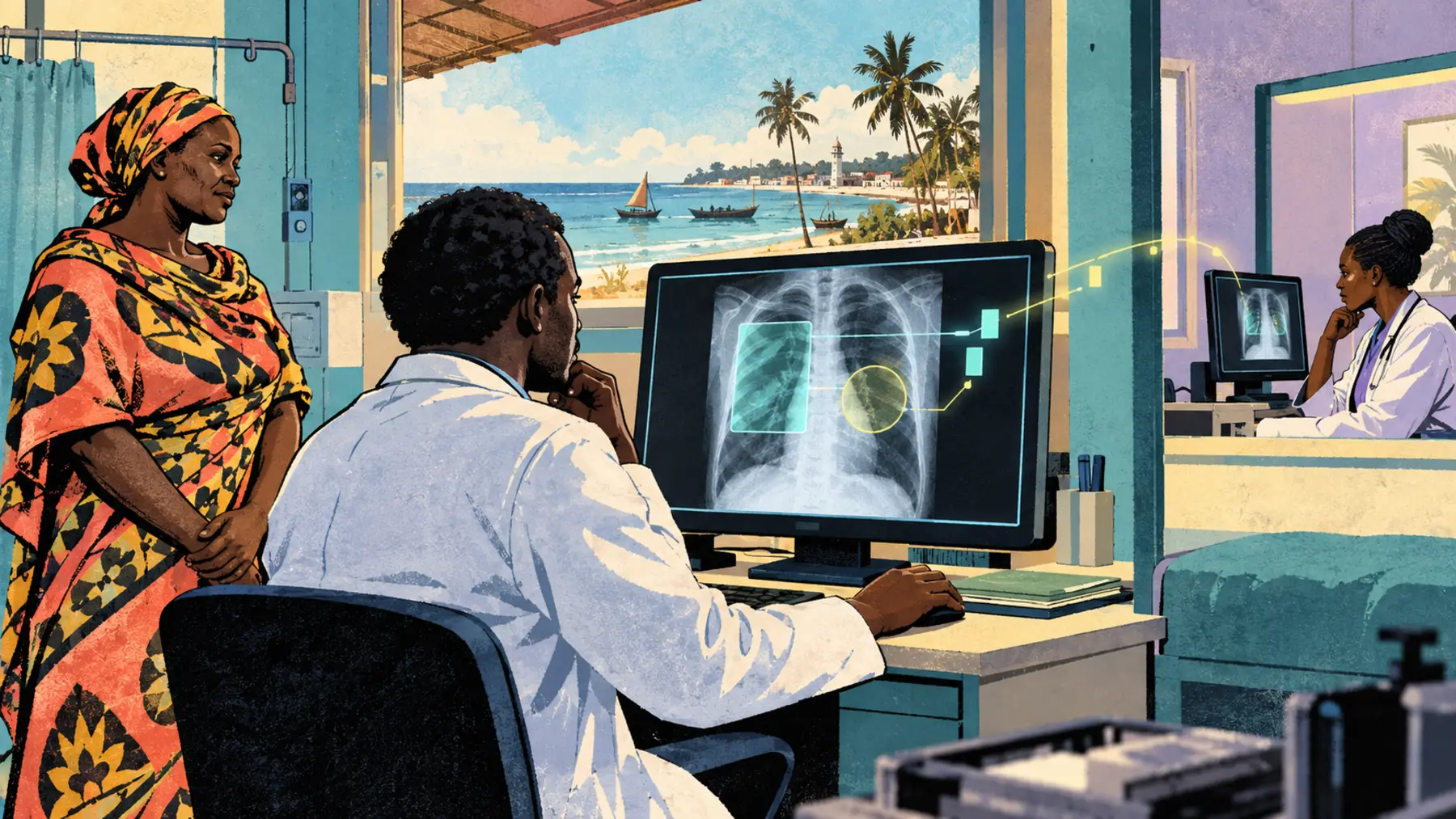
THE SIGNAL IN ONE SENTENCE
Kilifi County says Malindi Sub-County Hospital can now capture X-rays digitally, use an unspecified AI capability in the imaging workflow, and send images directly to clinicians instead of handing patients film. The county also installed a 64-slice CT scanner. Public information does not identify the AI system, the exact task it performs, its clearance, its accuracy, or whether it was validated on local patients.
01
WHAT ACTUALLY CHANGED
The date is the first thing to straighten out. Kilifi County officials inspected the new equipment at Malindi Sub-County Hospital on August 27. Kenya's Government Advertising Agency published the detailed Kenya News Agency account on September 10. The package includes a 64-slice CT scanner and digital X-ray machines that the government report describes as AI-enabled.
Digital transmission is the clearest operational change. The county's health executive, Peter Mwarogo, said patients would no longer need to carry film because images can be sent directly to doctors. That can remove a physical handoff from the care path. An image can reach the clinician who needs to read it without asking a patient or family member to become the hospital's courier.
The county expects the CT scanner to handle between 20 and 30 patients a day. It says the digital X-ray system can produce as many as 250 images daily and send results to doctors immediately. Those are county-reported capacity estimates, not independently measured utilization, turnaround time, or patient outcomes. A machine's maximum appetite and a hospital's everyday throughput are not the same number.
The AI part remains frustratingly foggy. A government photo caption says the radiology equipment can diagnose and transmit a patient's diagnosis to a medical officer or clinician. The public report does not name the maker or model, explain whether the software flags suspicious findings, prioritizes urgent cases, checks image quality, or drafts a report, or say how a clinician reviews its output. Until those details appear, the defensible description is AI-enabled imaging, not autonomous diagnosis.
The equipment sits inside a broader hospital expansion. The county says it is building a casualty and emergency facility at an estimated cost of about 700 million Kenyan shillings, plans to open intensive-care and high-dependency units within two months, and is moving toward electronic records. Officials also reported higher monthly surgery and maternity volumes after earlier upgrades. Each figure comes from the county and describes service activity, not proof that the new AI feature caused the increase.
02
WHY THIS MATTERS
The most important technology story here may be distance. Kilifi officials say local imaging should reduce referrals outside the county, shorten travel, and lower costs for patients and families. A scanner closer to home can matter before any clever algorithm enters the room. If the examination happens locally and the image travels digitally, a patient may avoid moving through the referral system simply to move a picture.
AI could help only if its job is specific. Software might check whether an image is usable, highlight a possible abnormality for review, or help a team sort a busy queue. Those are different clinical tasks with different risks. A vague AI label bundles them into one shiny sticker. Hospitals, clinicians, and patients need to know what the tool actually does, what it does not do, and what action follows when it disagrees with the person reading the image.
Local validation is not paperwork for decoration. Medical images, disease patterns, equipment settings, referral practices, and patient populations can differ from the data used to build a model. A hospital needs evidence that the system works on the examinations and conditions it will actually encounter, plus a way to measure misses, false alarms, downtime, and changes over time. Imported confidence is not the same as local performance.
The digital workflow has its own quiet infrastructure bill. Images need reliable storage, network capacity, access controls, backup, maintenance, display calibration, and staff who can recover when the connection fails. Faster transmission is useful only if the right clinician can open the correct study, compare it with prior images, preserve the record, and keep sensitive health information from wandering into the wrong inbox.
Responsibility should remain delightfully boring. The software can offer a signal. A qualified clinician still needs to interpret the image in context, decide whether more testing is required, explain uncertainty, and take responsibility for the care decision. If the county publishes the system identity, intended use, validation evidence, oversight process, and real turnaround data, this upgrade could become a practical model for accountable medical AI rather than a promising machine behind a locked specification sheet.
03
WHERE IT COULD HELP
- Capture X-rays digitally and send them to clinicians without film handoffs
- Provide local CT examinations that might otherwise require an outside referral
- Use a clearly defined AI function to support image-quality checks, case prioritization, or clinician review
- Measure reporting time, repeat scans, missed findings, false alarms, downtime, and patient travel after deployment
- Connect imaging records to authorized clinical teams while preserving access logs, backups, and a manual fallback
KEEP A HAND ON THE WHEEL
The Government Advertising Agency report confirms the equipment and quotes county officials, but it does not identify the X-ray maker, software model, intended clinical task, training data, regulatory clearance, local validation, accuracy, false-positive rate, false-negative rate, uptime, procurement terms, or responsibility process. Its throughput, service-volume, cost, and benefit figures are county-reported. The equipment was inspected on August 27, although the detailed government report appeared September 10. The phrase AI-enabled should not be read as evidence that the system can diagnose independently, improve outcomes, replace a radiologist, or work equally well across all patients and conditions. Patients should rely on qualified clinicians for interpretation and care.
04
TERMS WORTH KEEPING
OPEN GLOSSARY CARD
Digital radiography
An X-ray system that captures the image electronically instead of producing a physical film.
OPEN GLOSSARY CARD
Computer-aided detection
Software that marks possible findings in a medical image for a qualified person to review.
OPEN GLOSSARY CARD
Clinical validation
Testing whether a medical system performs safely and usefully for its intended patients, setting, equipment, and task.
SOURCES AND VERIFICATION STATUS
This article was written from the materials below. Product claims and dates were checked against those sources on September 11, 2026.
PUBLICATION RECEIPT: Revision 1. Published September 11, 2026.
THE PUBLICATION ENGINE
WANT A SIGNAL OF YOUR OWN?
We build source-grounded publications, private briefings, and editorial systems for organizations with something useful to say.
WORK WITH US