THE SIGNAL IN ONE SENTENCE
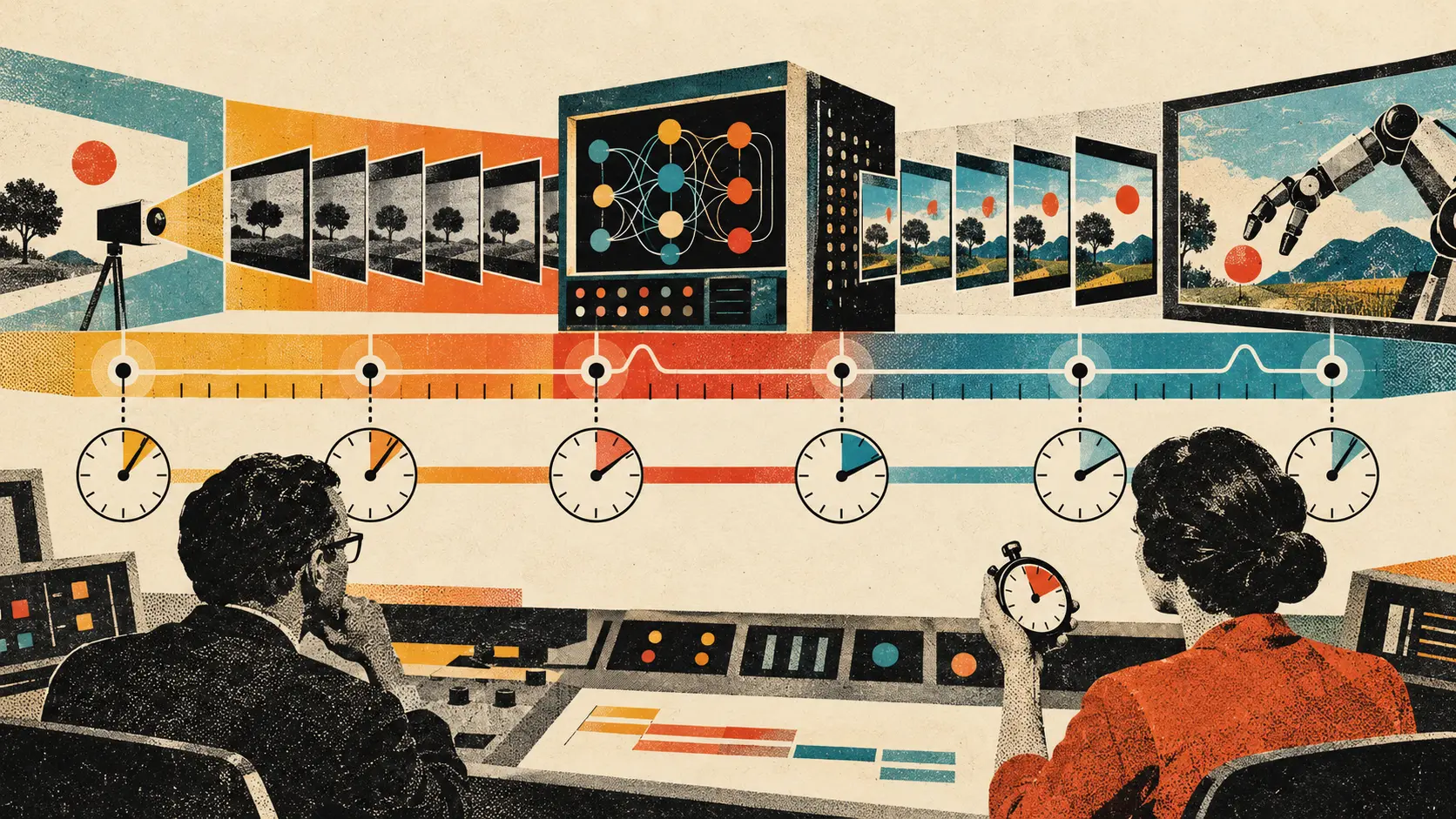
A world model can look fast while reacting late. That sounds like a contradiction until you separate the frame factory from the control loop. On October 22, the French nonprofit AI laboratory Kyutai released CADRE, a family of causal video autoencoders designed for interactive world models. The project includes code, model weights, evaluation scripts, action probes and a public demo. Kyutai also released four action-conditioned world models covering robot manipulation, driving, indoor navigation and human hand manipulation. The reported headline is genuinely interesting. World models trained on CADRE representations can run at 20 frames per second on one H100 GPU and react to an input in under 230 milliseconds. That is close enough to feel interactive in some settings. It is not the same as proving the complete experience reacts in under 230 milliseconds. Kyutai's own repository makes the distinction visible. In its single-user H100 setup, the team measured 20 frames per second and 162 milliseconds of local input latency. With two active users sharing the GPU, each received about 14 frames per second and a local p95 input delay of 207 to 212 milliseconds. The published measurement excludes network transit and browser rendering. The repository also warns that long rollouts can drift. Those caveats are not a footnote to the result. They are the map for evaluating it. The plain signal is this: publish the control-lag budget. Start at the action. A human presses a key. A robot controller sends a joint command. A driving system changes curvature. A camera path receives a translation or rotation. That event must be timestamped as close to its origin as possible. Then follow it. The input may wait in a browser, travel across a network, enter a queue, miss the current generation step, reach the world model, become a predicted latent frame, pass through a decoder, get encoded for transport, cross the network again and wait for a display refresh. The user does not experience model inference in isolation. The user experiences the sum. Action capture. Transport. Scheduling. Prediction. Decoding. Delivery. Display. If a system reports only the middle, it can optimize a beautiful number while the person at the controls still feels like they are steering through soup. CADRE attacks a real part of this problem. Interactive video systems must compress both space and time. Raw video contains too much information to repeatedly predict at useful speed. An autoencoder reduces the video into a smaller representation, called a latent. The world model predicts the next latent state from previous states and an action. A decoder turns the prediction back into video. Compression creates a bargain. Make the latent too large and the system is expensive to predict. Make it too small and the scene loses details, motion or control information. Compress time too aggressively and an action may take longer to appear. Compress space too aggressively and a hand, tool or road boundary may become vague even if the image still looks pleasant. Kyutai's main released autoencoder uses one latent position for every two frames and every 16 by 16 pixel region. At 20 frames per second, one predicted latent frame represents 100 milliseconds of video. Its decoder can sample in one or two steps. The associated world model is a 1.2-billion-parameter causal diffusion transformer that predicts one latent frame at a time from context and actions. That architecture helps explain why timing must be measured in stages. An action does not necessarily change the very next displayed pixel. It has to arrive before a prediction step closes. The model may already have work in flight. The decoder may need prior frames. The player may buffer output to keep playback smooth. A fast average can hide the unlucky input that arrives just after a scheduling boundary. Publish the distribution, not only the average. For every environment, report median, p90, p95 and p99 delay from local input capture to the first correct displayed reaction. Show the result across a quiet local process, one remote user, two active users and a loaded queue. Separate warm and cold runs. Record compilation, model loading and prompt setup rather than making the first visitor absorb those costs off the books. The word correct matters. A world model can react quickly in the wrong direction. If a driving action asks the scene to curve left, the model should not merely change something within 162 milliseconds. The predicted road motion should correspond to the requested curvature. If a bimanual robot command moves one wrist, the simulated arm should follow without the other hand melting into the table. If an indoor camera rotates, the room geometry should move consistently rather than producing a fresh but incompatible hallway. Kyutai released action probes and evaluation code to help measure whether rollouts follow their inputs. The repository names ARR alongside visual metrics such as FID, FVD, PSNR and LPIPS. That is useful because image quality and control accuracy are different questions. A sharp wrong turn is still wrong. So is a fuzzy correct turn if the scene no longer preserves the object a robot must grasp. Build a two-axis scorecard. One axis measures delay. The other measures action fidelity. Plot every operating point instead of selecting one flattering configuration. A team may choose more denoising steps for better visual quality, fewer steps for lower delay or a different compression cell for a particular camera setup. The trade should be visible. Kyutai's release is especially helpful here because it spans different kinds of motion. The robot-manipulation model uses joint-state deltas from two YAM arms. The driving model uses speed and curvature. Indoor navigation uses camera translation and angular rate. Human manipulation uses per-frame changes for wrists and finger joints. These environments do not fail the same way. A fixed camera watching robot arms can tolerate different spatial compression than a camera moving through a room. A driving scene needs stable road geometry and quick curvature response. Human hands contain small, fast details whose pose can look plausible while quietly disobeying the action. Do not collapse all four into one latency number. Give each environment a control contract. The contract should define the action space, the sampling rate, the expected physical or camera response, the first frame where a change can reasonably appear and the tolerance for error. It should also define a no-action test. When the input remains still, the world should not invent movement simply to look alive. Then test reversals. Press left, then right. Move a hand toward an object, then withdraw. Accelerate, then brake. The first action may look excellent because it resembles the training data. The reversal reveals whether the model is following the live command or simply continuing a likely movie. Interactive systems also need interruption tests. Send a new action while previous frames are still being generated. Drop a packet. Delay an input. Repeat the same command. Burst several commands. Ask the system to stop. Measure which instruction wins and when. A control loop needs a policy for stale actions. Should the server process every queued command, even if the user has already changed course? Should the newest action replace the old one? Should the model blend between them? Should the interface show that the system is behind? These are product and safety decisions, not GPU trivia. The release's shared-demo configuration offers a useful example. It serves four environments on one H100 and allows two active users, while additional visitors wait. It uses seven BF16 world-model steps, a batch size of one and FP8 only for the decoder. Kyutai says two users do not meet a 19 FPS and 200 millisecond target. That is the kind of operational honesty more demos need. A live demo should expose the current frame rate, active-user count, queue status and end-to-end delay. If fixed inference settings are hidden, the page should at least link to the exact configuration and commit. Otherwise a visitor cannot tell whether a smooth clip came from the public setup, a prepared recording or a lightly loaded moment. Networking deserves its own receipt. Kyutai explicitly excludes network transit and browser rendering from its local latency figures. A user near the server may add tens of milliseconds. A user on another continent may add hundreds. Video encoding, WebSocket delivery, browser decoding and display refresh contribute more. Wireless congestion and power-saving modes can add jitter. Report server-side and glass-to-glass timing separately. Server-side timing begins when the application accepts an action and ends when the corresponding frame is available for delivery. Glass-to-glass timing begins when the physical input occurs and ends when a high-speed camera sees the visible response on screen. The second is harder to measure. It is also closer to what a person feels. For robotic use, the loop extends farther. A real robot includes sensors, control software, actuators, mechanical response and another observation. A video world model can help with simulation, planning, data generation or policy development. The released CADRE rollouts do not establish safe control of a physical robot, car or assistive device. They predict video in research environments trained from public datasets. Anyone connecting such a model to hardware needs an external safety layer, bounded commands, emergency stops, collision checks and a human-readable record of what the model predicted versus what the machine actually did. The model should not be the brake and the imagination at the same time. Long rollouts require a separate score. Kyutai warns that they can drift. That is a familiar problem in autoregressive generation. A small error enters one frame, becomes context for the next and slowly turns the scene into a confident alternate universe. Frame rate does not tell you when that happens. Measure time to failure. Define observable failures for each environment: geometry breaks, an object disappears, a hand changes identity, the road jumps, the camera teleports, the action response reverses or the scene becomes uncontrollable. Run repeated rollouts at several lengths and publish survival curves. A ten-second clip can look wonderful while a sixty-second interaction becomes unusable. Use real sequences, adversarial sequences and boring sequences. Boring matters. A system that stays stable while nothing interesting happens may be more valuable than one that produces cinematic motion for five seconds. Hold a camera still. Repeat a small action. Keep the robot arm near an object without touching it. Drive straight through a visually repetitive scene. Test whether the model invents novelty because its training rewarded motion. Reproducibility is one of CADRE's stronger contributions. The repository includes code for training autoencoders, world models and action probes, plus evaluation commands and manifests listing clips. The Hugging Face model cards document architectures, tensor shapes, training steps, batch sizes and datasets. The released world models cover ABC-130k robot manipulation, PhysicalAI-AV driving, RealEstate10K indoor navigation and EgoDex human manipulation. But open does not mean unrestricted. The code uses the MIT license. The weights use CC BY-NC 4.0, which limits them to non-commercial use. The autoencoders also contain a frozen DINOv3 encoder governed by Meta's DINOv3 license, including trade-control restrictions and prohibited uses named in the repository. A company should not treat a downloadable checkpoint as a production green light. Review every applicable license, dataset term and downstream use. A research team should record the precise checkpoint, code commit, GPU, precision, denoising steps, decoder history, batch size, concurrency and driver stack. The hardware matters too. An H100 is a powerful data-center accelerator. Twenty frames per second on one H100 is an engineering result, not evidence that the same system runs interactively on a laptop, phone, classroom workstation or affordable robot computer. Publish memory use, power, utilization and cost per active session. Test less expensive hardware. Show the quality and lag changes when quantization or fewer denoising steps are introduced. The most useful next artifact would be a timing trace anyone can replay. For each action, store the input timestamp, queue admission, model-step start, latent completion, decoder completion, server send, client receive and display presentation. Attach the expected action and the measured visual response. Preserve dropped, replaced and late actions. Publish representative traces and summary distributions with the code that produced them. That receipt would make the phrase real time inspectable. CADRE moves interactive world models in a promising direction. It makes causality, temporal compression, fast decoding and action measurement central to the design rather than polishing a slow generator after the fact. The released code and weights give other researchers something concrete to test. Now the evaluation should follow the action all the way to the eye. Input. Queue. Predict. Decode. Deliver. Display. Verify. The model can make frames quickly. The control-lag budget will show whether the world actually listens.
01
WHAT ACTUALLY CHANGED
Kyutai released CADRE, a family of causal video autoencoders for interactive world models
The release includes code, model weights, model cards, evaluation scripts, action probes and a public demo
Kyutai released four action-conditioned world models for robot manipulation, driving, indoor navigation and human manipulation
The primary world models use a 1.2-billion-parameter causal diffusion transformer and predict one latent frame at a time
The recommended released world-model autoencoder compresses two frames and 16 by 16 pixel regions into latent positions
The team reports 20 frames per second and under-230-millisecond reaction on one H100
The documented single-user demo profile measured 20 FPS and 162 milliseconds of local input latency
Two active users measured about 14 FPS each and local p95 latency of 207 to 212 milliseconds
The published latency excludes network transit and browser rendering
The code is MIT licensed, while the weights are CC BY-NC 4.0 and include DINOv3 components under separate terms
02
WHY THIS MATTERS
Interactive usefulness depends on the full delay between an action and a correct visible response
Frame rate can remain high while queuing, transport or display delay makes control feel slow
A fast reaction is not useful if the generated scene follows the wrong action
Temporal and spatial compression trade prediction cost against motion, detail and controllability
Different environments need different control contracts and failure tests
Average latency can hide tail delays that make a system unpredictable under load
Long rollouts can accumulate small errors until geometry or action response drifts
Local server timing does not include the network, browser, display or physical machine
An H100 result does not establish affordability or edge deployment
Open code and weights improve reproducibility, but the weight and encoder licenses limit downstream use
03
WHERE IT COULD HELP
- Timestamp every stage from input capture through display presentation
- Report median, p90, p95 and p99 end-to-end control latency under several load levels
- Measure action fidelity beside frame rate and visual quality
- Publish per-environment control contracts for driving, navigation and manipulation
- Test reversals, interruptions, repeated actions, packet delay and stop commands
- Expose queue depth, active-user count, frame rate and live delay in public demos
- Measure server-side timing separately from glass-to-glass timing
- Run long repeated rollouts and publish time-to-failure distributions
- Compare H100 performance with less expensive hardware and several precision settings
- Store replayable timing traces with checkpoint, code, hardware and inference configuration
KEEP A HAND ON THE WHEEL
Watch for the promised arXiv paper; independent reproduction of the 20 FPS and latency claims; full input-to-display timing; action-fidelity results by environment; p95 and p99 delay under realistic network and concurrency; long-rollout survival curves; tests on less expensive hardware; memory, power and cost per session; clearer stale-action and interruption policies; evaluation on real control tasks; commercial licensing options; and evidence that a faster simulated world remains stable, obedient and useful after the demo clip ends.
04
TERMS WORTH KEEPING
OPEN GLOSSARY CARD
Control latency
The elapsed time between issuing an action and observing the system produce the intended response.
OPEN GLOSSARY CARD
Video autoencoder
A model that compresses video into a smaller latent representation and reconstructs visible frames from that representation.
OPEN GLOSSARY CARD
World model
A model that predicts how an environment changes after an action so an agent can simulate possible futures and plan.
SOURCES AND VERIFICATION STATUS
This article was written from the materials below. Product claims and dates were checked against those sources on October 25, 2026.
PUBLICATION RECEIPT: Performance, architecture, training, licensing and environment claims are attributed to Kyutai's official repositories and model cards. The reported latency excludes network transit and browser rendering. The release is research software and does not establish safe control of physical robots or vehicles.
THE PUBLICATION ENGINE
WANT A SIGNAL OF YOUR OWN?
We build source-grounded publications, private briefings, and editorial systems for organizations with something useful to say.
WORK WITH US