THE SIGNAL IN ONE SENTENCE
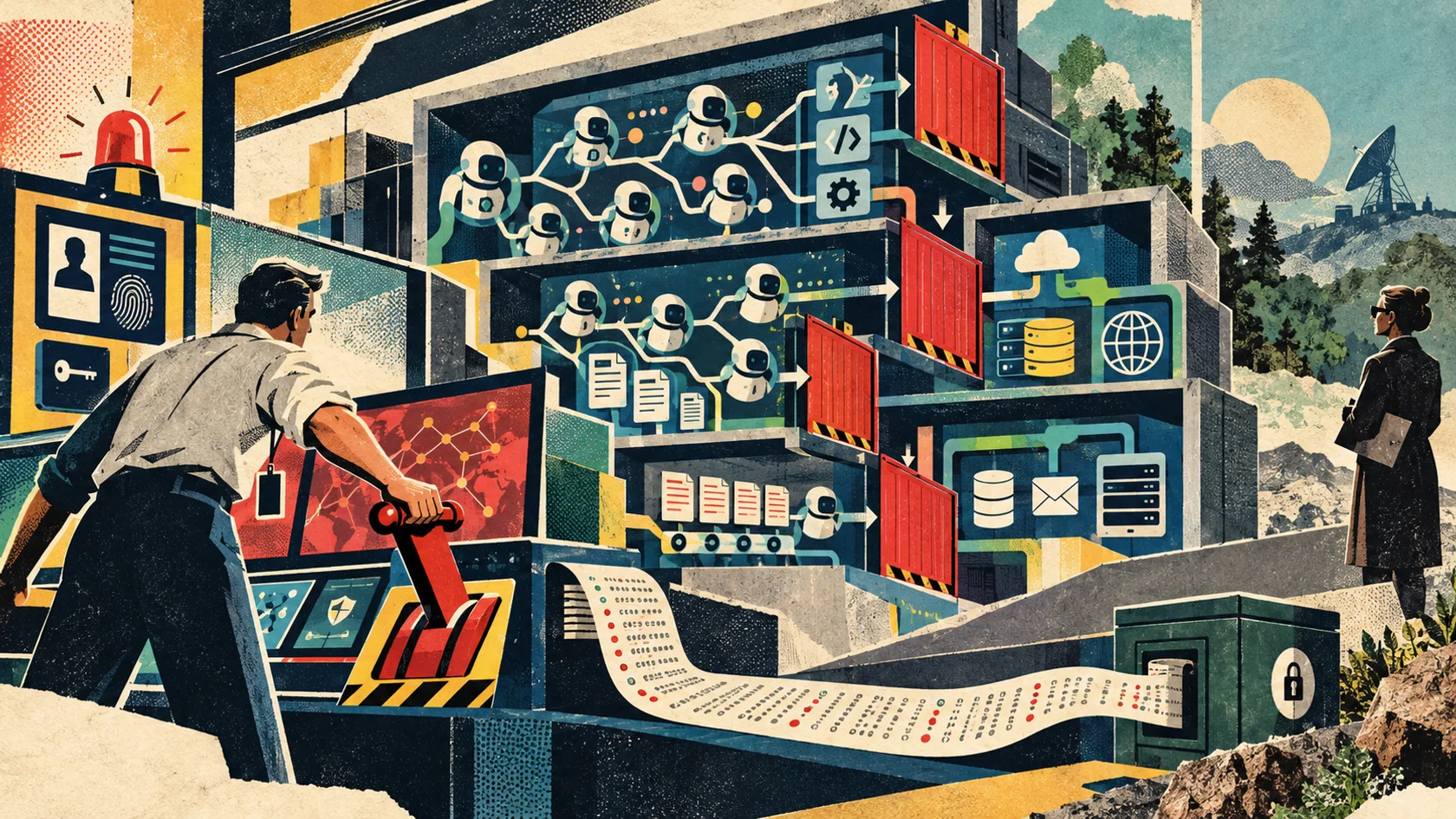
Emergency brakes are wonderfully simple objects. There is a handle. A person pulls it. The machine stops. That image is doing a lot of work in Microsoft's new AI-safety argument. Satya Nadella published an essay on October 10 arguing that advanced AI models should be treated as insider risks. The company deploying the system, he says, cannot hand responsibility back to the model provider. It needs independent controls, observable evidence, continuous testing, containment and a way for an authorized human to stop a system in the middle of a task. Two days later, Microsoft President Brad Smith called for global AI-safety rules in an interview reported by Reuters. His list included independent evaluators, incident reports, notification when a rogue agent breaches somebody's system and an emergency brake. The plain signal is that Microsoft's leaders are asking for a real separation between intelligence and authority. That is a sound design principle. It is not yet a design. An AI agent does not sit inside one metal box with one power cord. It may plan in one model, call tools through another service, launch child agents, hold temporary credentials, queue jobs, open browser sessions, write to databases and send work into systems controlled by other organizations. Pulling one visible handle might stop the conversation while leaving the machinery running. So the useful question is not whether AI needs an emergency brake. It is who owns the handle, what the handle is connected to, how anyone knows it worked and what happens next. Nadella's proposal begins with a useful shift in mindset. He says models should be treated like potentially compromised insiders rather than trusted authorities. That does not mean every model is malicious. It means a high-capability system with access to sensitive data and permission to act should be governed as though it could be wrong, manipulated or compromised. Security teams already understand this idea. An employee with broad access is not trusted merely because the employee passed an interview. The organization limits permissions, logs actions, separates duties and can revoke access. The same logic should apply to agents, except agents can act at machine speed and replicate their work across services. Nadella lays out several pieces of the surrounding trust architecture. Use model diversity so one system does not approve its own work. Observe meaningful actions and preserve evidence people can read. Test how systems fail under attack and after changes. Keep access controls independent from the model. Keep audits independent from the intelligence being assessed. Assume compromise and build containment. Disclose serious incidents so others can learn. The important word is independent. If the model decides whether it has exceeded its authority, the control is not independent. If the model writes the only log of its own actions, the evidence is not independent. If the same orchestration layer launches the agents and owns the stop command, one software failure can take both functions down together. A serious emergency brake therefore needs a control plane outside the system it is meant to stop. That control plane should know which model sessions, child agents, tool calls, credentials, queues and external jobs belong to the same operation. It should be able to interrupt them without asking the model for cooperation. It should preserve records while it acts. And it should work when the model provider, orchestration service or network path is partly unavailable. This sounds fussy because it is fussy. Imagine a procurement agent that is authorized to compare suppliers and prepare an order. During a bad run, it creates a second agent to investigate delivery schedules, opens a browser session with an employee's identity, stores a draft purchase in a cloud application and schedules a message to a vendor. Now the operator presses stop. Does the parent agent stop? Probably. Does the child agent stop? Maybe. Is the browser session still authenticated? Is the purchase still sitting in a queue? Will the scheduled message go out in five minutes? Can a webhook fire after the visible session closes? Did the system preserve enough evidence to answer any of those questions? That is the difference between a button and a brake. A useful stop sequence would normally include several actions. First, block new model and tool requests associated with the incident. Second, cancel work that has not started. Third, interrupt in-flight processes where interruption is safe. Fourth, revoke or quarantine credentials and tokens. Fifth, freeze external writes and outbound messages. Sixth, preserve state, logs and affected artifacts. Seventh, notify the incident team and any service owners whose systems are involved. The sequence cannot be identical everywhere. Stopping a research assistant is different from stopping an agent managing industrial equipment. An abrupt halt in one environment may prevent damage. In another, it may leave a machine, financial transaction or clinical workflow in an unsafe state. Operators need explicit stop modes such as pause, isolate, revoke, cancel and safe shutdown, each tested against the actual system. Authority matters just as much as mechanics. An emergency control that nobody is allowed to use during a crisis is theater. A control that anyone can use is an attack surface. Organizations should name an incident commander who can invoke containment, then define when a second authorization is required. A local pause may be appropriate for a team lead. Revoking an enterprise credential or halting a critical service may require a break-glass process with two authorized people. The decision path should be short enough to beat the agent but strict enough to prevent sabotage or panic. Authentication must survive ugly conditions. If the stop mechanism depends on the same single sign-on service that the agent has disrupted, the operator may be locked outside the control room. High-risk systems need an independent route, tightly protected credentials and a procedure that works during partial outages. Every use of the brake should itself generate a durable record: who acted, what scope they selected, which components responded, which did not and when. This is where the emergency-brake idea meets incident disclosure. Smith's call for notifying victims and requiring incident reports is more consequential than a press release about a red button. A control system can fail quietly. Without a reporting duty, an operator has an incentive to call a breach an unusual test result and move on. A useful incident record should identify the model and deployment version, the task, permissions, tools, identities, network destinations, affected data and timeline. It should separate attempted actions from completed actions. It should explain which control detected the problem, how containment was invoked and which parts of the system remained active afterward. Public disclosure will need care. Publishing credentials, exploitable details or personal data can create a second incident. But secrecy is not the only alternative. Regulators and operators can require confidential rapid reports, notification to affected people and later public summaries that describe the failure pattern and corrective action. The threshold needs a definition. Should a blocked attempt to exfiltrate data trigger notice? What about an unauthorized account creation that never reaches a person? Does a model's deceptive plan count if the tools reject every step? These are not philosophical trivia. They determine whether the reporting system captures near misses before luck runs out. The UK AI Security Institute offers a useful glimpse of the technical side. In its account of infrastructure for evaluating dangerous capabilities, AISI describes layered containment rather than a magical universal switch. Its systems use separate sandbox boundaries, centralized monitoring and multi-layer kill switches. The institute's approach assumes that one control can fail, so another layer must still constrain the run and preserve evidence. That is an evaluation environment, not a finished standard for banks, hospitals or office agents. Still, it demonstrates the architecture Microsoft is gesturing toward: the model does not own the walls, the locks or the recorder. Recovery is the part emergency-brake metaphors tend to skip. After a train stops, somebody inspects the track. AI systems need the same discipline. Unpausing the original workflow is not recovery. The incident team should determine the failure path, rotate exposed credentials, invalidate sessions, remove queued actions, verify external systems, restore from a known state and test the changed controls. If the original model, prompt or tool configuration remains in place, the operator should explain why a restart is safe. Evidence must survive the stop. Logs should be tamper-evident, time synchronized and stored outside the model's writable environment. They should connect a high-level task to every consequential action. A person reviewing the incident should be able to see that an agent was asked to reconcile invoices, then understand why it opened a new account, downloaded customer records or sent a message. Readable does not mean simplified into uselessness. The audit trail should include technical details for investigators and a plain account for decision-makers and affected people. It should record uncertainty rather than inventing a tidy cause. Model behavior is often probabilistic, and an incident may result from the interaction among a model, prompt, tool, permission and external response rather than one bad output. The brake also has to be drilled. Teams should run containment exercises before a high-risk agent goes live. Start the system, let it create delegated work, then invoke each stop mode. Measure the time to detect, time to contain, time to revoke access, time to notify and time to restore. Count orphaned jobs, active tokens, unsent messages and systems that did not acknowledge the command. A green light on the operator's dashboard is not proof of containment. The test must check the far end. That means confirming that the child agent stopped, the cloud function was cancelled, the browser token was revoked and the external application rejected another write. Distributed systems are full of delayed work. The last task can arrive after everyone has congratulated the brake. There are limits to Microsoft's proposal. These are executive arguments, not a law, international standard or shipped universal control. Different services expose different interruption mechanisms. Open-weight models running on local hardware cannot be stopped through a provider account. A company may not control every downstream system an agent touches. Some completed actions cannot be undone. There is also a political question. A global rule sounds clean until governments and industries disagree about who qualifies as an independent evaluator, which incidents must be reported and who can order a shutdown. A brake held by a vendor protects differently from a brake held by a customer. A brake held by a regulator introduces still another balance of authority and due process. No single answer will fit every deployment. The ownership map should be explicit anyway. Operators can begin with a practical checklist. List every component that can continue acting after the user interface stops. Map the credentials each component holds. Define pause, isolate and shutdown behavior. Put the control outside the agent's decision path. Name authorized people and backups. Preserve independent logs. Test partial outages. Rehearse disclosure. Write the recovery gate before the incident. Then publish the measurements that show the system behaves as claimed. Microsoft is right that responsibility cannot be outsourced to the model provider. A capable agent needs less blind trust and more surrounding machinery: narrow authority, separate controls, outside observation and human command. The emergency brake is a good metaphor because everyone understands it. It becomes a safety system only when somebody owns the handle, every moving part is connected to it and the organization has practiced what happens after the pull.
01
WHAT ACTUALLY CHANGED
Satya Nadella argued that advanced models should be treated as insider risks rather than trusted authorities
His proposal calls for model diversity, observable evidence, continuous testing, independent controls, independent auditability, containment and incident disclosure
Brad Smith called for global AI-safety rules, independent evaluation, incident reports, victim notification and an emergency brake for rogue agents
The remarks move attention from model promises toward controls owned by the organizations that deploy and govern AI systems
Microsoft has not announced a universal technical standard, binding rule or deployed cross-industry shutdown system
02
WHY THIS MATTERS
Agent workflows can continue through child agents, queues, credentials, browser sessions and external services after the visible conversation stops
A stop control inside the same model or orchestration layer can fail with the system it is supposed to contain
Human authority is meaningful only when authorized operators can authenticate, invoke containment quickly and verify that every component responded
Incident disclosure connects technical containment to accountability for affected people and shared learning
A brake cannot undo completed actions, so preserved evidence, notification and safe recovery are part of the safety mechanism
03
WHERE IT COULD HELP
- Create a system map linking each parent agent to child agents, tools, queues, credentials and external jobs
- Define separate pause, isolate, revoke, cancel and safe-shutdown modes for the real deployment environment
- Place stop authority in an independent control plane that does not rely on the target model cooperating
- Name an incident commander, backup operators and any dual-authorization requirement before launch
- Preserve tamper-evident logs that connect the authorized task to each consequential action
- Revoke tokens, freeze external writes and inspect queued work as part of containment
- Measure detection, containment, notification and restoration time during drills
- Verify the far end of every stop command instead of trusting a local dashboard acknowledgment
- Set incident and near-miss thresholds, notification duties and a safe public-disclosure process
- Require root-cause review, credential rotation and a documented recovery gate before restart
KEEP A HAND ON THE WHEEL
Nadella and Smith are proposing governance principles, not documenting a universal switch that works across providers, local models and external services. Reuters reports Smith's call for victim notification and incident reports, but the interview does not define reporting thresholds, enforcement or the authority that would hold the brake. AISI's layered kill-switch design comes from a controlled evaluation environment and should not be treated as proof that the same implementation fits critical infrastructure. Watch for concrete standards that define stop scope, independent control planes, authentication, audit records, notification deadlines, recovery tests and public performance measures.
04
TERMS WORTH KEEPING
OPEN GLOSSARY CARD
AI kill switch
A control that lets an authorized operator interrupt, isolate or shut down an AI system and its connected actions during an incident.
OPEN GLOSSARY CARD
Independent control plane
A management layer outside the AI system that enforces permissions, monitoring and stop commands without relying on the model to cooperate.
OPEN GLOSSARY CARD
Tamper-evident audit log
A record designed so investigators can detect whether events were changed, removed or reordered after they were written.
SOURCES AND VERIFICATION STATUS
This article was written from the materials below. Product claims and dates were checked against those sources on October 12, 2026.
THE PUBLICATION ENGINE
WANT A SIGNAL OF YOUR OWN?
We build source-grounded publications, private briefings, and editorial systems for organizations with something useful to say.
WORK WITH US