THE SIGNAL IN ONE SENTENCE
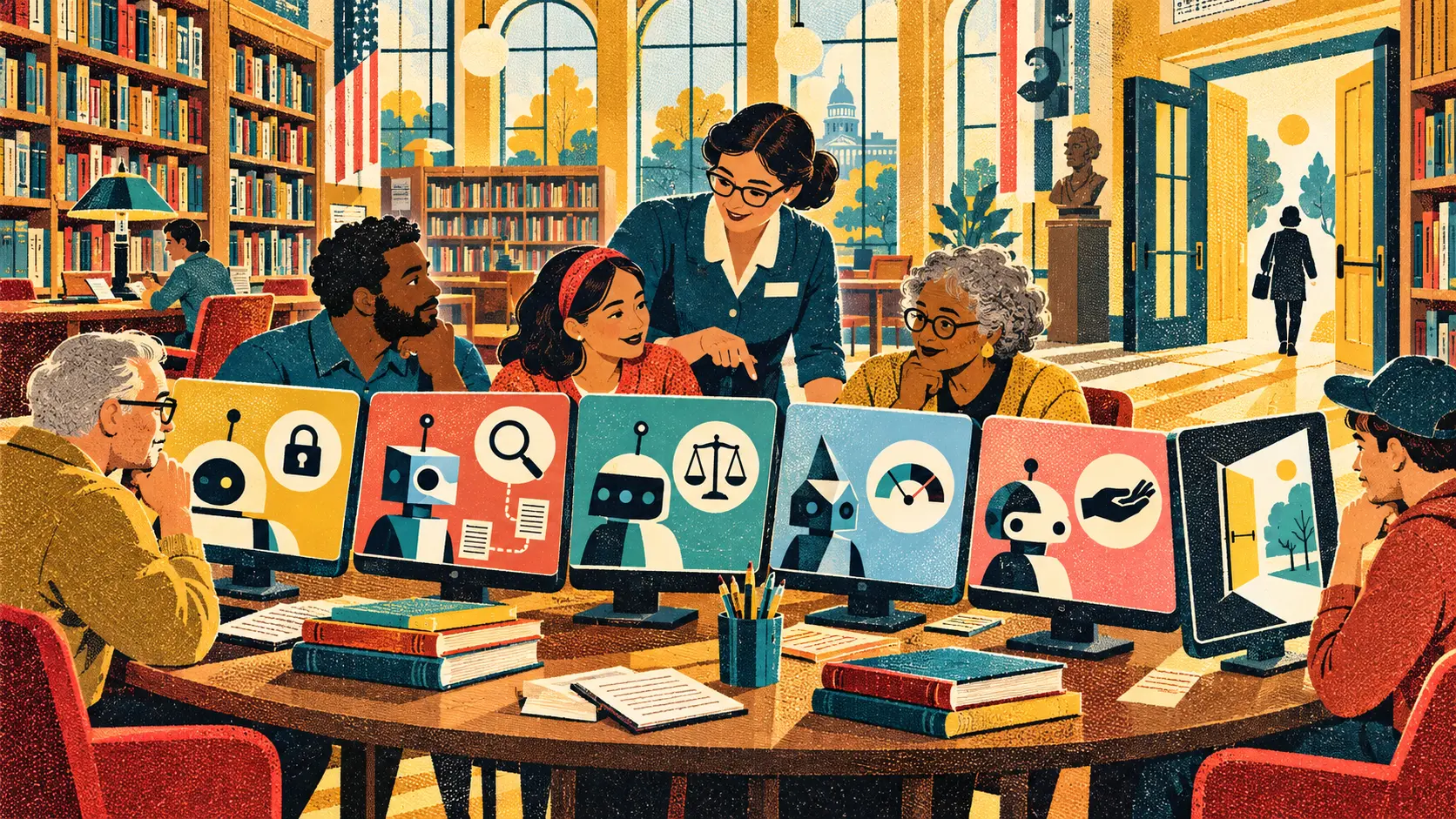
Public libraries have taught people how to use new technology for a very long time. They have also taught something more durable: how to ask whether the information in front of you deserves trust. That second job is the important one now. Microsoft and the Public Library Association have launched Building AI Skills and Agency Through Libraries, a United States program funded by Microsoft. The official PLA page says the effort will provide free training resources, webinars, lessons developed through a national community of practice and material for library workers and patrons. Microsoft's October 22 announcement says the curriculum will cover how AI works, when it may be useful, how to protect personal and confidential information, how to evaluate AI-generated claims and sources, and how to think about safety and bias. Those are sensible goals. The program also arrives with a built-in tension. Microsoft sells AI products. Public libraries do not exist to sell them. PLA says that directly. Its program page states that libraries should neither promote nor discourage particular AI tools. They should help communities understand the tools, use them thoughtfully and ask good questions. The page also says Microsoft instructional designers created the foundational training resources with input from library staff. That can be a useful partnership. It is not a reason to lower the independence bar. The plain signal is simple: train judgment that travels. A patron who completes an AI workshop should be better equipped to evaluate Copilot, ChatGPT, Gemini, a search engine's summary, a job portal's screening assistant and whatever arrives next year. If the lesson only makes one company's interface feel familiar, it has taught product navigation, not AI literacy. The first library exercise should be a choice, not a prompt. Give learners a task and ask whether AI belongs in it at all. Drafting a list of interview questions may be a reasonable use. Uploading a medical record, immigration document or confidential employment complaint to a consumer chatbot may not be. Looking for the opening hours of a local clinic may be faster and safer through the clinic's official page. The point is to make non-use a successful answer. Next, teach people to identify what information leaves the room. Before a patron pastes text into any tool, they should mark names, account numbers, health details, school records, legal facts, workplace secrets and anything else that could harm someone if retained or exposed. The practical habit is small: remove unnecessary details, replace identities with neutral placeholders and check the service's current data controls before sending. Privacy cannot be a tiny footnote below the exciting demo. Then make source checking visible. Ask a model a question about a local benefit, housing rule or public meeting. Have the learner open every cited source. Is the page real? Is it the responsible agency? Is the information current? Does the page support the claim the model made? A confident sentence with a dead link is not evidence. Neither is a real link that says something else. Library workers already teach this habit in ordinary information literacy. AI makes the old skill more urgent because fluent text can hide the gap between sounding sourced and being sourced. A good workshop should include a fake citation on purpose. Let the learner catch it in a safe room before a job application, medical choice or court filing makes the lesson expensive. Comparison comes next. Run the same bounded task through two different AI systems and one non-AI route. Compare the answer, sources, missing context, uncertainty, accessibility and effort. The exercise should not crown a permanent winner. It should show that tools make different mistakes and that an official database, librarian, calculator or ordinary search can sometimes be the better instrument. The current PLA patron page points learners toward several Microsoft and LinkedIn offerings, including a generative AI career path, a productivity path, an AI for job seekers course, Microsoft's AI Literacy Starting Guide and AI Skills Navigator. The job-seeker course specifically uses Microsoft Copilot. Those resources may be useful. They also make product-neutral instruction more than a philosophical preference. It needs to be designed into the room. Every vendor-specific demonstration should have a portable learning objective beside it. If a learner practices revising a Copilot prompt, the objective is not “use Copilot.” It is “state the task, provide necessary context, inspect the answer, correct the request and verify the result.” That sequence works elsewhere. Teach uncertainty as behavior, not decoration. Ask what the model could not know. Ask what might have changed since its training or retrieval. Ask which population, language or point of view may be missing. Ask the system for its sources, then remind learners that the system's confidence is not a measurement unless the product has actually been evaluated for that task. Bias deserves a concrete test too. Use paired prompts for resumes, benefits, neighborhood information or historical descriptions. Change one demographic cue while keeping the task stable. Compare assumptions, tone, recommendations and omissions. A single workshop cannot certify a system as fair, but it can teach patrons to notice when a neutral-looking answer carries an uneven burden. Accessibility should be part of the lesson plan, not an accommodation added after the slides are finished. Provide keyboard access, captions, readable contrast, large print, screen-reader-friendly handouts and alternatives to speech or fine-motor interaction. Offer examples that work on older devices and slow connections. Do not make a new account, a smartphone or a paid subscription the price of learning. Libraries serve people whom commercial onboarding often treats as edge cases. The curriculum should treat them as the public. PLA's library-worker page gives the program a useful public timetable. A webinar on December 3 will cover risks, benefits, policies, privacy, misinformation and critical thinking. A January 20 workshop will introduce library staff to generative AI with human oversight and library expertise kept in view. A February 17 train-the-trainer session will provide modular patron workshops, slides, facilitator notes, hands-on activities, prompt libraries and patron resources. PLA says more patron material on fundamentals, safety, work and careers will arrive in the coming months, and a spring 2027 webinar will share lessons from the pilot year. That means the program is beginning, not proven. Neither Microsoft nor PLA currently publishes the initiative's budget, the number or location of participating libraries, a complete curriculum, an independent governance structure or measured learning outcomes. The PLA pages identify Microsoft funding and Microsoft instructional design. They do not describe who can veto a lesson, how competing vendors will be represented, how conflicts will be disclosed or whether the public can inspect revisions. Those gaps are not accusations. They are the questions a public institution should answer before a pilot becomes a national template. Put a short independence label on every lesson. Name the funder, author, reviewers, release date, tools demonstrated and commercial links. Publish the learning objective separately from the product steps. Give library workers permission to substitute another service or a non-AI method. Keep an archive of revisions so a patron can see when safety or privacy guidance changed. Create a public feedback path too. Library staff will notice which examples confuse people, which translations fail, which accounts demand too much data and which demos quietly stop working. Patrons will find harms that a central design team misses. Record those reports, publish themes without exposing personal information and show what changed in response. Most important, measure judgment instead of attendance. Login counts are easy. Completion certificates are tidy. Neither proves that a learner can make a safer decision. Before and after the workshop, give learners short tasks. Can they identify private information that should not be pasted into a chatbot? Can they find the authoritative source behind a claim? Can they explain one limitation? Can they compare two tools? Can they spot a fabricated citation? Can they choose a human or non-AI route when it is better? Measure the task, not the learner's enthusiasm for the technology. Break results down by language, disability access, device quality, age group and prior experience when participation and privacy rules allow. If one group finishes the course but cannot use the material, the average score is hiding the problem. Library workers also need an escalation path. A class on prompting will inevitably attract questions about benefits, health, legal matters, schoolwork, scams and employment. The lesson should distinguish general education from professional advice, identify authoritative local resources and tell staff when to stop troubleshooting and refer the patron to a qualified person. The library must not become an unpaid help desk for every AI company's mistakes. Microsoft deserves credit for funding no-cost public learning and for naming privacy, sources, safety, bias and the decision not to use AI as part of literacy. PLA deserves credit for stating that the library's role is not to promote a particular tool. Now the program has to prove that principle in its materials, governance and measurements. The best result is not a room full of people who can type better prompts. It is a community that can pause before sharing private data, test a claim before repeating it, compare tools without brand loyalty, notice who is missing and ask a human for help. That kind of judgment will still work after the interface changes. It belongs in a library because it belongs to the public.
01
WHAT ACTUALLY CHANGED
Microsoft and the Public Library Association announced Building AI Skills and Agency Through Libraries on October 22, 2026
Microsoft is funding the initiative and its instructional designers created foundational training resources with library-staff input
PLA says the initiative will provide free lessons, webinars, trainer guidance and resources for library workers and patrons
A national community of practice is expected to develop and share lessons from library implementation
The stated topics include AI fundamentals, privacy, source evaluation, safety, bias and appropriate use
PLA says libraries should not promote or discourage particular AI tools
The library-worker series begins with a December 3 webinar and continues with workshops in January and February 2027
PLA plans to share pilot-year lessons in spring 2027
Current patron resources include Microsoft and LinkedIn courses, including a job-seeker course built around Microsoft Copilot
Neither partner has published a budget, participation count, complete curriculum, independent governance model or measured learning results
02
WHY THIS MATTERS
Libraries are trusted public institutions that reach people commercial training often misses
AI literacy should help people decide whether to use a tool, not only how to operate it
Vendor funding can expand access while creating a need for visible editorial independence
Privacy habits must be learned before patrons paste sensitive records into consumer systems
Fluent AI answers make traditional source checking more important, not less
Comparing tools and non-AI routes prevents familiarity from becoming product loyalty
Bias and accessibility need practical exercises tied to the communities a library serves
Library workers need referral boundaries for legal, medical, benefits and employment questions
Attendance and course completion do not show whether people can make safer decisions
Public revision records and feedback loops can keep training current as products and risks change
03
WHERE IT COULD HELP
- Start every workshop by asking whether AI is appropriate for the task
- Teach patrons to remove unnecessary personal and confidential details before using a tool
- Require learners to open and verify the authoritative source behind an AI-generated claim
- Use a fabricated citation exercise in a controlled classroom setting
- Compare two AI systems with an ordinary search, database, calculator or human expert
- Write portable learning objectives beside every vendor-specific demonstration
- Use paired prompts to reveal assumptions, omissions and uneven treatment
- Provide keyboard, caption, screen-reader, large-print and low-bandwidth learning routes
- Publish the funder, author, reviewers, tools, commercial links and revision date for each lesson
- Let library workers replace a named product without losing the lesson objective
- Measure privacy, source checking, uncertainty, comparison and non-use decisions before and after training
- Create a referral map for professional advice, scams, public benefits and local services
- Publish pilot feedback and curriculum changes without exposing patron information
KEEP A HAND ON THE WHEEL
This is a newly announced, Microsoft-funded program. The partners have published training topics and dates, not independent outcome evidence. The current pages do not disclose the program budget, number or location of participating libraries, a complete curriculum, an independent governance structure, reviewer identities, conflict rules or disaggregated learning results. Some patron resources are Microsoft and LinkedIn products, including a Copilot-based job-seeker course. Libraries should evaluate the finished materials for product neutrality, accessibility, privacy and local relevance.
04
TERMS WORTH KEEPING
OPEN GLOSSARY CARD
Authoritative source
The official or controlling record used to verify a claim, law, decision or quotation.
OPEN GLOSSARY CARD
Selection bias
A distortion that occurs when the people included in a study differ systematically from the wider population the reader may assume they represent.
OPEN GLOSSARY CARD
Accessibility accommodation
A reasonable change to a rule, environment, process, or tool that enables a person with disability to participate on an equitable basis.
SOURCES AND VERIFICATION STATUS
This article was written from the materials below. Product claims and dates were checked against those sources on October 23, 2026.
THE PUBLICATION ENGINE
WANT A SIGNAL OF YOUR OWN?
We build source-grounded publications, private briefings, and editorial systems for organizations with something useful to say.
WORK WITH US