THE SIGNAL IN ONE SENTENCE
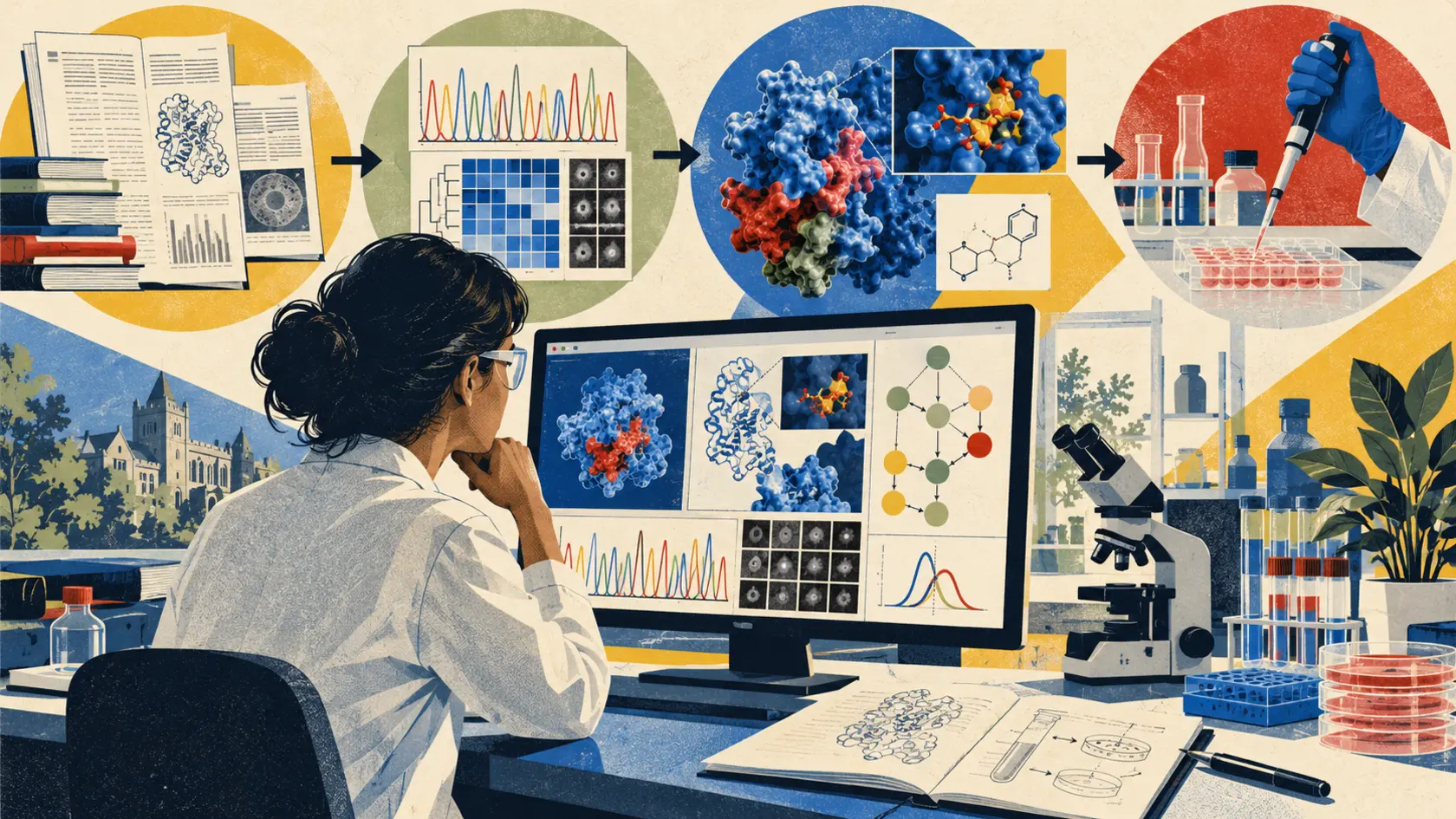
A free research tool is not free if nobody can reconstruct what it did. On October 15, OpenAI introduced the Rosalind Academic Plan for eligible academic labs at U.S. universities. Approved principal investigators and lab leads can activate as many as 30 named ChatGPT Business Standard seats at no cost for up to 12 months. The plan includes commercially available frontier OpenAI models, subject to usage limits, and access to GPT-Rosalind after a separate trusted-access review. GPT-Rosalind is OpenAI's specialized life-sciences model. Rosalind Workbench is the connected environment around it, designed to coordinate scientific tools and data for work in areas such as medicinal chemistry, genomics, sequencing analysis, protein research and experiment planning. The offer is real, but bounded. It is currently for eligible labs at U.S. universities. Access requires approval. The academic plan does not include API access. OpenAI says research data shared through the plan is not used to train its models by default. The company also says it verifies the institution and lab lead, reviews the proposed research, requires an institutional safety contact, and continues monitoring after activation. Those conditions matter because a life-sciences assistant is not merely a clever literature search box. It can help compare molecular candidates, inspect sequences, connect to data tools, plan an analysis and suggest the next experiment. A plausible answer can therefore move surprisingly close to an expensive or sensitive real-world action. The plain signal is that every result needs an evidence chain. That chain should let another scientist answer a basic question: how did this conclusion come to exist? Not just which model wrote the final paragraph. The record needs the original research question, the input data, the model and tool versions, the retrieved papers and databases, the intermediate calculations, the assumptions, the human choices, the rejected alternatives, the experimental controls and the correction history. Without that record, speed becomes fog. A researcher may receive a polished explanation of a protein variant or a ranked list of therapeutic targets. The prose can look finished even when the underlying evidence is mixed, an input file was mislabeled or the tool chain quietly replaced a measured value with a prediction. That distinction appears in one of OpenAI's own examples. A UCSF lab says GPT-Rosalind helped gather physicochemical parameters across ten drugs while the researcher refined the difference between predicted and experimentally measured values. That is exactly the kind of boundary a research record must preserve. A value copied from a curated database is not the same thing as a value inferred by a model. A docking score is not a biological effect. A proposed pathway is not a validated mechanism. A generated protocol is not an approved laboratory procedure. An attractive candidate is not a medicine. The workbench should make those categories harder to blur. Start with the question. Record the research objective before the model starts exploring. Write down the population, organism, assay, endpoint or molecular property being studied. Define what would count as useful evidence and what would falsify the idea. Mark any safety, ethics or data-governance constraints. This prevents the result from quietly changing the question after seeing the data. Next, freeze the inputs. Every dataset should have an identifier, version, source, access date and checksum. Sample labels and exclusion decisions should be preserved. If the workbench uses a paper, database or internal notebook, the relevant passage or record should be linked directly rather than reduced to a citation-shaped decoration. Then freeze the computational environment. Record the GPT-Rosalind version, system instructions, tool versions, database releases, code, parameters and random seeds where they apply. Save the tool calls and returned artifacts. If a run fails and is repeated, keep both attempts. The failed run is often where the useful warning lives. Scientific workflows also need a clean separation between observation and suggestion. An observation might be a sequencing quality metric, a measured concentration or a value retrieved from a named database. A suggestion might be an AI-generated hypothesis, a proposed target, a predicted interaction or a recommended follow-up experiment. Both can be valuable. They should not wear the same badge. Human judgment needs its own line in the record. Who approved the analysis plan? Who changed an inclusion criterion? Who decided that a surprising result was a likely artifact rather than a discovery? Who reviewed the proposed laboratory step? Which decision depended on expertise that was never written into the prompt? The aim is not to create paperwork for sport. It is to stop responsibility from evaporating into a chat transcript. Rosalind Workbench could be especially useful if it turns this evidence chain into the default interface. OpenAI describes sequencing workflows in which researchers inspect inputs, approve an analysis plan, follow the run and review quality-control metrics before choosing the next biological question. That sequence already contains natural checkpoints. Each checkpoint should produce a signed, exportable record. Before a run, the scientist approves the data and plan. During the run, the system records tools, parameters and errors. After the run, the scientist reviews outputs, marks uncertainty and chooses whether to continue. Before wet-lab work, an authorized person checks controls, biosafety and institutional requirements. The final package should travel with the result. A collaborator should not need the same subscription, the same chat history or the same model access to understand what happened. The export should include human-readable notes, machine-readable provenance, code and data references, intermediate artifacts, unresolved questions and a list of components that cannot be shared. That last category matters. Academic research includes restricted datasets, unpublished findings, patient information and sensitive biological work. Reproducibility does not mean dumping everything on the public internet. It means documenting what exists, why access is limited, who can review it and what a qualified independent group would need to reproduce the work under equivalent controls. The sponsored year also needs an exit plan. Twelve months is plenty of time for a lab to build habits around a tool. It is not a guarantee of permanent access. Before adopting the workbench for an important project, the lab should test whether it can export prompts, records, artifacts, tool configurations and review decisions in durable formats. Can a student finish the analysis after the free period ends? Can the lab migrate the workflow to another environment? Can a paper's supporting record still be inspected five years later? Can the institution remove a departing member while preserving their scientific contributions and access history? If those questions wait until month eleven, the plan has already become infrastructure by accident. Evaluation should happen locally too. OpenAI publishes benchmark claims for GPT-Rosalind on life-sciences tasks. Those figures describe selected tests under the company's methodology. They do not tell a particular lab how the system performs on its organisms, instruments, file formats, terminology or experimental standards. Each lab should create a small validation set from work it already understands. Include ordinary cases, ambiguous cases, missing data, mislabeled inputs and examples where a confident shortcut would be dangerous. Compare the AI-assisted workflow with the lab's established process. Measure more than whether the final answer sounds right. Track source accuracy, unsupported claims, omitted evidence, tool failures, correction time, reproducibility, cost, reviewer disagreement and the rate at which scientists accept suggestions without checking them. Repeat the test when a model, tool or database changes. The human factor deserves attention. A free plan can widen access inside a lab, which is useful. It can also create uneven dependence. A senior investigator may treat the system as brainstorming help while a junior researcher mistakes polished output for an approved method. One group may preserve every intermediate artifact while another copies a summary into a notebook. Labs need a common operating rule. Define which tasks are exploratory, which require a second human review, which require institutional approval and which should never be delegated to the system. Train people to challenge citations, distinguish predictions from measurements and report unexpected behavior without worrying that they are slowing everyone down. The point is not to keep AI away from science. Science has always adopted tools that let researchers see more, calculate faster and test questions that were previously impractical. A specialized model connected to real scientific software could be genuinely useful, particularly for small academic groups that cannot build their own AI infrastructure. But a research tool earns trust differently from a consumer assistant. It earns trust when another scientist can inspect the path, rerun the work, find the disagreement and understand why a person chose the next experiment. OpenAI is lowering one barrier by sponsoring access for eligible labs. The next barrier is less glamorous and more important: making AI-assisted research legible enough to survive peer review, staff turnover, model updates, failed experiments and the end of the free year. The breakthrough is not the answer that appears quickly. It is the answer that still makes sense when somebody else follows the evidence all the way back to the bench.
01
WHAT ACTUALLY CHANGED
OpenAI launched the Rosalind Academic Plan on October 15 for eligible academic labs at U.S. universities
Approved principal investigators and lab leads can activate up to 30 named Business Standard seats at no cost for up to 12 months
The plan includes commercially available frontier OpenAI models subject to usage limits
GPT-Rosalind access requires a separate trusted-access approval process
The academic plan does not include API access
OpenAI says research data shared through the plan is not used to train its models by default
Rosalind Workbench coordinates scientific tools and data for life-sciences workflows
The access process includes institutional and lab-lead verification, intended-use review and a designated institutional safety contact
02
WHY THIS MATTERS
Specialized AI can move from literature review to tool use and experimental planning, bringing suggestions closer to consequential action
Polished scientific output can hide the difference between measured values, database records, model predictions and human judgment
Academic labs need reproducible records even when models, subscriptions and connected tools change
Smaller research groups may gain access to capabilities they could not build or operate alone
Sensitive scientific work requires both inspectability and controlled access rather than indiscriminate disclosure
A one-year sponsored plan can create operational dependence unless export and migration are tested early
Company benchmarks do not establish performance on a lab's own organisms, instruments, data and operating standards
Clear human checkpoints help prevent an AI suggestion from becoming an unreviewed experimental action
03
WHERE IT COULD HELP
- Write the research question, success criteria and falsification conditions before asking the model to explore
- Assign identifiers, versions, access dates and checksums to every dataset and reference source
- Record model, tool, database and code versions plus parameters, prompts and returned artifacts
- Label each claim as observed, retrieved, calculated, predicted or proposed
- Preserve failed runs, rejected candidates, negative results and correction history
- Require named human approval at analysis, interpretation and wet-lab checkpoints
- Export human-readable notes and machine-readable provenance with every consequential result
- Build a local validation set containing ordinary, ambiguous, incomplete and adversarial examples
- Measure unsupported claims, missing evidence, tool errors, correction time and reviewer disagreement
- Define tasks that are exploratory, require secondary review, require institutional approval or remain off limits
- Test removal of a departing member without losing the scientific record or access history
- Run an exit exercise before the sponsored period ends and verify that another environment can inspect the workflow
KEEP A HAND ON THE WHEEL
This is an OpenAI access and product announcement, not independent evidence that GPT-Rosalind improves discovery, reproducibility or laboratory safety. Watch for eligibility detail, acceptance rates, usage limits, export formats, model and tool versioning, audit logs, correction workflows, independent evaluations, performance across scientific domains, data-retention controls, publication of negative results, incident reporting and proof that a lab can preserve or migrate its research record when sponsored access ends.
04
TERMS WORTH KEEPING
SOURCES AND VERIFICATION STATUS
This article was written from the materials below. Product claims and dates were checked against those sources on October 16, 2026.
PUBLICATION RECEIPT: The article separates confirmed plan terms and product descriptions from analysis about the evidence, reproducibility, governance and exit practices academic labs should require.
THE PUBLICATION ENGINE
WANT A SIGNAL OF YOUR OWN?
We build source-grounded publications, private briefings, and editorial systems for organizations with something useful to say.
WORK WITH US