THE SIGNAL IN ONE SENTENCE
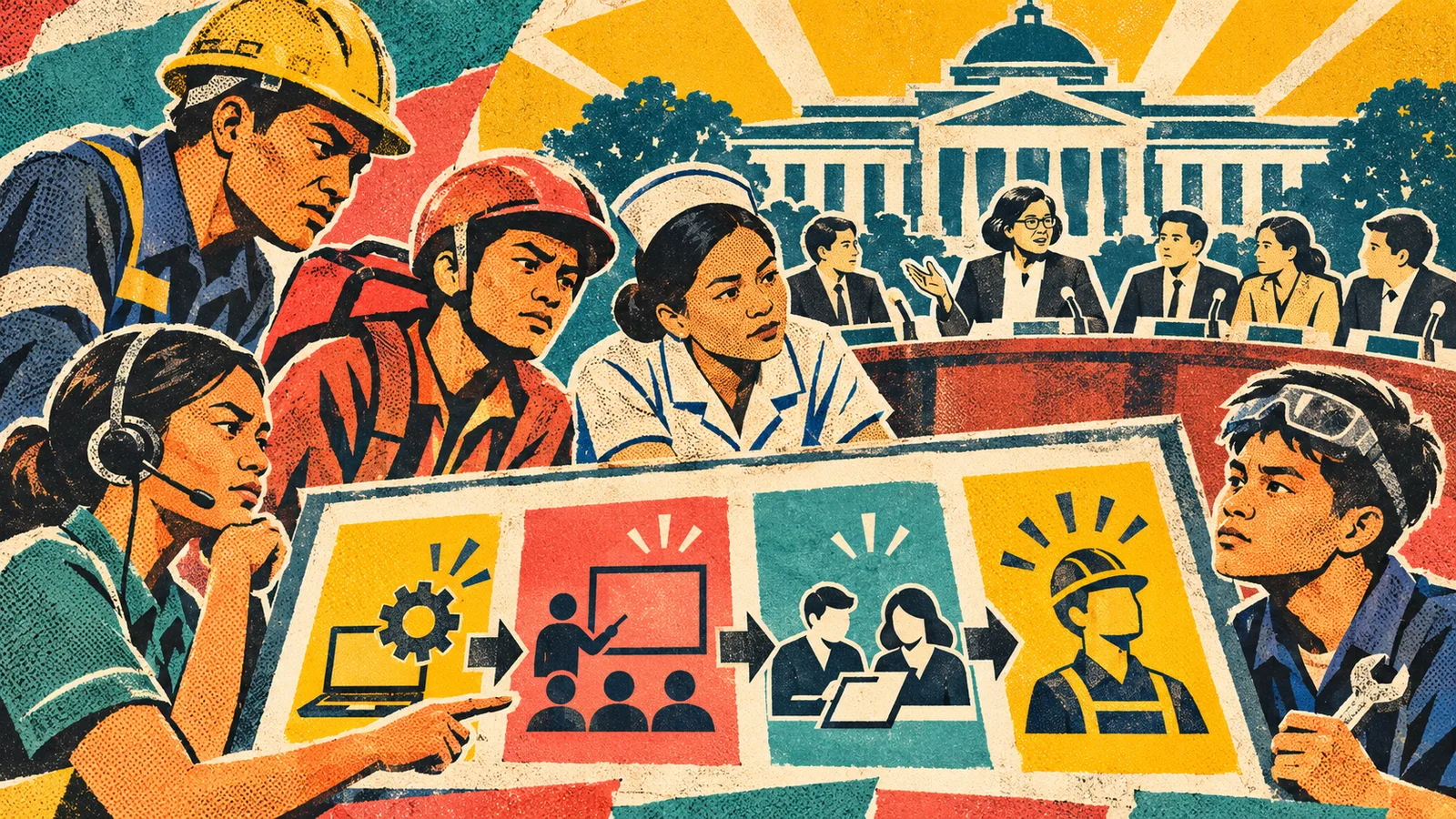
An AI council can include the labor department and still miss the worker. The meeting room is not the workplace. The Philippines has now created a national structure for coordinating artificial intelligence policy. Executive Order No. 131, signed on November 12, adopts a National AI Governance Framework and creates the National Artificial Intelligence Council. On November 20, the Department of Labor and Employment explained what it plans to do inside that structure. The department says it will help address the effects of AI on employment and skills, protect workers' rights and welfare during transitions and contribute to the council's Technical Working Group on Capabilities. That group is expected to develop action plans for a national AI competency and digital workforce development program. DOLE also says it will work with other government agencies, the private sector, academia and other stakeholders. Those are the right rooms to connect. They are not yet a transition plan. The plain signal is this: publish a worker transition ledger. For every sector, occupation and public program affected by AI, record the task that is changing, the people exposed, the employer or agency responsible, the evidence behind the change, the notice workers receive, the paid training offered, the new role or support available and the outcome six and twelve months later. Keep the ledger open enough for workers, unions, employers, schools and local governments to correct it. Do not reduce the future of work to a national estimate of jobs gained and jobs lost. Work changes task by task. A call-center worker may keep the same job title while an automated system drafts replies, scores calls, monitors tone and determines which cases reach a person. A nurse may spend less time on documentation and more time checking machine-generated notes. A factory worker may move from operating equipment to supervising sensors and responding to exceptions. A delivery worker may be managed by a system that changes routes, ratings and access to shifts. One occupation can contain relief, surveillance, deskilling, new responsibility and job loss at the same time. The ledger should begin with the task. Name what is being introduced. Is it a drafting tool, a screening model, a scheduling system, an automated quality check, a customer agent or a performance score? State what the system may recommend, what it may decide and where a person still has authority. Then name the affected workers. Count employees, agency workers, contractors, platform workers, apprentices and people doing informal work when the change reaches them. Break the record down by region, gender, age, disability and other relevant conditions without exposing individual workers. The point is not to build a prettier labor-market dashboard. The point is to stop people from disappearing inside an average. Next, record notice and consultation. Workers should know that a system is being introduced before it changes hiring, schedules, pay, monitoring, evaluation, discipline or access to work. They should receive a plain explanation of the purpose, data used, decision boundary, expected task changes and route to challenge an error. Consultation should happen while the design can still move. Asking workers for feedback after procurement is not participation. It is a product review with fewer stars. The ledger should show who was consulted, what concerns were raised, what changed in response and what remains disputed. Then make training concrete. DOLE's Institute for Labor Studies has already published useful warning signs. In a 2024 employer survey described by the institute, 51 percent of surveyed employers said they had integrated AI, and 64 percent of surveyed employees expressed interest in developing AI skills. The institute also reported limited access to training and uneven readiness. Those figures come from a survey, not a complete census of Philippine workplaces. They should guide questions, not become a slogan. For every training program, publish the target workers, entry requirements, cost, paid time, travel or equipment support, curriculum owner, instructor, practical assessment, completion rate and job outcome. Attendance is not a transition. A worker should be able to demonstrate the new task in the actual environment, understand the system's limits, recognize when it is wrong and know how to escalate a problem. Training should include the work around the model: checking sources, protecting personal information, documenting decisions, handling exceptions and serving people when the system is unavailable. Give workers paid time to learn. Telling someone to reskill at night, on their own device and at their own expense is not a workforce strategy. It is a transfer of cost from the institution making the change to the person carrying the risk. The ledger should distinguish three outcomes. The first is augmentation. The worker keeps the role and gains a tool, with clear responsibility, training and support. The second is transition. The original task shrinks or disappears, but the worker moves to a different role with paid preparation and no hidden loss in wages, hours, security or dignity. The third is displacement. The job or access to work ends. Do not call displacement a skills gap. If a company removes a role because it introduced automation, record that decision, the number of people affected, severance, income support, employment-service referral, training offer, placement result and the time required to regain stable work. PhilJobNet and Public Employment Service Offices can help connect people with opportunities. The ledger should show whether a referral became an interview, whether an interview became a job and whether the job lasted. Count job quality, not only placement. A person moved from regular employment to irregular gig work has not necessarily completed a successful transition. Record pay, hours, benefits, contract status, commuting burden, accessibility, occupational safety and the worker's own assessment of the result. Then give employers a responsibility column. An employer introducing AI should publish the business problem, affected tasks, expected benefits, worker consultation, training budget, redeployment plan, human review, monitoring boundaries and grievance route. If public money supports the training or technology, the public record should include the promised jobs and measured outcomes. This does not require exposing trade secrets. It requires exposing consequences. The same rule should apply to government. If a public agency uses AI in benefits, employment services, inspections, education, health or administration, the ledger should identify the accountable official, legal authority, affected workers and residents, evaluation method, appeal route, incidents and stop conditions. Public deployment can change both the civil servant's job and the citizen's service. Measure both. Now connect the local record to national policy. The National AI Council can set common fields and publish aggregated results. DOLE can own the employment and worker-protection portion. Education and training agencies can record programs and assessments. Employers can report planned changes. Labor organizations and worker groups can challenge omissions. Local governments and public employment offices can add regional evidence. Use permanent identifiers so a promise can be followed over time. A training announcement should later link to enrollment, completion, assessment, placement, wages and retention. A planned automation should later link to the actual task change, incident record, grievance outcome and employment effect. Publish revisions rather than quietly replacing the old entry. The uncomfortable cases are the useful cases. If a training program has high completion and no jobs, keep it visible. If a company predicted augmentation and later cut positions, update the record. If workers report that human review exists only on paper, investigate and publish the result. The ledger should also show what is not known. National AI governance is new. The DOLE statement does not announce a completed competency framework, named training budget, binding employer reporting rule, displacement fund or public outcome dashboard. It does not prove that every affected worker will receive notice, paid training, redeployment or income support. Do not write those benefits into existence. Write the fields that would let the public see whether they arrive. The Philippines is right to put labor inside AI governance. Now put the worker inside the evidence. Name the task. Record the notice. Price the training. Follow the person. Measure the new job. Publish the dispute. Keep the result open long enough to learn from it. That is how a council becomes a transition people can inspect rather than a meeting people are asked to trust.
01
WHAT ACTUALLY CHANGED
Executive Order No. 131 adopts a National AI Governance Framework and creates the National Artificial Intelligence Council.
The Department of Labor and Employment is a member of the council.
DOLE says it will address AI effects on employment and skills and protect worker rights and welfare during transitions.
The department will contribute to a Technical Working Group on Capabilities developing action plans for a national AI competency and digital workforce development program.
DOLE says it will coordinate with other government agencies, the private sector, academia and other stakeholders.
The November 20 statement does not announce a completed competency framework, training budget, binding employer reporting rule or public transition dashboard.
02
WHY THIS MATTERS
AI changes tasks before it changes job titles, so national job totals can hide who is actually carrying the transition.
Workers need notice and consultation before systems affect hiring, schedules, pay, monitoring, evaluation or access to work.
Training is useful only when people receive paid access, practical assessment and a realistic path into stable work.
A placement count can hide lower pay, insecure contracts, lost benefits or inaccessible work.
Employer and public-agency records can connect technology decisions to accountable owners and measurable worker outcomes.
Longitudinal evidence can distinguish augmentation, transition and displacement rather than treating every change as reskilling.
03
WHERE IT COULD HELP
- Record the exact task, system, affected workers, accountable employer or agency and expected change.
- Publish notice, consultation, worker concerns, design changes and unresolved disputes.
- Give workers paid training time, equipment and practical assessments tied to real tasks.
- Track completion, interviews, placement, pay, hours, benefits, contract status and job retention.
- Separate augmentation, transition and displacement in public reporting.
- Require employers introducing AI to publish worker-impact and redeployment plans.
- Connect public training support to promised jobs and measured outcomes.
- Record the human decision boundary, monitoring limits and grievance route for workplace systems.
- Follow displaced workers through employment services and publish whether referrals produce stable work.
- Keep historical entries and visible revisions so predictions can be compared with results.
KEEP A HAND ON THE WHEEL
The DOLE statement describes the department's intended role in the new national AI governance structure. It is not evidence that a national competency framework, digital workforce action plan, transition fund, employer reporting rule or worker outcome dashboard has been completed. The Institute for Labor Studies figures come from a 2024 survey described by the institute. They are not a complete census of all Philippine employers or workers and do not establish current national adoption rates. Government commitments to protect workers should be evaluated through budgets, rules, programs and outcomes. Watch for the council's membership and operating procedures, the Technical Working Group's deliverables, a public competency framework, funded training, employer duties, labor consultation, regional access, displacement support, PhilJobNet and Public Employment Service Office outcomes, grievance routes and published measures of wages, job quality and retention.
04
TERMS WORTH KEEPING
SOURCES AND VERIFICATION STATUS
This article was written from the materials below. Product claims and dates were checked against those sources on November 20, 2026.
THE PUBLICATION ENGINE
WANT A SIGNAL OF YOUR OWN?
We build source-grounded publications, private briefings, and editorial systems for organizations with something useful to say.
WORK WITH US