THE SIGNAL IN ONE SENTENCE
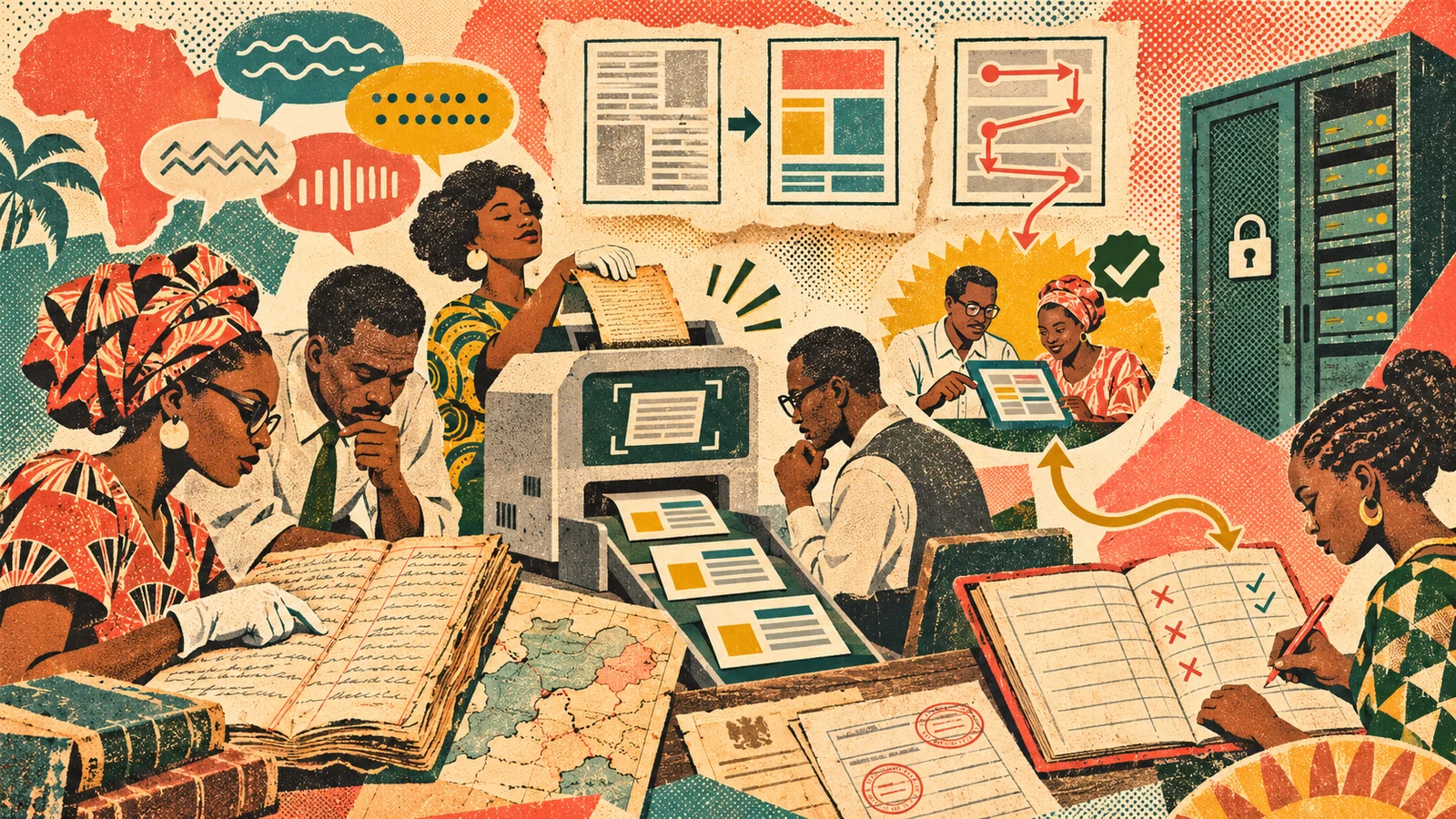
A government archive is not just a pile of old paper. It is a sleeping database with terrible handwriting. Amini has released Soma-1X Lite, an open-weight, 2-billion-parameter vision-language model built to turn scanned documents into structured, machine-readable records. It extracts text, page layout, semantic elements, bounding boxes and reading order. Tables can become HTML. Mathematical expressions can become LaTeX. The model is available under Apache 2.0 with inference and evaluation material. The size matters. Amini says Soma-1X Lite can run on a single GPU inside private or sovereign infrastructure. That makes it more practical for institutions that cannot send land records, police diaries, cabinet papers, civil registries or mineral surveys to an outside cloud. The origin matters too. The Nairobi-founded company says the work grew from processing millions of government records in private environments. It names handwritten police diaries and historical cabinet papers in Barbados, plus geological maps and mineral-resource records in Botswana. Amini says the Central African Republic is expected to follow. This is the kind of AI story that deserves attention. It is small enough to use, open enough to inspect and aimed at documents that large benchmarks often ignore. It can also turn one uncertain transcription into a very official mistake. The plain signal is this: keep the ground-truth ledger. For every processed page, preserve the source image, model version, prompt or decoding settings, extracted text, layout, reading order, confidence, human correction, reviewer identity or role, language, access rights and every system that later consumed the result. Do not let machine-readable become true by formatting. A scanned page carries several layers at once. There are words. There are headings, footnotes, stamps, marginal notes, signatures, crossed-out lines, tables, columns and annotations added years apart. Reading order can decide whether a number belongs to a person, parcel, payment or paragraph. A faded mark can be noise, punctuation or evidence. Document models try to recover that structure, not merely recognize characters. Soma-1X Lite reports competitive company-run results. Its model card lists 84.7 on olmOCR-Bench and 84.37 on OmniParse-Bench. A multi-pass harness that selectively reprocesses difficult regions raises the reported OmniParse score to 86.53. Amini also reports a mean character error rate of 2.90 percent across an internal set spanning ten African languages. Useful numbers. Not universal permission slips. The ten-language set is internal. A single mean can hide which language, script, page condition or record type caused the errors. Public benchmarks do not automatically represent a handwritten police diary, a colonial map, a folded birth register or a table copied through three generations of carbon paper. The ledger should break performance down where the institution actually works. Start with the page. Give every source image a stable identifier and cryptographic digest. Record where it came from, who may view it, the scan date, resolution, color mode, missing edges, rotation, bleed-through, damage and whether multiple pages were accidentally combined. If the page is rescanned, keep both versions. Then record the model pass. Name the exact checkpoint, tokenizer, code revision, quantization, hardware, image preprocessing, prompt, temperature, maximum output length and multi-pass settings. Soma-1X Lite is a 2B model based on Qwen3.5-2B-Base. A future update, quantized build or custom fine-tune may produce a different record from the same page. Reproducibility begins before the first corrected word. Preserve the raw output as well as the cleaned version. If a pipeline silently fixes punctuation, normalizes spelling, expands abbreviations or rearranges columns, those are additional transformations. Each can be useful. Each can also erase evidence or change meaning. A land parcel number is not a suggestion. A date is not close enough. A person’s name cannot be improved into a more common name because the model prefers it. The reviewer needs a side-by-side view. Show the image region, extracted text, structure and uncertainty together. Let the reviewer accept, correct, mark unreadable or request a better scan. Record the reason for the change. Separate a transcription error from an archival ambiguity. If two qualified reviewers disagree, preserve the disagreement instead of forcing a false certainty. That last part is especially important for historical material. An official document can contain outdated language, discriminatory classifications, administrative bias or a claim later shown to be false. Accurate digitization means preserving what the source says without endorsing it. A faithful transcription of a bad record is still a bad record. The ground-truth ledger should therefore keep provenance beside content. Who created the original record? Under which law, office or colonial administration? Was the document complete? Was the writer reporting firsthand knowledge? Has the institution corrected or superseded it? These questions are not model evaluation in the narrow sense. They are what stops searchable history from becoming context-free truth. Language deserves its own section. Amini’s internal evaluation spans ten African languages, and the examples include historical documents from several regions. That is welcome. African records can combine colonial languages, local languages, older orthographies, handwritten notes and administrative shorthand on the same page. Report errors by language and script, not only as one average. Track names, places, numbers, dates, legal terms and culturally specific vocabulary separately. Invite local archivists and language experts to define what counts as a serious mistake. Pay them when their corrections become evaluation cases, training data or product improvements. Open weights do not make community knowledge free. The same goes for layout. A model can transcribe every visible word and still connect the wrong label to the wrong value. Test reading order, nested tables, merged cells, multi-column pages, maps, seals, footnotes, handwriting over printed text and annotations at odd angles. For high-consequence records, validate fields twice. If an extracted civil record affects identity, benefits or inheritance, require human review and an appeal route. If a geological map influences mineral policy, preserve the map geometry and the assumptions used to convert it into structured features. If a police diary enters a search system, restrict access, preserve context and audit every lookup. Digitization can increase access. It can also increase exposure. A paper file in a locked room is difficult to search at scale. Once parsed, indexed and connected to an agent, the same names and incidents may be discoverable in seconds. Institutions need purpose limits, role-based access, retention rules, redaction, export controls and query logs before they celebrate a searchable archive. Running the model locally helps with one boundary. It does not settle the governance inside that boundary. A sovereign server can still grant the wrong employee broad access. A ministry can still reuse records for a purpose people never expected. A local deployment can still be insecure, biased or impossible to appeal. Sovereignty answers where the machine runs and who controls the infrastructure. Accountability asks what the controller is allowed to do. The ground-truth ledger connects the two. Every extracted field should point back to its page and region. Every correction should have a reviewer and reason. Every downstream index, dashboard or assistant should declare which version it used. When a correction arrives, dependent systems should be able to invalidate the old value and rebuild. Call it data lineage with a pulse. Without that chain, institutions can end up with two truths: the fragile paper nobody can search and the clean database nobody can explain. The release is also a chance for independent work. Amini publishes weights, evaluation scripts and technical documentation. Researchers can test the model on other scripts, record types and scan conditions. Archives can create representative, rights-cleared test sets. Governments can publish error cards without exposing the records themselves. Competing models can be compared with the same review protocol. Use those openings. Reproduce the public benchmark scores. Measure latency, memory and cost on the hardware institutions actually own. Test native precision and quantized variants. Publish representative failures. Check whether the multi-pass harness improves difficult regions or merely spends more compute on pages the first pass already misunderstood. Most importantly, measure the human work that remains. How many pages need no correction? How many need a quick fix? How many require a language specialist, archivist, surveyor or lawyer? How long does review take? Which errors recur? Which records should never enter an automated pipeline? A compact model can make millions of pages legible. The ground-truth ledger makes the process accountable. That is the difference between waking an archive and putting words in its mouth.
01
WHAT ACTUALLY CHANGED
Amini released Soma-1X Lite as an Apache 2.0 open-weight, 2-billion-parameter vision-language model for document parsing.
The model extracts text, semantic elements, bounding boxes, reading order, tables and mathematical expressions from document images.
Amini reports 84.7 on olmOCR-Bench and 84.37 on OmniParse-Bench, with 86.53 using its multi-pass inference harness.
Amini reports a 2.90 percent mean character error rate across an internal evaluation spanning ten African languages.
The model is designed to run on a single GPU within private or sovereign infrastructure.
The release draws on government-record processing work in Barbados and Botswana, with additional work described for the Central African Republic.
02
WHY THIS MATTERS
Digitizing paper records can make public knowledge accessible while also turning uncertain model output into authoritative-looking data.
Document understanding depends on layout, reading order, tables, annotations and provenance, not only character recognition.
Local inference can reduce external data transfer but does not replace access controls, purpose limits, review and appeal.
Internal language averages can hide uneven error rates across languages, scripts, names, dates and high-consequence fields.
Searchable archives create new privacy and surveillance risks even when the original paper was lawfully collected.
Open weights and evaluation code make independent reproduction and locally relevant testing more feasible.
03
WHERE IT COULD HELP
- Assign every source page a stable identifier, digest, provenance record and rights label.
- Record the exact model checkpoint, code, hardware, preprocessing, prompt, decoding and multi-pass settings.
- Preserve raw extraction beside every normalized or cleaned representation.
- Give reviewers a page-region view with accept, correct, unreadable and rescan options.
- Track corrections by language, script, record type, field, error class and consequence.
- Require dual review for identity, land, legal, mineral, financial and other high-consequence fields.
- Link every structured value back to its source image and human review history.
- Invalidate downstream indexes and assistants when a corrected record replaces an earlier extraction.
- Audit searches, exports and agent access after paper records become machine-readable.
- Compensate archivists and language experts whose corrections become benchmarks or training data.
KEEP A HAND ON THE WHEEL
Watch for independent reproduction of the reported benchmark scores, public details of the ten-language evaluation, error rates by language and script, testing on degraded and handwritten records, map and table accuracy, quantized-model behavior, review time, archival-rights guidance, privacy and appeal controls, government procurement terms, downstream correction propagation and evidence from live institutional deployments beyond company-reported examples.
04
TERMS WORTH KEEPING
SOURCES AND VERIFICATION STATUS
This article was written from the materials below. Product claims and dates were checked against those sources on November 26, 2026.
THE PUBLICATION ENGINE
WANT A SIGNAL OF YOUR OWN?
We build source-grounded publications, private briefings, and editorial systems for organizations with something useful to say.
WORK WITH US