THE SIGNAL IN ONE SENTENCE
A good teaching showcase should end with applause. It should not end with the applause. That is the useful lesson inside a new report from Asia University in Taiwan, where eight teachers recently presented classroom work involving artificial intelligence, augmented reality, simulation and new forms of assessment. The university's Teaching Resources and Faculty Professional Development Center held two hybrid sessions on October 21 and 28. The program brought together examples from general education, design, health and nursing, and business and management. Asia University says the sessions drew 236 in-person and online participations and received 99.2 percent positive feedback for satisfaction and willingness to recommend. Those are healthy signs for a professional-learning event. People came. They stayed interested. They apparently did not spend the afternoon quietly searching for the exit. But the number is about the showcase, not the students whose learning was being showcased. It does not tell us whether a nursing student recognized deterioration in a patient three months later. It does not show whether an English learner could identify a weak argument without a model beside them. It does not establish that an interior-design student produced a lower-carbon plan, understood the calculation or could defend a tradeoff when the software disagreed. The distinction sounds fussy until a bright demo becomes a curriculum. Asia University's November 2 report describes examples that are genuinely worth watching. Teachers used AI virtual patients to simulate clinical situations. Augmented reality supported emergency and critical-care nursing. Generative AI entered English critical-literacy work. AI image processing and carbon-footprint calculation were connected to low-carbon interior renovation design. These are not four versions of the same chatbot assignment. They put technology into different learning loops, with different risks and different definitions of success. A virtual patient can give a nursing student more chances to practice a conversation or a clinical judgment without putting a real patient at risk. An augmented-reality scenario can layer cues onto a simulated emergency. A language course can ask students to interrogate generated claims, assumptions and sources. A design course can use computation to explore material choices and carbon consequences. That variety is the point. It is also why one satisfaction number cannot evaluate the lot. The university's own event notice said the sessions would cover teaching design, research methods and outcome assessment. That framing is sensible. The next step is to make the assessment legible enough that another teacher can understand what changed, what was measured and what remains uncertain. Every AI teaching experiment needs a learning receipt. The receipt starts before the tool appears. Record the learning objective in ordinary language. Then capture a baseline task that students complete without the new system. If the goal is clinical reasoning, the baseline should test clinical reasoning. If the goal is critical literacy, it should test whether students can inspect a claim, trace a source and explain why an argument holds or fails. A generic attitude survey cannot stand in for either one. Next, describe the assignment and the permitted role of AI. Was the system generating a patient response, supplying visual overlays, drafting text, translating material, calculating carbon, giving feedback or scoring work? Could students revise its output? Were they required to cite its contribution? Was there a point when the tool had to be turned off? Without that role description, the phrase AI-enhanced learning can cover almost anything from spell-checking to automated judgment. Then preserve the student work. The useful artifact is not only the final answer. Keep the initial attempt, the tool interaction, the student's corrections, the teacher's intervention and the final submission. That sequence shows whether the learner noticed an error, copied it, challenged it or learned to ask a better question. In a clinical simulation, preserve the cues that were available and the decisions the student made. Record whether the virtual patient behaved consistently and whether a qualified instructor reviewed the scenario. A nursing student should not lose marks because a synthetic patient wandered off-script in an entertaining but medically implausible direction. In critical-literacy work, keep the source trail. Ask students to separate claims from evidence, identify missing context and compare the generated material with primary documents. The model can be the suspicious classmate who always sounds certain. It should not become the answer key. In low-carbon design, keep the inputs behind the calculation. Material quantities, emission factors, assumptions, geographic boundaries and software versions belong beside the polished rendering. A beautiful room does not become low carbon because the dashboard chose a soothing shade of green. Teacher intervention needs its own line on the receipt. If an instructor corrected a scenario, changed a prompt, supplied a source, re-explained a concept or overrode an automated score, that is part of the teaching. Hiding it makes the system look more capable and the pedagogy less reproducible. Accessibility belongs there too. A headset may create an immersive experience for one student and a migraine, mobility barrier or visual-access problem for another. A speech interface may work unevenly across accents. A generated English passage may be easier for a fluent reader than for a student who is still learning the language. The experiment should offer an equivalent route and report who could not use the default one. Then grade the thing that matters. Use a rubric tied to the learning objective. For clinical work, that might include cue recognition, prioritization, communication and justification. For critical literacy, it might include source quality, contradiction detection, uncertainty and revision. For design, it might include functional quality, carbon reasoning, material evidence and the ability to explain tradeoffs. Do not let speed swallow the rest of the rubric. AI often makes a task faster. Faster can be useful. It is not the same as better, safer or more deeply understood. The receipt also needs a transfer task. Give students a new case that does not resemble the demo. Change the patient, source, language, room, material constraint or data quality. If the learner can only succeed when the interface, prompt and example all look familiar, the system may have trained a procedure rather than developed a capability. Finally, check later. A retention test after several weeks tells us whether the knowledge stayed when the novelty faded. Include a no-AI checkpoint where the learner explains the reasoning unaided. The goal is not to ban tools from real work. It is to find out what the student can carry when the tool is unavailable, wrong or inappropriate. That sequence produces a more honest result than a victory graph made from smiles at the end of a presentation. It also lets teachers compare experiments without pretending they are identical. One course may find that a virtual patient improves the number of safe practice attempts but not long-term diagnostic reasoning. Another may find that generated examples help English learners critique weak arguments, provided the assignment requires source checking. A design studio may discover that students explore more alternatives but accept shaky carbon inputs too easily. Those mixed findings are not failures. They are the useful part. Asia University's report is a university-authored account of two sharing sessions. It is not a controlled comparison of student outcomes, and the public page does not publish the underlying instruments, response counts for the 99.2 percent figure, course-level baselines, retention results or complete datasets. The report also says teachers presented teaching-practice research and varied forms of assessment. That means some evidence may exist beyond what appears in the public summary. The careful conclusion is not that the projects lacked measurement. It is that the announcement does not give readers enough detail to judge the measurement. That is a common publication problem in education technology. A campus does the hard work. Teachers redesign courses, collect student work and discover awkward limitations. Then the public story compresses everything into participation, satisfaction and a cheerful photo. The most valuable evidence is left in the room. Institutions can fix that without publishing private student records. Release a one-page learning receipt for each experiment. Name the course, objective, cohort, comparison, permitted AI role, assignment, rubric, accessibility route, teacher intervention, measured result, retention window, known limitation and next revision. Aggregate small groups where privacy requires it. Publish instruments or sample tasks when possible. Version the receipt when the course changes. For clinical education, add expert validation of scenarios and a safety review. For language and literacy work, add source-provenance and authorship rules. For sustainability calculations, publish the boundaries and factor sources. For every course, explain what students still need to do without the tool. The result would not be a leaderboard for teachers. It would be a map of what happened in the classroom. The eight presentations in Taiwan matter because they show that AI in education is already splitting into many practical forms. The debate is no longer simply whether students should use a chatbot. It is about simulation, overlays, critique, calculation, authorship, access and the changing role of the instructor. That deserves more than a thumbs-up survey. Keep the applause. It tells us the work attracted attention. Then open the learning receipt and find out what the students could still do after everybody went home.
01
WHAT ACTUALLY CHANGED
Asia University published a November 2 report on two teaching-practice results sessions held on October 21 and 28 in Taiwan.
Eight teachers presented work from general education, design, health and nursing, and business and management.
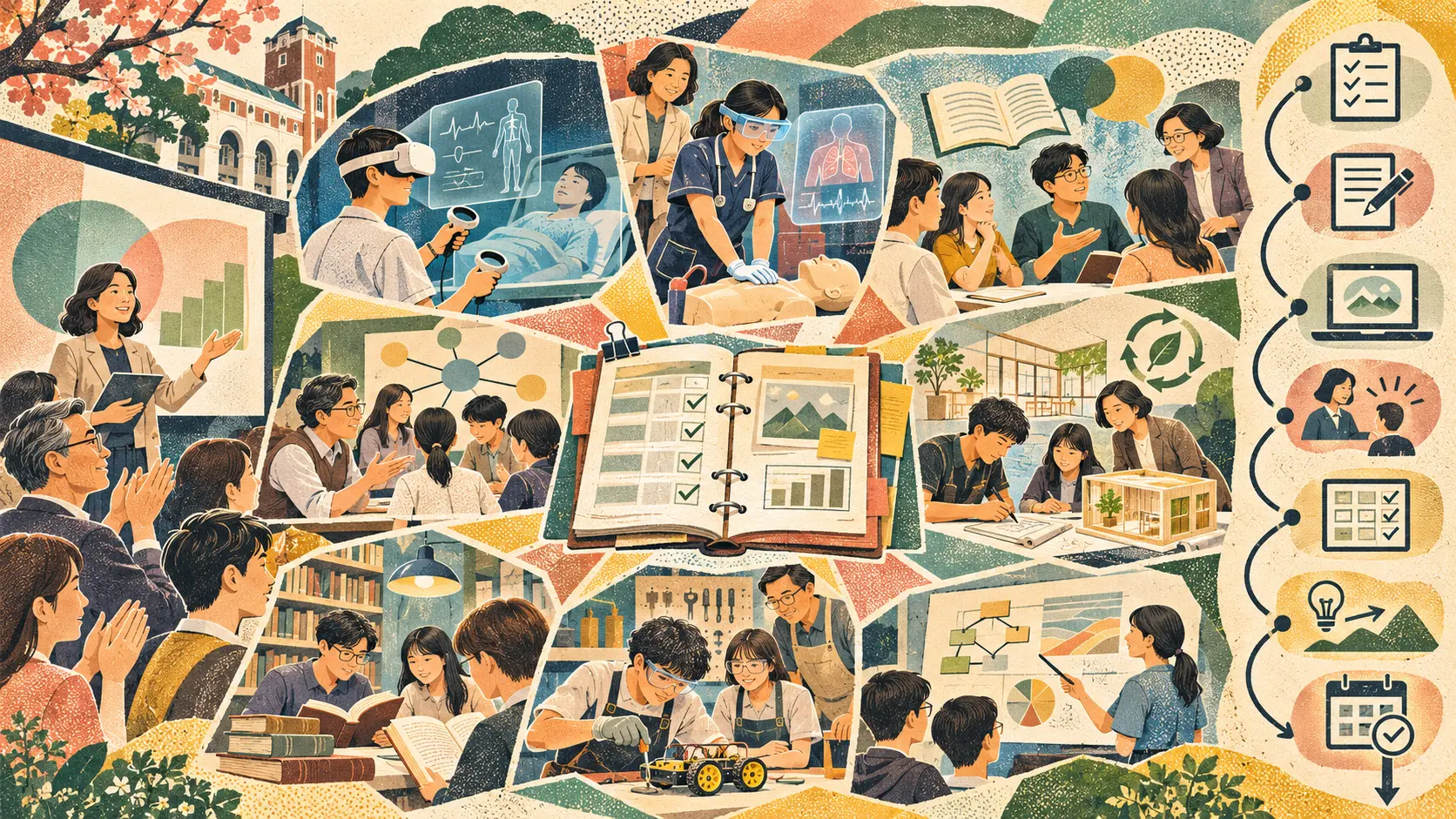
The university highlighted AI virtual patients, augmented reality for emergency and critical-care nursing, generative AI in English critical literacy, and AI image processing with carbon-footprint calculation for low-carbon interior design.
The two hybrid sessions recorded 236 in-person and online participations.
Asia University reported 99.2 percent positive feedback for satisfaction and willingness to recommend the sessions.
The public report describes a professional-learning showcase, not a controlled comparison of student learning outcomes.
02
WHY THIS MATTERS
AI teaching tools now play very different roles across simulation, visual guidance, writing, critique and calculation, so one evaluation measure cannot fit every course.
Event satisfaction shows whether a session was useful to attendees. It does not establish student retention, transfer, clinical competence, critical literacy or lower-carbon design performance.
A baseline and later no-AI task can show what students learned rather than only what the tool helped them produce.
Preserving drafts, tool interactions, corrections and teacher interventions makes the learning process inspectable without pretending the system worked alone.
Accessibility alternatives are necessary when headsets, speech interfaces or generated language create barriers for some learners.
Course-specific rubrics and transfer tasks can reveal whether gains survive outside the exact demo conditions.
Public learning receipts would let institutions share useful evidence while aggregating or withholding private student data.
03
WHERE IT COULD HELP
- State the learning objective and collect a baseline task before introducing the AI or immersive tool.
- Record the system's allowed role, including generation, translation, simulation, calculation, feedback or scoring.
- Preserve the student's initial work, tool interaction, corrections, teacher intervention and final submission.
- For virtual patients, validate scenarios with qualified clinical instructors and log inconsistent model behavior.
- For critical-literacy assignments, require primary-source tracing, contradiction checks and an explanation of uncertainty.
- For carbon calculations, retain quantities, emission factors, geographic boundaries, assumptions and software versions.
- Offer an equivalent non-headset, non-speech or otherwise accessible route and record who could not use the default experience.
- Use a course-specific rubric that rewards reasoning, evidence and correction rather than speed alone.
- Give students a transfer task with a new case, source, constraint or interface.
- Run a retention check several weeks later and include a no-AI explanation of the reasoning.
- Publish a privacy-safe learning receipt with the cohort, comparison, result, limitation and planned revision.
KEEP A HAND ON THE WHEEL
Asia University's November 2 page is an institutional report about two results-sharing sessions. It supports the event dates, eight presenters, named examples, participation total and 99.2 percent feedback figure. It does not provide the response count behind that percentage, the survey instrument, course-level baselines, comparison groups, complete assessment rubrics, retention tests, raw student outcomes or independent replication. The public report says teachers shared teaching-practice research and assessment approaches, so underlying evidence may exist outside the announcement. This article does not conclude that the projects lacked evaluation. It concludes that event satisfaction should not be presented as a substitute for inspectable evidence of student learning. The learning-receipt workflow is analysis by The Plain Signal, not an intervention tested by Asia University.
04
TERMS WORTH KEEPING
SOURCES AND VERIFICATION STATUS
This article was written from the materials below. Product claims and dates were checked against those sources on November 4, 2026.
THE PUBLICATION ENGINE
WANT A SIGNAL OF YOUR OWN?
We build source-grounded publications, private briefings, and editorial systems for organizations with something useful to say.
WORK WITH US