THE SIGNAL IN ONE SENTENCE
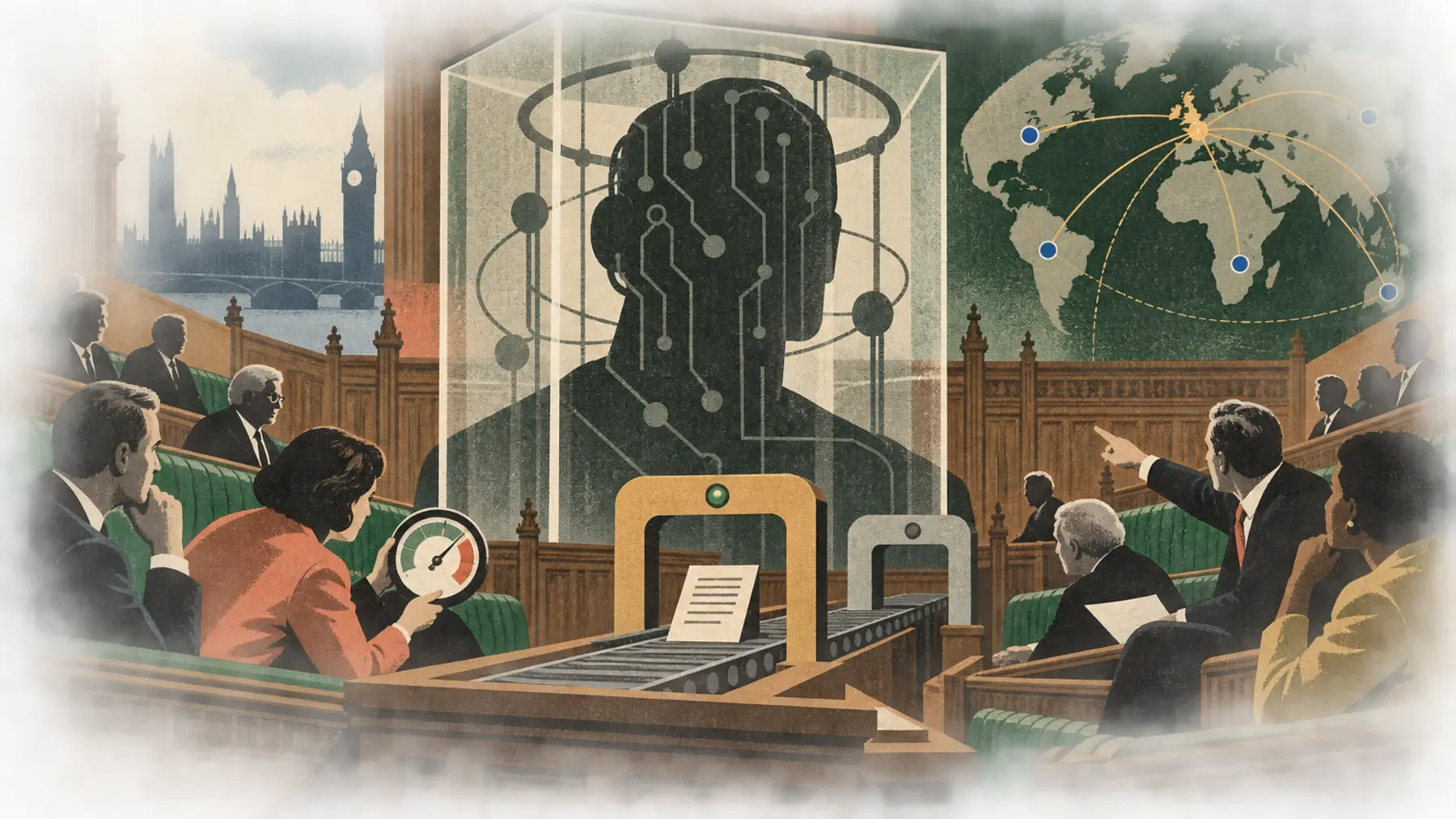
Labour MP Alex Sobel has introduced a private member's bill that aims to prohibit the development, deployment, and operation of artificial superintelligence in the United Kingdom. His proposal would also give government monitoring and control powers over possible precursors and encourage an international prohibition. Parliament has completed only the first reading. The detailed bill text is not yet public, the technology is hypothetical, and the government says this is not the right approach.
01
WHAT ACTUALLY CHANGED
On September 8, Labour MP Alex Sobel used Parliament's Ten Minute Rule to introduce the Artificial Superintelligence Bill. The Commons agreed that he could present it, and the bill received its first reading. UK Parliament lists the next stage as a second reading scheduled for November 13. That date is provisional, and a place on the calendar does not mean the bill has government support or enough time to become law.
The official long title states the ambition plainly: prohibit the development, deployment, and operation of artificial superintelligence systems, establish monitoring and control powers over such systems, and make connected provisions. That is all the enacted-looking language readers can safely rely on today. Parliament's publication record contains no bill document, so the clauses, enforcement powers, penalties, institutional roles, and territorial reach are not yet available for inspection.
Sobel's Commons speech supplies the intended theory. Instead of defining superintelligence with a fixed benchmark or amount of computing power, he proposed an outcome test: a system capable of seriously damaging UK security by neutralising, displacing, circumventing, subverting, or rendering ineffective relevant human authorities. He identified recursive self-improvement, meaning AI that automates further AI development without people in the loop, as a clear warning capability.
The proposal does not stop at the final hypothetical system. Sobel said it would let government monitor and, when necessary, restrict precursors to superintelligence. He also argued for an international agreement, potentially enforced through choke points such as advanced chips. Those details come from the sponsoring MP's presentation, not published statutory clauses. They describe the bill he intends, not a legal instrument anyone can yet audit line by line.
The political campaign expanded on September 11 when more than 70 MPs and peers urged Prime Minister Andy Burnham to support the bill and use Britain's coming G20 presidency to build an international coalition. The government declined. A spokesperson told the Guardian that ministers do not consider the proposed measures the right approach, while leaving open the possibility of more targeted action against serious AI-related national security risks.
02
WHY THIS MATTERS
Legislating before a capability exists is not automatically absurd. Safety law often tries to stop a catastrophic event before someone can demonstrate it in the town square. The challenge is that a legal trigger must still be observable. If a regulator cannot tell which system has crossed the line, developers cannot know which work is prohibited and inspectors cannot prove a violation. A frightening noun is not yet a regulatory instrument.
An outcome-based definition may age better than a number tied to today's hardware, but it creates its own measurement problem. A system might outperform people in cyber operations, scientific research, persuasion, or software design without being able to displace public authority as a whole. Regulators would need repeatable tests, access to relevant models, secure evaluation facilities, and a rule for handling uncertain or concealed capabilities before a court could treat the threshold as more than an expert argument.
Precursors are where the proposal becomes both practical and dangerous. Recursive self-improvement, automated AI research, advanced chips, large training runs, and autonomous tools may provide earlier signals than a finished superintelligence. They also support useful research and products. Monitoring them could create warning time. Restricting them without narrow definitions, due process, and appeal could freeze ordinary work that was never capable of producing the prohibited outcome.
The international problem is not a footnote. A UK prohibition could prevent development inside Britain while doing little about a system built elsewhere and delivered through a network. Sobel's own speech acknowledges this. An enforceable agreement would need shared definitions, compatible monitoring, protected inspections, evidence standards, consequences for violations, and enough participating chipmakers, cloud providers, states, and laboratories to cover the important routes around the rule.
The bill also reveals a useful split in the safety debate. Supporters see an irreversible capability and want a hard boundary before the evidence arrives too late. The government prefers targeted interventions against specific national security risks. Both positions eventually face the same unglamorous questions: what gets measured, who gets access, what action follows, how mistakes are corrected, and which institution remains responsible when the system or the regulator is wrong.
03
WHERE IT COULD HELP
- Define any prohibited capability with observable outcomes and repeatable tests
- Separate monitoring powers from restriction powers and require evidence for each step
- Give laboratories a confidential route to disclose concerning capabilities without publishing dangerous details
- Create independent evaluation access, review rights, and an appeal process before imposing restrictions
- Design international verification around shared definitions, chips, compute, cloud infrastructure, and model access
KEEP A HAND ON THE WHEEL
This is a private member's bill introduced under the Ten Minute Rule, not government legislation, enacted law, or an agreed international policy. First reading is a formal introduction and does not mean Parliament approved the substance. The second reading is scheduled for November 13, but future parliamentary dates can change and private members' bills often lack enough time or support to progress. No bill document was listed by Parliament at verification, so claims about precise clauses, penalties, chip controls, precursor thresholds, or enforcement mechanisms must be attributed to Sobel's September 8 speech rather than treated as settled text. Artificial superintelligence does not currently exist, forecasts and extinction-risk estimates are disputed, and recent harmful or deceptive behavior by narrower systems does not prove that a future system will meet the proposed threshold. The government opposes the bill's approach while considering whether targeted interventions may be needed.
04
TERMS WORTH KEEPING
OPEN GLOSSARY CARD
Recursive self-improvement
A process in which an AI system contributes to making later versions of itself or its development process more capable, potentially creating a repeated improvement loop.
OPEN GLOSSARY CARD
Artificial superintelligence
A hypothetical AI system whose broad capabilities would greatly exceed human abilities and could resist or displace human control.
OPEN GLOSSARY CARD
Ten Minute Rule
A Commons procedure that lets an MP make a short case for introducing a bill, usually without giving it the time or support available to government legislation.
SOURCES AND VERIFICATION STATUS
This article was written from the materials below. Product claims and dates were checked against those sources on September 11, 2026.
PUBLICATION RECEIPT: Revision 1. Published September 11, 2026.
THE PUBLICATION ENGINE
WANT A SIGNAL OF YOUR OWN?
We build source-grounded publications, private briefings, and editorial systems for organizations with something useful to say.
WORK WITH US