THE SIGNAL IN ONE SENTENCE
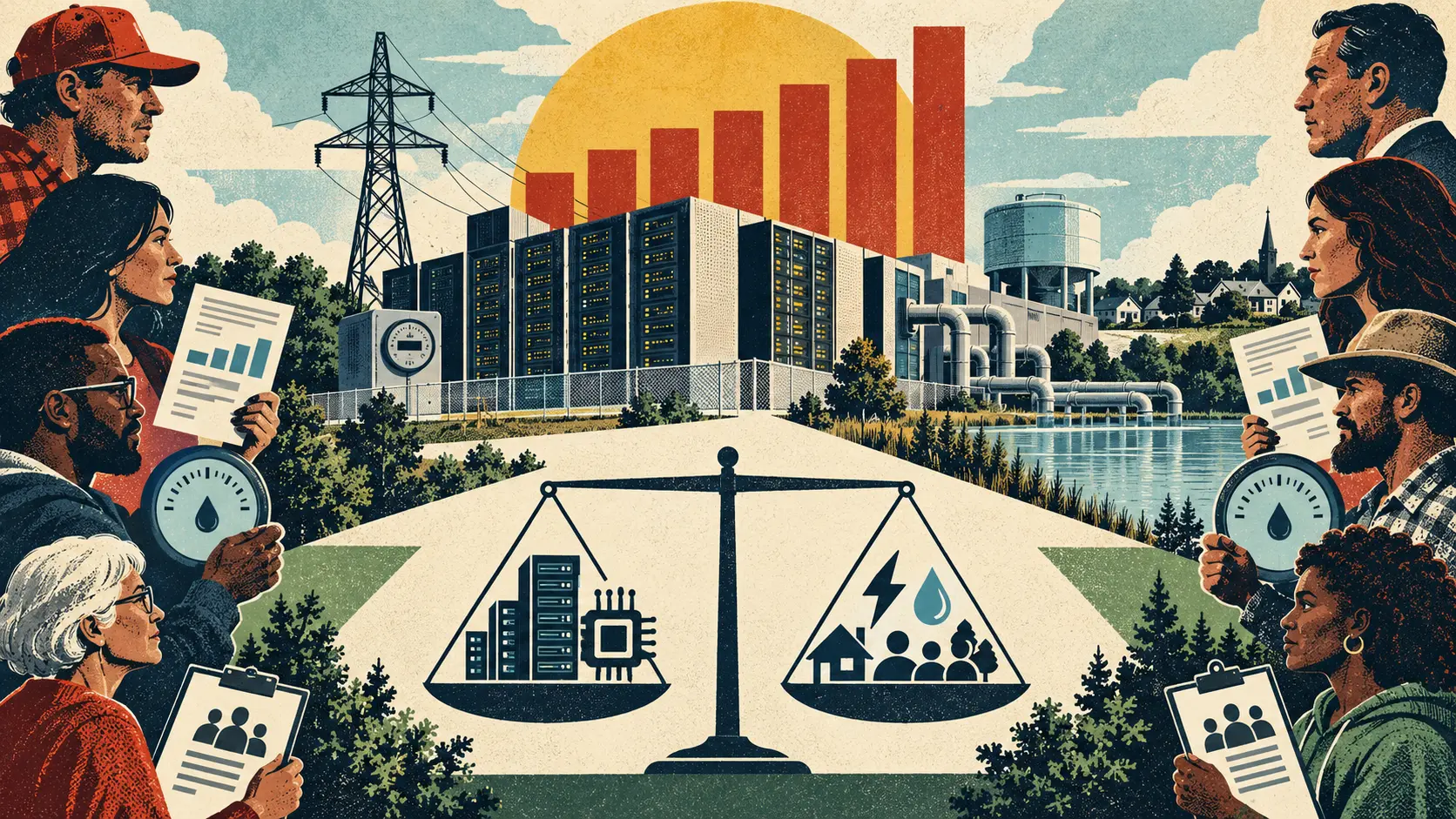
A new national survey finds that concern about artificial intelligence's environmental impact has risen from 41 percent of U.S. adults in 2025 to 53 percent in 2026. The political signal is not simply that Democrats are more worried. Majorities of Democrats and Republicans support three concrete rules for data centers: make operators cover grid-upgrade costs, require clean energy, and limit how many new facilities can be built. The strongest agreement sits close to the household meter. Eighty-four percent are at least somewhat concerned about local electricity prices, 79 percent about water supply, and 78 percent about power outages. Those numbers do not prove that a particular data center will raise a bill, drain a reservoir, or interrupt service. They measure what people said in one survey fielded in July. The practical signal is that an industry story about chips and national competition has become a kitchen-table infrastructure argument. A developer can answer that argument only with local evidence: projected load, water source, rate design, upgrade responsibility, emergency plan, enforceable limits, and public results after the servers turn on.
01
WHAT ACTUALLY CHANGED
The Associated Press-NORC Center for Public Affairs Research and the Energy Policy Institute at the University of Chicago released the survey on September 16. Fifty-three percent of adults said they were extremely or very concerned about AI's environmental impacts, compared with 41 percent in the 2025 survey. Forty-seven percent said AI will do more to hurt than help the environment, up from 33 percent the year before.
Concern rose most sharply among adults ages 18 through 29. Sixty percent in that group were extremely or very concerned, compared with 38 percent in 2025. The published release says about two-thirds of Democrats, about half of independents, and about four in ten Republicans were highly concerned. Those subgroup figures carry more uncertainty than the overall result.
The data-center questions were more concrete. Eighty-four percent were at least somewhat concerned about effects on local electricity prices, 79 percent about water supply, and 78 percent about power outages. At the same time, 55 percent saw data centers as at least somewhat beneficial for technological advancement and 49 percent said the same about job creation. Worry and perceived benefit can coexist in the same answer set.
Policy support crossed party groups. Seventy-three percent supported requiring data centers to cover electric-grid upgrade costs, 65 percent supported requiring clean energy, and 62 percent supported limiting the number of new data centers. The release says each policy drew majority support among both Democrats and Republicans. That is agreement on broad directions, not a vote on one statute, permit, price, threshold, or enforcement plan.
The survey interviewed 3,424 adults representing all 50 states and the District of Columbia from July 6 through 24. It combined NORC's probability-based AmeriSpeak panel with an opt-in sample supplied by Forthright and calibrated the combined data. Interviews occurred online and by phone. The overall margin of sampling error is plus or minus 2.2 percentage points at the 95 percent confidence level, including the design effect. The researchers warn that subgroup margins are larger and that sampling error is not the only possible source of error.
02
WHY THIS MATTERS
Environmental concern about AI can sound abstract until it reaches a utility bill, a well, or the reliability notice on a refrigerator. The survey suggests that those local systems are where a national technology debate becomes politically durable. People do not need to agree about frontier models to ask who pays for a substation or what happens when cooling demand meets a dry summer.
Cross-party support is useful and easy to overread. A Republican and a Democrat can both favor making data centers cover grid costs while disagreeing about which costs are incremental, whether shared infrastructure creates public benefits, what guarantee survives cancellation, and which regulator has authority. The poll identifies room for policy. It does not write the policy.
The benefit results prevent a lazy interpretation. About half of adults still see technological or employment benefits. Communities are not necessarily choosing between progress and refusal. They may be asking for a bargain they can inspect: useful investment with enforceable terms, known resource limits, durable jobs, emergency protection, and a way to correct projections that turn out to be wrong.
National percentages cannot approve or reject a local project. Electricity mixes, water systems, climate, grid capacity, tax deals, land use, and public institutions vary dramatically. A facility using reclaimed water beside abundant generation presents a different case from one drawing drinking water while a utility rushes new fossil capacity. The decision unit is the project, even when the political pressure is national.
Polling itself needs a receipt. The overall sample is large, but it blends a randomly recruited panel with an opt-in sample and statistical calibration. The published methodology is transparent about that design and about error beyond sampling. Readers should compare the exact question wording, field dates, response options, weighting, and subgroup uncertainty before turning a tidy percentage into a claim about every American.
03
WHERE IT COULD HELP
- Require a project-level resource sheet showing hourly and seasonal electricity demand, water withdrawal and consumption, cooling design, backup generation, emissions, land use, construction phases, and the assumptions behind every forecast
- Publish a cost ledger that separates customer-specific grid upgrades from shared investments, identifies who pays if the project shrinks or cancels, and names the financial guarantee that survives the original developer
- Translate clean-energy promises into contracts with the source, location, delivery hours, additional generation, storage, transmission limits, backup supply, emissions accounting, expiry date, and remedy when performance misses the claim
- Run local hearings with plain-language scenarios for normal operation, heat waves, drought, outages, rapid expansion, closure, and ownership transfer, then record who has authority to stop or change operations in each case
- Report measured electricity, water, reliability, jobs, tax revenue, complaints, incidents, and community payments after opening, using the same boundaries as the forecast so residents can see where the bargain held and where it did not
KEEP A HAND ON THE WHEEL
This survey measures reported attitudes during July 2026. It is not a referendum, election forecast, environmental assessment, engineering study, utility-rate case, water permit, or measurement of any specific data center. The year-to-year comparison shows an association in two surveys and does not by itself explain why concern rose. Overall percentages have a plus or minus 2.2 percentage-point sampling margin, while subgroup uncertainty is larger. The mixed probability and nonprobability design uses calibration to reduce known differences but cannot eliminate every source of bias or measurement error. Broad support for grid-cost recovery, clean energy, and limits does not establish agreement on thresholds, definitions, exceptions, prices, siting authority, or enforcement. Watch for the complete topline wording, later surveys using comparable questions, state and local ballot results, project-level disclosure rules, utility orders, water permits, enforceable community agreements, measured performance, and evidence that public concern changes an actual permit or rate decision.
04
TERMS WORTH KEEPING
OPEN GLOSSARY CARD
Public opinion survey
A structured study that asks a sample of people standardized questions to estimate attitudes or experiences in a larger population.
OPEN GLOSSARY CARD
Probability sample
A sample recruited through a method in which members of the target population have a known chance of being selected.
OPEN GLOSSARY CARD
Nonprobability sample
A sample recruited without a known selection chance for every member of the target population, often through an opt-in panel.
SOURCES AND VERIFICATION STATUS
This article was written from the materials below. Product claims and dates were checked against those sources on September 16, 2026.
PUBLICATION RECEIPT: Revision 1. Published September 16, 2026.
THE PUBLICATION ENGINE
WANT A SIGNAL OF YOUR OWN?
We build source-grounded publications, private briefings, and editorial systems for organizations with something useful to say.
WORK WITH US