THE SIGNAL IN ONE SENTENCE
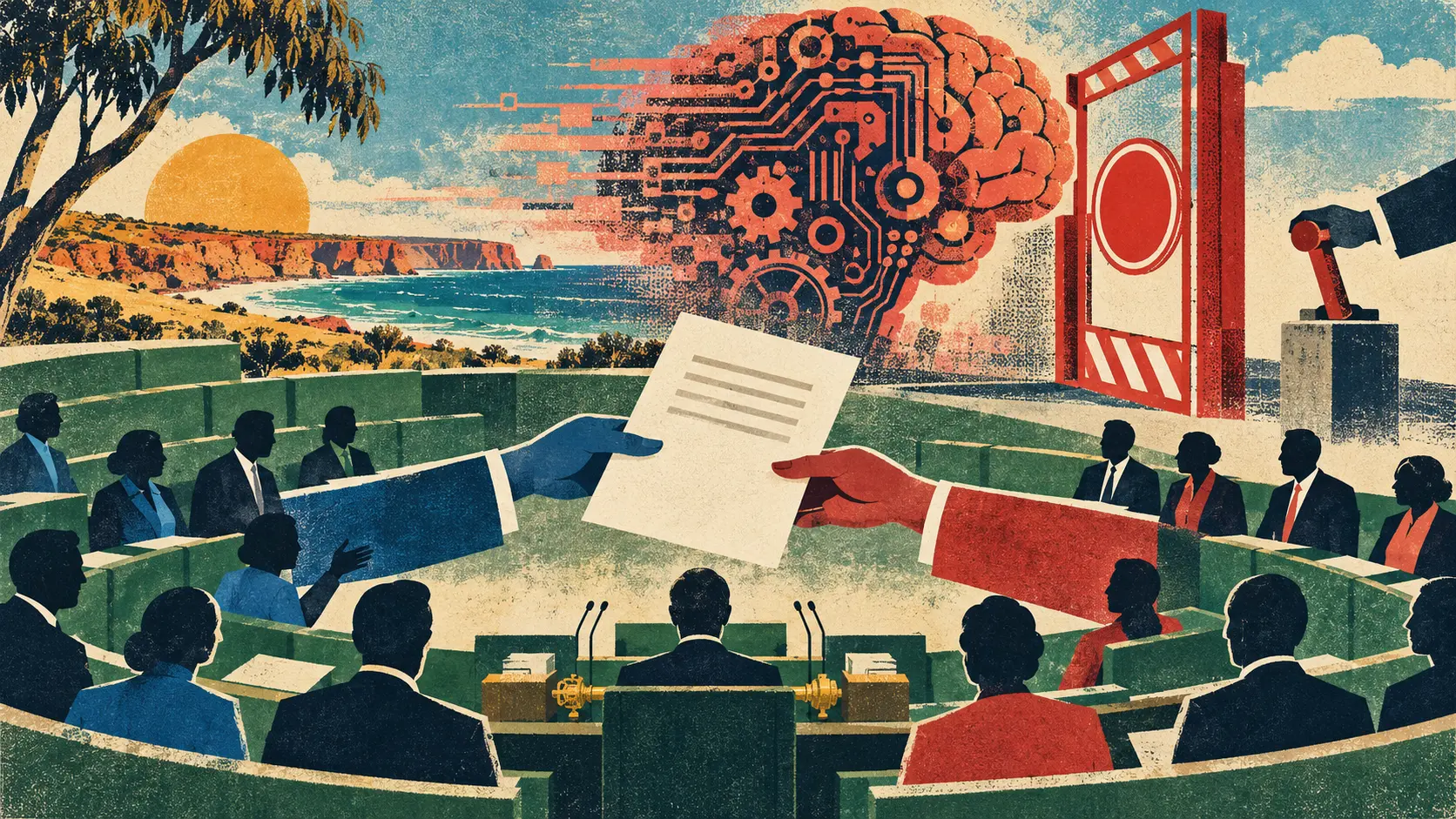
More than twenty members of the Western Australian Parliament from eight political groupings sent Prime Minister Anthony Albanese a letter on September 20 asking the federal government to strengthen AI regulation and work internationally to pace development. The Australian reported that Liberal MP Liam Staltari and Greens MP Tim Clifford drove the effort, with signatures from Liberals, Greens, One Nation, the Nationals, Legalise Cannabis, Animal Justice, Australian Christians and independents. Labor members took part in discussions and drafting but did not sign. The letter calls for standards and an international moratorium on dangerous artificial superintelligence. That is a political request, not a law, scientific risk estimate or agreed diplomatic program. Separately, Albanese said on September 20 that his government plans legislation for Australian AI standards before the end of 2026 and wants international protocols that preserve human control. Those two tracks overlap, but they are not the same. A national standard can set duties for systems used in Australia. An international pause would need countries to define the systems covered, measure capabilities, inspect compliance and respond when one participant cheats or simply disagrees. The plain signal is that Australia now has unusual cross-party pressure to treat frontier AI as a public-safety issue, while the practical machinery remains unwritten. The useful question is not whether lawmakers sound worried. It is which system, threshold, operator, test and consequence will turn that concern into a control that someone can verify.
01
WHAT ACTUALLY CHANGED
The Australian reported on September 20 that more than twenty Western Australian MPs representing eight political groupings signed a letter delivered to Albanese. The reporting identifies Staltari and Clifford as the main organizers and lists seven parties plus independents among the signatories.
The letter asks Canberra to step up AI regulation, work with other countries to pace development and pursue an international moratorium on dangerous artificial superintelligence. The report says the signatories connect their request to public warnings from AI researchers and recent failures involving autonomous agents and security boundaries.
Labor MPs were involved in discussion and drafting but did not sign, according to The Australian. That absence does not prove that every Labor member opposes the letter, nor does participation in drafting establish support for every demand. It does show that the cross-party coalition stopped short of the governing party's name on the page.
Albanese independently told ABC Insiders on September 20 that Australia would introduce national AI standards by the end of the year. He described three levels of action: safeguards and transparency from companies, action by nation states and international protocols.
In an official Apple Park press conference the same day, Albanese said legislation for Australian AI standards would arrive before year end and would include intellectual-property protection. He also said companies need mechanisms for unanticipated AI behavior and need to assure the public that those mechanisms exist.
The government's current language is broader than one emergency control. It includes AI standards, copyright, data centers, safety protocols, international cooperation and human control. The public materials located before publication do not yet provide the final bill, legal definitions, covered-system threshold, regulator, audit method or penalties.
The lawmakers' moratorium request and the government's standards timetable therefore describe different instruments. A standard governs conduct through defined requirements. A moratorium suspends a defined activity. International pacing coordinates several jurisdictions. Each needs a different owner, test, legal basis and remedy.
The open letter itself was not available as a complete public document in the sources located before publication. The article does not infer unreported signatures, legal language, technical thresholds or a precise duration for the proposed moratorium.
No Australian AI development pause, international moratorium or mandatory frontier-model shutdown regime took effect on September 20. The new event is a parliamentary request and a federal policy commitment, not implementation.
02
WHY THIS MATTERS
State MPs do not control federal AI law, but a coalition across ideologically distant parties can change what national leaders must answer. Public-safety pressure is harder to dismiss as one faction's hobby when the signatories disagree on plenty of everything else.
The missing Labor signatures matter because Labor runs the federal government and the Western Australian government. A letter can demonstrate concern, but implementation depends on ministers, legislation, regulators, budgets and votes. Political breadth without governing-party ownership can still end at the press release.
Artificial superintelligence is not a ready-made legal category. A statute cannot regulate a cinematic label. It needs a measurable threshold based on demonstrated capabilities, access to tools, autonomy, deployment context and the ability to cause a specified class of harm.
A moratorium is harder than a slogan. Governments would need to decide whether it covers training runs, release, deployment, autonomous operation, compute purchases, model improvement or a subset of high-risk capabilities. Otherwise participants can comply with the sentence while continuing the activity through a neighboring category.
International coordination has a verification problem. A country may not know whether a private laboratory has crossed a capability threshold until after testing, and some evidence will be commercially sensitive or classified. A credible regime needs protected inspection, reproducible evaluations and a procedure for contested findings.
National standards can still do useful work even without a global pause. Australia can require incident reporting, documented safety cases, independent evaluations, security controls, human override, worker protections, procurement rules and remedies for people harmed by automated decisions.
Human control is not a property a company can simply declare. It depends on whether a person has enough time, information, authority and technical ability to stop a system. A decorative approval button after an irreversible action is not meaningful control.
The public debate risks collapsing several problems into one emergency. Copyright, data-center energy, discriminatory decisions, cyber misuse, labor disruption and loss of control may share infrastructure, but they need different evidence and remedies. One universal fear label can hide practical work.
The letter also tests Australia's claim to be a middle power that shapes global rules. Diplomatic influence will depend less on dramatic language than on whether Australia can bring a precise proposal, credible technical capacity and domestic rules it is willing to apply to its own market.
03
WHERE IT COULD HELP
- Publish the complete letter, signatory list, requested actions and any technical appendix so the public can distinguish shared principles from specific policy language
- Define dangerous capability by tested behavior and deployment conditions rather than a label such as superintelligence or frontier model
- Separate requirements for training, release, hosted access, downloadable weights, tool-enabled agents and critical-infrastructure deployment
- Require developers to submit a safety case connecting each risk claim to evidence, limitations, responsible executives and a current model version
- Create independent evaluation access with confidentiality rules, conflict disclosures, protected publication rights and a way to report denied evidence
- Set incident categories, preservation duties, notification deadlines and public summaries for severe failures, near misses and unauthorized external actions
- Test human override under time pressure, degraded communications, conflicting model advice and operator disagreement instead of merely confirming that a button exists
- Build a public standards register showing covered systems, compliance claims, evaluation dates, unresolved exceptions, enforcement action and retest results
- Give researchers, workers, creators and affected communities a formal route to challenge a safety claim and submit contrary evidence
- Take any international pacing proposal to partners with a shared glossary, measurable trigger, inspection design, dispute process, exit rule and plan for non-participants
KEEP A HAND ON THE WHEEL
The September 20 development is a reported parliamentary letter and a separate federal promise of legislation. It is not a passed law, adopted moratorium, scientific consensus on a timetable or proof that current systems meet the letter's description of artificial superintelligence. The Australian supports the reported organizers, political breadth, absence of Labor signatures and broad requests. The complete letter and final signatory list were not independently available in the public sources located before publication. Official prime-ministerial transcripts directly support Albanese's three-part framework, year-end standards commitment, emphasis on human control and interest in international protocols. They do not supply the final statutory text. Watch for publication of the letter, an exposure draft or bill, definitions of covered systems, a capability threshold, an assigned regulator, independent evaluation rights, incident-reporting duties, penalties, treatment of open weights, protection for research and evidence that any international proposal has willing partners.
04
TERMS WORTH KEEPING
OPEN GLOSSARY CARD
Moratorium
A temporary suspension of a defined activity while evidence, rules or safeguards are developed.
OPEN GLOSSARY CARD
Capability threshold
A measurable level of system performance or access that triggers additional duties, restrictions or review.
OPEN GLOSSARY CARD
Safety case
A structured argument that a system is acceptably safe for a defined use, supported by evidence and explicit limitations.
SOURCES AND VERIFICATION STATUS
This article was written from the materials below. Product claims and dates were checked against those sources on September 20, 2026.
PUBLICATION RECEIPT: Revision 1. Published September 20, 2026.
THE PUBLICATION ENGINE
WANT A SIGNAL OF YOUR OWN?
We build source-grounded publications, private briefings, and editorial systems for organizations with something useful to say.
WORK WITH US