THE SIGNAL IN ONE SENTENCE
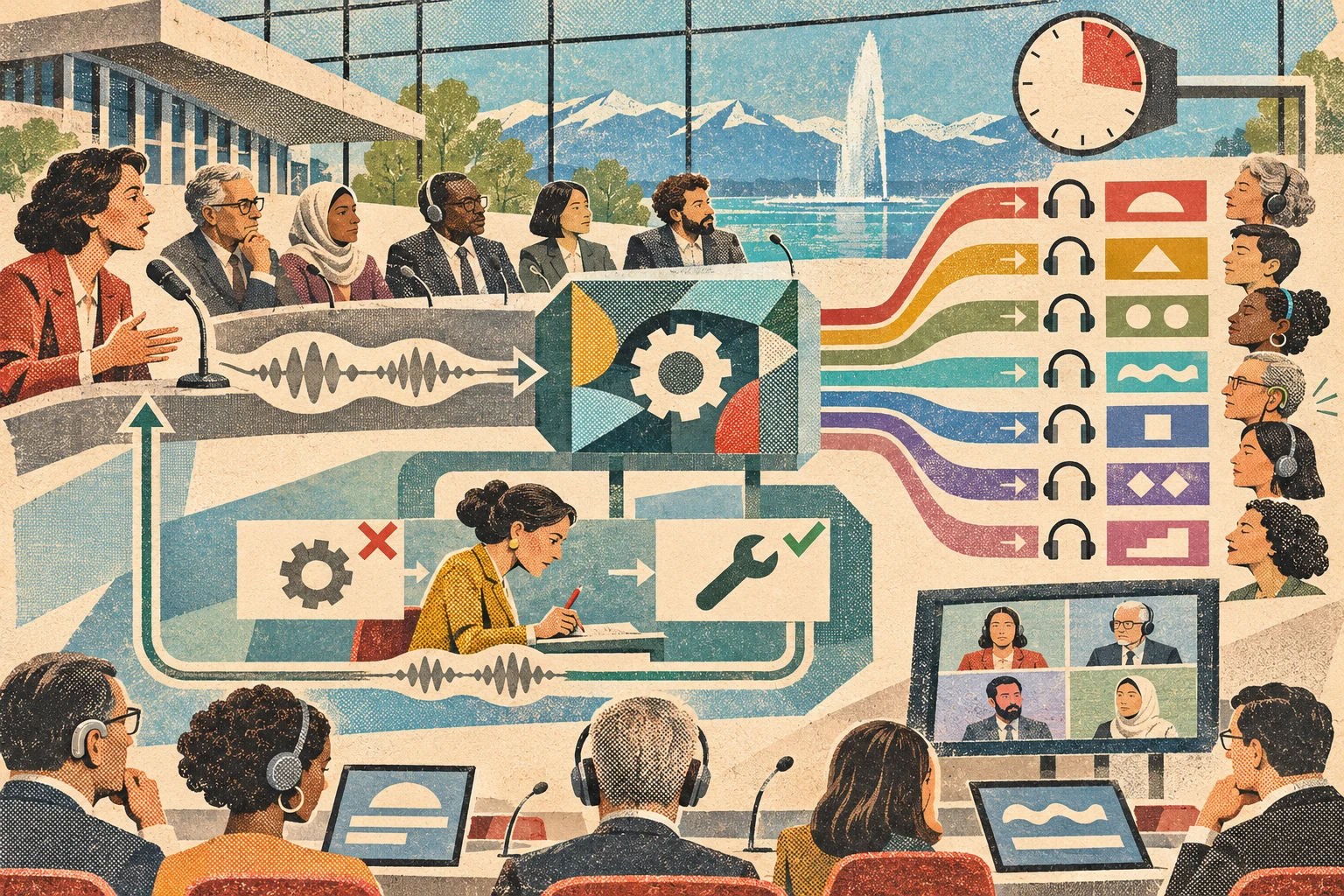
Interpretation is infrastructure you notice most when it disappears. A speaker names a treaty article. The interpreted voice arrives late, changes the number and glides onward with the confidence of a person who has never met a correction button. At its annual Artificial Intelligence Infrastructure Interchange meeting in Geneva on November 11, the World Intellectual Property Organization used a new speech-to-speech AI interpretation service. WIPO offered interpretation in English, French, Spanish, Arabic, Russian, Chinese and Portuguese. Online participants could also use live captions from WIPO's Speech-to-Text tool in 20 languages. The organization described the interpretation as experimental and intended for accessibility. Its meeting pages warned participants that the interpreted audio could arrive later than the original speech and might contain unnatural intonation. That is the verified reporting. It is also a refreshingly honest label. Experimental should mean more than a small badge beside a very large trust exercise. It should come with a public record of what the experiment actually did. WIPO did not publish meeting-specific accuracy, latency, comprehension or human-comparison results on the event pages. It did not say how often a term was omitted, how long corrections took, whether quality differed by language or how participants should flag a consequential mistake while a session was underway. The practical next step is a delay and correction card. Start with the path through the system. For each interpreted channel, identify the source language, speech-recognition model, translation step, speech-generation step, domain vocabulary and version used during the meeting. Record whether the service translated directly between each language pair or passed through an intermediate language. That architecture can shape the error. A name may be lost during recognition, a legal phrase may shift during translation and a correct translation may become difficult to understand when synthetic speech stresses the wrong word. Measure end-to-end delay from the speaker's mouth to the participant's ear. Publish the median, the 95th percentile and the worst sustained delay by language and session. Average latency is not enough. A system can feel fine for most of an hour and then fall 18 seconds behind during a fast exchange. That matters when a speaker refers to a slide, another delegate responds or a chair calls for an intervention. Mark where the lag grows. Is it caused by rapid speech, a language switch, a remote connection, an unfamiliar name, a long sentence or the need to wait for grammatical context? A delay card should help organizers change the conditions, not simply admire a stopwatch. Then classify errors by consequence. Count omissions, additions, wrong names, wrong numbers, reversed meaning, lost negation, incorrect legal or technical terms, speaker confusion and sentences that become fluent nonsense. Separate a harmless stumble from an error that changes a policy position, attribution, deadline or requested action. Proper nouns deserve their own column. The November 11 program included speakers and organizations from many countries and discussions about industry workflows, metadata, AI-generated content and a common lexicon for AI and intellectual property. Those are exactly the sessions where a product name, rights society, legal phrase or creator credit can carry the point. WIPO's Speech-to-Text page says its recognition models can be fine-tuned for particular speakers, vocabulary and domain terminology. That makes a meeting glossary a practical control. Before the event, invite speakers to submit names, organizations, acronyms, treaty references and technical terms. Publish which terms were loaded, how late additions were handled and which items the system still missed. Do not make prepared remarks a secret requirement for being understood. Extemporaneous speakers, accents, speech disabilities, remote microphones and code-switching belong in the test because they belong in the meeting. The card should show quality by language, not hide every channel inside one global score. Seven interpreted languages are seven user experiences. Direction matters too. French into Arabic may behave differently from Arabic into French. A single average can conceal a channel that is excellent for polished English presentations and unreliable for a fast floor intervention in another language. Live captions need a separate evaluation. Captions and synthetic speech may share upstream recognition or translation errors, but they create different accessibility demands. For captions, measure word error, punctuation, speaker labels, line timing, reading speed, text stability and correction behavior. A caption that repeatedly rewrites the previous line can be technically accurate at the end and exhausting to follow in real time. Test color contrast, font size, line length, keyboard access and compatibility with assistive technology. Let users choose the original-language transcript beside the translated one when bandwidth and layout allow. For interpreted audio, measure intelligibility, pronunciation, volume consistency, speaker changes, prosody and listening fatigue. Unnatural intonation is not merely cosmetic when stress changes meaning or makes a long technical session harder to follow. Voice design needs boundaries. A synthetic interpreter should not imitate a speaker closely enough to blur which voice is original. Participants should hear a clear cue when interpretation begins, changes language, reconnects after failure or falls behind live speech. Now test comprehension. After selected segments, ask participants short questions about the claims, names, numbers and requested actions they heard. Compare comprehension across the original audio, human interpretation where available, AI interpretation and captions. Do not turn participants into unpaid lab equipment for the entire day. Use short, consented samples, offer an easy opt-out and publish the method without exposing individual performance. Invite qualitative reports too. Did the delay break turn-taking? Did a voice make it hard to tell speakers apart? Did the participant return to the original audio? Did captions help recover a missed term? Did the system make somebody more able to join the meeting, or merely more aware of what they were missing? Accessibility success is not the number of language buttons. It is whether people could understand, respond and correct the record. Correction needs a live route. Put a report-error control beside each interpreted channel and caption panel. Let a participant mark the approximate time, language and type of problem without leaving the session. High-consequence errors should reach a human language specialist or meeting moderator quickly. The correction might appear as a caption note, a replay from the original audio, a revised transcript or a spoken clarification from the chair. Publish the median correction time and the share of reported issues resolved before the session ended. If a correction arrives three days later, it may improve the archive without repairing the meeting. Keep the original audio one click away. WIPO's related webcast disclaimer says interpretation facilitates communication but does not constitute the authentic record. Only the original speech is authentic. That is an essential boundary, especially in legal and policy discussions. The interface should make the boundary usable. A participant needs a visible way to switch to the original stream, replay a short segment and compare it with the interpreted version. The archived transcript should link corrections to timestamps in the original recording. Preserve versions. If WIPO corrects a transcript, the archive should show what changed, when, why and who approved the correction. A clean final transcript without a change record can erase the evidence needed to improve the system. Record failures outside the language model too. Conference interpretation depends on microphones, room acoustics, streaming, network stability, channel selection, captions, headphones and participant devices. The card should distinguish model errors from audio capture failures and delivery problems. Run drills before the meeting. Test a dropped connection, a speaker switching languages mid-sentence, two people talking over each other, an acronym-heavy presentation and a floor intervention from a poor microphone. Define the fallback. Can a participant return to the original audio immediately? Can captions continue if synthetic speech stops? Is a human interpreter available for a high-stakes session or correction? Who tells the room that one language channel is delayed or unavailable? Privacy and retention belong on the card as well. State which audio, transcripts, prompts, corrections and user reports are stored, for how long, where and for what improvement purpose. Explain whether meeting content becomes training material and how confidential sessions are excluded. WIPO says its Speech-to-Text service follows security and confidentiality practices, but the public event pages do not provide a meeting-specific data-handling notice for the experimental speech-to-speech service. A pilot should make that layer visible before participants speak. The service has a real potential benefit. Human interpreters are skilled professionals, expensive to schedule and difficult to supply for every language at every hybrid event. AI may expand access to meetings that would otherwise offer fewer languages, especially for remote participants. That potential does not make human expertise obsolete. It makes expert evaluation more valuable. Professional interpreters understand context, repair ambiguity, preserve tone and notice when a literal translation would mislead. They can help design the error taxonomy, prepare terminology, inspect difficult segments and decide which meetings or agenda items are not appropriate for experimental automation. WIPO's pilot occurred at an institution that lives inside terminology. The AIII agenda covered metadata, attribution, AI-generated content taxonomies, common lexicons and the infrastructure surrounding intellectual property. A system that mistranslates one term can change the very argument the meeting is trying to clarify. That makes this a strong place to test, provided the test becomes public evidence rather than a pleasant anecdote about seven languages. Publish the delay and correction card after each event. Show the system version, language directions, session conditions, terminology preparation, latency distribution, error categories, comprehension results, accessibility feedback, corrections, fallbacks and unresolved limitations. Let participants and language experts challenge it. The point is not to demand perfection from a new accessibility tool. Human interpretation is not error-free either. The point is to make every language channel inspectable enough that participants know when to trust it, when to check the original and how to fix a mistake before it hardens into the record. Seven languages is access. A visible correction path is authority.
01
WHAT ACTUALLY CHANGED
WIPO used a new speech-to-speech AI interpretation service at the November 11 Artificial Intelligence Infrastructure Interchange annual meeting in Geneva.
The hybrid meeting offered AI interpretation in English, French, Spanish, Arabic, Russian, Chinese and Portuguese.
Online live captions were available through WIPO's Speech-to-Text tool in 20 languages.
WIPO described the interpretation technology as experimental and made available for accessibility purposes.
The meeting pages warned that interpreted audio could be delayed relative to the original speech.
They also warned that the AI voice could have unnatural intonation.
The meeting ran from 10:00 to 18:00 Geneva time and included international sessions on AI and intellectual-property infrastructure.
WIPO's public event pages did not provide meeting-specific accuracy, latency, comprehension, correction-time or human-comparison results.
02
WHY THIS MATTERS
Speech-to-speech AI could expand language access at hybrid international meetings where full human interpretation is difficult to provide.
Delay can disrupt turn-taking, references to slides and responses between participants even when the eventual translation is accurate.
Errors in names, numbers, negation and technical or legal terms can change a speaker's position rather than merely make the voice sound awkward.
Quality can differ sharply by source language, target language, accent, microphone, vocabulary and speaking style.
Captions and interpreted audio create distinct accessibility experiences and need separate evaluation.
A visible path to the original speech and a timely human correction protects participants when an experimental channel fails.
WIPO's role in global intellectual-property discussions makes accurate terminology, attribution and authentic records especially consequential.
03
WHERE IT COULD HELP
- Publish the complete interpretation pipeline and version used for each event.
- Measure end-to-end delay by language with median, 95th percentile and sustained worst case.
- Classify omissions, additions, names, numbers, negation, terminology and speaker errors by consequence.
- Prepare a meeting glossary from submitted names, organizations, acronyms and technical terms.
- Report quality separately for every source and target language direction.
- Evaluate caption timing, stability, speaker labels, reading speed and assistive-technology compatibility.
- Evaluate interpreted audio for intelligibility, pronunciation, prosody, speaker changes and listening fatigue.
- Run short consented comprehension checks on claims, names, numbers and requested actions.
- Place an error-report control beside every interpreted channel and caption panel.
- Route consequential errors to a human language specialist or moderator during the session.
- Keep the original audio available for immediate comparison and timestamped replay.
- Version transcript corrections and preserve the reason and approval for each change.
- Distinguish model errors from microphone, network, streaming and device failures.
- Drill language switches, overlapping speech, dropped channels and terminology-heavy segments before the event.
- Publish data retention, training-use, confidentiality and deletion rules for audio and transcripts.
KEEP A HAND ON THE WHEEL
WIPO's meeting pages establish that experimental AI interpretation and live captions were available, but they do not publish meeting-specific accuracy, latency, comprehension, correction, accessibility or human-comparison results. The event notice warns about delay and unnatural intonation. It does not describe the system architecture, language-pair routing, error-report process, fallback staffing, correction workflow or data-retention terms for this meeting. The availability of seven interpreted languages and 20 caption languages does not establish equal quality across languages, accents, terminology, speaking speeds or remote-audio conditions. WIPO's Speech-to-Text page describes dedicated and multilingual models and the ability to tune vocabulary, but those general product claims are not a measured result for the November 11 event. WIPO's webcast disclaimer states that interpretation facilitates communication and that the original speech remains the authentic record. Experimental output should not be treated as a certified legal interpretation without an appropriate human process. Original meeting date: November 11, 2026.
04
TERMS WORTH KEEPING
SOURCES AND VERIFICATION STATUS
This article was written from the materials below. Product claims and dates were checked against those sources on November 11, 2026.
THE PUBLICATION ENGINE
WANT A SIGNAL OF YOUR OWN?
We build source-grounded publications, private briefings, and editorial systems for organizations with something useful to say.
WORK WITH US