THE SIGNAL IN ONE SENTENCE
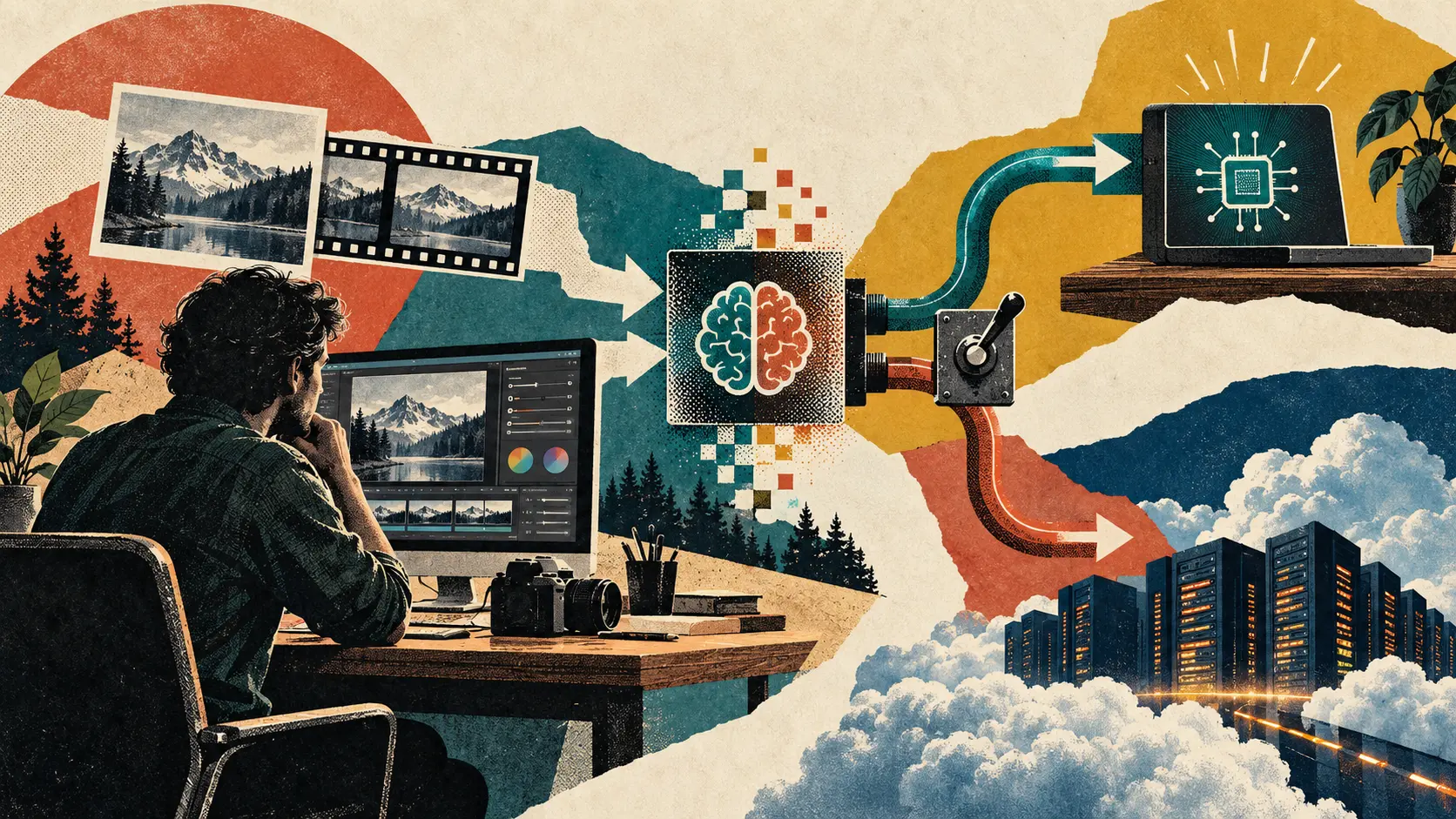
Adobe completed its acquisition of Topaz Labs on September 23. Topaz is known for software that enlarges images, reduces noise, sharpens detail and improves video with machine-learning models. Adobe says Topaz will remain a standalone brand, its applications and models will continue to be sold separately and chief executive Eric Yang will join Adobe's Digital Video and Audio organization. Some Topaz technology is already available in Firefly and Photoshop, and Adobe plans broader Creative Cloud integration. The technical hinge is Neurostream, which Adobe describes as a way to run complex enhancement models either on a user's device or through a Topaz cloud option. That choice matters more than it may sound. A local job can keep source material on hardware the creator controls and may continue without a network connection. A cloud job can bring more compute to large files or demanding models, but it also moves the file, or information derived from it, across a service boundary. Adobe's announcement does not provide a matrix showing which current and future workflows use which route, whether the creator chooses every time, what is uploaded, how long cloud material is retained or whether it may be used to improve models. It also does not publish deal terms, final integration dates, future prices or a permanent guarantee that every Topaz product will stay independent. Adobe describes better recovered detail, clarity, temporal consistency and natural-looking results. Those are product claims, not an independent comparison against original footage, competing software or expert restoration. The plain signal is that the acquisition could put unusually capable enhancement tools into familiar creative workflows. The useful promise is not simply local AI. It is a visible route for every file, a deliberate choice before upload, a receipt afterward and an export that does not become hostage to one subscription or one cloud.
01
WHAT ACTUALLY CHANGED
Adobe announced on September 23, 2026 that it had completed its acquisition of Topaz Labs.
Adobe says Topaz Labs will remain a standalone brand after the acquisition.
The company says Topaz applications and models will continue to be available as standalone products.
Topaz chief executive Eric Yang is joining Adobe's Digital Video and Audio organization.
Adobe says existing Topaz customers will continue to receive product support.
Topaz technology is already available through Adobe Firefly and Photoshop.
Adobe plans to integrate more Topaz technology across Creative Cloud workflows.
Named future uses include restoring archival footage, improving low-light shots, enhancing mobile clips and preparing material for large screens.
Adobe also points to upscaling generated video as a planned use.
For enterprise customers, Adobe describes applying enhancement models to legacy content at scale.
Adobe says Topaz's Neurostream technology can run complex models on a user's device.
The same technology can also use a Topaz cloud option.
Adobe says it will optimize performance as Topaz technology enters Creative Cloud products.
The announcement credits Topaz tools with recovering detail, improving clarity and temporal consistency and preserving natural-looking output.
Adobe notes that Topaz Labs received a 2025 Engineering, Science and Technology Emmy Award.
The announcement does not disclose the acquisition price, product-level integration dates, future pricing, a detailed data-flow map or model-training terms.
02
WHY THIS MATTERS
Photographers and filmmakers often work with unreleased footage, client material, cultural archives and personal images that cannot be treated as ordinary uploads.
On-device processing can reduce exposure by keeping source files within hardware and storage controlled by the creator.
Cloud processing may handle larger models or jobs that exceed local memory, but the convenience introduces transfer, retention, account and service risks.
Saying a platform can run locally does not establish that every model, setting or future integration actually does.
A creator needs the route at the moment of use, not a general promise buried in product marketing.
Video makes routing especially important because source files can be huge and an unnoticed upload can consume time, bandwidth and money.
Archival restoration carries an additional duty to preserve the source and document which pixels were inferred rather than recovered.
Enhancement can make an image look more plausible while quietly inventing texture that was never captured.
Temporal consistency matters in video because a convincing individual frame can still produce flicker or changing details across a sequence.
Independent comparisons are needed to separate an attractive demonstration from reliable performance across cameras, subjects, compression levels and motion.
Topaz remaining a standalone brand gives existing customers continuity today, but an acquisition announcement is not an unchangeable product covenant.
Creative Cloud integration can reduce export and import steps, yet deeper integration can also make switching tools harder if projects depend on proprietary settings or cloud history.
Model provenance matters when enhanced output is used in journalism, evidence, documentaries or historical archives.
Enterprises need a route map for compliance because one workflow may be acceptable on a local workstation while another requires a cloud vendor review.
Clear processing choices can become a competitive advantage. Privacy is easier to trust when the product shows the path instead of asking for faith.
The broader lesson is that local and cloud are not brand identities. They are observable technical states that should be disclosed for every job.
03
WHERE IT COULD HELP
- Show a local or cloud badge beside every model before a job begins, with no ambiguous automatic mode.
- Explain exactly what leaves the device for a cloud job, including source media, crops, previews, prompts, masks and technical metadata.
- Require explicit approval before the first upload for each project or client workspace.
- Provide a local-only project setting that blocks cloud processing rather than merely preferring local execution.
- Display estimated upload size, processing time and any usage charge before the creator commits.
- Issue a receipt after every job naming the model version, processing route, settings, time and files involved.
- Publish retention and deletion periods for uploaded media, derived files, logs and backups in plain language.
- State whether customer media or outputs may be used for model training, evaluation or human review, with a durable opt-out where relevant.
- Keep original files immutable and make enhanced versions new, clearly labeled derivatives.
- Store edit metadata with the derivative so another editor can reconstruct which enhancement steps were applied.
- Offer side-by-side and flicker tests that help creators spot fabricated texture, unstable faces and changing fine detail.
- For archival work, preserve checksums for the untouched source and record every crop, interpolation, denoise and upscale operation.
- For news and documentary work, attach provenance information that distinguishes camera capture from later machine-assisted reconstruction.
- Let teams restrict cloud jobs by collection, client, geography or sensitivity without disabling local models.
- Publish a living matrix for Photoshop, Firefly, Premiere and standalone Topaz products showing local availability, hardware requirements and cloud fallbacks.
- Export project settings and processed files in documented formats so leaving one subscription does not erase the restoration history.
- Measure quality on public test sets that include film grain, low light, faces, text, fast motion, animation and heavily compressed footage.
- Invite independent archivists, photographers and video engineers to audit claims about detail recovery, temporal consistency and natural-looking output.
KEEP A HAND ON THE WHEEL
Adobe has completed the acquisition, and its statement that Topaz will remain a standalone brand is a present commitment. It is not a permanent guarantee about future packaging, prices, subscriptions, support periods or product names. Neurostream can run complex models on a device or through a Topaz cloud option, according to Adobe. The announcement does not say which current and future models use each route, whether a cloud fallback can occur automatically, what material is uploaded, how long it is retained or whether customer content can be used for training. Claims about recovered detail, clarity, temporal consistency and natural-looking output come from Adobe. The announcement does not include an independent quality comparison, error rate or representative test set. Enhancement models can reconstruct plausible detail that was not present in the source, which is especially consequential for archives, journalism and evidence. Watch for a product-by-product processing map, explicit local-only controls, upload notices, retention and training rules, Creative Cloud integration dates, standalone pricing, hardware requirements, provenance records and independent tests that examine both attractive results and convincing mistakes.
04
TERMS WORTH KEEPING
SOURCES AND VERIFICATION STATUS
This article was written from the materials below. Product claims and dates were checked against those sources on September 25, 2026.
PUBLICATION RECEIPT: Revision 1. Published September 25, 2026.
THE PUBLICATION ENGINE
WANT A SIGNAL OF YOUR OWN?
We build source-grounded publications, private briefings, and editorial systems for organizations with something useful to say.
WORK WITH US