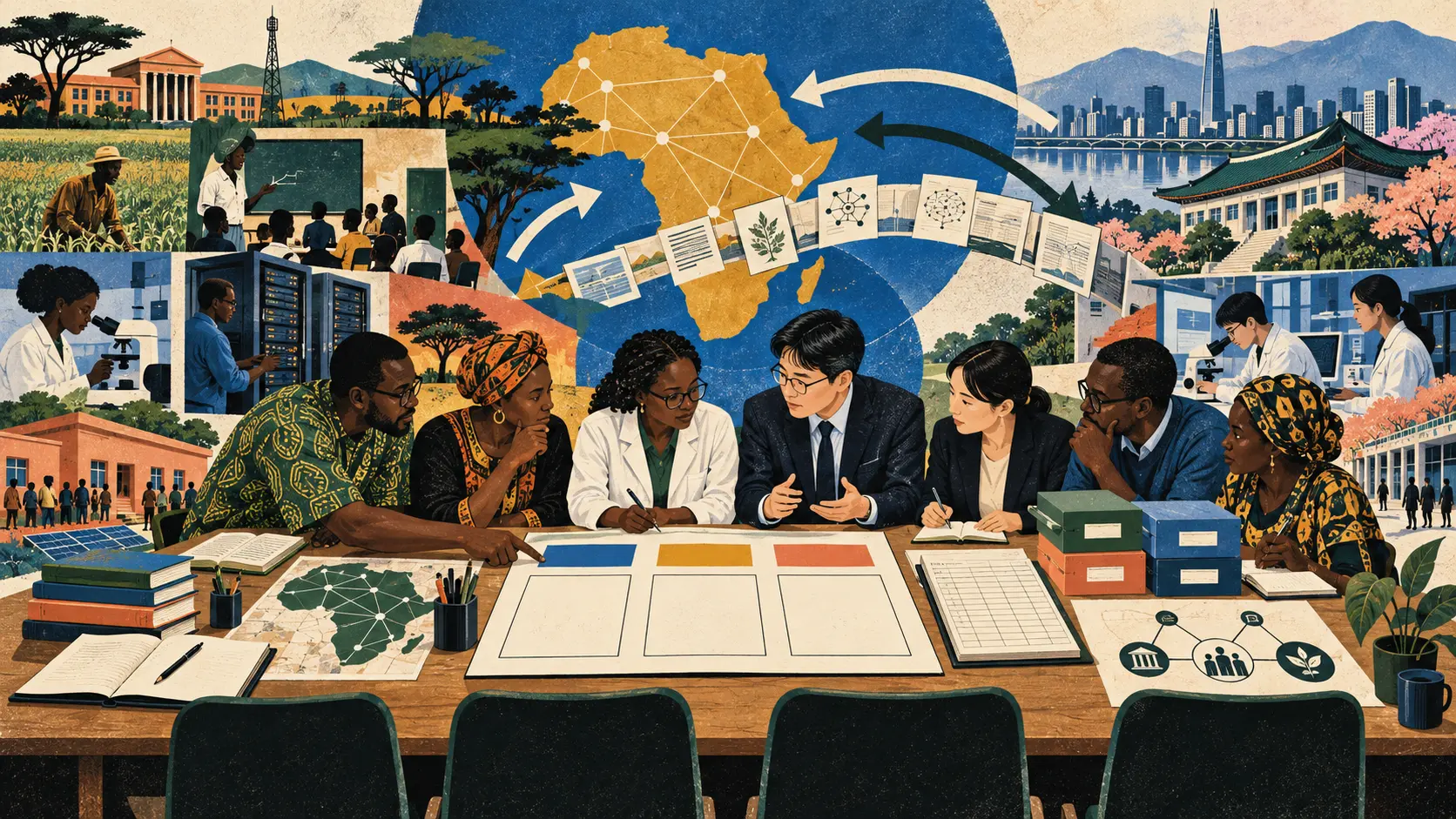
THE SIGNAL IN ONE SENTENCE
The African Development Bank and the Korea Advanced Institute of Science and Technology, better known as KAIST, have agreed to work together for three years on African AI and digital transformation. The bank says the framework covers research and development on public policy and AI-related datasets, plus studies, strategic advice, workshops, dialogue, and exchanges of expertise. That is a sensible menu. It is not yet a meal. The announcement does not publish a budget, list participating countries or institutions, name datasets, count fellowships or workshops, assign milestones, or define what success will look like. The wider Korea-Africa conference was explicit about connecting Korean technology, financing, infrastructure, and companies with African demand. That can produce useful partnerships, but it can also turn capacity building into a polite name for importing systems and consultants. The plain signal is that expertise exchange becomes durable capacity only when African institutions can choose the problem, govern the data, keep the people, maintain the tools, teach the next cohort, and continue the work after the agreement ends.
01
WHAT ACTUALLY CHANGED
The African Development Bank announced on September 16 that it and KAIST signed an agreement in Seoul on September 9. The bank describes it as a three-year framework intended to strengthen African capacity in artificial intelligence and digital transformation. The verified event is the signing and the stated scope. It is not a funded project award, deployed platform, scholarship class, completed study, or measured public-service result.
The agreement provides for joint research and development on public policies and datasets related to AI, along with studies and strategic advice. Those categories could support work on regulation, public-sector adoption, infrastructure, language access, education, or sector-specific applications. The public release does not identify a first research question, dataset, country, ministry, university, laboratory, language, license, publication rule, or decision that the work is expected to change.
The framework also includes workshops, dialogues, and exchanges of expertise. These can connect researchers and officials who would otherwise work separately. They can also become a familiar circuit of short visits, slide decks, and photographs. The announcement does not state how many people will participate, where sessions will occur, who selects participants, whether travel and compute are funded, how teaching will continue locally, or whether materials and code will remain openly usable afterward.
The agreement was signed during the eighth Korea-Africa Economic Cooperation Ministerial Conference, held in Seoul from September 8 through 11 under a theme centered on AI and digital infrastructure. Korea's Ministry of Finance and Economy says the wider conference produced a joint declaration and 2027 and 2028 action plan, then moved into business meetings about power, data centers, AI solutions, talent, startups, and investment. The KAIST framework sits inside that larger economic and infrastructure agenda rather than standing alone as a university exchange.
The Korean ministry says the African Development Bank presented its AI and digital-infrastructure project pipeline and procurement procedures to Korean companies. It also says Korea intends to combine development finance, policy programs, AI systems, data centers, and power infrastructure in follow-up projects. That context creates a useful accountability question: when research advice, public finance, procurement, infrastructure, and company entry travel together, who defines the need and who owns the resulting capability?
02
WHY THIS MATTERS
Africa is not one deployment environment. Countries differ in power reliability, connectivity, public budgets, research capacity, languages, laws, education systems, administrative data, and the public problems they need technology to solve. A continental agreement can open doors, but delivery must become specific enough to name the institution, community, dataset, infrastructure constraint, language, safeguard, and accountable official for each project.
Capacity is easy to count badly. A workshop can report attendance. A fellowship can report graduates. A dataset can report rows. Those are outputs, not proof that an institution can set its own research agenda, retain skilled staff, procure responsibly, maintain systems, negotiate with vendors, publish independent findings, or stop a harmful deployment. The strongest measure is what local people can decide and operate without asking the original partner to return.
Datasets require governance before scale. Public records may contain sensitive health, education, agricultural, identity, mobility, or financial information. A useful partnership should define purpose, lawful authority, community representation, consent where appropriate, access, security, language coverage, quality, documentation, benefit sharing, retention, correction, publication, and deletion. A dataset is not capacity if local institutions provide the records while another institution keeps the model, methods, and publication power.
University partnership can protect the work from becoming a simple sales channel, but only if academic independence is real. Researchers need the freedom to choose inconvenient questions, publish negative results, disclose conflicts, test Korean and other suppliers on equal terms, and say that a proposed system is unnecessary. If research is designed mainly to prepare procurement, the answer has been chosen before the study begins.
A three-year horizon is long enough to build something durable and short enough to expose wishful thinking. Permanent faculty positions, local compute operations, public-interest data offices, research software maintenance, graduate supervision, procurement expertise, and career paths all need money beyond a launch event. The framework should begin with the exit question: what remains in year four, who pays for it, and who holds the keys?
03
WHERE IT COULD HELP
- Publish a country and institution ledger naming the local lead, public problem, intended users, language, dataset, infrastructure need, partner role, budget, procurement link, milestone, safeguard, and decision right for every project started under the framework
- Fund African universities, laboratories, civil-service teams, standards bodies, and community organizations directly for permanent staff, graduate supervision, compute operations, data stewardship, security, maintenance, and open publication rather than paying mainly for visiting expertise
- Use a train-the-trainer model with measured handover: local instructors teach the next cohort, maintain the curriculum, adapt it to local law and language, run the tools without remote intervention, and receive multi-year support for the work
- Require every shared dataset to publish a data card covering provenance, legal authority, community role, languages, missing groups, quality, access, security, allowed uses, benefit sharing, retention, correction, deletion, and who can veto or stop a project
- Report outcomes one year after each activity, including staff retained, courses repeated, methods reused, locally led papers, public decisions changed, systems maintained, failed pilots, procurement avoided, complaints resolved, and capability still operating after outside support declines
KEEP A HAND ON THE WHEEL
The African Development Bank release verifies an agreement signed on September 9 and announced on September 16. It describes a three-year framework for cooperation, not a grant award, procurement contract, operating program, or completed technology transfer. The public material does not disclose a total or annual budget, funding source, country allocation, participating African institution, project list, fellow count, workshop count, compute commitment, dataset, language plan, intellectual-property rule, procurement boundary, publication right, implementation schedule, or outcome target. The Korean government's conference materials describe planned links among development finance, Korean companies, AI solutions, data centers, power infrastructure, policy advice, and follow-up projects. Those materials establish the wider agenda, not proof that the KAIST agreement will favor vendors or that any named project has been approved. The article's ownership tests are analysis based on what the announcements leave open. Watch for the agreement text, governance committee, African co-leads, first call for proposals, transparent selection rules, budgets, country and language coverage, data-governance terms, research-independence safeguards, public-interest licensing, conflict disclosures, procurement separation, evaluation methods, negative findings, retention results, and a funded plan for year four.
04
TERMS WORTH KEEPING
OPEN GLOSSARY CARD
Capacity building
Long-term investment in the people, institutions, infrastructure, rules, and resources needed to perform and govern work independently.
OPEN GLOSSARY CARD
Data stewardship
The accountable care of data across collection, documentation, access, quality, security, permitted use, correction, retention, and deletion.
OPEN GLOSSARY CARD
Local institutional ownership
Practical authority held by the institutions affected by a project to set priorities, control resources, govern data, make decisions, and continue or stop the work.
SOURCES AND VERIFICATION STATUS
This article was written from the materials below. Product claims and dates were checked against those sources on September 16, 2026.
PUBLICATION RECEIPT: Revision 1. Published September 16, 2026.
THE PUBLICATION ENGINE
WANT A SIGNAL OF YOUR OWN?
We build source-grounded publications, private briefings, and editorial systems for organizations with something useful to say.
WORK WITH US