THE SIGNAL IN ONE SENTENCE
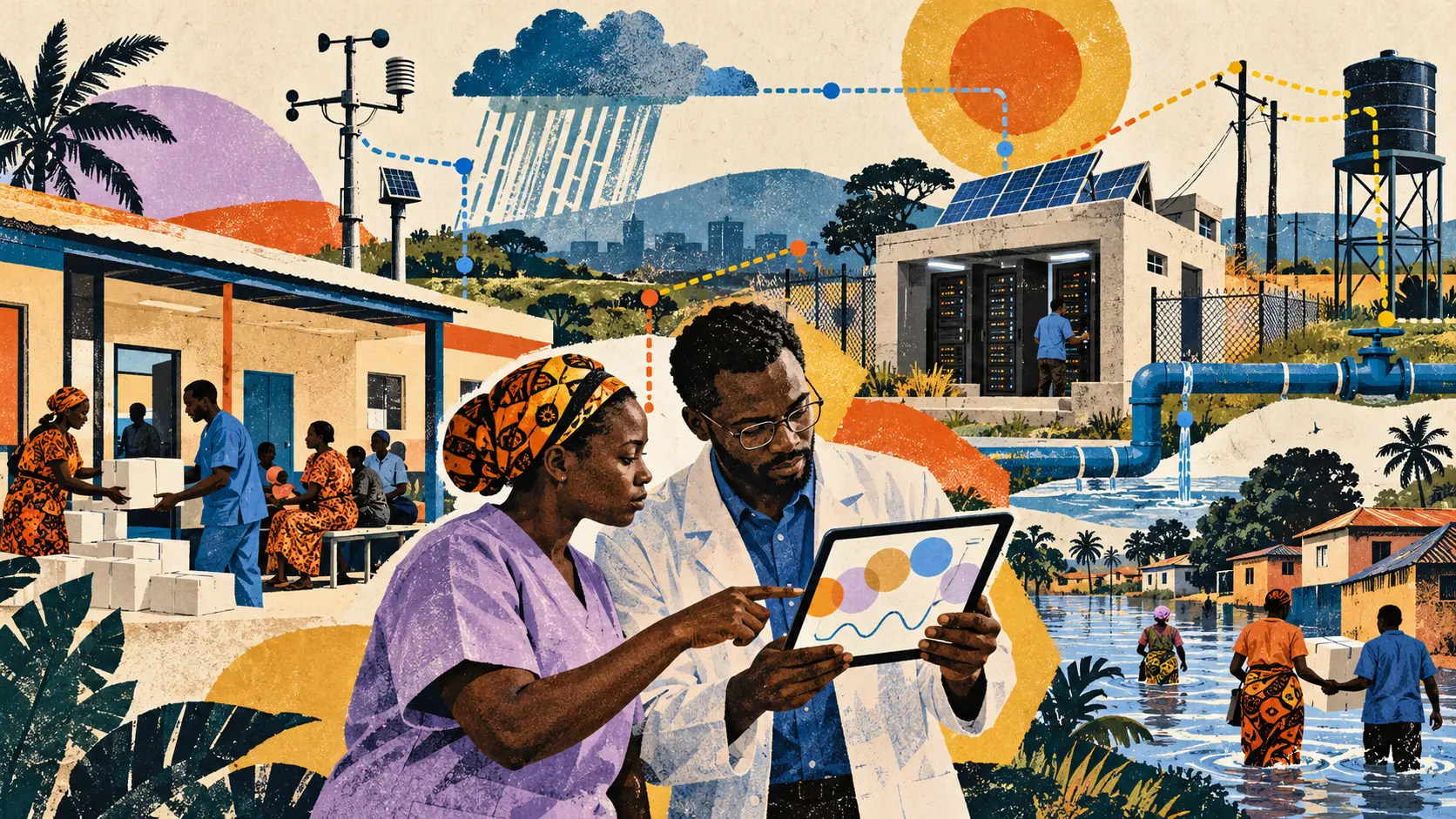
The easiest climate-health AI project to fund is a pilot. It has a beginning, a dashboard and a photograph. The harder thing to fund is the part that keeps working after the photograph: reliable electricity, connected clinics, interoperable records, weather sensors, local compute, multilingual data, maintenance staff and a public institution with the authority to act on a warning. A new research review argues that this missing foundation is shaping what artificial intelligence can do for climate and health across Africa. The paper, submitted October 26 by researchers affiliated with institutions in Rwanda and Slovenia, compares two bodies of Scopus-indexed literature. One covers global work at the intersection of AI, climate change and health. The other narrows the same question to African contexts. The authors use a method called Synthetic Knowledge Synthesis, combining a scoping review with bibliometric mapping and thematic clustering. Their central finding is a gap in research emphasis. The global literature leans toward predictive planetary-health work: environmental modeling, air-pollution mortality, chronic disease exposure and other systems that try to see a hazard before it becomes a queue at a clinic. The indexed African literature is more localized and reactive. It concentrates heavily on supervised machine learning for immediate problems such as infectious-disease triage, malaria, HIV, food security and basic sustainability. That work is not trivial or backward. When a health system is dealing with malaria, cholera, heat, floods, food insecurity and too few specialists, a model that helps identify the next patient or the next outbreak can be valuable. The problem is the ceiling. If the project can classify a blood smear but cannot rely on power, secure data exchange, connectivity or a maintained local server, it stays a useful island. It does not become an early-warning network. The authors name three structural constraints: limited compute, fragmented data and energy instability. Those are not side notes beneath the model architecture. They are the architecture. Consider a cholera warning system. The model might combine rainfall, water pressure, sanitation conditions, clinic reports and mobility patterns. But the prediction is only the last link in a longer chain. Someone has to maintain the rain gauge. The water utility has to expose trustworthy pressure data. Clinics need a consistent way to record cases. The system needs power during the storm, a network when roads are cut, and a local team that can tell the difference between a real signal and a broken sensor. Public-health officials need a threshold for acting. Medical supplies need to exist. Communities need a warning they can understand and trust. If any of those links fail, a better neural network will not repair the chain. The same is true for heat, malaria, air pollution and food insecurity. A heat-risk model needs local temperature and health data at useful resolution. A malaria forecast needs weather, habitat, movement and case reporting. A food-security monitor needs evidence that reaches beyond the loudest social-media accounts. Each application depends on institutions that can gather, govern and use the information. The paper offers many possible applications, from coastal-hazard forecasting and grid optimization to pathology support, outbreak prediction, water-leak detection and disaster response. Those are proposals and literature-derived opportunities, not results from one deployed system. That distinction matters. This study does not test a model in a clinic. It does not show that one funding program improved health outcomes. It maps an indexed research landscape and argues about the conditions under which better work could grow. The map also has blind spots. The authors acknowledge that their method relies on English-language publications indexed in major databases. That can miss local implementations, government programs, community knowledge, regional journals and projects documented in French, Arabic, Portuguese, Swahili or other languages. A thin indexed literature is not proof that local expertise is thin. It may also be evidence that the indexing system is looking in the wrong place. That is why the most useful response is not to rank Africa against a single global curve. Africa is not one deployment environment. The paper itself notes major differences in digital-health readiness between countries and warns against treating the continent as a single context. A national electronic-record system, a community health-worker network, a conflict-affected rural clinic and a coastal city do not begin with the same assets or risks. The funding unit should therefore be a durable local capability, not an imported model. Start with the problem owner. Name the ministry, clinic network, water utility, research institution or community organization that decides what problem matters. Give that group authority over the goal, evaluation and stop conditions. Then map the infrastructure chain. List every dependency between observation and action: sensors, records, data standards, consent, power, connectivity, compute, model updates, staff, procurement, maintenance, communication and the final public-health response. Price the whole chain. If a grant pays for training but not battery backup, replacement sensors, mobile data, cybersecurity or a technician after year one, the budget is describing a demonstration rather than a service. Data governance needs equal weight. Health and mobility records are not a free raw material. Define who can collect them, where they are stored, how long they remain, who can link them and what happens when a person or community objects. Data sovereignty is not solved by moving a server closer. Local institutions need real control over access, reuse, model updates and partnerships. Communities need a route to challenge harmful classifications. Researchers need enough documentation to discover when a supposedly representative dataset excludes the places at greatest risk. Localization also means more than translation. A model should reflect local disease patterns, seasons, care pathways, infrastructure and the cost of an error. A false alarm may waste scarce staff and supplies. A missed warning can delay an outbreak response. The acceptance threshold belongs to the health system living with both consequences. Build for degraded conditions. Test power loss, intermittent networks, missing sensors, delayed case reports and a broken data feed. Decide what the system does offline. Preserve the last trustworthy observation without pretending it is current. Keep a human decision path. AI can prioritize, forecast and summarize. A named public-health authority should still decide when to mobilize workers, warn a community or redirect supplies. The system should show which evidence changed the recommendation and how uncertain that evidence is. Measure the outcome that matters. Model accuracy is not enough. Track warning lead time, coverage of vulnerable communities, false-alert workload, response time, service uptime, local maintenance cost and whether the intervention changed health outcomes. Publish failures. If a flood disconnected the clinic, say so. If a model trained in one country drifted in another, show it. If the available data overrepresented cities, attach that limitation to every result. Then fund the boring middle. Pay for data stewards, electrical technicians, public-health analysts, field validation, local-language communication, security reviews and procurement that does not collapse when a vendor leaves. The paper's call for foundational investment is persuasive because it moves the AI conversation away from a contest over model novelty. It also needs a careful reading. The review is a preprint. Its conclusions are author-reported. Its database and language choices shape what it can see. Some opportunities in the discussion are supported by cited examples rather than evaluated directly by this study. Treat it as a map of a problem, not a final census of African climate-health AI. The signal is still strong. When research is concentrated on immediate triage, the answer is not to sneer at triage or parachute in a frontier model. The answer is to fund the conditions that let local teams move from reaction to prediction on their own terms. Reliable power. Governed data. Maintained sensors. Local compute where it makes sense. Secure connectivity where it does not. Skilled people. Public authority. Community trust. The clever model can come after that. Or, more accurately, it can finally become useful because that exists.
01
WHAT ACTUALLY CHANGED
Researchers compared global and African Scopus-indexed literature on AI, climate change and health
The authors used a scoping review, bibliometric mapping and thematic clustering through Synthetic Knowledge Synthesis
The global corpus emphasized predictive planetary-health applications and complex environmental modeling
The African corpus emphasized localized, reactive work including infectious-disease triage and food security
The paper identifies limited compute, fragmented data and energy instability as barriers to scaling more predictive systems
The authors call for funding to move from isolated pilots toward foundational infrastructure and localized frameworks
The paper explicitly warns that African countries have very different levels of digital-health readiness
02
WHY THIS MATTERS
Climate-health prediction depends on sensors, records, power, connectivity and public institutions before it depends on a model
A useful local classifier can remain an isolated pilot if the surrounding system cannot maintain or act on it
Imported datasets and infrastructure can weaken local relevance, sovereignty and long-term maintenance
Africa is not one deployment environment, so national and local readiness must shape every implementation
English-language database coverage can miss regional research, government systems and community-led work
Funding the whole observation-to-action chain can turn a demonstration into a durable public-health capability
03
WHERE IT COULD HELP
- Map every dependency from weather or health observation to a public-health action
- Budget for backup power, connectivity, replacement sensors, maintenance and cybersecurity
- Create interoperable records without surrendering local control over access and reuse
- Test outbreak and hazard systems under power loss, missing data and delayed reporting
- Localize models to disease patterns, languages, seasons, care pathways and error costs
- Give a named local institution authority over goals, evaluation, deployment and stopping
- Measure warning lead time, service uptime, equity, workload and health outcomes alongside accuracy
- Publish geographic gaps, urban bias, failed transfers and infrastructure outages
- Support data stewards, technicians, health analysts and community communication as core AI work
- Treat every cross-country transfer as a new validation problem
KEEP A HAND ON THE WHEEL
This is a new preprint and literature analysis, not a clinical trial, deployed system evaluation or complete census. The paper relies on English-language publications indexed in major databases, which can omit regional journals, non-English work, local government programs and community-led systems. Its application examples and policy recommendations should not be read as outcomes produced by this study. Watch for independent replication, transparent corpus counts, country-level analysis, multilingual evidence, public data and code, and programs that measure sustained health outcomes rather than pilot completion.
04
TERMS WORTH KEEPING
SOURCES AND VERIFICATION STATUS
This article was written from the materials below. Product claims and dates were checked against those sources on October 28, 2026.
PUBLICATION RECEIPT: The article presents the findings as an author-reported literature analysis, not a clinical outcome study, and foregrounds the paper's English-language database limitation and country-level differences.
THE PUBLICATION ENGINE
WANT A SIGNAL OF YOUR OWN?
We build source-grounded publications, private briefings, and editorial systems for organizations with something useful to say.
WORK WITH US