THE SIGNAL IN ONE SENTENCE
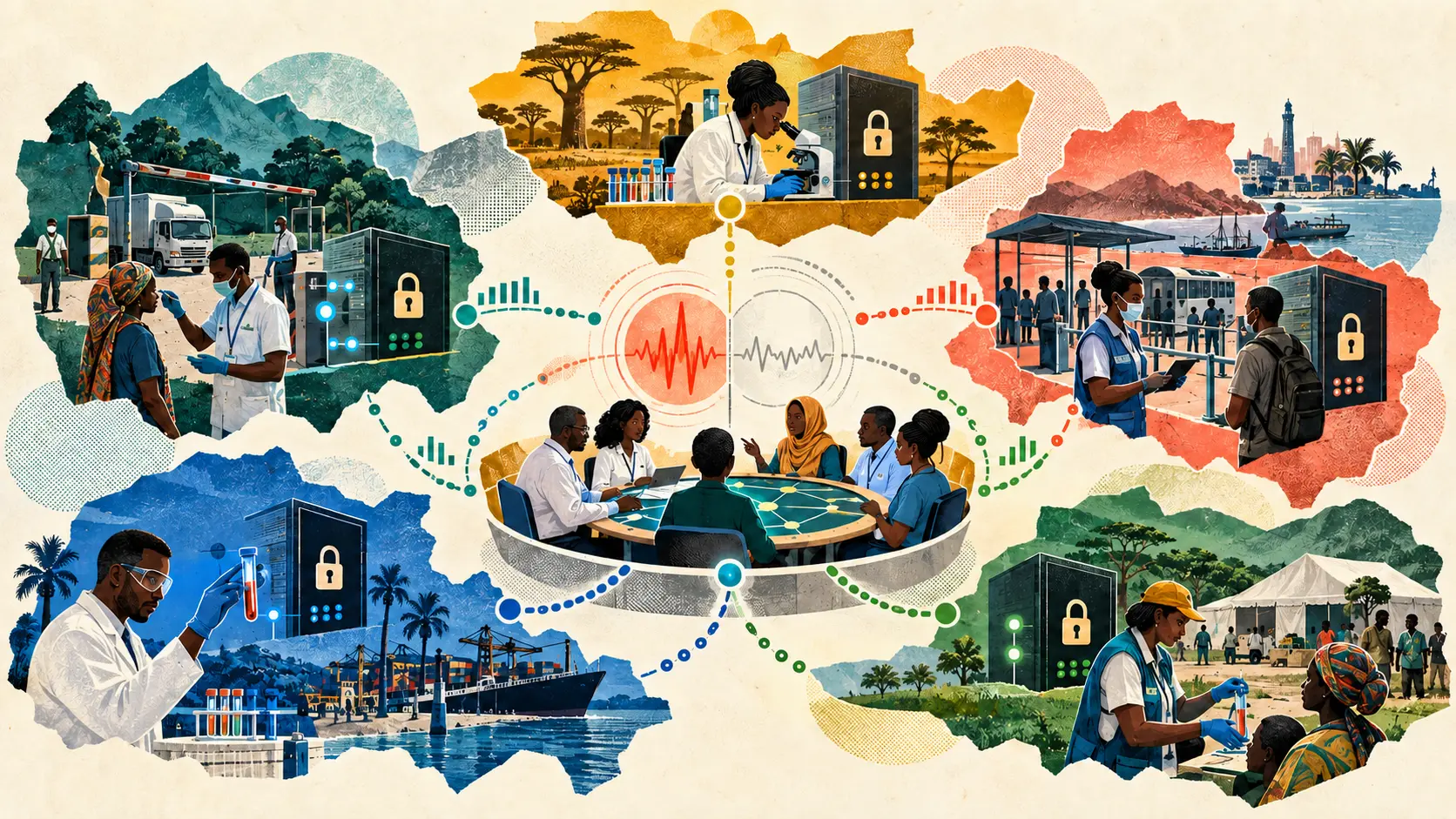
African leaders and health officials have backed a practical-sounding idea: a disease does not stop at a border, so the warning about it should not stop there either. On September 25, during the United Nations General Assembly in New York, participants adopted the New York Call to Action on Cross-Border Preparedness Intelligence in Africa. The event was convened by the World Health Organization Regional Office for Africa, Dure Technologies and the President of the Central African Republic. WHO says the call supports stronger cooperation and responsible use of artificial intelligence for infectious-disease preparedness. This is not a proposal to dump every country's health records into one giant continental bucket. WHO describes a model in which countries retain control of their data while sharing intelligence needed for joint preparedness and response. The technical center is the Preparedness Data Exchange, or PDX, launched in March. WHO says it combines preparedness and risk information and uses AI-enabled capabilities to help officials identify emerging risks, analyze information and improve readiness. The border-facing piece is Voyage Sante+, a digital health-screening platform developed with Dure Technologies for points of entry. The new call also builds on an August memorandum signed by health ministers from ten African countries. Those parts make the announcement more than a conference slogan. A data exchange exists, a screening platform has been named and a group of governments has signed a cooperation instrument. What the public still cannot inspect is the evidence layer that turns those components into a trustworthy early-warning system. WHO has not published the model card, training data, signal definitions, accuracy by country or pathogen, false-alarm and missed-alert rates, human-review rules, privacy and security assessment, complete data schema, operating budget or country-by-country implementation calendar. That gap matters because an outbreak warning is neither a diagnosis nor a command. A false alarm can waste scarce laboratory, staffing and travel resources. A missed signal can cost time when time is the scarce resource. Border screening can support public health, but it can also burden travelers and communities when a score is treated as proof rather than a prompt for verification. The International Health Regulations already require countries to maintain surveillance and response capacity, including at points of entry, and to notify WHO about relevant public-health risks. AI does not replace those legal and operational duties. It adds another inference between a messy signal and a human decision. The plain signal is that Africa now has political backing for a shared preparedness layer. It does not yet have a public receipt showing how the AI layer performs. The useful next move is not a prettier prediction dashboard. It is a common evidence ledger that follows every signal from local source to regional alert, records which data crossed a border, preserves the country's authority, shows who verified the warning and measures what happened next. That is how sovereignty becomes an operating rule instead of a reassuring adjective.
01
WHAT ACTUALLY CHANGED
African leaders, health ministers, regional institutions and partners adopted the New York Call to Action on Cross-Border Preparedness Intelligence in Africa.
The call was adopted on September 25, 2026 during a presidential dialogue held alongside the United Nations General Assembly in New York.
WHO Africa published its account of the agreement on September 26.
The dialogue was convened by WHO in the African Region, Dure Technologies and the President of the Central African Republic.
Participants called for stronger cross-border cooperation and responsible use of AI in infectious-disease preparedness.
WHO says the work should strengthen existing public-health systems and expertise rather than replace them.
The Preparedness Data Exchange was presented as the emerging regional platform supporting the approach.
WHO says PDX launched in March 2026.
PDX integrates preparedness and risk information to support earlier evidence-based decisions across the region.
WHO describes the platform as having AI-enabled capabilities designed to identify emerging risks, analyze information and improve readiness.
Voyage Sante+ was identified as a digital health-screening platform for points of entry.
The platform was developed in partnership with Dure Technologies as part of the PDX initiative.
Participating governments and partners called for strengthened use of Voyage Sante+.
WHO describes a proposed model in which countries retain control over their data while sharing intelligence for collective preparedness and response.
WHO says it will support member states as they translate the call into national policies, financing and practical cross-border arrangements.
The work builds on the Bangui Communique and its calls for surveillance, harmonized alerts, timely information sharing and coordinated preparedness.
It also builds on an August 2026 cross-border memorandum signed by health ministers from ten African countries.
That memorandum covers information sharing, early detection and coordinated action before, during and after emergencies.
The public WHO account does not identify every country that will implement PDX or Voyage Sante+ first.
It does not publish a technical evaluation of the AI-enabled capabilities described in the announcement.
02
WHY THIS MATTERS
Pathogens cross borders through people, animals, goods and environments, so one country can hold a signal that matters immediately to a neighbor.
A shared regional view can help officials connect weak observations that look ordinary when each country sees them alone.
Country control over source data can make cooperation politically and legally possible without requiring one central owner of every record.
Country control is meaningful only if access, purpose, retention, onward sharing and deletion are technically enforced and auditable.
Preparedness data can include facility readiness, laboratory capacity, staffing, supplies, mobility, environmental signals and outbreak reports with very different sensitivity.
Combining those sources may improve context while also multiplying quality, compatibility and privacy problems.
An AI-generated risk signal is a hypothesis for investigation, not laboratory confirmation and not a clinical diagnosis.
False alarms can divert laboratories, field teams, vaccines, protective equipment and public attention from real needs.
Missed alerts can delay investigation and coordinated response during the short window when an outbreak may still be contained.
A single accuracy number would hide whether the system performs differently by pathogen, country, language, data source or connectivity level.
Border screening can support surveillance while also creating consequences for travelers who may not know how a flag was produced or challenged.
The International Health Regulations already place surveillance, notification and point-of-entry duties on states, so the new tools enter an existing legal system.
A dashboard cannot compensate for missing laboratories, weak reporting channels, staff shortages or an unfunded response plan.
Ten ministerial signatures create a cooperation base, but a memorandum does not by itself make systems interoperable or finance daily operations.
Political support can unlock national policy and money, which is why the lack of a public implementation timetable matters now rather than later.
A regional platform should publish which conclusions come from observed data, statistical methods, machine-learning models and human judgment.
Public-health officials need enough explanation to decide whether to verify, monitor, escalate or ignore a signal.
Communities need a remedy when screening or data-sharing errors create travel restrictions, stigma or other burdens.
The same evidence ledger can improve trust between countries because every alert carries its source, uncertainty, permissions and verification history.
The announcement matters beyond Africa because federated regional intelligence is a reusable answer to the tension between shared risk and sovereign data.
03
WHERE IT COULD HELP
- Publish a regional inventory of participating countries, connected systems, covered data classes and planned activation dates.
- Give each country a machine-enforced policy for which fields may be shared, for which purpose and with which neighbors or regional bodies.
- Keep raw personal and clinical data inside the national boundary unless a defined legal and public-health need authorizes transfer.
- Share the minimum useful intelligence, such as an aggregated trend, confidence range and verification status, instead of every underlying record.
- Attach provenance to every signal, including source system, collection time, country, transformation steps and known quality limits.
- Publish model cards for every AI component with training data scope, intended use, excluded use, update history and accountable owner.
- Measure sensitivity, specificity, precision, recall and alert delay separately by pathogen, country and source type where sample sizes allow.
- Report false alarms and missed alerts with the operational cost or delay each one produced.
- Require a named epidemiologist or authorized public-health team to verify a signal before it changes travel, resource allocation or public messaging.
- Give point-of-entry staff a clear display of signal age, uncertainty, missing data and the next permitted action.
- Provide travelers with a plain-language explanation, contact point and review path when screening produces a consequential flag.
- Test the workflow during quiet periods with exercises that include outages, stale feeds, conflicting national reports and malicious data.
- Maintain offline and low-bandwidth procedures so a network failure does not erase surveillance at the border.
- Log every cross-border query, data disclosure, alert, reviewer decision, correction and downstream action.
- Use independent security testing for identity, access, encryption, data isolation, incident response and supply-chain risk.
- Publish national privacy and public-health legal assessments before connecting sensitive sources.
- Fund laboratories, field verification, staffing and communications alongside analytics so an alert can lead to action.
- Create a regional incident process for a leaked record, forged signal, compromised account or model failure.
- Give participating countries a tested exit and data-deletion procedure rather than making regional cooperation technically irreversible.
- Publish an annual scorecard covering connectivity, alert quality, verification time, response time, harms, costs and unresolved gaps.
KEEP A HAND ON THE WHEEL
WHO Africa verifies the September 25 adoption of the New York Call to Action, the conveners, the responsible-AI language, the March launch of PDX, Voyage Sante+ at points of entry, the proposed country-control model and the August memorandum signed by health ministers from ten countries. WHO describes PDX as integrating preparedness and risk information and says its AI-enabled capabilities are designed to help identify emerging risks. It does not publish an independent evaluation showing that the platform predicts outbreaks, improves health outcomes or outperforms existing surveillance. The public account does not provide a model card, complete data schema, list of connected national systems, exact implementation countries, error rates, country or pathogen breakdowns, privacy impact assessment, cybersecurity test, procurement terms, operating budget, response capacity, appeal process or delivery schedule. Voyage Sante+ is named and its intended point-of-entry role is described, but screening variables, decision rules, human-review steps and traveler remedies are not public in the reviewed materials. The International Health Regulations provide binding public-health duties and context, but they do not certify the new AI components. Watch for the complete call, national implementation plans, technical documentation, independent validation, a data-governance charter, country participation list, financing, border-screening safeguards and published records connecting alerts to verified action.
04
TERMS WORTH KEEPING
SOURCES AND VERIFICATION STATUS
This article was written from the materials below. Product claims and dates were checked against those sources on September 27, 2026.
PUBLICATION RECEIPT: Revision 1. Published September 27, 2026.
THE PUBLICATION ENGINE
WANT A SIGNAL OF YOUR OWN?
We build source-grounded publications, private briefings, and editorial systems for organizations with something useful to say.
WORK WITH US