THE SIGNAL IN ONE SENTENCE
Feather Robotics has put a number on a category that usually arrives wrapped in a sales call: $29,990. That is the current promotional price on the company's product page for a wheeled, two-arm development platform. The page lists a one-meter reach, 600 millimeters of vertical travel, a base that can move in any direction at up to 1.3 meters per second, dual hot-swappable batteries rated for ten hours, replaceable end effectors, swappable onboard compute, teleoperation, simulation support and an open software development kit for Python and ROS 2. Feather says the machine is shipping today. The combination is genuinely useful. A developer can buy a body, attach task-specific tools, run different models and work on a physical application without first inventing every motor, bracket and control layer. That is the platform argument, and it is more concrete than another glossy promise about a robot that may someday walk into a factory. Feather also announced a $7.6 million pre-seed round led by Gradient. The company says it built its first prototype in two months, received its first order in nine months, passed $1 million in revenue and has machines working in manufacturing, food service and other settings. TechCrunch reports that Feather has begun selling small quantities and says its robots cook in restaurants and clean science laboratories. Those details show commercial motion, but almost every deployment result still comes from Feather or its investors. The reviewed materials do not name most customers, publish fleet size, define a successful shift, count human interventions or provide an independent reliability benchmark. The product page says fewer parts create fewer failure points and greater reliability. That is a design hypothesis until a field ledger shows the denominator. A ten-hour battery rating is not ten hours of productive work under every payload. Hot swapping can reduce charging interruptions without preventing gripper faults, localization errors, software crashes, network loss, human rescues or parts delays. Even the phrase carrying capacity of an adult human, used in the company announcement, leaves buyers without a numeric payload curve for each reach, speed and end-effector configuration. NIST has spent years developing repeatable ways to evaluate mobile manipulators, the useful technical name for a robot arm mounted on a moving base. Its work treats safety, mobility, manipulation, energy, human-system interaction and task performance as separate things that need measurement. That is the missing bridge between a development kit and dependable equipment. A buyer should start with one bounded task, define success before the robot arrives, count every attempt and log every stop, recovery, intervention and repair. The result should include task completion rate, cycle time, accuracy, dropped objects, near misses, battery life under the actual load, mean time between failures, mean time to repair, spare-part delay and operator minutes per shift. The same ledger should preserve the exact hardware, end effector, model, control software and SDK version, because a result from one configuration does not automatically transfer to another. The $29,990 number also is not total deployment cost. Integration, task tooling, safety controls, site preparation, training, teleoperation, maintenance, spares and downtime all sit outside the promotional price unless a contract says otherwise. Feather's open SDK can make that work easier, but open SDK does not necessarily mean open-source hardware, stable interfaces forever or permission to modify every layer. Buyers need the repository, license, supported versions, update policy and service terms in writing. The plain signal is that Feather has made physical AI more purchasable. It has not made reliability measurable for the public. That is not a reason to dismiss the robot. It is a reason to buy the platform like an engineer instead of hiring it like a person. Put one task in front of it, keep the receipts and let the ledger decide whether the prototype becomes equipment.
01
WHAT ACTUALLY CHANGED
Feather Robotics announced a public launch of its modular robot platform on September 24, 2026.
The current Feather product page lists a promotional price of $29,990 while supplies last.
The same page shows a regular price of $32,990 crossed out above the promotional price.
Feather describes the product as a hardware platform for robotics developers rather than a finished worker for one fixed job.
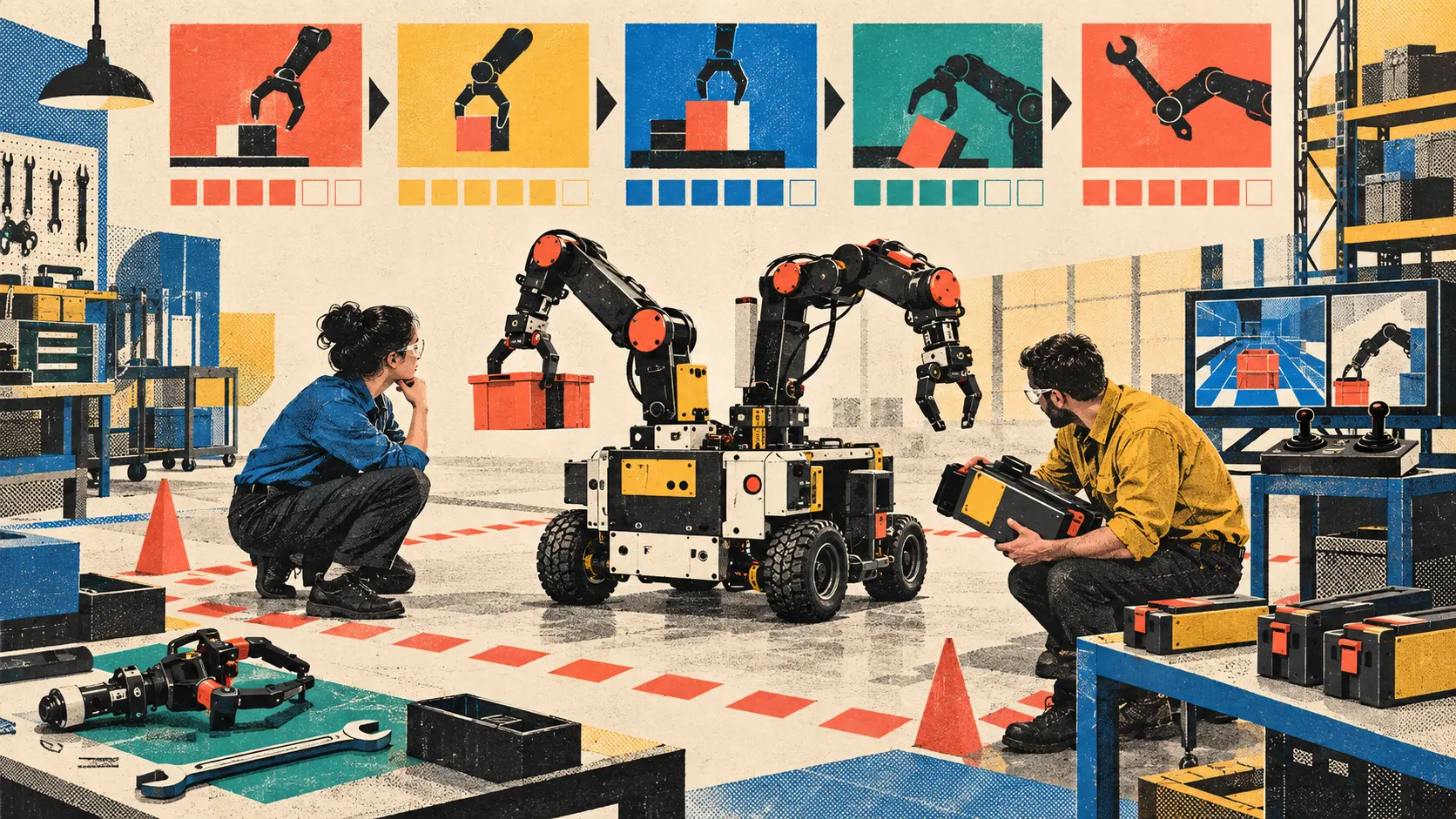
The platform has two arms mounted on a wheeled mobile base.
The company lists one meter of reach and 600 millimeters of vertical travel.
The base is described as holonomic, meaning it can move in any direction without first turning.
Feather lists a maximum base speed of 1.3 meters per second.
The product page lists dual hot-swappable batteries and a ten-hour battery rating.
The robot supports modular end effectors for task-specific tools.
The onboard compute can be swapped rather than permanently fixed to one configuration.
The public feature list includes built-in teleoperation, inverse kinematics and collision detection.
Feather says developers can use simulation before moving code to the physical machine.
The software development kit supports Python and ROS 2.
Feather calls the SDK open, but the reviewed page does not provide a complete public map of licenses, interface guarantees and supported versions.
The company says the platform is shipping today.
Feather announced a $7.6 million pre-seed round led by Gradient.
The company says it crossed $1 million in revenue after building its first prototype in two months and receiving its first order in nine months.
TechCrunch reports that Feather has sold small quantities and says robots are cooking in restaurants and cleaning science laboratories.
The reviewed public materials do not publish a fleet-wide reliability benchmark, a complete customer list or a task-level field ledger.
02
WHY THIS MATTERS
A public price lets small robotics teams compare a platform with the cost and delay of building custom hardware from scratch.
A purchasable body can move developer effort toward task design, perception, control and customer integration.
Modular end effectors make one base useful for experiments that need different grippers or tools.
Swappable compute can help teams test new models without replacing the whole machine.
Python and ROS 2 support lower the software barrier for developers already using common robotics tools.
Teleoperation gives a team a fallback and a way to collect demonstrations, but every remote rescue is still labor that should be counted.
Simulation can reduce some physical testing, but a simulated result does not establish safety or reliability in a cluttered workplace.
A wheeled base avoids the complexity of walking, but it still has to localize, navigate, stop and recover around people and objects.
A ten-hour battery rating does not reveal runtime under a particular payload, speed, compute load, floor or temperature.
Hot-swappable batteries can reduce charging downtime while leaving mechanical, software and service downtime untouched.
One-meter reach is useful only when paired with payload, accuracy and repeatability data across the reachable workspace.
The phrase carrying capacity of an adult human is not a substitute for a numeric payload curve and tested lifting conditions.
Revenue and customer activity indicate demand, but they do not reveal task completion rate or the amount of human support behind each deployment.
Small-quantity sales are different from a large installed fleet with repeatable maintenance and spare-parts operations.
A lower purchase price can be erased by custom tooling, integration, supervision, downtime and service costs.
Reliability depends on a complete configuration, so hardware, end effector, model, control stack and software version belong in every result.
NIST treats mobile-manipulator safety and performance as measurable properties rather than conclusions inferred from appearance or price.
Comparable test methods let a buyer distinguish an impressive demonstration from repeatable work.
Publishing failure and recovery data would help the whole developer ecosystem choose tasks that match the machine's actual limits.
The platform becomes dependable equipment only when field evidence survives changes in shift, site, operator and software version.
03
WHERE IT COULD HELP
- Choose one bounded task with a clear start state, finish state and failure definition before purchasing hardware.
- Record the robot price separately from end effectors, compute, integration, site preparation, safety controls, training and service.
- Define a successful attempt in observable terms such as object placed, container filled or surface cleared.
- Run enough repeated attempts to show ordinary variation rather than selecting the cleanest demonstration.
- Measure successful completions, partial completions, failures and abandoned attempts with the same denominator.
- Log cycle time by task phase so travel, manipulation, waiting and recovery are visible separately.
- Count every human intervention, teleoperation minute, reset, repositioning and manual cleanup.
- Measure battery runtime under the real payload, speed, compute load and environmental conditions.
- Time every battery swap and record whether the robot, operator or another system initiated it.
- Test numeric payload, accuracy and repeatability at several reaches instead of relying on one broad capacity phrase.
- Track dropped objects, collisions, protective stops, near misses and unsafe approaches as distinct events.
- Calculate mean time between failures and mean time to repair from timestamped field records.
- Keep spare-part inventory, shipping delay, warranty response and service escalation in the operating-cost ledger.
- Attach every result to the exact robot serial number, end effector, compute module, model and software versions.
- Repeat the task after SDK, model, firmware or hardware changes before assuming the old result still applies.
- Document who may teleoperate, what they can see, how commands are authenticated and what happens when connectivity fails.
- Use NIST-style test artifacts or other repeatable fixtures to measure position and manipulation performance against ground truth.
- Start in a controlled area, then widen the operating envelope only after each new condition passes a defined gate.
- Write support terms for response time, replacement parts, supported software and end-of-life notice into the purchase agreement.
- Publish an aggregate deployment card with task success, intervention, uptime, battery, safety and repair metrics after the pilot.
KEEP A HAND ON THE WHEEL
Feather's current product page directly supports the promotional price, regular price, 600-millimeter vertical travel, one-meter reach, holonomic base, maximum listed speed, dual hot-swappable batteries, ten-hour battery rating, modular end effectors, swappable compute, teleoperation, collision detection, simulation, Python and ROS 2 support and the company's statement that the platform is shipping. The September 24 company announcement, reproduced in a September 25 SEED Innovations investor update, supports the funding amount, prototype and order timeline, revenue claim, customer categories and broader carrying-capacity claim. Those results are company statements reproduced by an investor, not an independent audit. TechCrunch independently verifies the launch context, founder account, price and small-quantity sales, but its deployment and revenue details still come from Feather. NIST provides independent technical context for measuring mobile-manipulator safety and performance; it does not test or endorse Feather. The reviewed materials do not publish a complete customer list, installed fleet count, task-success denominator, intervention rate, mean time between failures, mean time to repair, numeric payload curve, battery test conditions, safety certification ledger, service-level record or independent comparison. Watch for a public SDK repository and license, a detailed specification sheet, supported software versions, numeric payload and accuracy data, safety documentation, named reference deployments, field reliability results, warranty and service terms, and measurements that distinguish autonomous work from teleoperated recovery.
04
TERMS WORTH KEEPING
SOURCES AND VERIFICATION STATUS
This article was written from the materials below. Product claims and dates were checked against those sources on September 27, 2026.
PUBLICATION RECEIPT: Revision 1. Published September 27, 2026.
THE PUBLICATION ENGINE
WANT A SIGNAL OF YOUR OWN?
We build source-grounded publications, private briefings, and editorial systems for organizations with something useful to say.
WORK WITH US