THE SIGNAL IN ONE SENTENCE
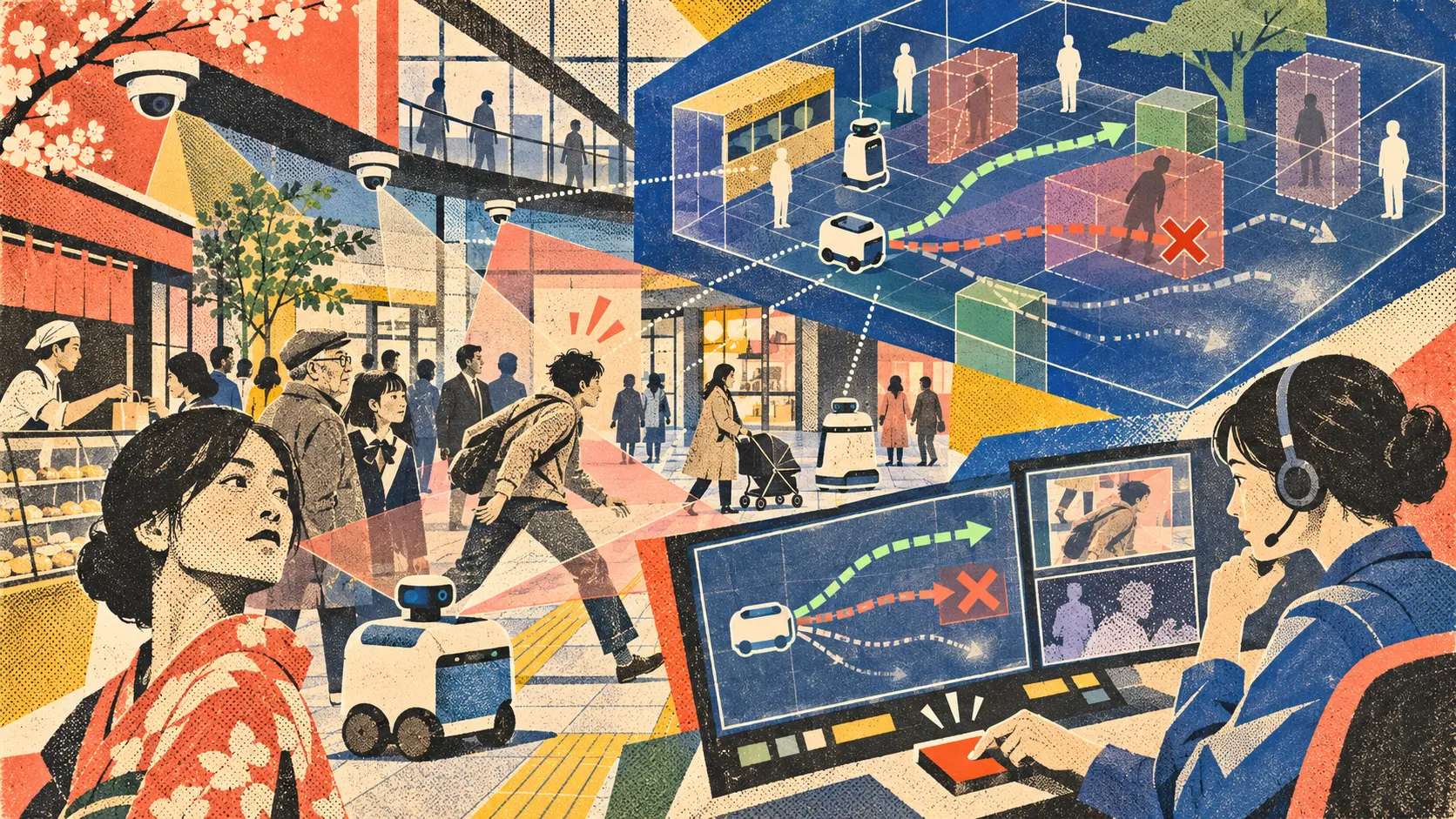
A robot that sees only through its own camera is a little like a person steering a shopping cart while looking through a cardboard tube. It may understand the patch of floor in front of it. It may not see the child running around the shelf, the delivery cart emerging from a doorway or the second robot taking the same shortcut. Fujitsu wants to widen that view. On October 30, Fujitsu opened a Research Portal page for its spatial world model. The company says the technology combines information from cameras installed throughout a space with cameras carried by robots. It turns those observations into a three-dimensional scene graph representing people, objects and robots, then models their interactions to predict possible future actions. The portal is new. The underlying technology is not. Fujitsu originally announced the work on December 2, 2025. That date matters because a fresh webpage is not a fresh field result. The current documentation explains an intended architecture and use cases, including security, visitor guidance and coordination among multiple robots. It does not add a new peer-reviewed evaluation, comparative deployment study or public field-safety record. There is still a useful idea here. Most mobile robots build a local world from their own sensors. That approach works best in spaces that are stable, mapped and politely empty. Offices, shops and public facilities are not polite. People pause, reverse direction, gather in doorways, carry awkward objects and ignore the routes a planner expects them to take. Fujitsu says its spatial model is meant to represent the whole shared space. A ceiling camera may see around a corner that blocks a robot's view. Another robot may see the back of an object. The combined scene graph can, in principle, give every machine a better account of where things are and how they relate. Then comes the ambitious part: imagining what happens next. The model may infer that a visitor is approaching a reception desk, that a person will cross a corridor or that two robots are about to interfere with each other. Fujitsu says this future prediction could help robots avoid collisions, divide work and collaborate with people. That sounds sensible. It also moves the system from mapping the present to gambling on human behavior. The difference is important. A camera observation can be wrong because of blur, glare, occlusion, bad calibration or a stale network packet. A tracked identity can jump from one person to another. A three-dimensional reconstruction can place an object several centimeters away from its real position. Future prediction adds another layer of uncertainty because people are not trajectories with shoes. A shopper who appears to be walking toward an exit may turn toward a child. A person using a cane may move differently from the examples in the training set. A worker may step backward while carrying a box. A crowd may split around a temporary display. A security robot may interpret a hurried gesture as a route when it is actually a warning. The model does not need to be useless for these failures to matter. It only needs to be confident at the wrong moment. So the useful product is not merely a spatial world model. It is a future-action test that sits between the model's imagined scene and any command sent to a robot. Start by preserving the observation record. Every person, object and robot node in the scene graph should carry its source camera, capture time, calibration version and confidence. The system should mark which surfaces were directly observed, which were inferred and which are hidden. If two cameras disagree, the disagreement should remain visible instead of being averaged into fake certainty. Time matters as much as space. A beautifully reconstructed scene that is 800 milliseconds old can be more dangerous than a rough scene that is current. Each prediction should record the age of its inputs and the delay between sensing, fusion, planning and motion. The safety gate should reject actions when latency exceeds a limit appropriate to the robot's speed, stopping distance and environment. Identity deserves suspicion too. The system may need a temporary track to predict motion. It usually does not need to know a person's name. Persistent facial identity creates privacy risk without necessarily improving collision avoidance. A safer design uses short-lived anonymous tracks, resets them when they leave the operational area and keeps identity confidence separate from position confidence. Next, ask the model for more than one future. A single predicted path invites automation to treat possibility as destiny. Real spaces contain branches. The person may continue, stop, turn or reach for an object. The test should keep several plausible futures with probabilities or confidence ranges, then require the robot's proposed action to remain safe across the credible set. If one likely future is convenient and one less likely future puts a human in the stopping zone, the robot does not get to vote for convenience. The test should also know every robot's intent. Sharing observations without sharing planned actions can still produce a polite mechanical pileup. Each robot should publish its proposed path, speed, task priority, stopping envelope and fallback state to a coordinator. The coordinator can detect crossing paths, blocked exits, contradictory goals and jobs that silently assume another robot will move first. Priority rules need human values, not only optimization. An evacuation route outranks a cleaning schedule. A person using a mobility device gets more clearance, not less. A security task does not justify trapping someone between machines. A service robot should not race a human to a doorway because the route planner found a shorter completion time. Then run the imagined future against a hard safety envelope. Some constraints should not be negotiable by a learned model: maximum speed near people, minimum separation, stopping distance, accessible route width, fire-exit clearance and behavior during sensor or network failure. The predictive model can propose. A simpler verified controller should be able to refuse. Refusal is only useful if the fallback is safe. Stopping in place may block an exit or leave a heavy robot in a person's path. A good fallback can include slowing, moving to a designated refuge point, yielding the task to another robot, asking a human operator for help or switching to a conservative local controller when the shared model disappears. The facility needs to test those fallbacks before opening day. Run the system in shadow mode first. Let it observe live scenes and propose actions without controlling the robots. Compare its predicted futures with what actually happened. Record near misses, identity swaps, missed objects, stale scenes and cases where a human supervisor would have rejected the plan. Build a replay library from those failures. The library should include ordinary mess, not only dramatic collisions: a reflective floor, an umbrella hiding a leg, a stroller next to a suitcase, children moving unpredictably, a person changing pace, two identical uniforms crossing, a temporary sign, a dropped object, a dead camera and a network delay that arrives just below an alert threshold. Accessibility cannot be a final checklist. People move, communicate and occupy space in many ways. A system trained around one supposedly normal walking pattern can classify difference as uncertainty or obstruction. Test wheelchairs, canes, guide dogs, mobility scooters, signed communication, sensory needs and people who pause longer than the planner expects. Invite disabled people into the design and evaluation, with payment and power to reject unsafe behavior. Privacy needs a similarly concrete boundary. A whole-space camera system can become a very capable surveillance system by accident or design. Facilities should publish what is sensed, why it is needed, where processing occurs, how long raw video and scene graphs are retained, who can access them and whether the data is reused for training. The default should minimize raw imagery, persistent identity and retention. Security teams should assume the world model can be attacked. Someone may cover a camera, place an adversarial object, spoof a robot's position or flood the coordinator with stale messages. A compromised robot should not be able to tell every other robot that a corridor is empty. Signed device identity, authenticated messages, replay protection, sensor cross-checks and isolation are part of physical safety. After deployment, preserve the outcome. For each consequential action, keep the input versions, scene graph, alternative futures, selected plan, rejected plans, safety checks, operator intervention and what actually occurred. That record turns an awkward incident into a test case instead of a memory. The public metrics should be equally grounded. Report collision and near-miss rates, emergency stops, false obstacles, missed obstacles, identity-switch rates, time spent in degraded mode, human overrides and the performance of different environments and populations. Average task completion time is useful. It is not a safety argument. Fujitsu's portal gives developers a clearer look at the intended system and how it differs from a world model carried by one robot. That is useful documentation. It is not proof that a shared predictive model is ready to direct machines through a busy facility. The next evidence should show how often the model's imagined futures match reality, how quickly error grows, how the controller behaves when cameras disagree and whether people can understand and challenge the system around them. Physical AI has a habit of making software metaphors literal. When a chatbot guesses wrong, a sentence goes sideways. When a robot guesses wrong, something with wheels may go sideways too. Let the model imagine. Make the safety system test the imagination before anyone has to dodge it.
01
WHAT ACTUALLY CHANGED
Fujitsu launched a public Research Portal page for its spatial world model on October 30, 2026.
The company says the system combines fixed-camera and robot-camera observations into a shared three-dimensional scene graph.
The documented model represents interactions among people, objects and robots and is intended to predict possible future actions.
Fujitsu presents security, visitor guidance, human-robot collaboration and coordination among multiple robots as intended uses.
The portal distinguishes a whole-space model from world models maintained independently by individual robots.
The underlying technology was originally announced on December 2, 2025, so the new event is portal availability rather than a new research result.
The portal launch does not include a new peer-reviewed evaluation, comparative deployment study or public field-safety record.
02
WHY THIS MATTERS
Fixed cameras can reveal areas hidden from a robot, while robot cameras can add close and changing views of the same space.
A shared scene can help multiple robots detect intersecting routes and coordinate work before they interfere with each other.
Predicting human motion introduces uncertainty beyond mapping because people can stop, turn, gather or behave outside the training distribution.
Occlusion, latency, calibration errors and identity swaps can turn a plausible scene graph into an unsafe control input.
Whole-space sensing creates privacy, retention and surveillance questions even when its immediate purpose is robot navigation.
Accessibility needs can be missed when a planner treats one walking pattern or body movement as normal.
The field needs outcome evidence and safe fallback behavior, not only demonstrations of intended capability.
03
WHERE IT COULD HELP
- Attach sensor source, timestamp, calibration version, confidence and occlusion state to every scene-graph node.
- Keep several plausible future paths rather than collapsing uncertain human behavior into one predicted route.
- Require a proposed robot action to remain safe across the credible future set and the robot's full stopping envelope.
- Share each robot's intended path, speed, task priority, safety zone and fallback state with the coordinator.
- Enforce hard rules for speed, separation, accessible routes, exits and degraded operation outside the learned model.
- Run new models in shadow mode and compare predicted futures with observed outcomes before granting control authority.
- Turn near misses, identity swaps, missed objects, stale scenes and human overrides into a permanent replay library.
- Use short-lived anonymous tracks and minimize raw video, persistent identity, retention and secondary training use.
- Test crowds, children, mobility devices, guide dogs, reflective surfaces, temporary objects, dead cameras and network delay.
- Preserve the scene, alternative futures, selected action, rejected plans, safety checks, intervention and outcome for consequential events.
KEEP A HAND ON THE WHEEL
The portal describes Fujitsu's intended architecture and use cases. It does not publish a new peer-reviewed evaluation, comparative deployment result, field-safety record or independent validation. The underlying technology was announced in December 2025, while portal availability is dated October 30, 2026. Future-action predictions can fail through occlusion, stale data, calibration drift, identity mistakes, unusual movement and conflicting robot goals. Whole-space sensing also raises privacy, accessibility and security risks. Watch for shadow-mode results, scenario coverage, near-miss rates, human overrides, latency limits, independent safety review, retention rules and a verified fallback when the shared model is uncertain or unavailable.
04
TERMS WORTH KEEPING
SOURCES AND VERIFICATION STATUS
This article was written from the materials below. Product claims and dates were checked against those sources on November 2, 2026.
THE PUBLICATION ENGINE
WANT A SIGNAL OF YOUR OWN?
We build source-grounded publications, private briefings, and editorial systems for organizations with something useful to say.
WORK WITH US