THE SIGNAL IN ONE SENTENCE
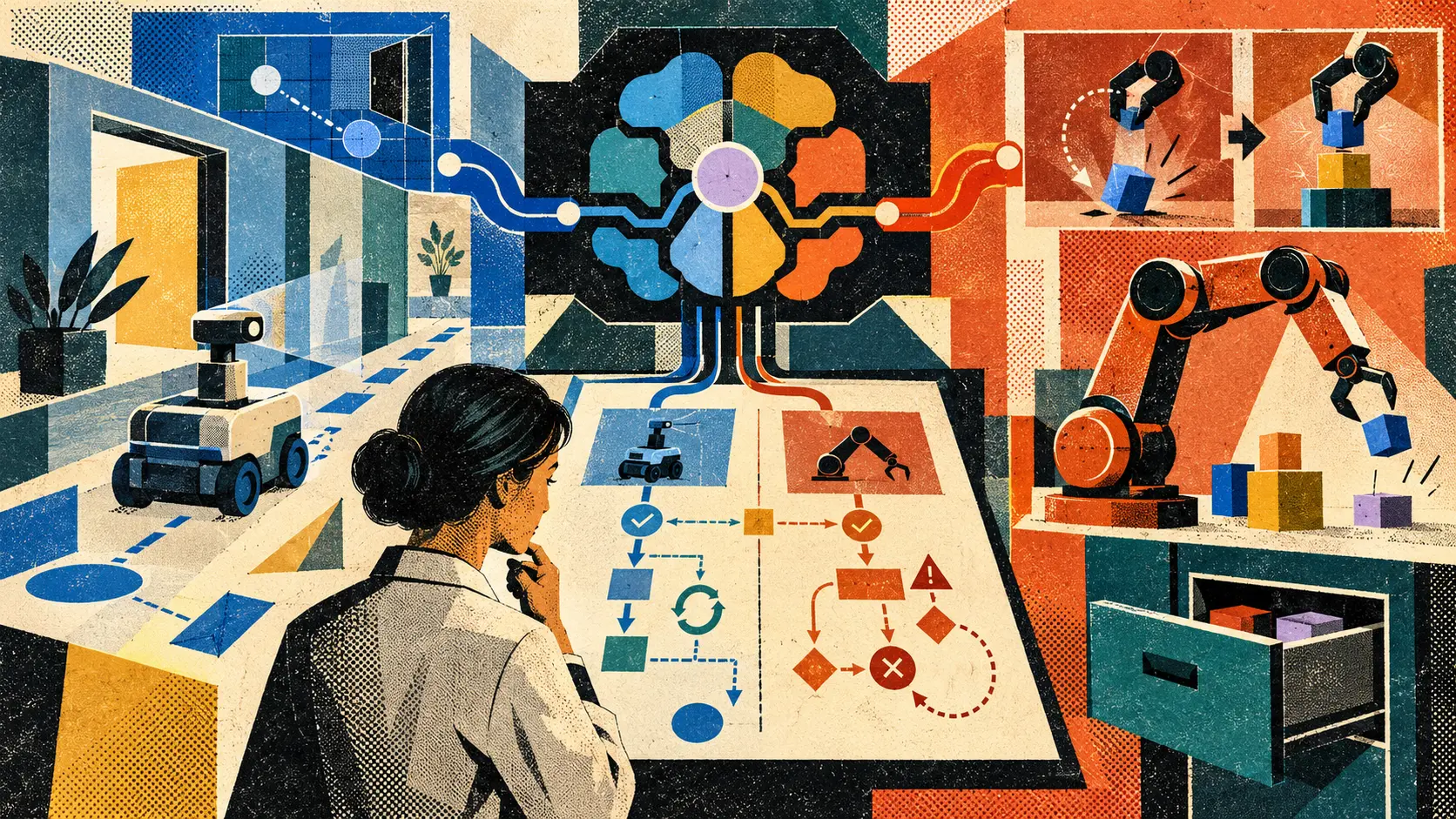
A robot that can walk to a table and stack the blocks on it sounds like one system. Inside the machine, it is usually a committee meeting. One component understands the instruction. Another estimates where the robot is. Another chooses a route. A manipulation model decides how to move the arm. Motion controllers keep joints and wheels from doing something memorable for the wrong reason. The awkward part is the chairperson. Researchers from Xiaomi's Embodied Intelligence Team, Tsinghua University and the University of Macau have introduced OmniBrain-0, a compact high-level model intended to coordinate navigation and manipulation through one shared decision layer. The paper was submitted on October 26. The authors present four-billion- and nine-billion-parameter versions and a reinforced nine-billion-parameter variant. Instead of asking separate high-level planners to take turns, OmniBrain-0 receives multimodal context, reasons about progress and calls specialist skills from a common control loop. The plain-language signal is simple. Robots are getting a shared manager for jobs that used to live in separate software neighborhoods. That can make a long task more coherent. It can also hide where one skill stops and another begins. If the boundary disappears from the interface, a clean demo can conceal a very messy failure. OmniBrain-0 does not replace the entire robot stack. The project page depicts one learned decision model above specialist systems. A manipulation vision-language-action model still produces the detailed actions for the arm. A vision-language-navigation system still handles local movement. Perception, control and hardware remain part of the machinery. The shared model decides what should happen next. That distinction matters because "one robot brain" can sound like one end-to-end intelligence controlling every motor. This is closer to a general contractor coordinating specialized trades. The contractor reads the plan, checks progress, chooses which crew to call and decides what to do after a setback. The researchers train that coordinator in stages. Their Multi-domain Omni-Planning Distillation process uses expert teachers to transfer planning behavior across manipulation and navigation tasks. The goal is not merely to collect isolated answers. It is to teach the model a common pattern for understanding an instruction, observing the scene, selecting a skill and evaluating what happened. Then comes Reinforced Self-Improvement, or RSI. The system attempts tasks, collects trajectories and uses verified successful examples plus corrective reminders to improve later behavior. The authors describe this as a data flywheel for turning interaction experience into better decision making. On the five simulated benchmarks shown on the project page, the reinforced nine-billion-parameter model improves over its base version. The reported scores are 69.3 on LIBERO-Pro, 84.5 on LIBERO-Plus, 43.2 on RoboCasa365, 89.4 on RoboTwin 2.0 and 66.0 on R2R-CE. Those numbers need two labels attached. First, they are author-reported results from the team's benchmark setup. Second, the displayed closed teacher, GPT-5.6-Sol, remains higher on all five comparisons: 78.3, 86.2, 52.4, 91.2 and 71.0 respectively. That does not make OmniBrain-0 uninteresting. A smaller model that can coordinate specialized robot skills locally or at lower cost may be useful even when it does not top a large teacher. It does mean the story is about compact coordination and a training method, not a universal robot brain taking the crown. The project also shows selected physical manipulation examples, including block stacking, placing an apple and opening a drawer. These are worth seeing. They are not a safety case. A demonstration tells us that the system completed those tasks under those recorded conditions. It does not tell us how often it failed, what happened before the successful take, how it behaves around a child or a pet, whether it recognizes a damaged gripper, or what it does when the drawer sticks halfway open. The best next step is not to demand a more cinematic video. It is to demand a more visible skill boundary. Start with the plan. For every instruction, record the coordinator's decomposition into subgoals. If the request is "go to the kitchen, find the red cup and place it in the sink," the trace should show navigation to the kitchen, target search, approach, grasp, transport and placement as distinct commitments. Each commitment needs a success condition. The robot should not infer that it found the cup merely because a red patch appeared. It should not infer that it grasped the cup because the arm closed. It should not infer that the task finished because the final action command was sent. Progress has to come from observed state, not from the coordinator's optimism. Next, log the handoff. When the shared model calls the navigation specialist, preserve the destination, confidence, allowed area and stop conditions. When it calls the manipulation specialist, preserve the target object, grasp constraints, protected regions and maximum force or motion envelope. The coordinator should not be allowed to smuggle an ambiguous instruction into a specialist and later call the result a specialist failure. Then log the return. Every skill should report more than success or failure. It should return evidence: current pose, target visibility, collision margin, grasp state, elapsed time, uncertainty and a structured reason when it stops. This is the robot equivalent of requiring a receipt instead of accepting "trust me, it worked." Failure labels deserve unusual care. A navigation failure can mean no route, bad localization, blocked passage, moving obstacle, timeout or a destination that never existed. A manipulation failure can mean the target moved, the grasp slipped, the object was occluded, the arm reached a limit or the force estimate became unsafe. Those failures demand different recovery branches. If the system treats them all as "try again," reinforced self-improvement can become reinforced repetition. Retry limits need to be explicit. One regrasp after a clean slip may be sensible. Ten increasingly forceful attempts at a stuck drawer are not persistence. They are a maintenance ticket with a shoulder joint attached. Define the number of retries, how the approach must change, which state is reset and when the robot must ask for help. Make the reset visible too. A coordinator that carries a mistaken belief from one attempt into the next can produce a very consistent series of wrong actions. Cross-domain transitions are the most interesting tests. Do not score only pure navigation and pure manipulation. Score the moment the robot arrives slightly off-angle, the target is moved during approach, the floor surface changes while the arm is carrying something, or a person interrupts between finding and grasping. That is where a shared decision model should earn its keep. It is also where one mistaken high-level state can contaminate two specialists at once. Build a transition matrix. Test navigation to manipulation, manipulation back to navigation, interrupted manipulation, interrupted navigation, a failed handoff, stale visual context, a specialist timeout and a contradictory progress report. Track completion, unsafe motion, time, retries, human interventions and whether the coordinator selected the correct recovery branch. Keep the compact-model claim practical. Four billion and nine billion parameters are small relative to frontier cloud models. They are not free. Measure memory, latency, power, thermal behavior and control frequency on the exact robot hardware. A high-level decision that arrives after the scene has changed can be wrong even if the reasoning looked excellent when it started. Compare local and remote operation. If the coordinator runs on the robot, measure battery and heat. If it runs across a network, test packet loss, delay, disconnection and stale responses. The machine needs a safe behavior while the smart part is thinking or unavailable. Human authority belongs in the architecture, not in a paragraph at the end. The operator needs a physical stop, a clear task state, a way to cancel the current subgoal and an explanation of what the robot will do next. High-risk actions should require approval before the specialist is called. The system should preserve enough evidence for someone to reconstruct a failure after the fact. Independent reproduction will have to wait for more artifacts. The public GitHub repository currently presents the project page and research materials. Its release status says the code is coming soon. Until code, checkpoints, evaluation scripts and task configurations are available, outside teams cannot fully reproduce the reported pipeline from the repository. That is not a scandal. It is a boundary. Readers should know where the public evidence ends. OmniBrain-0 points toward a sensible direction for embodied systems. A shared high-level model may help robots carry context across locomotion and manipulation, recognize when a long task has gone off course and select a recovery without wiring a fresh policy for every combination. The architecture becomes more useful, not less, when its seams are visible. Show the plan. Show the tool call. Show the specialist's evidence. Show the failed assumption. Show the retry. Show who stopped the machine. One brain can coordinate the work. The safety case still needs every boundary.
01
WHAT ACTUALLY CHANGED
Researchers from Xiaomi, Tsinghua University and the University of Macau introduced OmniBrain-0 on October 26
The project presents four-billion- and nine-billion-parameter shared high-level decision models for both navigation and manipulation
Specialist manipulation and navigation systems remain below the shared coordinator rather than disappearing into one end-to-end controller
Multi-domain Omni-Planning Distillation transfers planning behavior from expert systems into one compact model
Reinforced Self-Improvement uses verified interaction trajectories and corrective reminders to improve the nine-billion-parameter model
The authors report gains across five simulated benchmarks and show selected physical manipulation demonstrations
The public repository currently says code is coming soon
02
WHY THIS MATTERS
Long robot tasks often fail at the handoff between navigation, perception, manipulation and recovery
A shared coordinator can preserve task context across skills and choose the next action from observed progress
The same shared state can spread one mistaken assumption across several specialists
Compact models may make local robot coordination more practical, but hardware latency, power and heat still need measurement
Author-reported benchmark gains do not establish safe behavior around people, property or unfamiliar environments
Visible skill boundaries make failures diagnosable and human intervention possible
03
WHERE IT COULD HELP
- Coordinate mobile manipulation in homes, warehouses, laboratories and service environments
- Carry a task plan from room-scale navigation into object search, grasping and placement
- Use structured progress signals to choose recovery branches after a failed skill
- Build a transition matrix for navigation-to-manipulation and manipulation-to-navigation handoffs
- Record subgoals, specialist calls, evidence, uncertainty, failures, retries and operator interventions
- Set retry limits and require a changed recovery strategy before repeating an action
- Measure memory, latency, energy, thermal load and stale-response behavior on the shipping robot
- Test network loss and define a safe local behavior when a remote coordinator is unavailable
- Require approval for high-risk specialist calls and preserve a physical emergency stop
- Rerun cross-domain tests whenever the coordinator, specialist model or hardware changes
KEEP A HAND ON THE WHEEL
The results are author-reported from a new preprint and project page. The reinforced nine-billion-parameter model improves over the base model on the five displayed benchmarks but remains below the closed teacher shown by the authors on all five. Physical demonstrations are selected examples, not a failure-rate report or safety validation. The public repository says code is coming soon, so the full training and evaluation pipeline is not yet independently reproducible from released code. Watch for checkpoints, code, task configurations, complete trial counts, independent replication, hardware latency, failure distributions and safety testing around people.
04
TERMS WORTH KEEPING
SOURCES AND VERIFICATION STATUS
This article was written from the materials below. Product claims and dates were checked against those sources on October 28, 2026.
PUBLICATION RECEIPT: The article distinguishes the shared high-level coordinator from the specialist robot stack, labels benchmark and demonstration evidence as author-reported, preserves the teacher comparison, and states that public code is not yet available.
THE PUBLICATION ENGINE
WANT A SIGNAL OF YOUR OWN?
We build source-grounded publications, private briefings, and editorial systems for organizations with something useful to say.
WORK WITH US