THE SIGNAL IN ONE SENTENCE
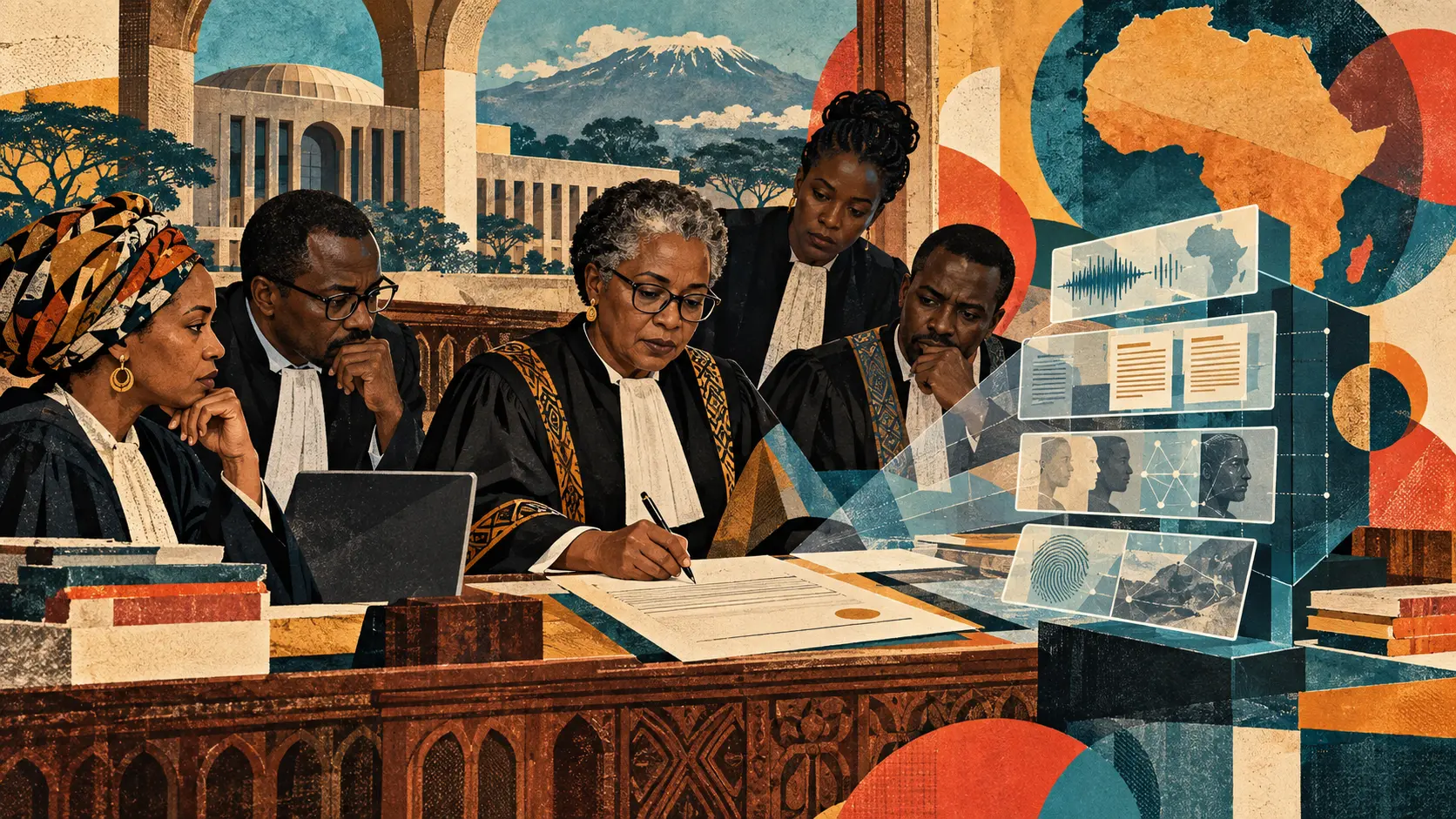
The African Court on Human and Peoples' Rights has started a conversation that every court will eventually need to have: if artificial intelligence touches a judgment, who gets told, what gets checked and who remains responsible? From September 15 through 18, UNESCO held a four-day dialogue with the Court during its eighty-second ordinary session. UNESCO says 72 people participated, including justices, legal officers and staff from language, documentation, library, communication and information-technology units. The subjects were not limited to whether a chatbot can make paperwork move faster. Participants examined bias, opacity, privacy, data protection, judicial independence, human oversight and the problem of identifying AI-generated or manipulated evidence. They also debated whether courts and litigants should disclose AI use to one another, including when a system helps translate, transcribe or draft part of a decision. That is the useful center of the story. A court does not need to hand a machine the gavel for AI to affect due process. A mistranslated phrase can change testimony. A shortened summary can remove a qualification. A fabricated image can enter the record. A drafting tool can make an invented authority look polished enough to survive a hurried review. The final signature may still belong to a judge, but the path to that signature can contain several invisible machine steps. Alongside the training, UNESCO says a needs assessment was initiated to examine the Court's current digital practices and explore possible uses. The dialogue ended with discussion of a tailored AI policy. The careful words are initiated, explore and discussion. They do not mean the Court has adopted a policy, approved a product or deployed an AI decision system. UNESCO has not published the needs assessment, a list of tools currently used by Court personnel, procurement records, system evaluations, incident logs or the proposed policy text. The broader statistics need the same care. UNESCO reports that 44 percent of surveyed judicial operators use tools such as ChatGPT for work and only 9 percent have training or institutional guidance. Those figures describe a wider survey, not the 72 participants and not a measurement of staff at this Court. They show why the conversation matters, but they cannot tell us how often this Court uses AI. UNESCO's global program provides guidelines and a toolkit built around human rights, transparency, accountability, judicial independence and meaningful human oversight. Those materials can help a court draft its own rules. They cannot substitute for local decisions about confidential records, languages, evidence, vendors, access, appeals and the authority to stop a system. The plain signal is that the Court has opened the right file before pretending the policy is finished. The next step should be a public disclosure and review ledger. For each permitted use, the Court should name the task, tool, data, responsible person, required verification, disclosure rule, retention period and remedy. Translation, transcription, research, drafting and evidence analysis should not share one vague permission slip. Each carries different risks and deserves its own control. A workshop can create awareness. A policy must turn awareness into repeatable duties that litigants can understand and judges can enforce.
01
WHAT ACTUALLY CHANGED
UNESCO held a four-day dialogue with the African Court on Human and Peoples' Rights from September 15 through 18, 2026.
The dialogue took place during the Court's eighty-second ordinary session.
UNESCO published its account of the engagement on September 25.
Seventy-two people participated, with 27 attending in person and 45 joining online.
Participants included justices, legal officers and personnel from language, documentation, library, communication and information-technology units.
The program examined opportunities and risks created by AI for judicial institutions, human rights and the rule of law.
Participants worked through algorithmic bias, opacity, privacy and data-protection concerns associated with commonly used AI systems.
The discussion addressed judicial independence and the need for human oversight.
Participants considered how courts might identify AI-generated and manipulated evidence.
They debated whether courts and litigants should systematically disclose AI use to one another.
The disclosure discussion included AI-assisted translation, transcription and drafting of judicial decisions.
The training used UNESCO's Global Toolkit on AI and the Rule of Law for the Judiciary.
It also drew on UNESCO's Guidelines for the Use of AI Systems in Courts and Tribunals.
A needs assessment was initiated alongside the training to examine the Court's current digital practices.
The assessment is also intended to explore how AI could support the Court's work.
The dialogue concluded with discussion of a possible AI policy tailored to the Court's mandate and institutional context.
UNESCO says its Judges Initiative has engaged more than 38,000 judicial actors across more than 160 countries.
UNESCO reports that 44 percent of surveyed judicial operators use AI tools for work while only 9 percent have training or institutional guidance.
Those survey percentages describe a wider population and are not measurements of the African Court's staff.
The Court has discussed policy development, but no adopted Court policy or completed needs assessment was published in the reviewed materials.
02
WHY THIS MATTERS
A court can be affected by AI even when no system is asked to decide the case.
Translation can change the meaning of testimony, pleadings or a judgment when context and legal terms are handled poorly.
Transcription can turn a mistaken word into part of the official record unless a person checks it against the original audio.
Drafting assistance can introduce invented authorities, altered facts or overconfident language into a document that appears professionally finished.
Evidence-analysis tools can change which documents, images or passages receive attention before a judge reaches the merits.
Generative tools can also create convincing false evidence, making provenance and authentication part of ordinary courtroom procedure.
A litigant cannot meaningfully challenge a machine-assisted step that the institution never discloses.
Disclosure alone is not enough if the record omits the tool, version, task, source material and responsible reviewer.
Judicial independence means vendors and automated recommendations cannot quietly become a second decision-maker.
Human oversight is meaningful only when the reviewer has time, authority, evidence and training to reject the output.
Confidential court records create privacy and security duties that consumer tools may not be designed to meet.
Language diversity makes local validation essential because performance can vary across languages, dialects and legal terminology.
A policy written before mapping actual workflows may regulate an imagined system while missing tools personnel already use.
A needs assessment can reveal those existing practices, but its method and findings must be visible enough to support accountability.
The wider 44 percent and 9 percent figures show a governance gap, but applying them directly to this Court would create a false local statistic.
Different tasks deserve different rules because a calendar assistant does not carry the same risk as evidence analysis or judgment drafting.
Litigants need a remedy when an AI-assisted error affects notice, translation, access to evidence or the reasoning in a decision.
Courts need incident procedures because correcting one judgment does not automatically find the same error in another case.
Public rules can improve trust by showing that efficiency is subordinate to due process, rights and reasoned human judgment.
The Court's work matters beyond Tanzania because a regional human-rights institution can establish a practical disclosure model for other courts.
03
WHERE IT COULD HELP
- Publish the completed needs assessment with sensitive security details removed and clearly identify its method, scope and limitations.
- Create an inventory of every AI-enabled tool used by judges, chambers, registry staff, translators, researchers and contractors.
- Classify each use by task, data sensitivity, effect on a case and potential consequence for a litigant.
- Prohibit unapproved tools from receiving confidential filings, deliberative material, personal data or sealed evidence.
- Require a data-protection and human-rights impact assessment before a high-consequence use begins.
- Validate translation and transcription systems separately for each supported language, legal vocabulary and audio condition.
- Keep the original audio, document or evidence available so a reviewer can compare every machine-assisted output with its source.
- Require judges and authorized staff to verify citations, quotations, factual claims and legal authorities before signing a document.
- Record the tool name, provider, model or version, date, task, operator and human reviewer for each case-related use.
- Disclose material AI assistance to the parties in a form that allows a focused question or challenge.
- Define when minor administrative assistance may be logged internally and when it must appear in the case record.
- Give litigants a practical route to request the relevant logs, challenge an output and seek correction without technical expertise.
- Require human review of any system used to identify, classify, summarize or authenticate evidence.
- Test systems with manipulated documents, fabricated media, missing context, rare languages and conflicting sources before operational use.
- Measure error rates, override rates, time savings, complaints and downstream corrections instead of reporting adoption alone.
- Set retention and deletion rules for prompts, outputs, uploaded records, logs and vendor copies.
- Contractually bar vendors from training on Court material unless a lawful, explicit and public authorization permits it.
- Create an incident process for data exposure, fabricated authority, biased output, manipulated evidence and an unavailable audit trail.
- Review the policy after every material model change, new use, incident or relevant judicial ruling.
- Publish an annual aggregate report covering approved uses, tests, incidents, challenges, corrections and suspended systems.
KEEP A HAND ON THE WHEEL
UNESCO verifies the September 15 to 18 dialogue, the seventy-two participants, the represented Court units, the topics examined, the launch of a needs assessment and discussion of a possible tailored AI policy. Its account also verifies that participants debated disclosure for translation, transcription and drafting. UNESCO's broader program page supports the 44 percent use, 9 percent training or guidance and 92 percent demand for regulation and training figures, but those numbers come from UNESCO's wider survey and do not measure this Court. The reviewed materials do not publish the Court's completed needs assessment, a tool inventory, current-use count, adopted policy, vendor list, procurement contracts, case-level disclosures, error measurements, language evaluations, privacy or security assessments, incident history or litigant remedy. The training demonstrates institutional attention, not product approval or deployment. Watch for the needs-assessment report, draft and final policy, public consultation, authorized-use register, disclosure rule, language-specific validation, evidence-authentication procedure, data-retention limits, vendor restrictions, audit access, complaint process and annual performance report.
04
TERMS WORTH KEEPING
SOURCES AND VERIFICATION STATUS
This article was written from the materials below. Product claims and dates were checked against those sources on September 27, 2026.
PUBLICATION RECEIPT: Revision 1. Published September 27, 2026.
THE PUBLICATION ENGINE
WANT A SIGNAL OF YOUR OWN?
We build source-grounded publications, private briefings, and editorial systems for organizations with something useful to say.
WORK WITH US