THE SIGNAL IN ONE SENTENCE
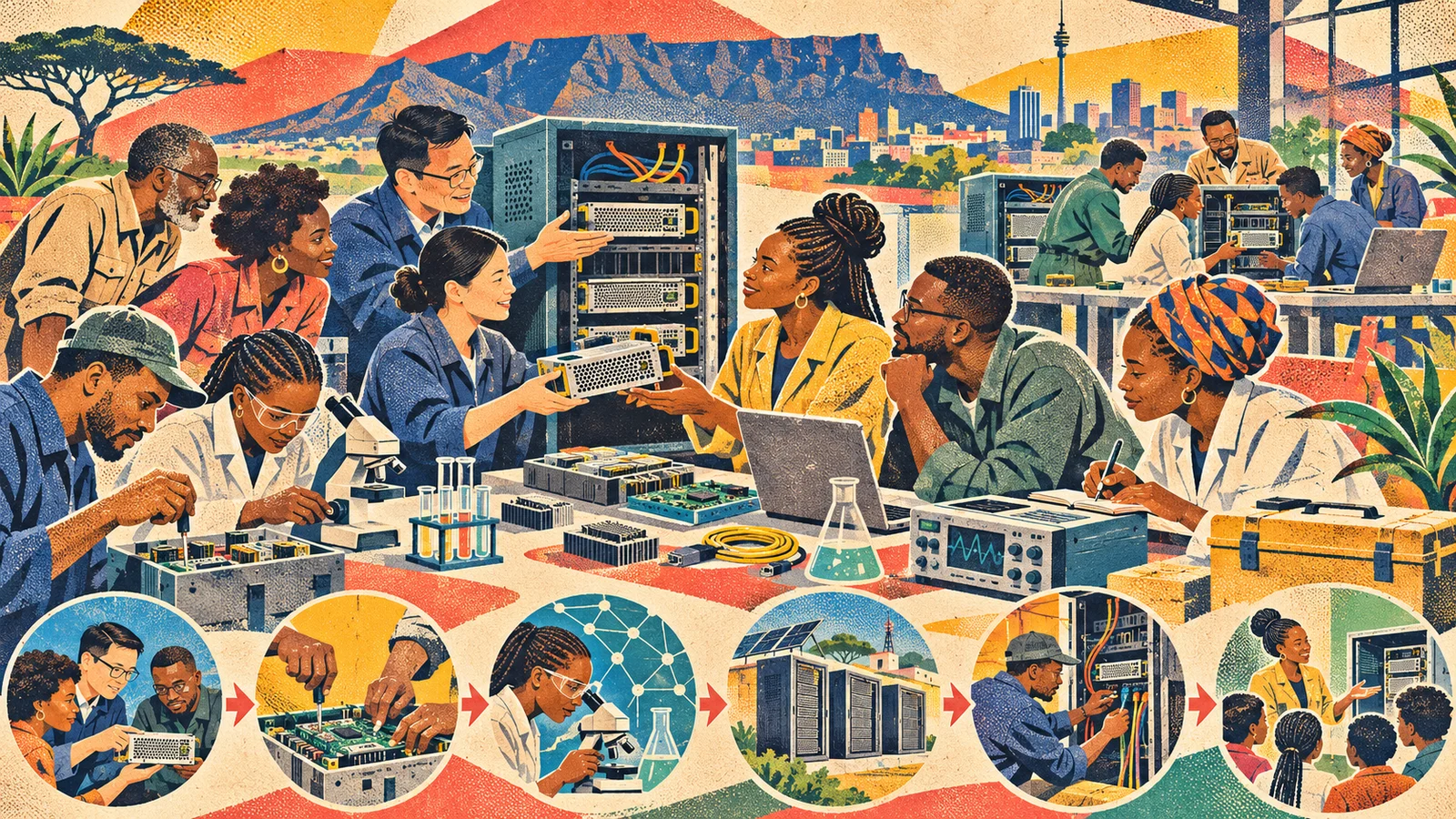
South Africa and China are planning an Artificial Intelligence Talent Development and Innovation Centre in South Africa. That is the announcement. The interesting question is what remains in the room after the visiting experts leave it. South Africa's Department of Science, Technology and Innovation announced the proposal on November 12 after talks in Wuhan between Deputy Minister Nomalungelo Gina and China's Vice Minister of Science and Technology, Zhang Guangjun. The department says preparatory work is underway. A Chinese technical team is expected to visit South Africa for a preliminary assessment. The proposed centre is meant to address digital-skills gaps, build innovation capacity and deepen collaboration with Chinese institutions. The same official statement says the two countries want stronger links among universities, research institutions and industry, with more scientific work translated into economic and social applications. Those are sensible goals. They are not yet an operating design. The announcement does not name a site, budget, launch date, governing body, partner institutions, curriculum, number of learners, compute allocation, scholarship plan, intellectual-property rules, job-placement target or way to measure whether the centre works. That makes the preliminary assessment the first important test. It should not merely inspect buildings, bandwidth and electrical sockets. It should establish a capability baseline. What can South African students, instructors, researchers, public institutions and small companies do today? Which skills are scarce? Where are the existing laboratories, courses, research groups and computing facilities? Which institutions already have capable staff but lack hardware, funding or access? Which provinces and communities are routinely left outside advanced technical programs? Without that map, the centre could duplicate work in one city while calling the duplication capacity building. The plain signal is that a talent centre needs a capability-transfer scorecard before it needs a ribbon. Start with the skill ladder. Attendance sits on the first rung. A participant can observe a demonstration and understand the vocabulary. Reproduction is next. The participant can follow a documented process and recreate a result with the same tools and data. Adaptation is harder. The participant can change the model, dataset, hardware or workflow for a South African problem and explain why the change works. Deployment means the team can move a tested system into a real setting with security, monitoring, maintenance and accountable human decisions. Maintenance means the team can diagnose a failure, replace a component, update a model, rotate credentials, restore data and keep the system useful after the original instructor is gone. Teaching means local instructors can train the next cohort without importing the entire lesson again. Governance means South African institutions can decide which systems should be built, which data may be used, which risks are acceptable and when a project should stop. The scorecard should track movement up that ladder. Certificates can remain in the file. They are just not the outcome. Publish the curriculum. Name the learning objectives, prerequisites, contact hours, practical work, assessment method, equipment, model access, safety boundaries and person responsible for each module. Distinguish short digital-literacy courses from advanced machine-learning engineering, research science, data stewardship, cybersecurity, AI assurance and hardware operations. Do not use one giant number called people trained. Someone who attended a two-hour introduction and someone who can maintain a computing cluster have not received the same thing. Report each level separately. South African institutions should own the curriculum with their partners. That means local universities, technical and vocational colleges, research councils, public agencies, labor organizations, industry and community groups help decide what is taught. The subjects should connect to work South Africa actually needs: agriculture, energy, health, manufacturing, public services, climate, mining safety, logistics, education, language technology and scientific research. The partner can bring useful methods and equipment. The agenda should not arrive sealed in a shipping case. Make train-the-trainer a core output. Every advanced program should identify the local instructors who will eventually run it, the supervised teaching they must complete and the date on which they can deliver the course independently. Pair visiting experts with South African instructors from the first lesson rather than adding local staff after the material has already hardened. Measure teaching independence. Can the local team update the lab when a software dependency changes? Can it rewrite an exercise for a local language or dataset? Can it evaluate a student project without the partner? Can it teach the same capability at another institution? If not, the centre has rented instruction. Compute is part of the curriculum. Students cannot learn serious AI engineering entirely through slides. They need time with real hardware, datasets, development environments, evaluation tools and deployment systems. The centre should publish how much computing capacity exists, which institutions can use it, how access is allocated, how long people wait, what support is available and what happens to work after a course ends. Free access during a workshop followed by unaffordable commercial rates is not durable capacity. The same applies to hardware. If the project includes accelerators, networking, sensors, storage or laboratory equipment, name the owner, warranty, maintenance contract, software licenses, replacement plan, energy demand, spare parts and technicians trained to repair it. A donated machine that becomes unusable after one failed component is a very expensive sculpture. Use an independence test. At the end of each program, ask a South African team to rebuild the training environment from documentation, run the practical evaluation, diagnose a seeded failure, restore from backup and teach the procedure to another cohort without the visiting partner in the room. Record what help was required. The point is not to exile collaboration. It is to prove that collaboration created another capable node rather than a permanent support ticket. Research access needs its own track. The official statement says the countries want stronger links among universities, research institutions and industry. A useful centre could provide joint laboratories, fellowships, doctoral supervision, shared datasets, compute access and routes for promising work to reach real users. Publish how research questions are selected. South African researchers should be able to lead projects based on local priorities, not only contribute data or field access to an agenda set elsewhere. List principal investigators, budgets, compute, datasets, partner roles, publication rights, expected outputs and community obligations. Intellectual property is where a friendly announcement can become a lopsided contract. Before research begins, state who owns code, models, datasets, patents, teaching materials and improvements created by students or staff. Define licensing, revenue sharing, publication review, confidential work and the right of South African institutions to keep using the results after a partnership changes. Joint ownership sounds fair until no one can use the work without unanimous permission. Spell out the operating rights. Data should not become the hidden tuition fee. A centre working on health, education, agriculture, public services or language technology may receive valuable South African data. The project record should identify who supplied it, which people or communities are represented, what consent and legal authority apply, where it is stored, who can access it, what leaves the country, what models are trained from it and how people can correct or withdraw records where appropriate. Communities should receive a share of the benefit when their knowledge, language or experience makes a system possible. Open science can help, but open does not mean ownerless. Sensitive records, Indigenous knowledge, commercial information and security-relevant data need specific governance. Publish what can be shared, what remains protected and who decides. Jobs are another missing measure. Track internships, apprenticeships, research positions, startup support, public-service placements and permanent employment linked to the centre. Report placement at three, six and twelve months, the kind of work, location, pay band where lawful, retention and whether the job actually uses the trained skill. Do not count a person as employed because they completed one freelance labeling task. Measure who gets access. Publish applications, admissions, completion and advanced-level progression by province, institution type, gender, disability and other locally appropriate equity measures. Report financial support, travel, housing, childcare, connectivity and assistive technology. A national centre can quietly become a center for people who already live near the best-connected campus and can afford to spend six months proving they deserve opportunity. Create regional routes. Use satellite laboratories, traveling equipment, shared online environments, funded placements and partnerships with technical colleges and universities beyond the largest urban institutions. Make advanced instruction available without pretending a video stream replaces hands-on access. The centre also needs a public money receipt. Name the South African and Chinese contributions, whether they are grants, equipment, staff time, loans, scholarships or services, and who owns each asset. Publish procurement, subcontractors, operating costs, renewal obligations and what happens if one government changes priorities. In-kind support should have a realistic value, not a ceremonial price tag. Governance should be balanced and visible. The board should include South African education and research institutions, technical experts, industry, workers, students and public-interest voices. Chinese partners should have a clear role without becoming the sole source of technical truth. Publish conflicts, meeting summaries, program decisions, evaluation results and a route for participants to raise concerns. Independent evaluation matters because the institutions running the centre will naturally want to describe it as a success. Use practical tests, external reviewers and published outcome definitions. Compare results with the baseline. Report failed programs and changed plans. Ask whether the centre strengthens existing South African institutions or competes with them for the same instructors. Avoid the flagship trap. One beautiful facility can absorb attention while the surrounding education and research system remains underfunded. The centre should distribute curriculum, tools, instructor training and computing access outward. Its scorecard should show capability created across institutions, not only activity inside its walls. The bilateral partnership can be useful precisely because the two countries bring different resources and experience. China has institutions, companies and technical teams with AI and infrastructure knowledge. South Africa has researchers, universities, public institutions, industries, languages and local problems that should shape the work. The strongest exchange moves both ways. Chinese researchers should learn from South African science and operating contexts. South African teams should retain the authority and tools to continue independently. The announcement also mentions advanced manufacturing, biotechnology, 5G, the Square Kilometre Array and a planned open-science conference in 2027. That wider relationship can create useful bridges among AI, scientific instruments, networks and real applications. It can also make the scorecard fuzzy if every meeting and adjacent project is counted as proof that the centre succeeded. Keep the unit of measurement honest. For this centre, report the site, budget, partners, curriculum, instructors, learners, compute, research projects, intellectual-property terms, placements, locally led deployments, maintained systems and independent teaching capacity. Then ask the closing question. If the international partner steps away for a year, what can South African teams still do? Can they teach the course, operate the lab, allocate the compute, maintain the hardware, update the software, govern the data, publish the research, support the deployment and train the next instructor? That is capability transfer. Everything else is an event calendar with better equipment.
01
WHAT ACTUALLY CHANGED
South Africa's Department of Science, Technology and Innovation announced on November 12 that South Africa and China plan to establish an Artificial Intelligence Talent Development and Innovation Centre in South Africa.
Deputy Minister Nomalungelo Gina discussed the proposal with China's Vice Minister of Science and Technology, Zhang Guangjun, in Wuhan on November 11.
The department says the centre is intended to address digital-skills gaps, build innovation capacity and deepen collaboration with Chinese institutions.
Preparatory work is underway and a Chinese technical team is expected to visit South Africa for a preliminary technical assessment.
The two sides also discussed stronger links among universities, research institutions and industry, along with practical applications of scientific research.
They agreed to keep technical teams engaged, develop specific projects, review existing agreements and draw up an implementation action plan.
The talks also identified advanced manufacturing, biotechnology and 5G as priorities and discussed the Square Kilometre Array as a basis for scientific collaboration.
South Africa's planned 2027 Open Science International Conference was also discussed.
02
WHY THIS MATTERS
A training centre can create durable local capability or remain dependent on imported instructors, tools and support.
Hands-on access to compute, hardware, datasets and deployment systems determines whether learners can move beyond theory.
Train-the-trainer programs can spread capability across institutions instead of concentrating it in one flagship building.
Research partnerships need clear leadership, publication, data and intellectual-property rules before valuable work begins.
Job placement, retention and practical operating skills provide stronger evidence than attendance or certificate counts.
Regional access and financial support determine whether a national centre reaches people outside established urban institutions.
Independent evaluations can show whether the centre strengthens South Africa's existing education and research system.
A one-year partner-absence test reveals whether cooperation created independence or a permanent service dependency.
03
WHERE IT COULD HELP
- Publish a baseline map of existing AI programs, instructors, laboratories, compute, skills gaps and regional access.
- Define a capability ladder from observation and reproduction through adaptation, deployment, maintenance, teaching and governance.
- Report each training level separately instead of combining every participant into one people-trained number.
- Give South African institutions joint authority over curriculum, assessments and local application priorities.
- Pair every visiting expert with local instructors and set a date for independent course delivery.
- Publish compute capacity, allocation rules, waiting times, prices, support and post-course access.
- Name equipment ownership, licenses, energy, warranties, spare parts, maintenance and technicians.
- Run a practical independence test covering setup, failure diagnosis, recovery and teaching.
- Publish research leadership, budgets, datasets, compute, partner roles, publication rights and community obligations.
- Set intellectual-property, licensing, revenue-sharing and continued-use rights before projects begin.
- Create a data register covering source, consent, storage, access, cross-border transfer, model use and community benefit.
- Track internships, placements, job quality, skill use and retention at three, six and twelve months.
- Report access and progression across provinces, institution types and locally appropriate equity measures.
- Use satellite labs, funded placements and technical-college partnerships to distribute hands-on access.
- Publish each country's financial, equipment and staff contribution with ownership and operating obligations.
- Commission independent evaluation against the baseline and publish failures, corrections and partner-absence results.
KEEP A HAND ON THE WHEEL
The centre is planned. The November 12 statement does not say that a facility has been selected, funded, built or opened. The announcement does not publish a site, budget, governance structure, partner institutions, curriculum, learner capacity, launch date, compute plan, scholarship program, intellectual-property terms, data rules, procurement, job-placement target or outcome measures. A preliminary technical assessment is expected. The statement does not identify the visiting team, assessment date, public terms of reference or report-release commitment. The official purpose is to address skills gaps and build innovation capacity. Those are intended outcomes, not measured results. Meeting activity, signed agreements, equipment delivered, course attendance and certificates should not be treated as proof that South African teams can operate independently. International cooperation can create useful mutual capacity, but it can also concentrate technical authority, extract data or leave institutions dependent on proprietary systems if operating rights remain unclear. The capability ladder, scorecard, partner-absence test and detailed reporting fields in this article are Plain Signal analysis. Official statement date: November 12, 2026. The bilateral talks occurred November 11, 2026. Verified November 13, 2026.
04
TERMS WORTH KEEPING
OPEN GLOSSARY CARD
Local skills transfer
A structured process through which people in the adopting country gain the knowledge, access and practical ability to operate, evaluate, repair or replace a system.
OPEN GLOSSARY CARD
Train-the-trainer
A teaching model that prepares local participants to become instructors who can adapt and repeat the program for later cohorts.
OPEN GLOSSARY CARD
Compute allocation
The documented assignment of processing capacity across products, training, research, evaluation, safety work, and other workloads over a stated period.
SOURCES AND VERIFICATION STATUS
This article was written from the materials below. Product claims and dates were checked against those sources on November 13, 2026.
THE PUBLICATION ENGINE
WANT A SIGNAL OF YOUR OWN?
We build source-grounded publications, private briefings, and editorial systems for organizations with something useful to say.
WORK WITH US