THE SIGNAL IN ONE SENTENCE
An agent that chooses tools, accesses data, retries failures, and spends money is a production system, so it needs the same operational discipline as one.
01
WHAT ACTUALLY CHANGED
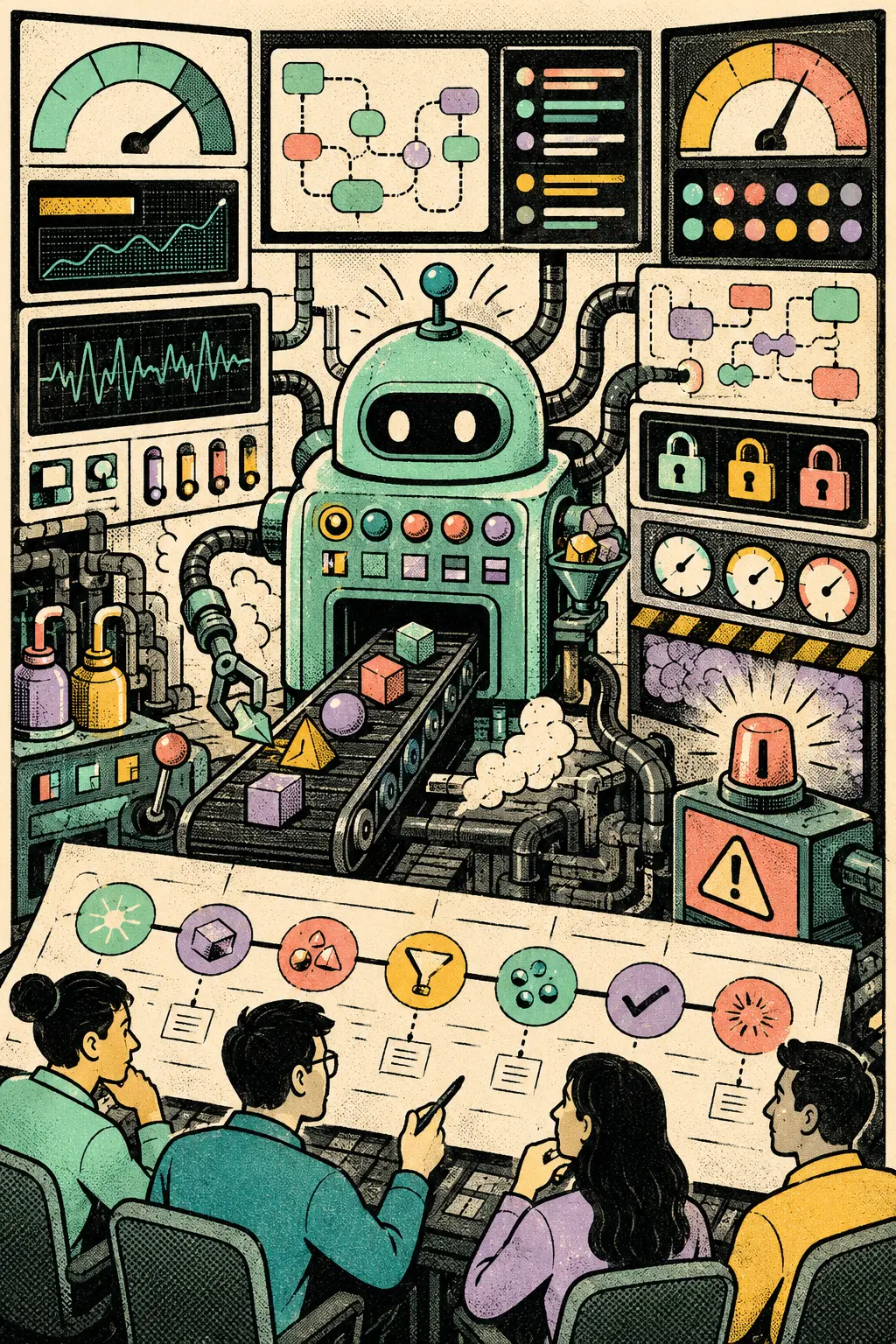
Databricks released The Big Book of AgentOps, a field manual covering agent architecture, evaluation, observability, permissions, cost management, governance, and stakeholder ownership. It organizes the work into four deployment patterns and a seven-phase lifecycle.
The guide is refreshingly willing to say that more agents are not automatically better. It warns teams against reaching for multi-agent orchestration before the complexity is justified and against leaving evaluation until the end of development.
That advice reflects how agents fail in practice. A model may choose the wrong tool, retrieve stale data, loop through retries, exceed a budget, expose information, or return a plausible answer after an upstream service quietly broke. The final prose can look fine while the system underneath is on fire.
The framework is vendor-authored, and its customer examples are selected case studies. Its value is not proof that one platform solves AgentOps. It is a concrete checklist teams can argue with before a prototype wanders into production wearing a fake mustache.
02
WHY THIS MATTERS
Organizations are learning that the model is only one component of an agent. Retrieval, tools, memory, permissions, fallbacks, evaluation, logs, budgets, and human escalation form the larger product that users actually experience.
Operational discipline makes failures legible. If a team can trace which tool was called, which data was read, what the model decided, how much it cost, and who approved the release, an incident becomes something people can investigate rather than a spooky anecdote.
The simplest architecture is often the strongest starting point. A single well-instrumented agent with clear limits may outperform a theatrical committee of bots that spend half their time explaining themselves to one another.
03
WHERE IT COULD HELP
- Define evaluation gates before an agent ships
- Trace tool calls, data access, retries, failures, and costs
- Choose the simplest architecture that can reliably perform the job
- Assign responsibility across engineering, security, product, and compliance
KEEP A HAND ON THE WHEEL
The framework comes from Databricks and naturally reflects its platform. Treat the lifecycle and patterns as a starting checklist, then verify tooling, costs, governance requirements, and failure rates in the environment where the agent will actually run.
04
TERMS WORTH KEEPING
OPEN GLOSSARY CARD
AgentOps
The discipline of evaluating, deploying, observing, governing, and improving AI agents in production.
OPEN GLOSSARY CARD
Observability
The ability to understand a system’s internal behavior from its logs, traces, metrics, and outputs.
OPEN GLOSSARY CARD
Evaluation gate
A required test or review that a system must pass before it advances to the next stage.
SOURCES AND VERIFICATION STATUS
This article was written from the materials below. Product claims and dates were checked against those sources on September 2, 2026.
PUBLICATION RECEIPT: Revision 1. Approved by Zak and published September 2, 2026.
THE PUBLICATION ENGINE
WANT A SIGNAL OF YOUR OWN?
We build source-grounded publications, private briefings, and editorial systems for organizations with something useful to say.
WORK WITH US