THE SIGNAL IN ONE SENTENCE
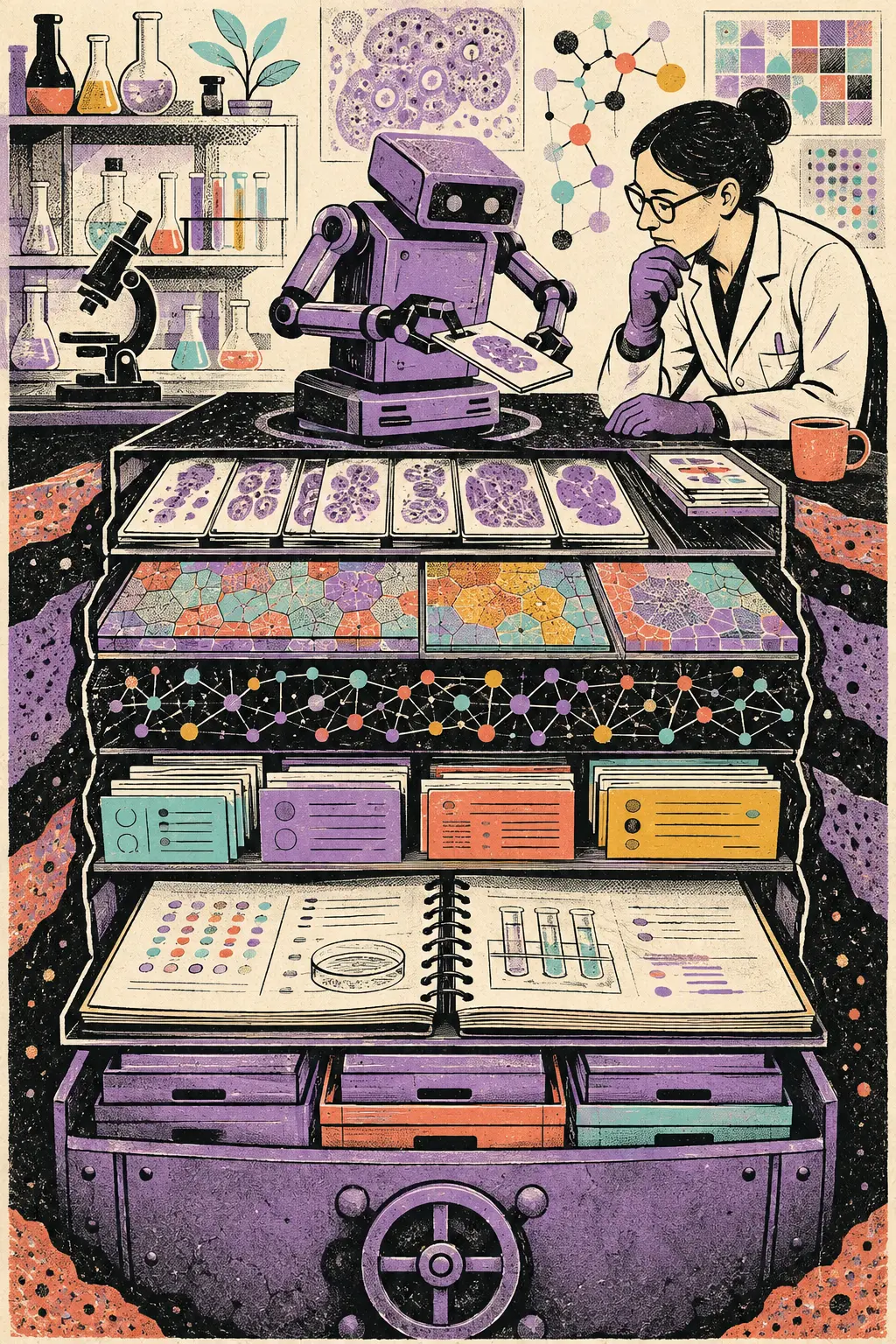
The agreement combines an AI research agent with specialized patient data and reproducible scientific tools, because a fluent interface alone cannot discover a useful drug target.
01
WHAT ACTUALLY CHANGED
Owkin signed a licensing agreement that gives Boehringer Ingelheim access to K Pro, its AI research environment, and multimodal patient data. The work builds on a 2025 pilot that studied the tumor microenvironment.
Under the new agreement, Owkin will license oncology data, generate additional immunology data, and support both human-led analysis and automated hypothesis campaigns. Financial terms were not disclosed.
K Pro is presented as an environment where scientists can ask questions across molecular and clinical data, generate reports, and inspect the evidence behind an analysis. The combination matters. A model can suggest a biological relationship, but its value depends on the quality, consent, lineage, and relevance of the patient evidence it can interrogate.
This remains research infrastructure, not a new treatment. Any target or hypothesis still has to survive experimental validation, clinical development, safety testing, and regulatory review. Biology retains its ancient right to be difficult.
02
WHY THIS MATTERS
Scientific AI is often marketed as if the model itself were the laboratory. In practice, the defensible asset may be the governed collection of patient samples, linked modalities, analysis tools, and reproducible workflows surrounding it.
That bundle is harder to copy than a chat interface. It can also be harder to inspect from the outside. Data rights, cohort composition, privacy protections, missing populations, and validation methods determine which conclusions the system can responsibly support.
The human role does not disappear. Researchers choose the question, evaluate biological plausibility, check confounders, and decide which finding deserves an expensive experiment. Automation can widen the search without turning a hypothesis into a fact.
03
WHERE IT COULD HELP
- Prioritize possible cancer and immunology drug targets
- Study patient subgroups and tumor heterogeneity
- Generate and test biological hypotheses across several data types
- Reproduce analyses inside one governed research environment
KEEP A HAND ON THE WHEEL
The deal is verified, but the medical impact is prospective. Detailed financial terms, privacy controls, cohort composition, validation results, and rights governing the underlying patient data are not fully public.
04
TERMS WORTH KEEPING
OPEN GLOSSARY CARD
Multimodal patient data
Linked health research data from several forms, such as tissue images, molecular measurements, and clinical records.
OPEN GLOSSARY CARD
Tumor microenvironment
The cells, molecules, blood vessels, and surrounding tissue that interact with a tumor.
OPEN GLOSSARY CARD
Hypothesis campaign
A structured sequence in which a system generates, ranks, and investigates many possible scientific explanations.
SOURCES AND VERIFICATION STATUS
This article was written from the materials below. Product claims and dates were checked against those sources on September 2, 2026.
PUBLICATION RECEIPT: Revision 1. Approved by Zak and published September 2, 2026.
THE PUBLICATION ENGINE
WANT A SIGNAL OF YOUR OWN?
We build source-grounded publications, private briefings, and editorial systems for organizations with something useful to say.
WORK WITH US