THE SIGNAL IN ONE SENTENCE
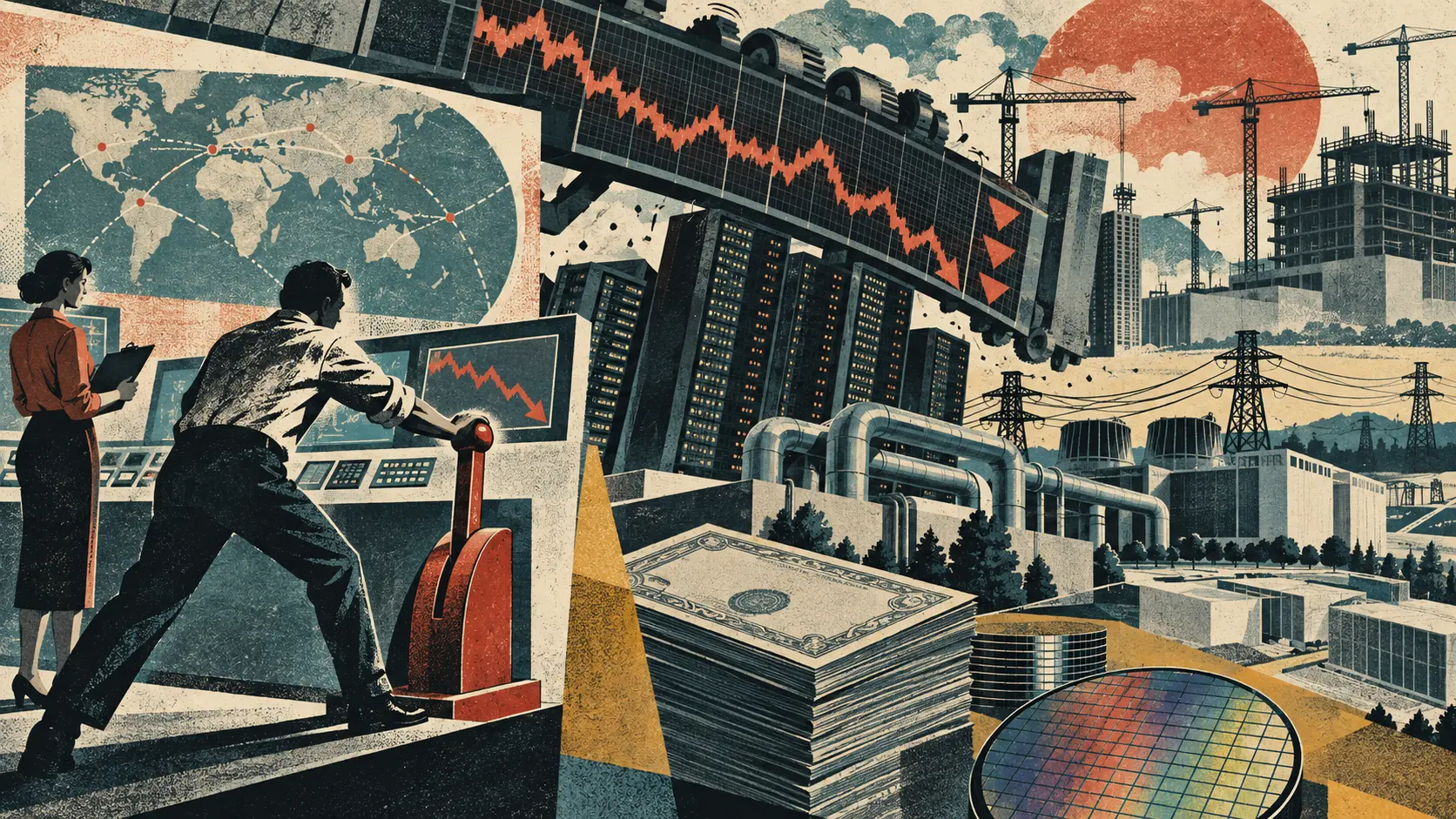
Leaders at Anthropic, OpenAI, and xAI backed slowing the improvement of frontier AI models because they believe the risks are becoming harder to control. Investors immediately had to price a new possibility: the technology may not advance on the relentless timetable built into chip orders, data-center leases, power contracts, borrowing, and very optimistic valuations. Reuters reported sharp declines in AI-linked shares across the United States, Europe, and Asia on September 14. Those were intraday moves, not final closing prices and not proof that the AI boom is over. They are evidence that a safety argument has crossed into the financing model. A brake can reduce speed. It does not make the road, the loan, or the electric bill disappear.
01
WHAT ACTUALLY CHANGED
The material new event is the market reaction. The Plain Signal covered Dario Amodei's September 12 safety proposal in issue 115. On September 14, Reuters reported that AI-linked shares fell across Wall Street futures, Europe, and Asia after Sam Altman and Elon Musk publicly agreed with the broad call to slow capability gains. This follow-up is about what happened when the proposal reached the price screen.
At the time Reuters measured the moves, Nasdaq e-mini futures were down 1.9 percent. Nvidia was down 3 percent, AMD 5.7 percent, and SpaceX 2.6 percent. Meta and Amazon were each down more than 1.4 percent. These numbers are a time-stamped market snapshot. They can change before a trading session closes and should not be treated as permanent losses.
The reaction was international. Reuters reported European technology shares down 2.5 percent, with ASML down 5.8 percent, Infineon down 8.4 percent, and Siemens Energy down 7.4 percent. In Asia, SoftBank fell as much as 13.2 percent, TSMC slipped 1.2 percent, and SK Hynix fell 6.3 percent. The common thread is exposure to the physical and financial supply chain behind AI computing.
The safety message also collided with financing plans. Altman said OpenAI would not pursue an initial public offering this year because of safety concerns. Reuters separately reported that Anthropic was still moving ahead with a planned public debut and discussing Nvidia as an anchor investor. A call to coordinate on safety does not mean every company has adopted the same capital plan.
A Bank for International Settlements report published September 14 said the AI-driven market rally was showing growing vulnerability as investors became more cautious about future profitability and leverage increased at major technology firms. BIS economist Frank Smets also said markets showed no overall signs of stress. Both halves matter: vulnerability is not the same thing as a crisis.
02
WHY THIS MATTERS
The AI investment case has often assumed two things rise together: technical capability and demand for computing. If laboratories deliberately stretch the interval between more capable models, the revenue curve could arrive later than the bills. Data centers still owe rent. Utilities still build generation and transmission. Borrowers still pay interest. Chips already ordered still need customers.
Safety has become a balance-sheet variable. Until now, many investor models treated governance as a constraint that might arrive from legislators or regulators. The September 14 reaction shows that laboratory leaders can introduce timing risk themselves. A voluntary delay, a stricter release gate, or a costly external evaluation can alter cash flow even before any law changes.
The effects do not stop at AI laboratories. Semiconductor manufacturers, memory suppliers, cloud providers, cooling companies, utilities, construction firms, and private-credit funds have built plans around sustained expansion. A slower frontier could still produce enormous demand for inference and practical applications, but the mix of spending may shift away from the most aggressive training projects.
The selloff also shows why circular financing deserves plain language. When a supplier invests in a customer that uses the money to buy the supplier's products, activity can grow quickly while the underlying demand becomes harder to read. That arrangement is not automatically improper. It does make the system more sensitive to a change in expectations about growth, funding, or deployment pace.
For ordinary readers, the useful question is not whether one morning proves a bubble. It does not. The useful question is who carries the fixed obligation if the schedule changes. Public shareholders can sell. Workers, host communities, utilities, lenders, and ratepayers may remain tied to buildings and contracts. Governance needs to account for the exit costs as well as the launch promises.
03
WHERE IT COULD HELP
- Stress-test an AI project against a six-month, twelve-month, and twenty-four-month delay in frontier model availability before signing long leases or power commitments
- Separate spending for frontier training from spending for inference, maintenance, and proven customer workloads so a slowdown does not turn every compute plan into one undifferentiated bet
- Publish debt, lease, power, supplier-financing, and related-party exposure in a form that boards, lenders, communities, and regulators can actually compare
- Attach release-gate and external-evaluation costs to financial forecasts instead of treating safety work as an invisible footnote
- Track intraday market moves as signals of changing expectations, not as product benchmarks, safety evidence, or investment advice
KEEP A HAND ON THE WHEEL
The September 14 share moves cited here were intraday observations reported by Reuters. They are not closing prices, a forecast, or investment advice. Several forces can move technology stocks at once, including interest rates, energy prices, positioning, and broader risk appetite. The market reaction does not prove that the CEOs' safety claims are correct, that a coordinated slowdown will occur, or that AI demand will collapse. Amodei's six-to-twelve-month scenario is his forecast, not an established prediction. Altman and Musk expressed support publicly, but detailed company policies and enforcement mechanisms were not available when this article was verified. Reuters' report that Anthropic is proceeding with an IPO and discussing Nvidia as an anchor investor relies on sources familiar with the talks, not a completed offering. The BIS described growing vulnerability while also saying markets showed no overall signs of stress. Readers should distinguish a repricing event from a financial crisis and a safety proposal from an operating rule.
04
TERMS WORTH KEEPING
OPEN GLOSSARY CARD
Capital expenditure
Money spent to acquire, build, or improve long-lived assets such as factories, machinery, infrastructure, data centers, and equipment.
OPEN GLOSSARY CARD
Frontier model
A highly capable general-purpose AI model near the leading edge of current development whose broad abilities may create significant or systemic risks.
SOURCES AND VERIFICATION STATUS
This article was written from the materials below. Product claims and dates were checked against those sources on September 14, 2026.
PUBLICATION RECEIPT: Revision 1. Published September 14, 2026.
THE PUBLICATION ENGINE
WANT A SIGNAL OF YOUR OWN?
We build source-grounded publications, private briefings, and editorial systems for organizations with something useful to say.
WORK WITH US