THE SIGNAL IN ONE SENTENCE
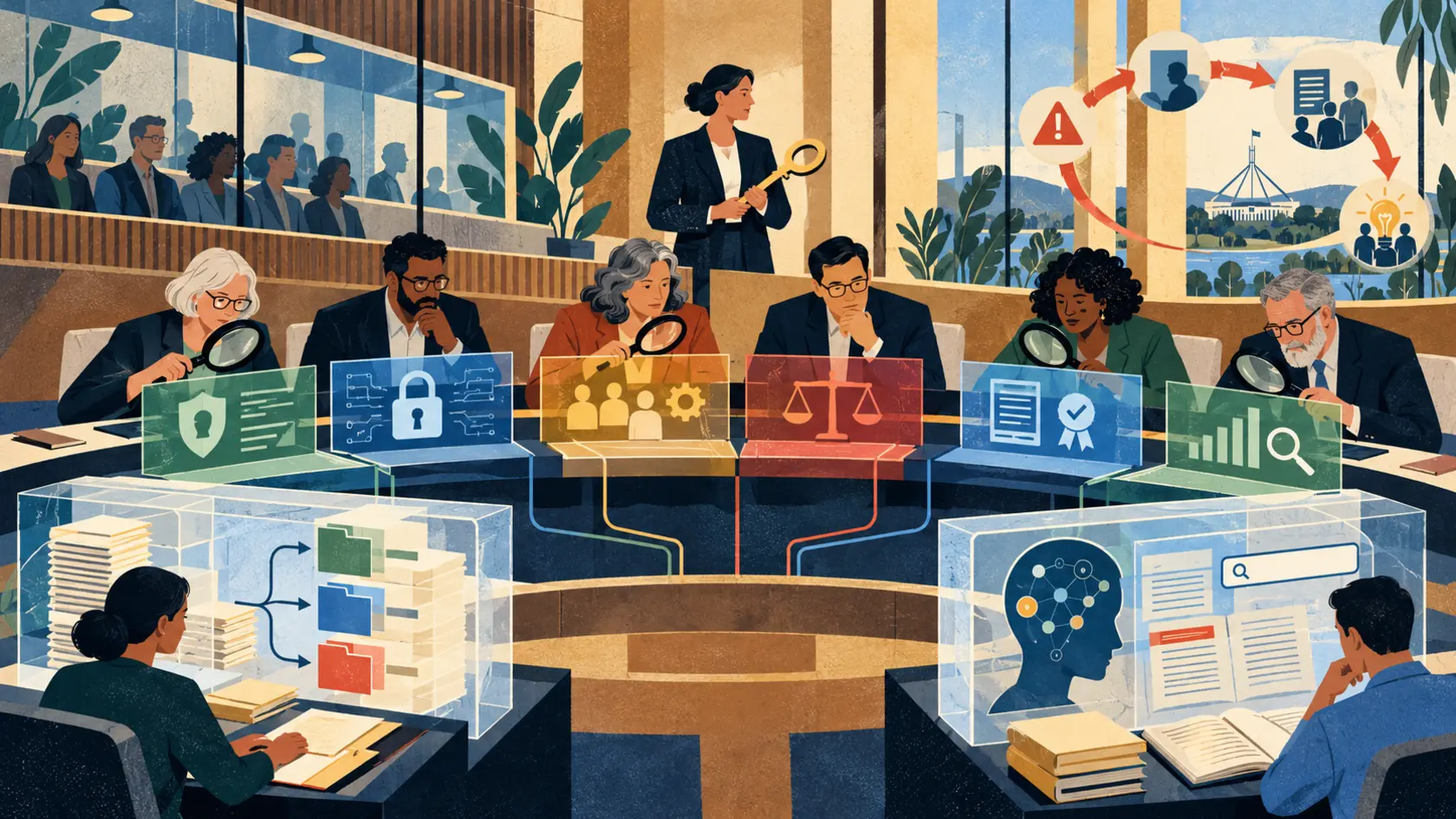
The most useful person in an AI meeting may be the one who did not help build the thing. Project teams know the requirements, the deadlines and the small miracles required to get a government system through procurement. They also know which questions threaten the launch calendar. Familiarity can create expertise. It can create blind spots too. Australia has put another table in the room. On October 7, the Digital Transformation Agency published details from the inaugural meeting of the Australian Government's AI Review Committee. The meeting itself happened on June 26. The committee reviewed two proposed public-service uses and endorsed terms that define a continuing role: provide expert, non-binding advice before selected AI systems are deployed, and study how agencies handled serious AI incidents after the immediate response is finished. The delay between meeting and public release is worth noticing. It does not make the committee useless, but a transparency mechanism becomes more useful when the public can inspect it while decisions are still fresh. The committee sits outside the project team. It is not outside government. Its members bring experience from digital transformation, AI safety and assurance, privacy, cybersecurity, workforce policy, integrity and data. The panel can consult external experts when conflicts and security requirements are managed. The terms require members to disclose interests and recuse themselves when their home agency presents a use case or when a related matter involves that agency. This is a challenge function, not an independent regulator or a new approval authority. The terms say the committee's advice is non-binding. It does not count as endorsement, sanction, immunity or compliance advice. Agencies remain responsible for identifying, assessing, managing and monitoring the risks in their systems. That limitation sounds like fine print, but it is the center of the design. The committee can ask whether the use of AI is appropriate, whether the risks were found and whether the safeguards are adequate. It cannot carry the agency's accountability out of the room in a briefcase. The first two cases show the kind of work entering the gate. The Attorney-General's Department discussed possible AI support for document analysis, matter triage and workflow optimization, with staff productivity and wellbeing as the stated goals. Services Australia presented a proof of concept intended to help staff locate internal operational documentation. Neither description is proof of a deployed product or a public benefit. The release does not provide a model name, evaluation dataset, error rate, privacy assessment, worker study, accessibility result, cost, rollout date or measured service outcome. The committee emphasized human oversight, quality assurance, monitoring, privacy, workforce capability and planning for scale. Those are sensible areas. The important question is whether advice in those areas becomes a visible change in the project. The plain signal is that a review gate earns trust only when people can see what entered, what the reviewers challenged, what the agency changed and who accepted the risk that remained. That can be done without publishing sensitive operational details. A useful public review record could name the agency, purpose, people affected, decision supported, data categories, risk rating and current stage. It could summarize the largest risks, the committee's recommendations, the agency's response, any conditions attached to deployment and the next review date. Security-sensitive details can stay protected while the public still learns whether the governance did anything. Australia's terms promise a communique after each meeting. The first public communique describes the two use cases and broad themes from the discussion. The minister receives meeting minutes and the advice issued to agencies. The public material is thinner than the internal record. That split creates the committee's most important test. If the panel identifies a material weakness and an agency proceeds anyway, will anyone outside the department know? If the agency changes its plan, can the public connect the change to the review? If the committee sees the same failure across several agencies, will the lesson become a reusable standard rather than a private warning repeated in six separate rooms? Non-binding advice can still be powerful when the response is recorded. An agency can publish whether it accepted, partly accepted or rejected each recommendation. A rejection can include the accountable official, reasoning, compensating control and review date. Senior leaders tend to read advice differently when declining it creates a durable record. This is not about embarrassing a team for disagreeing with experts. Good governance allows reasonable disagreement. The record tells everyone which assumptions need monitoring and prevents a later failure from being rewritten as unforeseeable. The committee's scope is also narrower than the phrase government AI may suggest. The terms focus on non-corporate Commonwealth entities covered by the responsible-use policy. The normal pre-deployment lane is for systems with a residual high-risk rating or those an agency identifies as highly sensitive, novel or complex. The committee may consider other government use cases case by case, including systems already deployed. That leaves agencies with the first classification decision. A review gate cannot inspect a use case that was never identified, was divided into harmless-looking components or received an optimistic risk score. Agencies need a live inventory and a credible way for workers, auditors and the public to challenge a classification. A novel system should not avoid review merely because its vendor describes it as a familiar productivity feature. The two first cases sound low drama. That is exactly why they matter. Document analysis and search can shape what a public servant sees first, what disappears below a threshold and which file is treated as relevant. Matter triage can influence priority and attention even when a person makes the final decision. Workflow optimization can measure workers, redistribute tasks and turn a suggestion into an informal performance rule. An internal system is not automatically low consequence because the public never touches the interface. The review should follow the decision path. Who relies on the output? Can a missed document affect legal advice, a benefit claim or an investigation? Does the system rank, summarize or exclude? Can staff see the source material? Are uncertainty and omissions visible? Is there a tested route for correction? Does monitoring measure only speed, or also quality, fairness and downstream harm? Human oversight needs more precision than a checkbox. A reviewer must have enough time, context, authority and skill to challenge an output. If an AI summary arrives with confident formatting and a worker has thirty seconds to process the queue, the human may be ceremonial. Useful evaluation measures how often people detect planted errors, override the system, request more evidence and recover when the tool is unavailable. Quality assurance should be equally concrete. For document search, test whether the system retrieves the current policy, preserves citations and reveals gaps instead of inventing an answer. Include conflicting versions, unusual phrasing, scanned material, accessibility formats and documents from smaller teams. For triage, evaluate false negatives, delayed matters and performance across case types. Measure what the system misses, not only whether users like the demo. Workforce evidence matters because productivity tools change jobs before they change headcount. Track which tasks disappear, which new verification work appears and whether staff gain time for judgment or inherit a faster queue. Give workers a channel to report automation bias, confusing instructions and pressure to accept unreliable outputs. Publish the training, escalation routes and workload measures alongside time saved. The committee's second function begins after something serious goes wrong. It can review an agency's response to a serious AI incident once the agency has completed its immediate response. The terms say the goal is to understand root causes, prevent similar events and strengthen incident handling across government. Waiting until containment is sensible. An incident team should protect people, stop damage and preserve evidence before preparing a public lesson. Waiting indefinitely is not. The useful sequence is straightforward. Contain the system. Preserve logs, versions, prompts, data paths and human decisions. Notify affected people when required. Restore the service safely. Then give the committee a record detailed enough to distinguish a model error from a broken workflow, a weak permission, missing monitoring, poor training or a decision to ignore a warning. After review, publish a safe account of what happened, what changed and which other agencies should check for the same pattern. The account can protect personal information and security details while still naming the control that failed. The committee is scheduled to review its own effectiveness at least annually. That review should use evidence rather than meeting counts. How many cases were referred? How long did review take? How many recommendations did agencies accept? What changed before deployment? Did any reviewed system produce a serious incident? Were repeated risks converted into shared guidance? Did external experts broaden the panel's view? Were conflicts disclosed and recusals recorded? How quickly did public communiques appear? The harder measure is whether the committee catches a problem early enough to matter. A panel can become governance theater if it meets after the procurement decision is irreversible, receives polished slides instead of test evidence or issues advice so general that every agency can claim compliance. It can slow useful services if referrals are vague, review capacity is thin or teams wait months for predictable feedback. The best defense is a clear intake standard and a reusable evidence pack. Before the meeting, agencies should submit the operational purpose, alternatives considered, affected groups, data map, risk assessment, evaluation plan, human-control design, security tests, workforce impact, monitoring thresholds, rollback process and accountable decision-maker. The committee should flag missing evidence early. After the meeting, the agency should record its response and the public should receive a proportionate summary. That makes the panel less like a ceremonial jury and more like a shared assurance service. Australia already has a technical standard for the government AI lifecycle, an impact-assessment tool and responsible-use policy. The committee's value is not another stack of principles. It is the chance to compare real projects across agencies and turn recurring mistakes into common practice. The first communique shows a credible start and a deliberately limited power. Experts can challenge the plan. They can ask for better privacy, monitoring, workforce preparation and human oversight. They can study an incident after the alarms stop. They cannot make the agency's decision disappear. That is why the empty chair at the review table matters most. It belongs to the official who must decide whether to deploy, sign the risk and explain the result to the public.
01
WHAT ACTUALLY CHANGED
Australia published the terms and first communique for an AI Review Committee created under the AI Plan for the Australian Public Service
The committee gives non-binding pre-deployment advice on use cases rated residual high risk or identified as highly sensitive, novel or complex
It can also review how agencies responded to serious AI incidents after immediate response work is complete
The first meeting considered proposed document analysis, matter triage and workflow support at the Attorney-General's Department plus an internal-document search proof of concept at Services Australia
The panel highlighted human oversight, quality assurance, monitoring, privacy, workforce capability and planning for scale
Agencies remain accountable, and committee advice does not constitute endorsement, immunity or compliance advice
02
WHY THIS MATTERS
A cross-functional panel can identify blind spots that a project team, vendor or single control function may miss
Non-binding advice has practical force only when agency responses, remaining risks and accountable decisions are recorded
Internal search, summarization and triage can still affect public outcomes by shaping what evidence workers see and which matters receive attention
Post-incident review can turn one agency's failure into reusable guidance across government when findings are published safely and promptly
Public trust depends on evidence that review changed a system, not simply proof that a meeting occurred
03
WHERE IT COULD HELP
- Refer high-risk, sensitive, novel or complex use cases before procurement and architecture choices become difficult to reverse
- Give reviewers the purpose, alternatives, affected groups, data map, evaluation evidence, human controls, security tests and rollback plan
- Publish a proportionate record of recommendations and whether the agency accepted, modified or rejected each one
- Measure human oversight through error detection, override authority, escalation speed and recovery, not only the presence of a person
- Test internal search and triage against missing, conflicting, outdated, inaccessible and unusual documents as well as normal cases
- Preserve incident evidence, complete immediate response, then publish a safe root-cause account and cross-agency lessons
- Review the committee annually using referral volume, response time, recommendation uptake, project changes and recurring-risk reduction
KEEP A HAND ON THE WHEEL
Watch for the next committee communique, shorter publication delays, agency responses to recommendations, disclosed recusals, review turnaround time, concrete evaluation results for the first two use cases, evidence of worker participation, public incident lessons, referral numbers, recommendation uptake, cross-agency standards created from repeated findings and the committee's first annual effectiveness review.
04
TERMS WORTH KEEPING
OPEN GLOSSARY CARD
AI incident
An event involving an AI system that causes or creates a serious risk of harm, failure, misuse, loss of control, security compromise, or rights violation under a stated reporting rule.
OPEN GLOSSARY CARD
Non-binding advice
A recommendation that an organization should consider but is not legally required to follow.
OPEN GLOSSARY CARD
Residual high-risk rating
A finding that a use case still carries high risk after proposed safeguards and controls are taken into account.
SOURCES AND VERIFICATION STATUS
This article was written from the materials below. Product claims and dates were checked against those sources on October 8, 2026.
THE PUBLICATION ENGINE
WANT A SIGNAL OF YOUR OWN?
We build source-grounded publications, private briefings, and editorial systems for organizations with something useful to say.
WORK WITH US