THE SIGNAL IN ONE SENTENCE
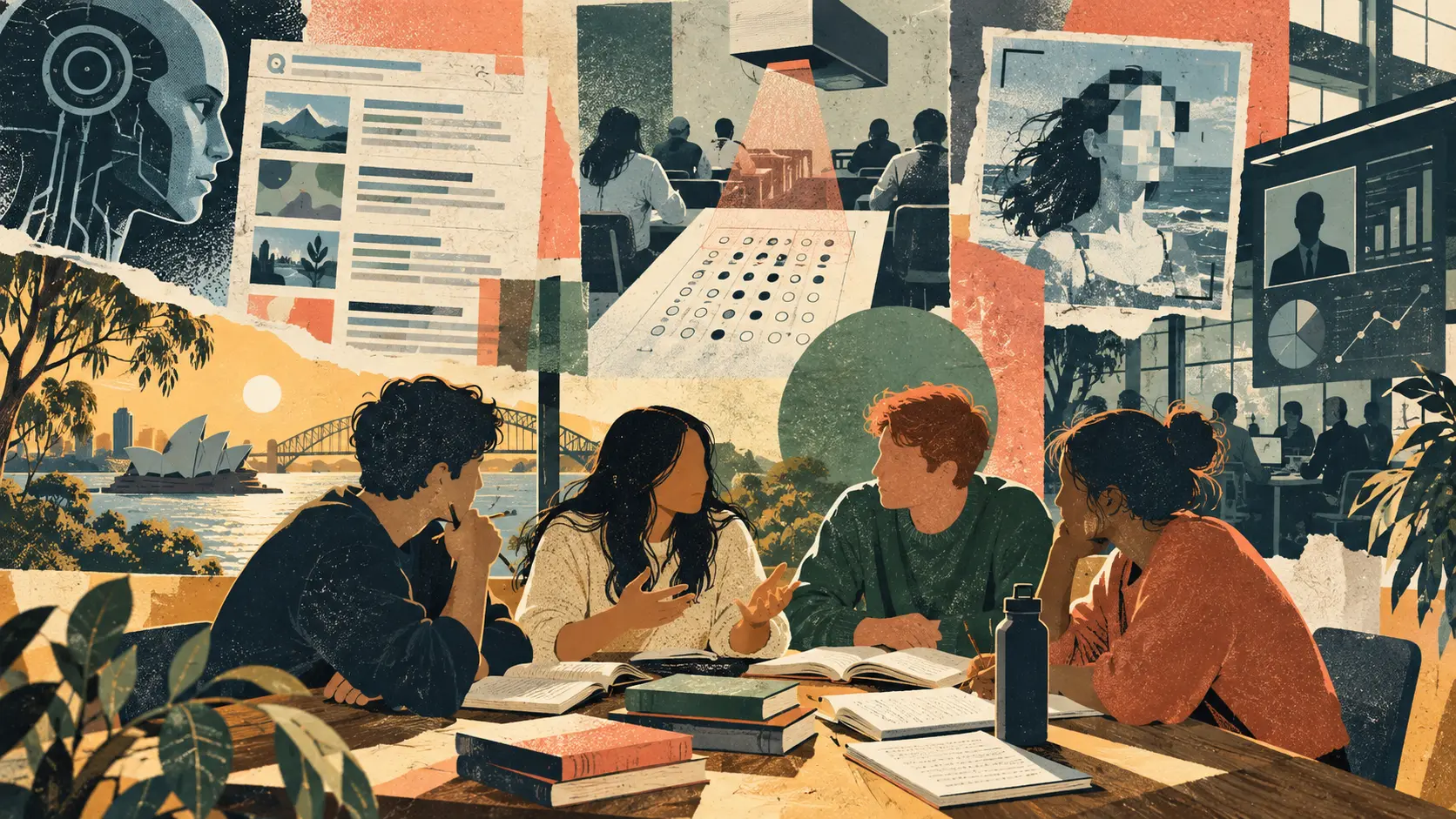
ABC News published direct accounts on September 19 from young Australians who are trying to avoid, limit or question artificial intelligence. Their problem is not simply whether to open a chatbot. AI can appear inside search, study tools, assignment rules, image manipulation and workplace expectations, including systems chosen by somebody else. A person can refuse one product while remaining subject to the wider system. Australia already has useful principles. The national framework for generative AI in schools says the technology should support critical thinking rather than restrict human thought, protect autonomy and dignity, make its effects transparent, and let affected people question tools, outputs and decisions. Higher-education guidance is less tidy because real courses are less tidy: depending on the task, AI may be banned, restricted, encouraged or required. Neither document creates a universal right to opt out. Two surveys add context without measuring the same thing. Minderoo surveyed 2,010 Australian adults in January and found broad concern about speed, risk and regulation. HEPI surveyed 1,054 full-time United Kingdom undergraduates in December 2025 and found near-universal student use, including 94 percent using generative AI to help with assessed work. Those results are not an Australian youth refusal rate. The plain signal is that choice must be designed at the system level. If an institution wants students to think for themselves, it needs to disclose where AI is operating, state when its use is actually a learning outcome, provide a credible human route when feasible, protect non-users from disadvantage and give everyone a way to challenge automated effects.
01
WHAT ACTUALLY CHANGED
ABC News published a September 19 feature built around named interviews with Australian students and families who are uneasy about AI. The article includes 19-year-old Curtin University student Elise Humphreys, 16-year-old Melbourne student Jenson Rainbird and 17-year-old Ingrid Miedecke. Their accounts are first-person evidence of particular experiences. They do not establish how all Australian young people feel.
Humphreys described a contradiction that deserves more attention than a simple pro-or-anti label. She worries that AI can weaken independent thought and feel like a shortcut, yet she also fears falling behind if she refuses tools that other students use. The pressure comes from relative advantage as much as formal policy. Nobody has to order universal adoption for non-use to begin feeling costly.
Rainbird told ABC that he tries not to use AI but still encounters it through Google search and study tools. His father, Justin, described AI use as a workplace performance measure. That family contrast is illustrative rather than representative, but it shows how education and employment can send the same young person different messages: preserve your thinking, become fluent with the tools and do not be the last person to adopt them.
Miedecke raised bias, misogyny and environmental cost. Her mother, teacher Cat Miedecke, told ABC that a photograph containing a child, other students and a teacher had been uploaded without consent and manipulated to depict a Nazi salute. This article treats that as a family account, not an independently verified incident. Its governance lesson remains concrete: one person's refusal cannot protect them when another person uploads their image.
Minderoo Foundation's February release documents a national survey conducted from January 20 to 28 among 2,010 Australians aged 18 and older. The sample used interlocked age, gender and regional quotas and was weighted. Almost two-thirds said AI was moving too fast, nearly six in ten said they had recently seen an image or video they could not confidently classify as real or AI-generated, and 69 percent chose stricter regulation over minimal regulation in a forced choice. These are adult attitudes, not a youth refusal measure.
HEPI's Student Generative AI Survey 2026 was conducted by Savanta in December 2025 among 1,054 full-time United Kingdom undergraduates. It found that 95 percent used AI in at least one way and 94 percent used generative AI to help with assessed work. Twelve percent said they directly included AI-generated text in assessed work, while 65 percent said assessment had changed significantly. The study was sponsored by education-technology company Kortext and concerns UK higher education, not Australian schools.
Australia's national framework for generative AI in schools was updated after education ministers endorsed its 2024 review. The framework says AI should support critical thinking and creativity rather than restrict human thought and experience. It also says learning design should identify how AI should and should not be used, preserve unbiased evaluation of student ability, protect autonomy and dignity, disclose effects, limit unnecessary data collection and let affected people question tools, outputs and decisions.
The Tertiary Education Quality and Standards Agency gives students a more task-specific reality check. Its guidance says AI may be restricted, banned, encouraged or required depending on a subject and assessment. Students must understand attribution and local rules because inconsistent use may become academic misconduct. That flexibility can match different learning goals, but it also makes the quality of disclosure and the availability of alternatives more important.
Curtin University says it encourages ethical AI integration across curriculum, research and student experience and describes AI as complementary to human work rather than a replacement. Humphreys studies at Curtin, but her comments should not be read as an allegation about a particular Curtin course or rule. The university page is useful as an institutional example of a wider direction: many universities are preparing students for AI-rich work, even as some students ask to protect AI-free thinking.
02
WHY THIS MATTERS
Refusal is not a binary switch. A student can decline to prompt a chatbot while receiving AI summaries in search, automated feedback in a learning platform, machine-generated study material from a classmate or an assessment designed around assumed AI access. Choice has to follow the complete learning path, not just the visible app.
Thinking is not a quaint alternative to tool use. Education is partly a protected place for memory, judgment, uncertainty, explanation and the productive frustration of solving something slowly. If every difficult step is routed through an assistant, a student may produce a better-looking artifact while the institution learns less about what the student can actually do.
The opposite risk is real too. A blanket ban can leave students unprepared for workplaces where AI literacy is expected, and it can punish people for using accessibility or language support that has become entangled with generative features. A credible policy separates learning to use AI from being compelled to use it for every kind of learning.
Assessment rules become a fairness issue when they vary by subject, teacher or task and are communicated badly. A student may treat a tool as normal in one class and commit misconduct with the same behavior in another. Task-level instructions, examples and appeal routes matter more than a general slogan on the institution's website.
Privacy breaks the idea that personal refusal is enough. A young person may avoid uploading a face, voice, essay or location while a friend, teacher, vendor or school system supplies the same information. Consent needs to cover third-party uploads, retained data, model training, redistribution and the right to ask what happened after material entered the system.
Employment pressure can reach backward into education. If students believe recruiters and managers will reward visible AI use, they may adopt tools before they have a reasoned view of the tradeoffs. A workplace measure based only on usage can reward button pressing rather than better judgment, safer work or stronger outcomes.
Equal access runs in two directions. Students who cannot afford a premium tool, use a supported language, disclose a disability or accept a vendor's data terms should not be disadvantaged. Neither should a student who chooses a credible non-AI route for a task whose purpose is independent thought. Institutions need to measure both forms of exclusion.
Young people have unusually high exposure and unusually limited institutional power. School students often cannot select the platform, negotiate a contract, vote on policy or leave the classroom. A participation process that asks for student views after procurement is complete is feedback, not consent. Student voice belongs before adoption, during evaluation and after harm.
03
WHERE IT COULD HELP
- Publish an AI map for every course and school service that identifies where AI is present, which organization provides it, what data it receives, whether outputs affect a decision and who can answer questions
- Give each assessment a plain rule that labels AI use as prohibited, limited, optional or required, explains the learning purpose and supplies examples of acceptable attribution and unacceptable substitution
- Offer an equivalent non-AI route when AI competence is not itself the learning outcome, then compare workload, access, grading and completion so the alternative is real rather than a penalty disguised as choice
- Preserve human-first checkpoints such as oral explanation, worked reasoning, drafts, practical demonstration and supervised problem solving so polished output cannot replace evidence of student understanding
- Require consent and minimization rules for student images, voices, writing and behavioral data, including restrictions on third-party uploads, retention, vendor reuse, model training and further distribution
- Create a contestability path with a named human contact, response clock, evidence record and appeal for students affected by an AI output, detection claim, automated recommendation or denied alternative
- Train staff to distinguish AI literacy from AI volume by assessing verification, judgment, disclosure, error handling and the ability to complete core work without hidden dependence on a model
- Report outcomes separately for required users, optional users and non-users, including achievement, misconduct findings, accessibility, privacy complaints, cost and student confidence in their own skills
KEEP A HAND ON THE WHEEL
ABC's named interviews are valuable direct accounts, not a representative measure of Australian youth. The manipulated-photo episode is a family account reported by ABC and was not independently verified for this article. Minderoo surveyed Australians aged 18 and older, not specifically young people, and commissioned the research it published. Its February release sits outside the preferred 72-hour news window and is included as dated background. HEPI studied full-time UK undergraduates, not Australians or school students, and the survey was sponsored by Kortext, which sells education technology. Usage, approval, anxiety, dependence and refusal are separate measures. The 94 percent HEPI figure means respondents used generative AI to help with assessed work; it does not mean 94 percent submitted generated text or approved of the tools. Australia's school framework is aspirational guidance, not a statute creating a universal opt-out right. TEQSA guidance allows task-level requirements and does not promise an alternative in every course. A non-AI route may be inappropriate where AI competence is the stated learning outcome, but that purpose should be explicit and the data and accessibility conditions should still be reviewable. Watch for procurement rules that require student consultation, public AI registers, assessment-specific instructions, equivalent alternatives, data-use contracts, appeal records and evidence that students can decline a tool without losing access, marks or future opportunity.
04
TERMS WORTH KEEPING
SOURCES AND VERIFICATION STATUS
This article was written from the materials below. Product claims and dates were checked against those sources on September 19, 2026.
PUBLICATION RECEIPT: Revision 1. Published September 19, 2026.
THE PUBLICATION ENGINE
WANT A SIGNAL OF YOUR OWN?
We build source-grounded publications, private briefings, and editorial systems for organizations with something useful to say.
WORK WITH US