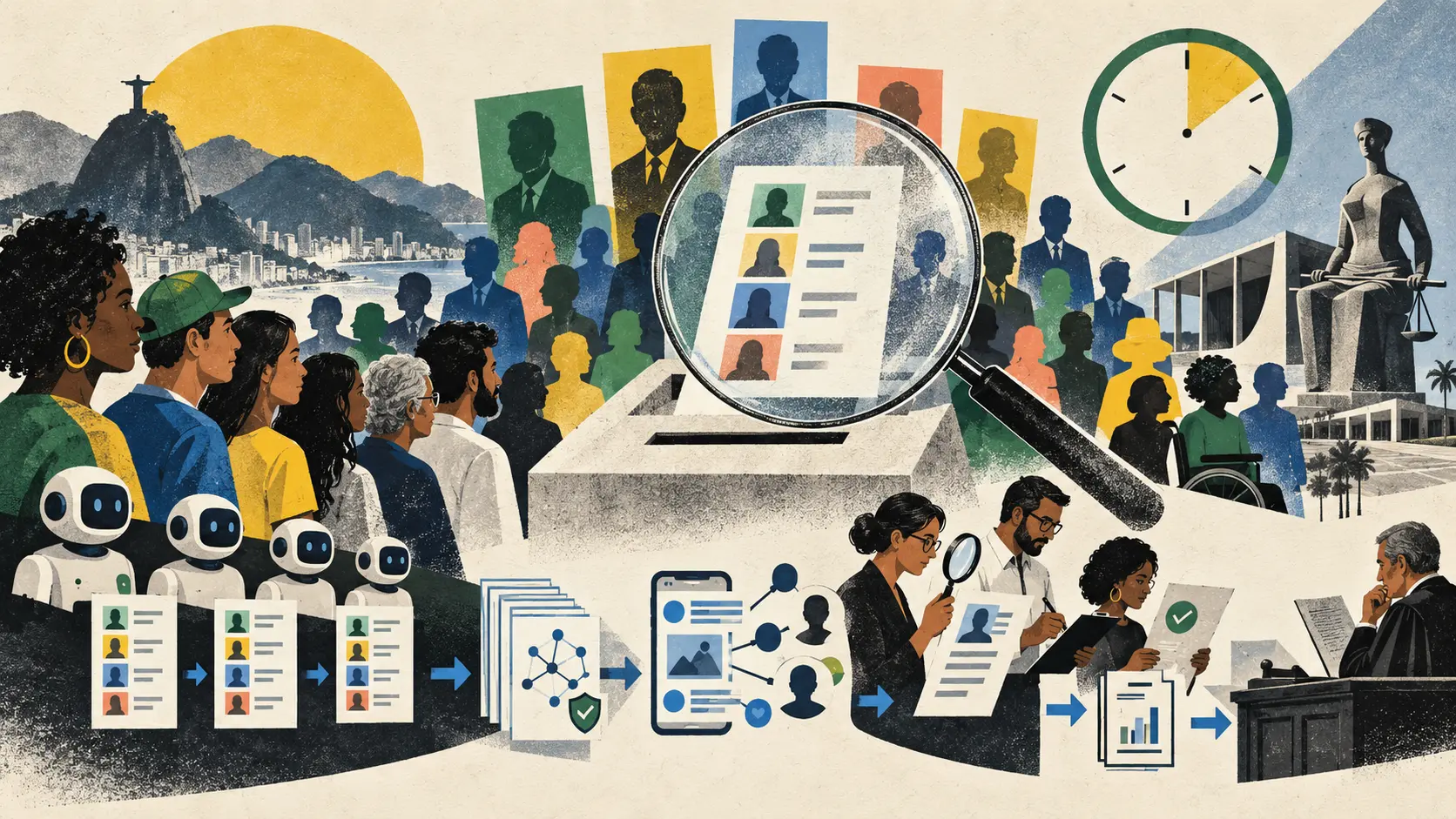
THE SIGNAL IN ONE SENTENCE
Brazil votes in the first round of its general election on October 4. OpenAI public-policy executive Bruno Lewicki told Folha that the country will be a major global test of artificial intelligence in elections and said the experience could inform preparations for later votes, including France in 2027. The important part is not whether Brazil gives an AI company a good case study. It is whether Brazilian voters, campaigns, researchers and the Electoral Justice system can see what the systems actually did. The Tribunal Superior Eleitoral, or TSE, has prohibited AI providers from ranking, recommending, suggesting or prioritizing candidates and from expressing an electoral preference, even when a user asks. Campaign material that uses synthetic multimedia must disclose the manipulation and the technology. A narrower blackout bars publication, republication and paid promotion of new synthetic content using a candidate or public person's image, voice or manifestation from 72 hours before the vote until 24 hours after it ends. Platforms must provide complaint channels and measurable compliance plans. OpenAI points to product rules, official information sources and provenance signals for generated media. Those controls matter, but they are not a scorecard. The company acknowledges that outside studies have found chatbots ranking or recommending candidates despite the rules. Provenance does not cover ordinary text, and even image metadata can disappear. The plain signal is that Brazil is testing an accountability chain, not merely a chatbot. A vendor can publish a policy. Only independent prompts, preserved outputs, public indicators, fast complaints and reviewable court records can show whether the policy survived an election.
01
WHAT ACTUALLY CHANGED
Folha published an interview on September 19 with Bruno Lewicki, OpenAI's head of public policy for Latin America. He described Brazil as a major test for the use of AI in elections and said lessons could travel to later contests. He also said the company expects the election to proceed without major AI disruption. Those are company expectations, not an independent forecast or a result.
Brazil's 2026 rules now address conversational systems directly. Article 28, paragraph 1-C of TSE Resolution 23.610, as amended by Resolution 23.755, prohibits providers of AI systems from ranking, recommending, suggesting or prioritizing candidates, campaigns, parties, federations or coalitions. It also prohibits automated opinions, electoral preferences, voting recommendations and direct or indirect political favoring, even when a user requests them.
The same resolution requires election advertising that uses synthetic multimedia to state prominently and accessibly that the content was fabricated or manipulated and identify the technology used. That disclosure rule reaches text, audio, video and images used in campaign material. It does not turn a deceptive item into acceptable speech when another prohibition applies.
A new timing rule is narrower than a general ban on AI content. From 72 hours before the election until 24 hours after it ends, publication, republication and paid promotion are prohibited for new synthetic content made or altered with AI that uses the image, voice or manifestation of a candidate or public person. The restriction applies even when the item is labeled. It concerns distribution of that defined material, not every private generation request or every mention of a candidate.
Platforms that offer political promotion must add a field for advertisers to declare AI use. Application providers must also provide a specific complaint route for candidates, parties, federations and coalitions, and the TSE can require immediate removal or unavailability of material that violates the synthetic-content rules.
The resolution adds an evidence mechanism for technically difficult cases. A judge may shift the burden of proof and require the respondent to explain how and at which stages AI was used and to demonstrate the truthfulness of the published information. Electoral courts may also partner with universities and organizations that have digital-forensics and AI expertise.
Internet application providers must prepare compliance plans with duties tied to the resolution, measurable and periodic indicators, deadlines, expected results and an implementation trajectory. That creates the outline of an audit trail. The public value will depend on which indicators are disclosed, whether outsiders can reproduce them and what happens when the trajectory slips.
OpenAI says its usage policies prohibit political campaigning, lobbying, election interference, voter demobilization and deceptive impersonation. In the Folha interview, Lewicki pointed to official sources, media-origin signals and continuing product improvements. He also acknowledged reports from Brazilian researchers that chatbots, including systems beyond ChatGPT, had still ranked or recommended candidates. A policy and a violation can coexist. The useful measurement is the rate, severity, repair time and recurrence of the violation.
OpenAI describes provenance tools for generated images and audio, including metadata, credentials and watermarking. Its own provenance research says text remains much harder: watermarking can be weakened by translation, rewriting or another model, and text metadata is still early. Image credentials can also be removed through screenshots, re-encoding or platform handling. A present marker can support an origin claim. A missing marker cannot prove that a file is human-made.
02
WHY THIS MATTERS
An election is a terrible place to discover that a safety policy works only in a demonstration. Answers arrive in local Portuguese, slang, typos, audio, screenshots and chained follow-up questions. A system can refuse a blunt request and still steer a user through a comparison, a summary or an apparently neutral ranking. Testing must follow the conversation, not stop at the first prompt.
Brazil is not one presidential prompt. It is a federal contest with offices, regions, parties, coalitions and thousands of candidacies. The surface area includes model answers, generated media, campaign production, paid promotion, group messages, search, recommendation, complaint handling and court enforcement. A single company dashboard cannot see the whole path.
The TSE's ranking ban targets a subtle but important power. A chatbot does not need to say vote for someone to shape a choice. It can decide which names appear first, which traits count, which scandals receive detail and which uncertainty disappears. The order of an answer is part of the answer.
Provenance is useful when it records a positive chain from a known tool to a file. It is weaker when treated as a universal detector. Files can lose metadata, tools may not add it, a human can edit output and text has no reliable equivalent. Election communication needs provenance, disclosure, platform context and evidence-based investigation together.
The 72-hour and 24-hour window recognizes a practical asymmetry. A convincing synthetic clip can travel in minutes while authentication, legal review and correction take hours or days. The blackout creates breathing room around the vote, but its effectiveness depends on rapid detection, clear responsibility for republication and consistent treatment across major platforms and smaller channels.
Complaint systems are part of election infrastructure. A form that exists but routes slowly, hides status, accepts only one media type or offers no appeal can fail at the exact moment it matters. Useful systems need clocks, case identifiers, evidence preservation, reasoned decisions and escalation paths that candidates and ordinary users can understand.
Compliance indicators can turn promises into evidence. Providers could report tested languages, refusal consistency, ranking failures, repeat violations, response times, appeals, restored content and provenance survival. Aggregate numbers need independent spot checks because a company can improve the metric by narrowing the denominator or excluding difficult cases.
The biggest risk in calling Brazil a test is deciding that the tester also gets to write the questions, inspect the machine and assign the grade. Companies have important telemetry and security knowledge. Courts, researchers, journalists, campaigns and civil society bring adversarial prompts, local context, legal authority and the ability to compare platforms. The system needs all of them.
03
WHERE IT COULD HELP
- Build a public Portuguese test set covering candidate rankings, vote recommendations, issue comparisons, coalition questions, regional slang, typos, audio prompts, screenshots and multi-turn attempts to obtain the same prohibited result
- Run the same tests across major chatbots on fixed dates and accounts, preserve complete conversations and settings, and publish pass, fail and ambiguous examples with a method another researcher can repeat
- Separate model behavior from distribution behavior by recording who generated an item, who labeled it, where it was first published, who republished it, whether it was promoted and how each platform responded
- Give every complaint a timestamp, evidence receipt, case number, decision reason, appeal path and final status, then publish median and high-percentile response times for the election period
- Test provenance through ordinary transformations such as screenshots, cropping, compression, messaging-app forwarding and reposting, and state clearly when absence of a credential proves nothing
- Require campaign teams to keep production records for synthetic material, including the tool, prompt or editing stage, responsible person, approval, disclosure and distribution time, so a court request can be answered quickly
- Publish platform compliance plans with measurable indicators, deadlines and changes, while letting independent Brazilian researchers audit samples and report disagreements without relying on company permission
- After the election, issue a joint incident review that separates attempted abuse, policy violations, distribution reach, voter exposure, removal time, appeals and proven electoral effect instead of compressing everything into a success claim
KEEP A HAND ON THE WHEEL
Brazil is not a controlled experiment, and no AI company can establish that the election was safe by announcing that its own controls worked. Lewicki's description of the country as a major test and his confidence about a calm election are company statements reported by Folha. The outlet discloses a commercial agreement with OpenAI to supply journalism to its ecosystem, which makes direct legal texts and independent testing especially important alongside the interview. OpenAI's product policies establish intended behavior, not consistent enforcement. Reports that chatbots ranked candidates are evidence of failure cases, but the public material reviewed here does not provide a complete, independently replicated failure rate for every platform, language or prompt type. The 72-hour restriction is not a blanket ban on all AI generation. It concerns publication, republication and promotion of defined new synthetic content using a candidate or public person. Provenance markers can support a positive origin claim, but missing markers do not prove human authorship, and ordinary text lacks an equivalent mature signal. The TSE rules are new, and their interpretation will develop through decisions and enforcement. Watch for published compliance plans, independent Portuguese-language test suites, complaint and appeal data, court rulings, evidence-preservation practices, provenance survival after reposting, coordinated behavior across platforms and a post-election account that includes failures rather than only a corporate victory lap.
04
TERMS WORTH KEEPING
SOURCES AND VERIFICATION STATUS
This article was written from the materials below. Product claims and dates were checked against those sources on September 19, 2026.
PUBLICATION RECEIPT: Revision 1. Published September 19, 2026.
THE PUBLICATION ENGINE
WANT A SIGNAL OF YOUR OWN?
We build source-grounded publications, private briefings, and editorial systems for organizations with something useful to say.
WORK WITH US