THE SIGNAL IN ONE SENTENCE
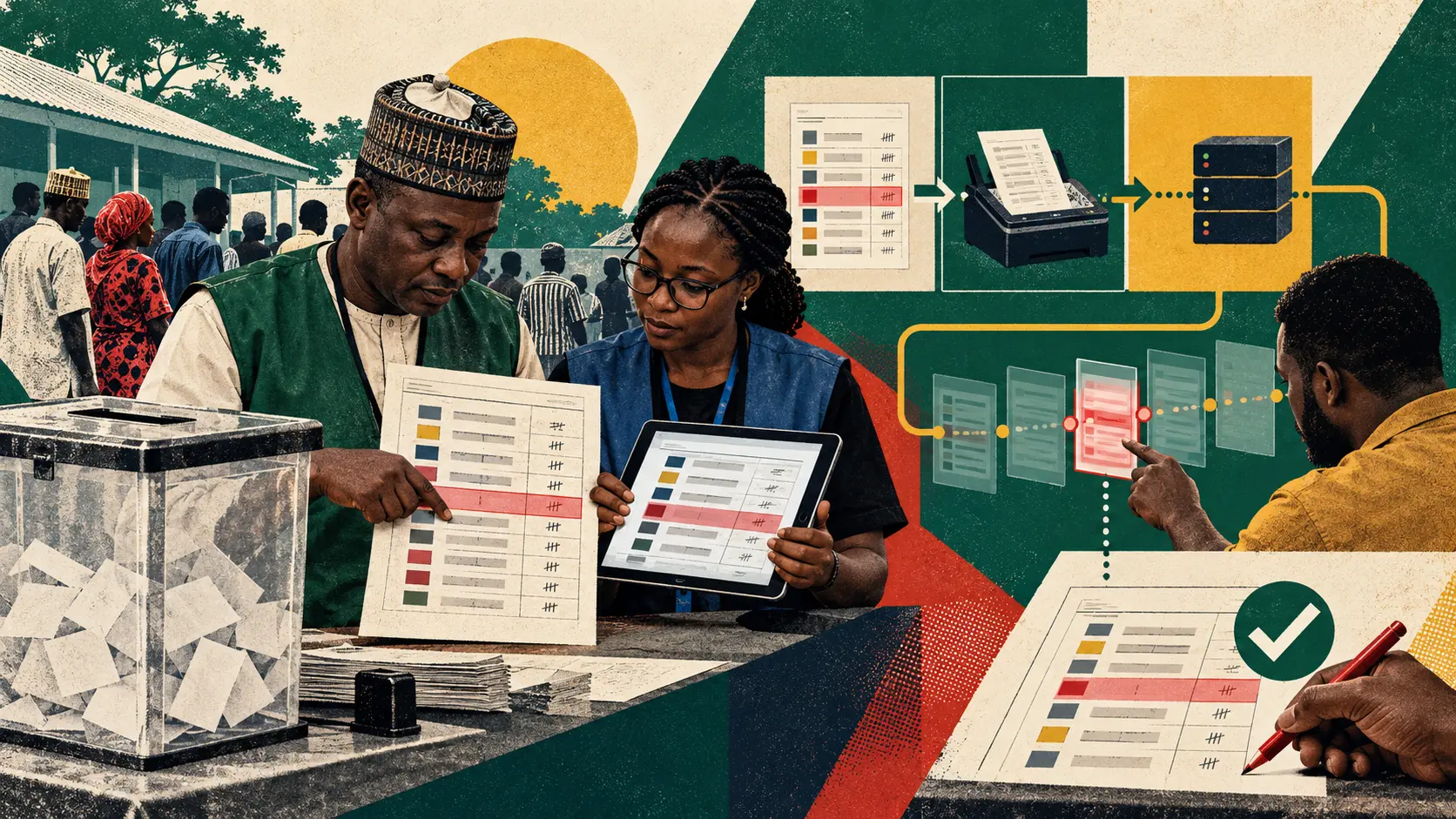
Election-night software has a strange job. It has to move fast enough to keep the public informed and slowly enough to let people check what happened. Nigeria's Independent National Electoral Commission, known as INEC, says it plans to use artificial intelligence in its management of results for the 2027 general election. According to remarks reported by Radio Nigeria Lagos and The ICIR, the proposed checks would help catch the wrong document being uploaded to the INEC Result Viewing Portal and identify figures that do not agree with the number of accredited voters. Dr Lawrence Bayode, INEC's director of information and communication technology, described a possible comparison between the scanned polling-unit result form, known as Form EC8A, and the figures entered electronically. If the two agree, the record could proceed to the portal. If they do not, the discrepancy should be resolved before publication. That is a sensible use for computation. It is also exactly the sort of system that can become dangerous when a flag quietly turns into a verdict. The plain signal is this: every mismatch needs a human receipt. AI should point to the disagreement. It should not decide which result is true, silently rewrite a figure or prevent a lawful record from moving forward without an accountable human decision. The receipt begins with the source. For every alert, retain the polling-unit identifier, the original image reference, the figures detected from the image, the figures entered in the result system and the accredited-voter count used for comparison. Record which rule or model version raised the alert, when it happened and what kind of mismatch it found. Then record the human response. Who reviewed the alert? Which original material did that person inspect? Did the reviewer confirm an entry mistake, identify a poor scan, find that the automated extraction was wrong or conclude that the record required a deeper investigation? If a figure changed, preserve the before and after values, the stated reason, the authority for the correction and the time it was published. Finally, preserve the appeal. Party agents, observers, journalists and voters should be able to understand that a discrepancy occurred and how it was resolved. That does not require exposing personal data or security-sensitive system details. It does require a stable public trail linking the source record, alert, human judgment and final published result. Without that trail, the system asks the public to trust a black box during an event where every unexplained pause or correction can acquire a political life of its own. The distinction between assistance and authority matters here. Nigeria's new AI for Elections programme makes the boundary unusually explicit. Rise Networks launched the project with INEC, the National Centre for Artificial Intelligence and Robotics, and other partners. It combines a hackathon, a development hub and a community of practice running from October 2026 into February 2027. The application rules say teams must build working solutions rather than submit only presentations. They also prohibit partisan persuasion, political microtargeting, manipulating participation, unauthorized access to systems or data, testing on live election systems and presenting AI output as an authoritative electoral result. Those restrictions are not decorative. They describe the gap between a civic prototype and election infrastructure. The hackathon allows artificial, synthetic, open or explicitly approved data. That is a prudent starting point because competitors should not experiment on live election records. It also means a successful demonstration will not prove that a system can handle real polling-unit forms, uneven lighting, weak connectivity, rushed data entry, regional variation, damaged paper or an adversary actively trying to confuse it. Before any deployment, INEC needs a representative field test. Build a benchmark from lawfully available historical material and carefully designed synthetic cases that reflect the actual messiness of result forms. Include clear scans, blurred images, shadows, folded pages, handwriting, overwritten digits, stamps, missing fields, rotated photos and numbers placed close together. Include honest mistakes and deliberately manipulated examples. Then publish the useful error rates. How often does the system flag a correct record? How often does it miss a genuine mismatch? How often does it extract a digit incorrectly? How does performance change with image quality, device type, language context, network condition and form layout? How long does a human need to resolve each alert, and does that review create a backlog during peak reporting? An average accuracy score would hide the operational problem. A system that looks impressive overall can still fail badly on the hardest forms or produce so many false alerts that officials begin clicking through them. A low false-positive rate can sound reassuring while a small number of missed discrepancies carry enormous public consequences. Election assurance needs the full confusion matrix, tested by independent evaluators under realistic conditions. The system also needs a manual path. If the model is unavailable, the network drops or a form cannot be read reliably, authorized officials must be able to continue under documented procedures. The AI cannot become a single gate that prevents a valid result from being handled. Manual processing should create the same receipt, including why automation was bypassed and who approved the next step. No model should correct a number automatically. Optical character recognition can help extract digits from a form, but extraction is evidence for review, not the source of truth. A highlighted mismatch is useful because it focuses attention. An invisible rewrite is harmful because it erases the fact that judgment occurred. Versioning matters too. If INEC changes the extraction model, comparison rule, confidence threshold or form template during an election period, the receipt must identify which version handled each record. The commission should test the update before release, preserve the earlier version and document why the change was necessary. Otherwise two polling units with the same problem could receive different treatment without anyone being able to explain why. Security cannot be separated from accuracy. An attacker might alter an image, flood the system with false mismatches, steal reviewer credentials or exploit the upload path. The design should isolate document ingestion from core result systems, limit each user's permissions, log access, require strong authentication, protect records against later alteration and rehearse recovery from an outage or compromise. Independent observers need access to the assurance process, not administrative control over the system. That could include published test protocols, witnessed pre-election evaluations, cryptographic references for source documents, aggregate alert statistics and a process for examining contested cases. The public should be able to verify that controls operated as described without gaining access that could harm the election. INEC has reportedly created a dedicated AI division and is preparing rules for responsible use. It has also said the technology could eventually help with voter information, election records, operations and misleading information. Each of those uses needs a separate decision. A result-form mismatch detector, a multilingual voter-information assistant and a system that classifies misleading claims have different data, harms, legal questions and appeal needs. Putting them under one broad AI policy would make responsibility blurry. Every tool needs its own purpose, prohibited uses, test, owner, incident process and sunset condition. The voter-information side offers a useful contrast. A chatbot can help explain registration, polling locations or procedures in English, Hausa, Igbo and Yoruba. It can also give an outdated or fabricated answer. The safe design should retrieve from authoritative material, show the source and date, admit uncertainty and hand difficult cases to a person. It should never infer how someone is likely to vote or tailor political persuasion to them. The hackathon's own design maxim gets this right: start with the problem, understand the people and context, then decide whether AI is the correct and efficient tool. That order should survive contact with procurement. There is no published INEC technical specification for the planned result checks, no named production model, no benchmark, no error rate, no procurement record and no public appeal design in the reviewed material. The hackathon has not selected winners, and winning it would not prove that a prototype belongs in a national election. The next milestone should therefore be evidence, not a more polished demonstration. Publish the problem statement. Publish the test set design. Let independent experts and election observers challenge it. Run the system beside existing procedures without granting it decision authority. Count every flag, override, delay and failure. Show what changed after the test. Election technology earns legitimacy through inspectable procedure. If AI catches a transposed digit or the wrong uploaded form, good. Let it raise its hand. Then let a named human inspect the original, explain the judgment and leave a receipt that another person can follow. That is slower than magic and faster than distrust.
01
WHAT ACTUALLY CHANGED
INEC says it plans to use AI checks in result management for Nigeria's 2027 general election
The proposed system would flag wrong document uploads and figures that conflict with accredited-voter counts
INEC described a possible comparison between scanned Form EC8A records and electronically entered figures before publication to IREV
The commission has created a dedicated AI division and is preparing responsible-use rules
The AI for Elections programme opened a national hackathon alongside a development hub and community of practice
Hackathon rules prohibit testing on live election systems and presenting AI output as an authoritative result
02
WHY THIS MATTERS
A discrepancy detector can catch ordinary data-entry and upload mistakes before they become public controversy
False alerts, missed mismatches and poor image extraction could delay or distort result handling if people treat the model as authoritative
A human-readable receipt lets officials, observers and the public reconstruct why a record was flagged and changed
Synthetic-data prototypes are useful for development but cannot establish performance under real polling-unit conditions
Election legitimacy depends on consistent procedure, versioned systems, independent testing and a workable appeal path
Separate AI uses for results, voter information and misinformation need separate safeguards rather than one vague policy
03
WHERE IT COULD HELP
- Flag a scanned result form whose extracted figures differ from the electronic entry
- Check whether reported vote totals exceed the recorded number of accredited voters
- Detect when the wrong document type or polling-unit form is being uploaded
- Show a reviewer the exact field that triggered a discrepancy instead of silently changing it
- Create a versioned receipt containing the source record, rule, alert, reviewer, decision and correction
- Test extraction across blurred, rotated, shadowed, handwritten and damaged forms before deployment
- Publish false-positive, false-negative and unresolved-case rates from independent evaluations
- Provide a documented manual route when the model, network or image fails
- Give observers a safe way to inspect the assurance process without exposing protected systems
- Use authoritative sources and human escalation for multilingual voter-information assistants
KEEP A HAND ON THE WHEEL
The reviewed reporting describes planned capabilities and remarks at a programme launch, not a published INEC production specification. No deployed model, benchmark, procurement, audit method, error rate, incident process or appeal design has been released. Hackathon participants must use artificial, synthetic, open or approved data and may not test on live election systems. A working prototype or prize does not establish readiness for an election, and the programme does not guarantee that a winning project will be deployed by INEC. Watch for a formal policy, representative test data, independent evaluation, public error rates, version controls, cybersecurity review, human-override rules, incident disclosure and an appeal process connected to the legal result-management procedure.
04
TERMS WORTH KEEPING
OPEN GLOSSARY CARD
False positive
A result that incorrectly labels a negative case as positive, such as calling human writing AI-generated.
OPEN GLOSSARY CARD
Human control
The practical ability and authority of people to understand, direct, interrupt or stop an automated process before unacceptable harm occurs.
OPEN GLOSSARY CARD
Audit trail
A durable record of actions, changes, identities, and times that lets someone reconstruct what happened.
SOURCES AND VERIFICATION STATUS
This article was written from the materials below. Product claims and dates were checked against those sources on October 24, 2026.
THE PUBLICATION ENGINE
WANT A SIGNAL OF YOUR OWN?
We build source-grounded publications, private briefings, and editorial systems for organizations with something useful to say.
WORK WITH US