THE SIGNAL IN ONE SENTENCE
A serial number can tell you which robot is standing in front of you. A safety passport should tell you whether that robot deserves to be standing there. Beijing has published an unusually concrete action plan for embodied-intelligence robots through 2028. It combines industrial targets, data and computing infrastructure, real-world testing, component goals, certification and safety governance. One provision deserves attention beyond the usual race for faster hands and more expressive robot faces. The city plans a one-machine-one-code management system covering research, production, retirement and recycling. The official document describes identity authentication, trusted traceability and behavior auditing across the full lifecycle. That could become a factory asset tag with a nicer name. Or it could become the safety passport physical AI badly needs. The difference is what the code resolves to, who can inspect it and whether the history survives an inconvenient event. Start with the body. Every deployed robot should have a durable identity tied to its physical hardware, manufacturer, model, serial record and current owner or operator. The identity should survive resale, refurbishment and reassignment. Replacing a battery should not create a new machine. Replacing the arms, drive system or control computer should create a recorded change, not a convenient case of amnesia. Then pin the software. A modern robot is not one fixed product. It is a shifting stack of perception models, planning systems, control software, safety policies, applications, drivers and remote services. A safety review performed in March does not automatically cover a new model installed in September. The passport should record the exact software and model versions, cryptographic hashes, release dates, vendor, approved configuration and the person or organization that authorized each update. It should show which components can update remotely and whether an operator can roll back safely. Put the permitted job in the record too. A robot cleared to move sealed cartons on a fenced warehouse floor is not automatically cleared to assist an older person at home. The environment, payload, tools, nearby people, network access and consequences of failure all change. The passport should name the tasks and sites for which the machine was evaluated. It should record limits such as speed, payload, operating temperature, required separation distance, supervision level and prohibited tools. If the robot crosses those limits, the record should show who approved the exception and for how long. Beijing's plan sets detailed performance goals for robot platforms. It calls for rated loads above 40 percent of a robot's own weight, mean time between failures above 2,000 hours, annual failure rates below 10 percent for core motion components and end effectors, a design life above five years and more than four hours of battery endurance during continuous work. Those are targets, not achieved results. They also need operating conditions. A mean-time-between-failures number is nearly useless without the tested workload, sample size, maintenance schedule, temperature, floor conditions, payload and definition of failure. A gripper that jams and recovers after three tries may count as a minor delay in one report and a dangerous failure in another. The passport should link each performance claim to the test method, machine sample, environment, result distribution and testing organization. Publish the median and the ugly tail. People standing beside robots care about the worst credible failure, not only the average machine on a polite day. Certification needs independence. The plan calls for real-world test grounds, evaluation and certification platforms, and third-party inspection bodies. That is promising if third party means something more than a different sign on a nearby office. The record should identify who paid for the test, who designed it, what conflicts were disclosed, which standards applied, which failures occurred and whether a regulator or independent laboratory reproduced the result. Certification should expire after material hardware or software changes. Now add the incident history. Record collisions, near misses, unplanned stops, dropped objects, damaged property, privacy breaches, unauthorized network access and cases in which a human had to take control. Log emergency-stop activations and whether the machine actually became safe within the promised time. Do not let an owner erase that record by selling the robot to another company or registering it under a new fleet account. The history should travel with the machine. The current operator can add context and contest an entry, but cannot silently delete the past. The passport should distinguish an incident from a rumor and an operator mistake from a design defect. It should also preserve the original evidence. A useful entry points to sensor logs, video where lawful, maintenance records, software versions, witness accounts and the final investigation. Access can be tiered, but the public summary should not become a blank card marked proprietary. Beijing also wants more than one million hours of high-quality embodied data collected across at least 100 real settings. That is a giant training target and a giant consent problem. Robot data can include workers' bodies, voices, faces, habits, mistakes and the physical layout of workplaces, care facilities and homes. The safety passport should identify the data classes used to train or update the deployed system, their provenance, consent basis, retention rule, geographic source and known gaps. It should not expose individual workers or residents. Use tiered views. The public can see data categories, source regions, collection dates, consent rules and known limitations. Regulators and accredited auditors can inspect more detailed evidence under privacy protections. Operators can see what they need for safe use. Personal identities and raw biometric records stay protected. Workers should know when their motions are being collected to train the machine that may later change their job. They should have a correction and complaint path, and paid data work should be described as work rather than atmospheric exhaust from the factory floor. The plan also proposes more than 50,000 PFLOPS of dedicated embodied-intelligence computing capacity. That figure belongs in a public resource receipt. State-supported compute should disclose who receives capacity, what projects use it, what energy and water it consumes, which safety conditions apply and what public benefit results. A giant number without allocation and outcome data is only a very warm brag. Make the identity code useful offline. A robot must remain safely stoppable when its registry, network or cloud service is unavailable. The physical machine should carry a locally readable identifier and a signed summary of its current approved configuration. A remote registry can provide deeper history, but connectivity cannot become a prerequisite for the emergency stop. Use signed, append-only records. Manufacturers, testing bodies, owners, repair shops, software vendors and regulators can each sign the entries they are responsible for. The system should expose when an entry was added, changed or revoked. It should detect cloned identifiers and show a clear last-known-good state. Do not turn the robot registry into a worker surveillance registry. Behavior auditing should describe the machine's actions and safety-relevant human interventions. It should not quietly assemble productivity scores, biometric profiles or disciplinary records for every person nearby. The governance design needs purpose limits, access controls, retention periods, appeal rights and penalties for misuse. Build a public recall path. If a model update causes unsafe motion across several fleets, the passport system should identify affected machines, notify owners, restrict the risky capability and show whether each robot was patched or removed from service. A recall that depends on vendors voluntarily searching their own spreadsheets is not much of a recall. The passport matters outside Beijing too. Robots, components, models and software cross borders. A machine may be assembled in one country, trained with data from another, certified in a third and operated in a fourth. A portable safety history can help buyers, insurers, workers and regulators compare evidence across that chain. That does not require one global database. It requires interoperable fields, verifiable signatures, stable identifiers and rules for what must travel with the machine. The Beijing plan is not proof that any of this has been built. It is a municipal industrial policy issued on November 11, effective through the end of 2028. Its performance numbers, production shares and leadership claims are goals. Its proposed safety institutions will have to earn trust through implementation. Still, one-machine-one-code is a useful opening. The public version should answer a simple set of questions. What is this robot? Who is responsible for it? What software is it running? What work was it tested to do? What changed? What failed? Who stopped it? What evidence supports its certification? Where does its history go when it is sold? What happens when it retires? If the code cannot answer those questions, it is a label. If it can answer them without turning nearby people into permanent records, it becomes infrastructure. Give the robot an identity. Give the public the safety history attached to it.
01
WHAT ACTUALLY CHANGED
Beijing issued its 2026 to 2028 action plan for the high-quality development of the embodied-intelligence robot industry on November 11, 2026.
The plan targets at least five internationally leading and ten domestically leading humanoid-robot companies by 2028.
It targets Beijing-Tianjin-Hebei production capacity equal to 25 percent of China's total and a regional key-component support rate above 60 percent.
The city plans more than one million hours of high-quality data collection across at least 100 real-world settings.
The city plans more than 50,000 PFLOPS of dedicated embodied-intelligence computing capacity.
Robot-platform targets include rated loads above 40 percent of body weight, mean time between failures above 2,000 hours, design life above five years and more than four hours of continuous-operation battery endurance.
The plan calls for real-world evaluation, testing, certification and third-party inspection capacity.
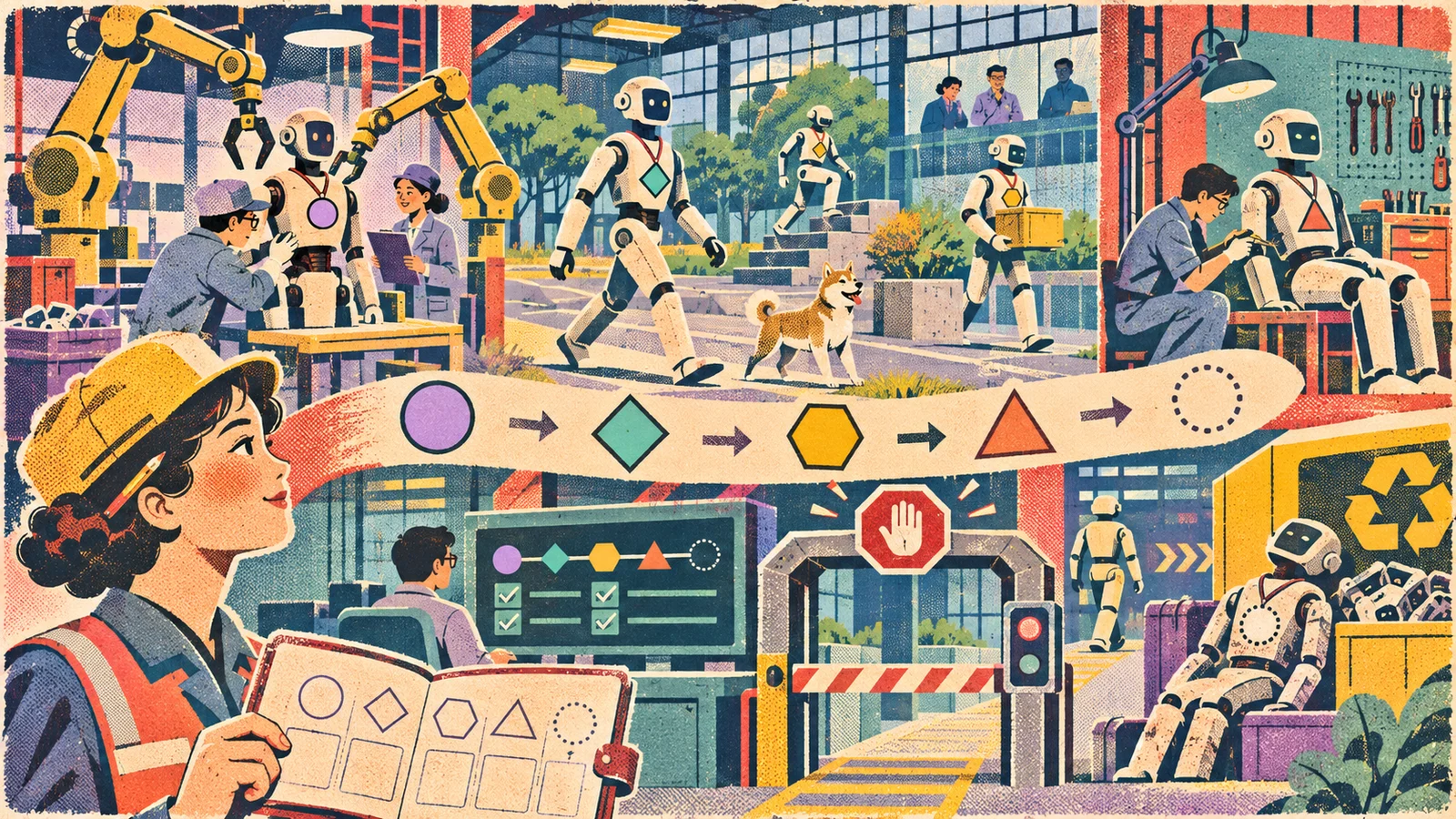
It proposes a one-machine-one-code system for identity authentication, trusted traceability and behavior auditing across research, production, retirement and recycling.
02
WHY THIS MATTERS
Physical AI can change after deployment because hardware, models, control software and remote services are updated separately.
A stable identity can connect those changes to the exact machine that people encounter.
A serial number alone cannot show whether a robot is certified for its current job or whether its configuration changed after testing.
A portable incident and maintenance history can prevent unsafe machines from receiving a clean slate after resale.
Performance targets can mislead unless the test conditions, sample size, definitions and result distribution remain attached.
Large-scale collection of real-world robot data can capture workers, residents and sensitive physical environments.
A tiered public safety passport can support accountability without publishing personal data.
Interoperable records could improve recalls and safety review when robots, components and software cross borders.
03
WHERE IT COULD HELP
- Bind a durable identifier to the robot body, manufacturer, model, serial record and current owner.
- Record hardware changes, repairs, replacements, transfers, retirement and recycling.
- Pin every deployed model and software component to a version, cryptographic hash and approving organization.
- List authorized tasks, sites, tools, payloads, speed limits, supervision and prohibited uses.
- Attach performance claims to test methods, conditions, samples, distributions and testing bodies.
- Expire certification after material hardware, software or operating changes.
- Record collisions, near misses, privacy breaches, dropped objects, emergency stops and human overrides.
- Preserve incident evidence while providing a public summary and protected regulator view.
- Describe training-data categories, provenance, consent rules, retention and known gaps without exposing individuals.
- Give workers and residents notice, correction paths and enforceable limits on secondary use.
- Publish compute allocation, energy, water, safety conditions and public outcomes for supported capacity.
- Keep a locally readable, signed safety summary on the robot for network outages.
- Use append-only signed entries from manufacturers, labs, owners, repair shops and regulators.
- Prevent identifier cloning and display the last known approved configuration.
- Separate machine behavior auditing from worker productivity and biometric surveillance.
- Create a recall mechanism that can find, notify, restrict and verify every affected machine.
KEEP A HAND ON THE WHEEL
This is a municipal industrial action plan with targets through 2028, not evidence that the production, reliability, evaluation, safety or identity systems already exist. The targets for company leadership, production share, component support, compute, data, battery endurance, reliability and failure rates are policy goals. The official plan does not yet publish the data fields, access rules, technical standard, privacy controls, audit procedure, enforcement body or public interface for one-machine-one-code. Behavior auditing can improve accountability, but it can also become worker or resident surveillance if purpose limits and privacy protections are weak. Third-party testing is only credible when the testing body, funding, conflicts, methods, failures and change-control rules are visible. The one-million-hour data target needs consent, provenance, worker protections, retention limits and evidence that rare failures and diverse settings are represented. Original publication date: November 11, 2026. Verified November 13, 2026.
04
TERMS WORTH KEEPING
SOURCES AND VERIFICATION STATUS
This article was written from the materials below. Product claims and dates were checked against those sources on November 13, 2026.
THE PUBLICATION ENGINE
WANT A SIGNAL OF YOUR OWN?
We build source-grounded publications, private briefings, and editorial systems for organizations with something useful to say.
WORK WITH US