THE SIGNAL IN ONE SENTENCE
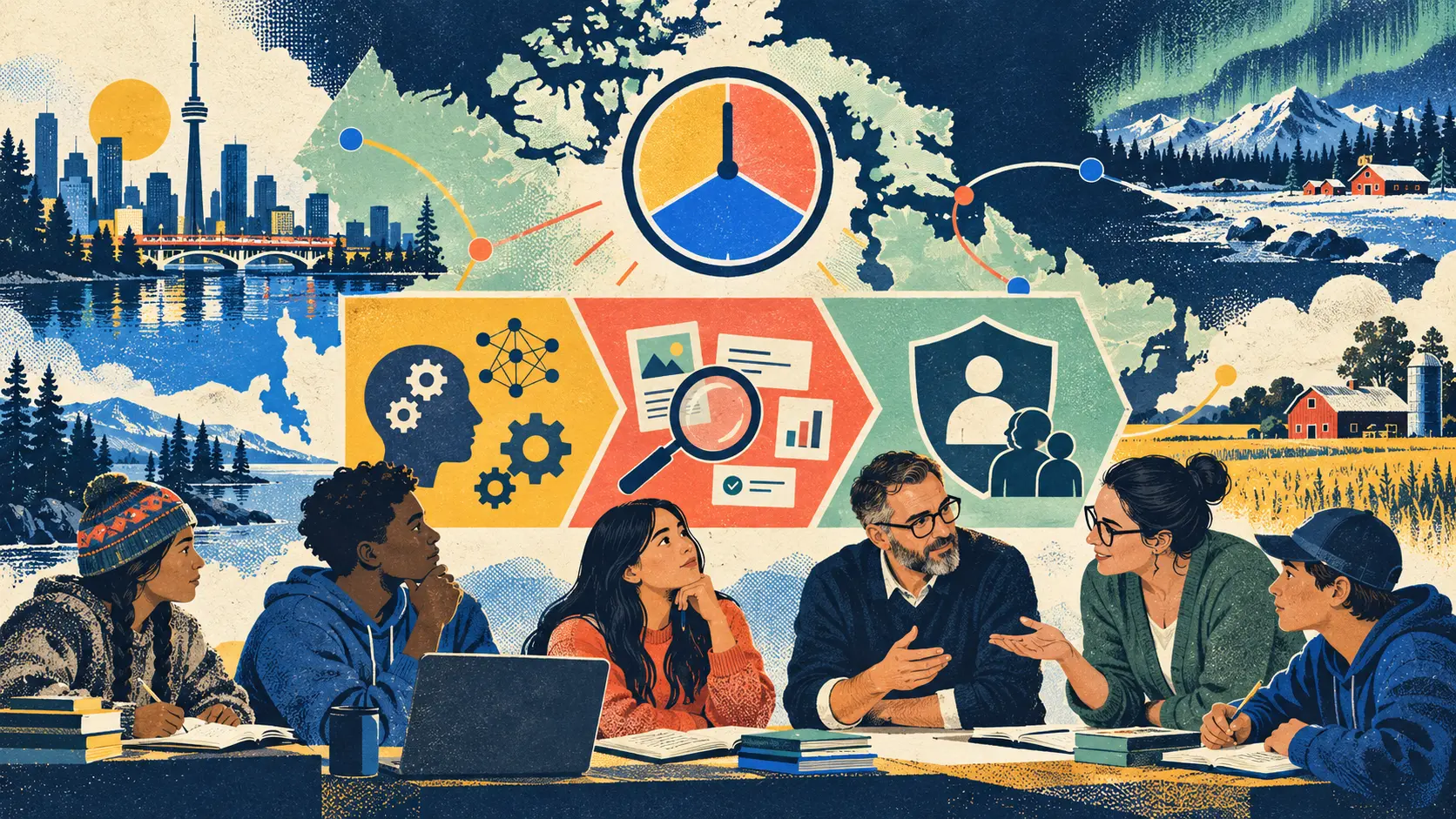
Canada is funding a national AI literacy program led by the Alberta Machine Intelligence Institute. It aims to reach up to one million post-secondary students and more than 50,000 K-12 educators, with additional courses for workers and the wider public. The first student course lasts three hours. That is enough time to build a useful set of habits, but not enough to turn anyone into an AI expert. The important test is whether learners leave better able to question an output, protect private information, recognize bias and misinformation, and decide when not to use the tool.
01
WHAT ACTUALLY CHANGED
Innovation, Science and Economic Development Canada announced the National AI Literacy Initiative in Edmonton on September 9. The federal government described it as a C$13 million partnership with the Alberta Machine Intelligence Institute, or Amii, and placed it under Canada's new National Artificial Intelligence Strategy. The program is free and organized into separate streams for post-secondary students, K-12 educators, and the public.
The largest promise is reach. Government materials say Amii-led programming is expected to reach up to one million post-secondary students and more than 50,000 K-12 educators. Those numbers are targets, not enrollment, participation, completion, or demonstrated learning. Amii says its existing post-secondary consortium represents 61 institutions and more than 900,000 students, which helps explain how a million-person opportunity could be assembled. Representation is still not the same as one million people taking the course.
The student entry point is deliberately short. Participating institutions can offer a free three-hour course covering foundational AI knowledge, responsible use, and workplace readiness. The government says institutions can join the national consortium beginning September 21. Amii says applications opened September 10 and that a bilingual version will be available by September 29. The different dates appear to describe an application window, formal availability, and language rollout rather than one single launch moment.
Teachers receive a longer sequence. The first chapter of Essentials for Educators is scheduled for September 21, with five additional chapters arriving through the fall. The federal overview says the materials cover technical concepts, ethical safety and governance, and classroom applications. Amii says schools and boards will be able to place the materials inside their own professional-development systems and gives 2031 as the horizon for reaching 50,000 educators.
A third stream is meant for people outside formal education. The government says community partners in urban, rural, and remote places will test an initial course later in 2026 before direct open access. Amii gives December 4 as the community launch date and says a final version will be free online in both official languages. Workers and job seekers are also being directed to short courses through the federal Job Bank training finder. The public announcement does not yet provide completion data, learning results, a full public syllabus, or an independent evaluation plan.
02
WHY THIS MATTERS
AI literacy is becoming ordinary civic literacy. A person may meet an automated system while applying for a job, studying, receiving a service, checking a health claim, or deciding whether a convincing image is real. Useful training should not begin with prompt tricks. It should begin with questions: What system am I using? What data am I giving it? What evidence supports this answer? Who is responsible if it is wrong?
Three hours can be valuable if the course teaches a small number of durable habits. Learners can practice checking a claim against a direct source, removing personal information before using a tool, asking how an output was produced, noticing when a system is guessing, and recording where AI contributed to school or work. Three hours cannot cover model architecture, every workplace rule, disciplinary standards, accessibility needs, or the changing law. The course should present itself as a front door, not a diploma-shaped finish line.
Teachers need more than personal confidence. They must decide which assignments should allow AI, how students should disclose its use, what evidence of learning still matters, how to protect children's information, and how to support students who have unequal access to paid tools or reliable internet. Classroom-ready material can reduce duplicated work across thousands of schools. It also needs room for provinces, school boards, subjects, age groups, and Indigenous communities to adapt the guidance rather than receiving one national script.
Canada's geographic and linguistic design will determine who benefits. A free online course is not fully accessible when broadband is unreliable, a learner needs disability accommodations, an educator has no paid professional-development time, or a community wants material in a language beyond English and French. Working through local partners could help. The program should publish which communities participate, who is missing, and what changes after their feedback.
The budget deserves an evidence trail. C$13 million can finance curriculum development, translation, delivery, support, evaluation, and updates, but the announcement does not break down those costs. A national program should report spending alongside course access, completion, pre-course and post-course knowledge, retained skills, learner confidence, behavior changes, and differences across groups. Registrations make a handsome chart. Better judgment is the outcome the country is actually buying.
03
WHERE IT COULD HELP
- Teach a five-question pause before using AI: identify the system, remove sensitive data, check the source, test the answer, and keep a human responsible
- Give educators subject-specific examples showing permitted use, required disclosure, evidence of student learning, privacy limits, and an appeal route
- Offer downloadable and low-bandwidth versions, disability accommodations, paid educator time, and community delivery beyond English and French where local partners identify a need
- Use short pre-course and post-course scenarios to measure whether learners can spot fabricated citations, biased framing, privacy risks, and unsupported confidence
- Publish enrollment, completion, learning, retention, accessibility, regional coverage, cost, and learner-feedback data without turning the course into surveillance
KEEP A HAND ON THE WHEEL
The September 9 announcement is outside the preferred 24-hour window and sits at the edge of the permitted 72-hour international expansion. The C$13 million amount is a government description of the partnership, not a published cost breakdown. One million students and more than 50,000 educators are intended reach figures, not current enrollments or completions. Amii's 61 institutions and more than 900,000 students are represented by an existing consortium, not proof that every represented learner will participate. The three-hour description applies to the foundational student course, not every stream. The government and Amii publish slightly different milestone dates for applications, formal course access, bilingual availability, and the community program, so each date should remain attached to its specific event. The public material reviewed does not provide a complete syllabus, assessment instrument, accessibility audit, privacy impact assessment, outcome study, spending breakdown, long-term update schedule, or independent evaluation. Free access does not by itself establish equitable participation or useful learning.
04
TERMS WORTH KEEPING
OPEN GLOSSARY CARD
Learning outcome
A specific ability, understanding, or behavior that a learner should demonstrate after instruction.
OPEN GLOSSARY CARD
Consortium
A group of organizations that work together toward a shared program or goal while remaining separate institutions.
OPEN GLOSSARY CARD
Media literacy
The ability to examine who created information, why it was made, what evidence supports it, and how it may influence an audience.
SOURCES AND VERIFICATION STATUS
This article was written from the materials below. Product claims and dates were checked against those sources on September 12, 2026.
PUBLICATION RECEIPT: Revision 1. Published September 12, 2026.
THE PUBLICATION ENGINE
WANT A SIGNAL OF YOUR OWN?
We build source-grounded publications, private briefings, and editorial systems for organizations with something useful to say.
WORK WITH US