THE SIGNAL IN ONE SENTENCE
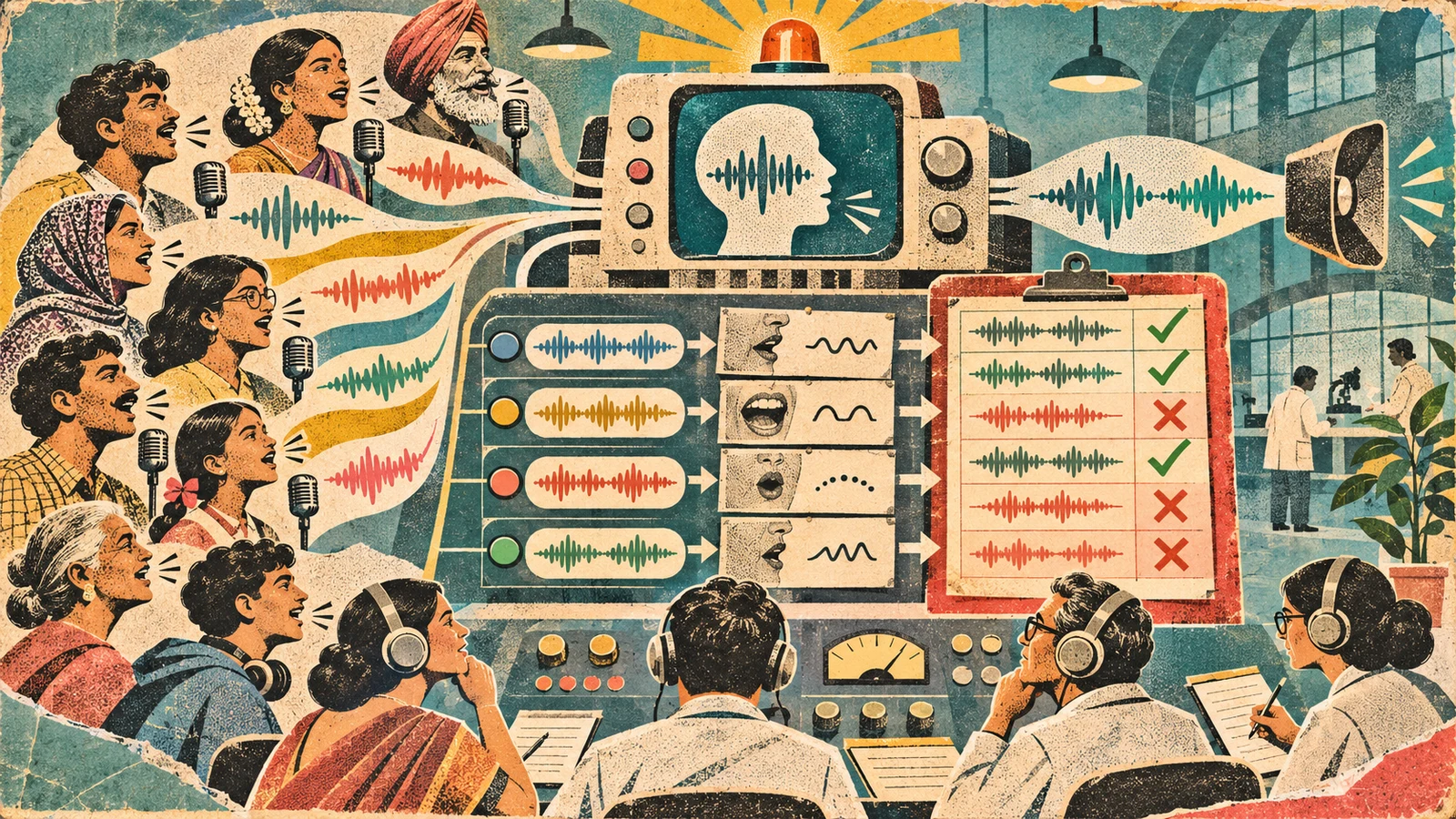
A language list is not a listening test. It is a promise about who should be able to speak. Chariot, a Delhi speech-AI laboratory, held its Chariot One launch and research showcase in New Delhi on November 25. The company says it is one of four teams selected under the IndiaAI Mission to build foundation models for the country. Its public models include Chariot-1 TTS for speech generation and Chariot-1 ASR Realtime for speech recognition. The lab says its current text-to-speech release covers English and 11 Indian languages with more than 50 voices. Its public language list includes Hindi, Urdu, Bengali, Marathi, Telugu, Tamil, Gujarati, Kannada, Malayalam, Odia and Punjabi. The speech-recognition list covers ten Indian languages. That is a meaningful map. It is not the territory. India's spoken life does not arrive as a neat dropdown. People change language inside a sentence. They carry regional accents into national languages. They pronounce names, addresses, medicines, money, dates and government terms in ways shaped by home, work, age, education and local habit. A model can sound smooth while quietly sanding those differences away. The plain signal is this: publish the accent miss ledger. For every supported language, show what the model heard, what it produced, where it hesitated, which people judged it and how the system behaves when confidence is low. Count the polished examples. Keep the ugly ones. Chariot describes its broader research direction as speech reasoning. The company argues that speech carries information that a transcript misses, including timing, rhythm, emphasis, silence, accent, emotion and social intent. It wants models that work directly with spoken interaction rather than passing a transcript through one model and reading the answer through another. That ambition is larger than today's product. Chariot's own FAQ says its text-to-speech system is a first public milestone, focused on speech generation. The broader plan extends toward speech understanding, conversation, reasoning and action. That distinction matters. A model that pronounces a difficult sentence well has not yet demonstrated that it understands why a person paused, whether a clarification is needed or when silence is the correct response. Start the evaluation with the released capability. Chariot publishes company-run results for its text-to-speech model. It says a 1,029-sentence English test of dates, currencies, URLs, units and other difficult written forms produced 94 percent correct verbalization. The company also reports naturalness and intelligibility measurements for English and Hindi and says it uses blinded preference tests, recognizer-based checks, latency measurements and normalization evaluations. Those results are useful evidence about the company's test design. They are not independent validation across every listed language, accent or use case. The public page gives much more detail for English and Hindi than for the rest of the language list. That creates the first entry in the ledger: support breadth and evaluation depth are different numbers. Publish both. For each language, report how many speakers contributed test audio, which regions and dialects were represented, the age and gender distribution, recording conditions, sentence types, code-switch patterns and human evaluation method. If the test set is small or geographically narrow, say so in plain language. Do not hide behind one average. A system can score well overall and fail systematically on a district, caste-linked dialect, rural recording condition, speech disability or name pattern. The people living inside that failure do not experience the average. They experience the model asking them to repeat themselves again. Split errors by consequence. Mispronouncing a brand name in an advertisement is annoying. Misreading a medicine dose, bank amount, train time, legal instruction or emergency address can cause harm. The same model can be acceptable for one job and reckless for another. Build a severity table before deployment. Level one covers cosmetic errors that do not change meaning. Level two covers awkward delivery, accent drift or missing emphasis that may confuse or exclude a listener. Level three covers changed names, numbers, dates, money, locations, dosage or intent. Level four covers a system that continues confidently when it should ask, stop or hand the interaction to a person. Then test the boring material. Marketing demos enjoy clean sentences. Real services get account numbers, initials, abbreviations, noisy rooms, cheap microphones, coughs, children in the background, code-mixed phrases and people speaking while walking beside traffic. Put that mess in the benchmark. Chariot highlights context-aware pronunciation and examples involving flight times, order numbers, medical notation and digital payments. Those are exactly the places where a public evaluation can become useful. Release the prompts, expected spoken forms, acceptable alternatives, model version, audio settings and per-category errors. Let native speakers disagree visibly. There may not be one correct pronunciation for a borrowed word, local name or mixed-language sentence. A good evaluation does not force every difference into an error. It records acceptable regional forms, explains how judges resolved disagreement and preserves minority judgments when consensus is artificial. That is especially important for voice generation. A synthetic voice can improve access to education, customer support, public information and creative tools. It can also imitate a person without meaningful consent, flatten local identity or make fraud easier to scale. Chariot advertises instant voice cloning among its multilingual capabilities. Any deployment using cloning needs a consent record, permitted-purpose list, revocation path, output disclosure, abuse monitoring and a plan for a voice owner who changes their mind. Consent should follow the voice. If a voice is adapted into another language or accent, record whether the speaker authorized that transformation. If a campaign generates thousands of local variants, record who approved the script and who can withdraw it. If a user uploads someone else's sample, the product needs more than a checkbox and optimism. The same care belongs on the recognition side. Speech recognition can help call centers, classrooms, accessibility tools, field workers and public services. It also creates transcripts that may be treated as records. A wrong transcript can become a wrong decision with a timestamp attached. Show confidence at the span level. Mark uncertain names and numbers. Preserve the original audio when policy permits. Let the speaker correct the transcript. Record whether a person reviewed it before downstream action. Do not turn a low-confidence guess into a database fact because the API returned valid JSON. For public services, test the exit. Can a caller reach a person without successfully speaking the system's preferred phrase? Can someone choose a language before the model has already misclassified them? Does the service work for a person with a speech impairment? Is text available for someone who does not want to speak? Can a citizen challenge a transcript used in a decision? Multilingual access is not access if the failure path becomes a locked door. Measure code-switching as its own capability. Do not take a Hindi score and an English score, average them and call the result Hinglish. Build conversations that switch naturally at clause, phrase and word boundaries. Include names, technical terms, local units and English acronyms spoken with Indian phonology. Report where the system changes language correctly and where it invents a boundary. Test both directions. Recognition must preserve what a person said. Generation must produce what a person can understand. A pipeline can pass each component benchmark and still fail when the recognized text is normalized, translated, reasoned over and spoken back. Run end-to-end tasks. Ask for a bus schedule, a bank balance, an appointment change, a school notice and a medicine reminder. Record every transformation from audio input to final audio response. Keep the intermediate transcript, language decision, tool call, answer and synthesized speech. When the final answer is wrong, the trace should reveal where it bent. Local teams should own the test. A national model benefits from national infrastructure, but language quality cannot be certified from one office. Partner with universities, teachers, disability groups, call-center workers, translators, regional media and community organizations. Pay people for evaluation work. Publish who participated and which communities remain missing. The ledger should also travel beyond India. Every multilingual model faces the same temptation: add languages faster than evaluation grows. Indian speech AI makes the gap obvious because the linguistic landscape is so rich. The lesson applies to Arabic varieties, African languages, Indigenous languages, regional Spanish, migrant communities and any system that treats one standard form as the whole language. Chariot's launch is worth watching because it puts speech, not translated text, at the center of the model plan. It gives Indian languages a place in the architecture rather than bolting them on after an English product is finished. Now comes the less glamorous work. Publish the per-language tests. Release the hard audio. Show the corrected transcript beside the first guess. Keep the accent miss ledger open. That is how a language list becomes a listening system.
01
WHAT ACTUALLY CHANGED
Chariot held its Chariot One model launch and research showcase in New Delhi on November 25.
The Delhi lab says Chariot-1 TTS and Chariot-1 ASR Realtime are its first public steps toward speech-native reasoning systems.
Chariot lists text-to-speech support for English and 11 Indian languages across more than 50 voices.
The company publishes detailed text-to-speech evaluation claims for English and Hindi, including a 1,029-sentence hard-verbalization test.
Chariot says it is one of four teams selected under the IndiaAI Mission to build foundation models for India.
02
WHY THIS MATTERS
Speech systems can widen access to services and information for people who are poorly served by English-first interfaces.
A supported-language count can conceal thin coverage of dialects, accents, code-switching, noisy environments and high-consequence terms.
Voice generation and cloning create consent, fraud, identity and revocation duties alongside product capability.
Recognition errors can become durable records or trigger downstream decisions unless uncertainty and correction remain visible.
India offers a demanding multilingual test case whose lessons apply to speech systems in every linguistically diverse country.
03
WHERE IT COULD HELP
- Create a per-language test matrix for dialect, accent, age, gender, recording condition, domain and code-switch pattern.
- Separate cosmetic pronunciation errors from failures involving names, money, dates, medicine, locations or user intent.
- Publish prompts, acceptable spoken forms, model versions, judge instructions, disagreement and per-category error counts.
- Run end-to-end tasks that preserve audio, transcript, language choice, tool call, answer and synthesized response.
- Add span-level confidence, speaker correction and human review before transcripts become operational records.
- Attach consent, permitted uses, disclosure, abuse monitoring and revocation to every cloned voice.
- Test whether users can reach a person or alternate channel without first satisfying the speech model.
- Pay regional speakers and community organizations to test the system and publish the coverage gaps they find.
KEEP A HAND ON THE WHEEL
Watch for complete Chariot-1 model cards, weights or API documentation, per-language and per-dialect evaluation sets, independent listening tests, latency under real network conditions, code-switch benchmarks, speaker-consent controls, synthetic-audio disclosure, abuse reporting, pricing, data-retention rules, public-service pilots and evidence that the speech-reasoning roadmap moves beyond generation into verified understanding and safe action.
04
TERMS WORTH KEEPING
SOURCES AND VERIFICATION STATUS
This article was written from the materials below. Product claims and dates were checked against those sources on November 25, 2026.
THE PUBLICATION ENGINE
WANT A SIGNAL OF YOUR OWN?
We build source-grounded publications, private briefings, and editorial systems for organizations with something useful to say.
WORK WITH US