THE SIGNAL IN ONE SENTENCE
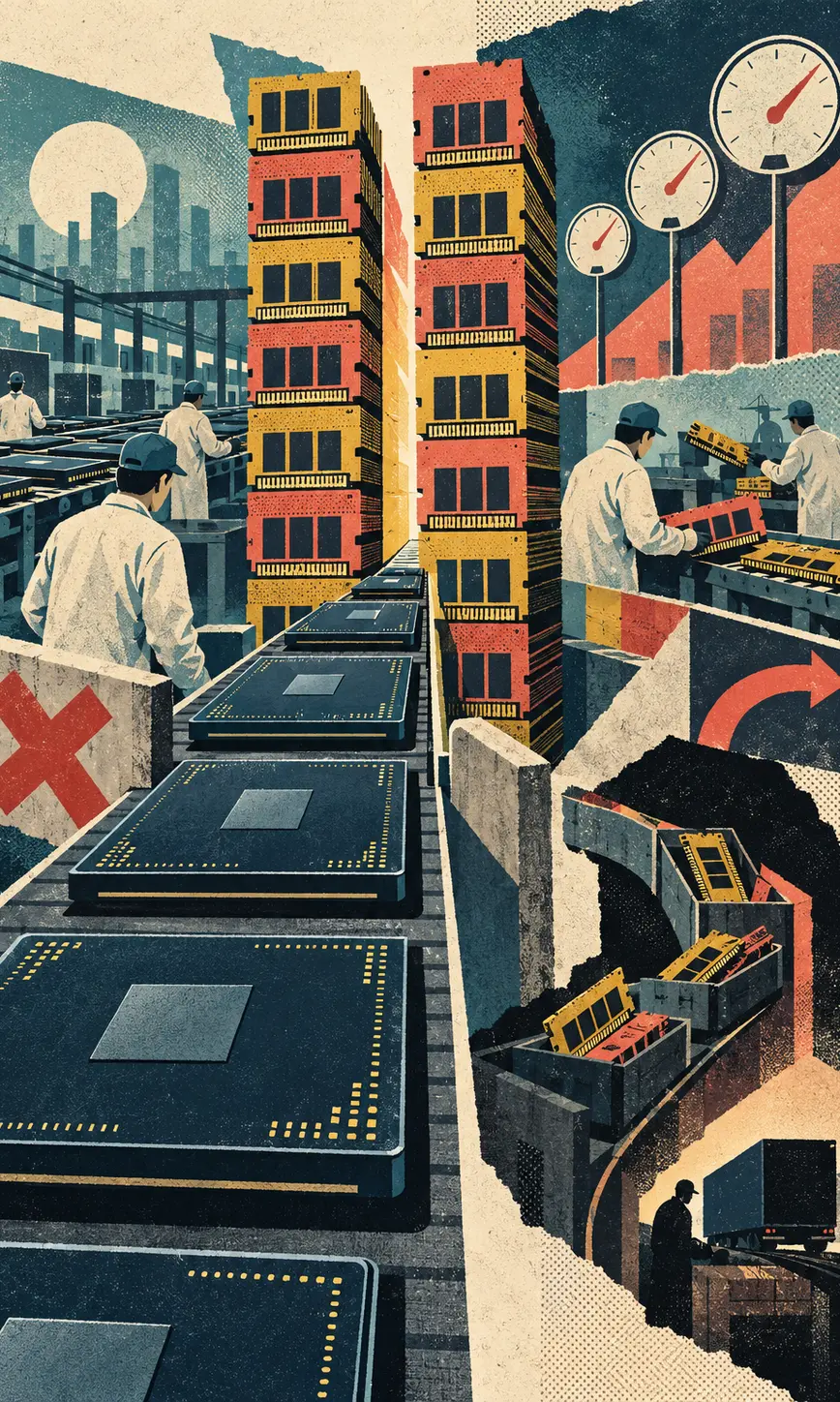
Chinese companies can design and sell their own AI processors, but those processors need very fast memory beside them. That memory is scarce, restricted, and expensive, so accelerator cards are getting more expensive too.
01
WHAT ACTUALLY CHANGED
Chinese AI chipmakers are sharply raising prices for current and upcoming accelerators as high-bandwidth memory becomes a production bottleneck. Reuters reported the changes on September 10 after speaking with three people familiar with customer quotes and supply allocations. Huawei, Cambricon, MetaX, and Iluvatar CoreX did not respond to the publication's requests for comment.
Huawei's upcoming Ascend 950DT accelerator card is now indicated above 250,000 yuan, or about $37,255 at the conversion used by Reuters. Depending on contract terms, that is 20 percent to 50 percent above prices quoted two months earlier. Huawei has publicly said the 950DT will be available in the fourth quarter of 2026, but the new pricing itself was not announced by the company.
The squeeze reaches older products too. Reuters' sources said Huawei's Ascend 950PR rose from roughly 60,000 yuan at the start of the year to more than 80,000 yuan, while the older 910C board moved from about 90,000 yuan to more than 110,000 yuan. Cambricon's next-generation chip, tentatively called the 690, was repriced 20 percent to 30 percent above its indicated level two months ago. Cambricon has not formally launched that chip.
The expensive part hiding beside the processor is HBM, or high-bandwidth memory. It stacks memory close to the compute chip so enormous quantities of model data can move quickly enough to keep the processor busy. Memory makes up a substantial share of an AI accelerator's production cost, so a shortage does not stay in the parts bin. It travels straight into the price of the finished card.
Supply is also being rearranged. Reuters reported that Iluvatar doubled planned GPU shipments to ByteDance to 100,000 units this year and diverted chips intended for its own use. The same report said advanced HBM export restrictions have pushed some Chinese buyers toward costly grey-market procurement. That route may keep a line moving, but it brings uncertain provenance, inconsistent support, and obvious legal risk.
02
WHY THIS MATTERS
China's push for domestic AI hardware is often described as a processor contest. This price jump shows why that frame is too tidy. An accelerator is a small industrial ecosystem made from logic, stacked memory, packaging, interconnects, power systems, software, and manufacturing capacity. Replacing one famous foreign chip does not replace every dependency wrapped around it.
Memory bandwidth determines how much of an accelerator's arithmetic can actually be used. A processor can be impressive on paper and still spend its day waiting for weights and intermediate results to arrive. That makes HBM more than storage. It is a traffic system for the model, and a traffic jam can make expensive compute sit idle.
Higher card prices eventually reach model builders and users. Cloud providers need more capital to add capacity. Startups face higher training and inference bills. Universities and smaller laboratories wait longer or accept older hardware. Large customers with purchasing power get priority, which can concentrate useful compute among the companies already large enough to negotiate from the front of the queue.
The grey market is a particularly ugly pressure valve. Components can arrive without a clean chain of custody, reliable warranties, predictable firmware, or assurance that they match the advertised grade. Procurement teams also face sanctions and export-control exposure. A cheap detour can become an expensive incident once a board fails, an audit begins, or replacement parts vanish.
The broader signal is simple: national AI capacity is limited by the least substitutable component, not the most photographed one. China has built credible domestic accelerator suppliers. Their current problem is that a local processor can still be priced by a global memory shortage and a foreign export rule. The memory wall is now a market wall too.
03
WHERE IT COULD HELP
- Model the full accelerator bill of materials before promising domestic capacity
- Reserve scarce HBM-backed systems for workloads that actually need their bandwidth
- Test older or lower-memory accelerators for inference jobs that tolerate them
- Audit component provenance, warranties, and export-control exposure before grey-market procurement
- Track card prices, delivery times, and allocation changes as closely as benchmark scores
KEEP A HAND ON THE WHEEL
The price quotes, customer allocations, and grey-market details come from Reuters sources familiar with the matter, not public price lists or company filings. Huawei, Cambricon, MetaX, Iluvatar CoreX, and ByteDance did not confirm the reported changes. Contract prices can vary by volume, configuration, delivery date, support, and customer. Huawei has described proprietary memory technologies for its Ascend 950 series but has not disclosed complete manufacturing and sourcing details. The shortage and export controls are important pressures, but public evidence does not establish how much of each price increase comes from memory, packaging, demand, product changes, or commercial strategy.
04
TERMS WORTH KEEPING
SOURCES AND VERIFICATION STATUS
This article was written from the materials below. Product claims and dates were checked against those sources on September 10, 2026.
PUBLICATION RECEIPT: Revision 1. Published September 10, 2026.
THE PUBLICATION ENGINE
WANT A SIGNAL OF YOUR OWN?
We build source-grounded publications, private briefings, and editorial systems for organizations with something useful to say.
WORK WITH US